

Main decision tree
Itchy bites and infestations
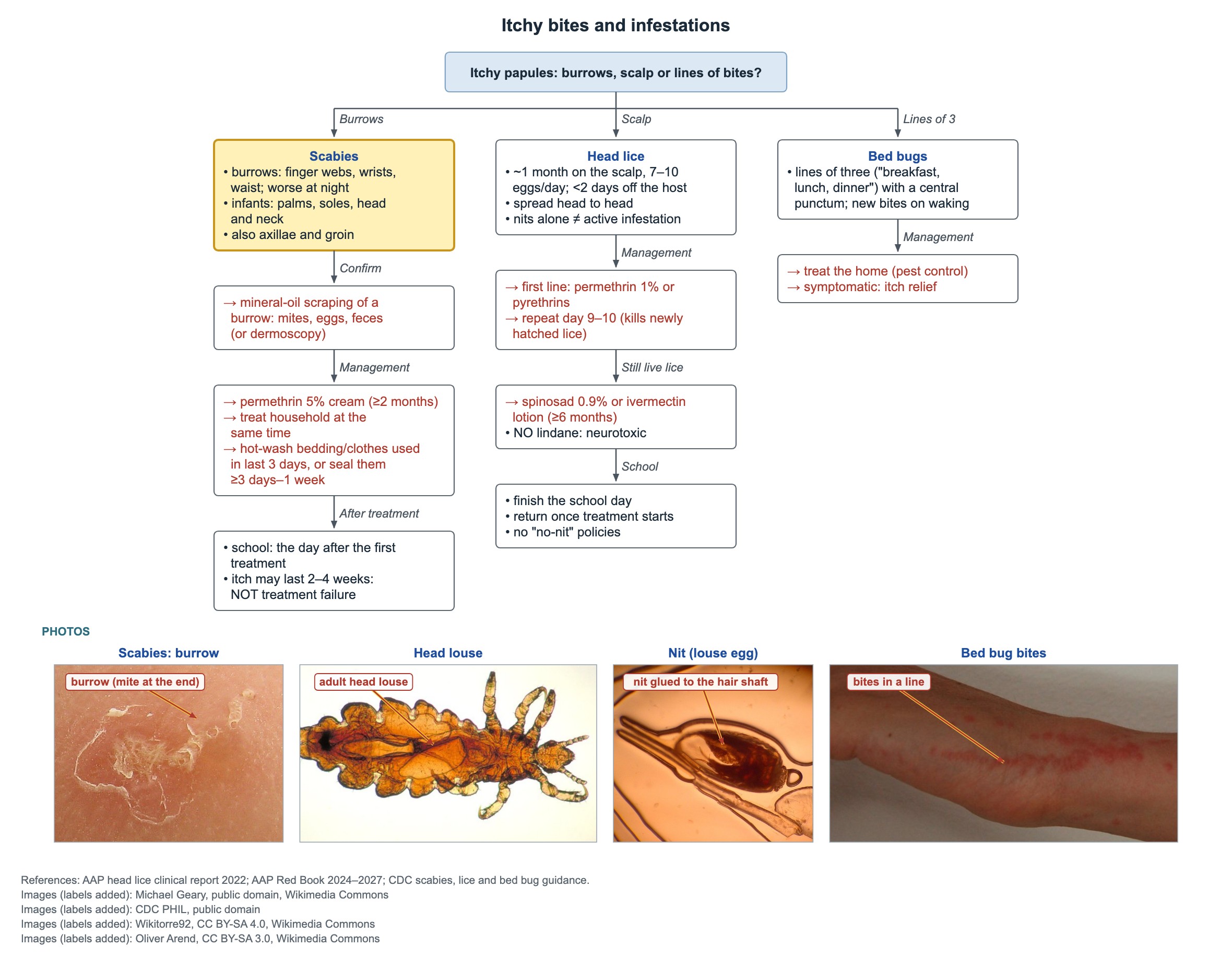
Key points
- Scabies: night itch, itchy family members, burrows in finger webs, wrists, axillae, waist and groin; infants also have palms, soles, head and neck.
- Scabies: permethrin 5% cream from 2 months of age; treat the whole household at the same time; school the day after the first treatment.
- Itch can last 2–4 weeks after correct scabies treatment; that is not treatment failure.
- Head lice: permethrin 1% or pyrethrins, repeated on day 9–10; still live lice → spinosad 0.9% or ivermectin 0.5% lotion (from 6 months); no lindane.
- Children with head lice stay in school; no 'no-nit' policies; nits alone do not prove active infestation.
- Tinea capitis and kerion need oral griseofulvin or terbinafine for about 6–8 weeks; topicals do not work.
- Impetigo: topical mupirocin for limited lesions, oral cephalexin if widespread.
Scabies: recognize and confirm
Think of scabies with intense itch that is worse at night, itchy family members and burrows. The mite Sarcoptes scabiei spreads by prolonged skin-to-skin contact.
- School-age child: finger webs, wrists, axillae, waist and groin.
- Infants: palms, soles, head and neck are involved more than in older children, often with vesicles and pustules.
- Confirm: mineral-oil scraping of a burrow under the microscope shows mites, eggs or feces; dermoscopy is an alternative.
- Crusted scabies: thick crusted plaques on the hands and finger webs in an immunocompromised patient (for example AIDS); scrapings show many mites and it is very contagious.
- Bed bugs: itchy papules in lines of three ('breakfast, lunch, dinner') with a central punctum, new bites on waking; treat the home with pest control and give itch relief.
Scabies: treatment and return to school
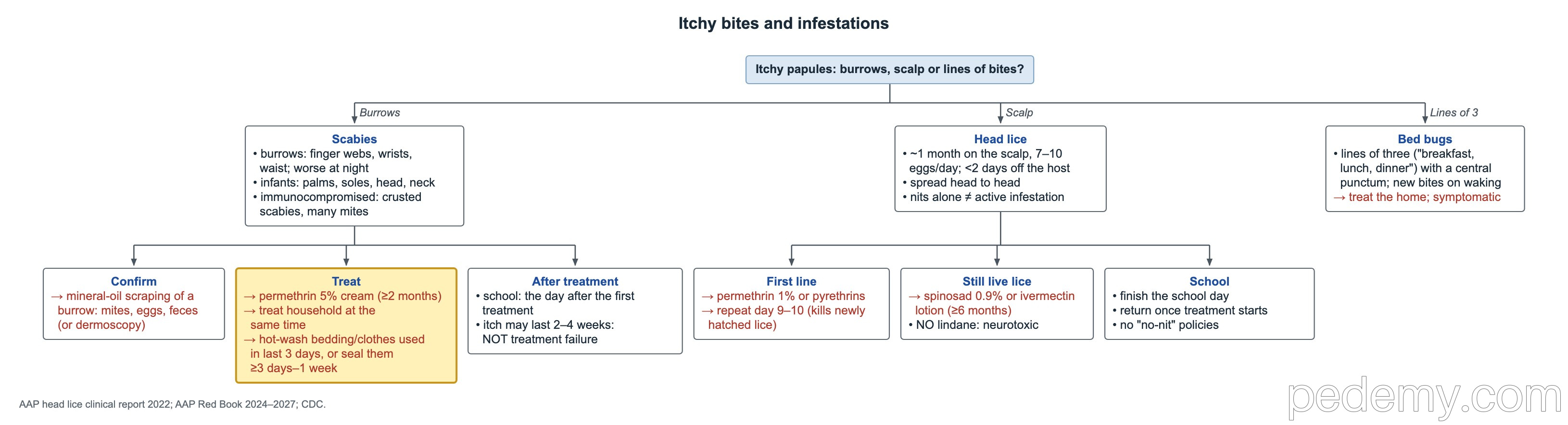
- Permethrin 5% cream for infants 2 months and older and for children: apply from the neck down (include the scalp and face in infants), wash off after 8–14 hours, repeat in 1–2 weeks.
- Treat all household and close contacts at the same time, even without symptoms.
- Bedding, clothes and towels used in the last 3 days: hot wash and hot dry, or seal in a bag for at least 72 hours.
- School or child care: the day after the first treatment.
- Itch may last 2–4 weeks after correct treatment; this is not treatment failure. New burrows or new lesions after 2 weeks suggest failure or reinfestation.
- Lindane is avoided in children because of neurotoxicity (seizures).
Head lice
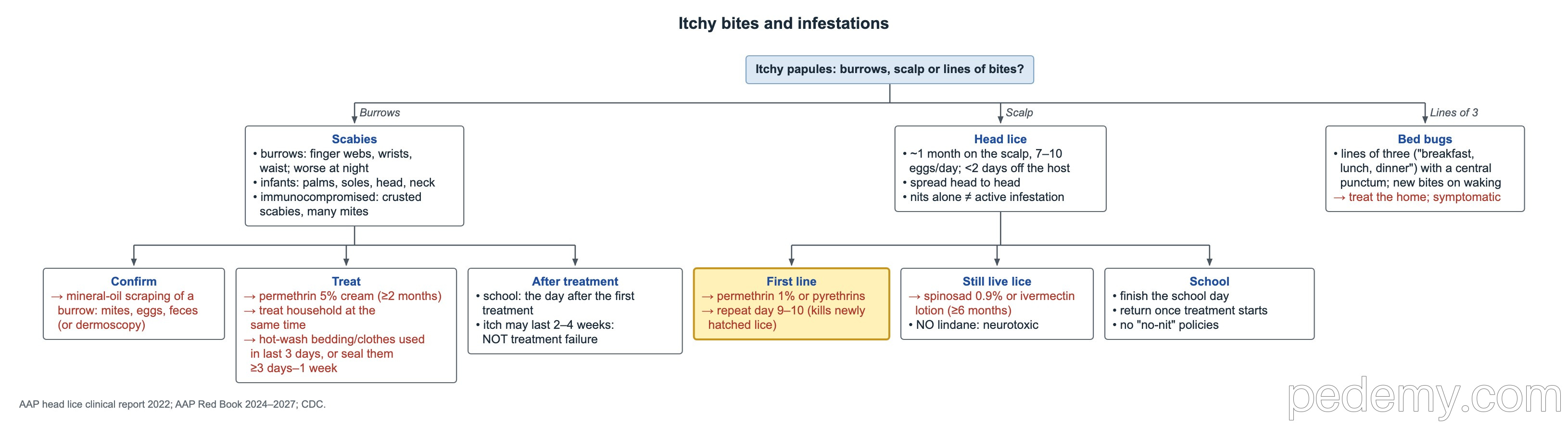
A head louse lives about 1 month on the scalp, lays 7–10 eggs (nits) a day and survives less than 2 days off the host. Lice spread by direct head-to-head contact; they cannot jump or fly, and pets do not carry them. Nits on the hair shaft without live lice do not prove active infestation.
- First line, no known local resistance: OTC permethrin 1% or pyrethrins with piperonyl butoxide.
- Repeat on day 9–10 to kill nymphs that hatched from surviving eggs.
- Live lice after correct use: spinosad 0.9% suspension or single-use ivermectin 0.5% lotion, both from 6 months of age.
- Do not use lindane: it is neurotoxic and can cause seizures.
- School: the child finishes the school day and returns once treatment has started. The AAP advises against 'no-nit' policies and exclusion.
Fungal infections and look-alikes
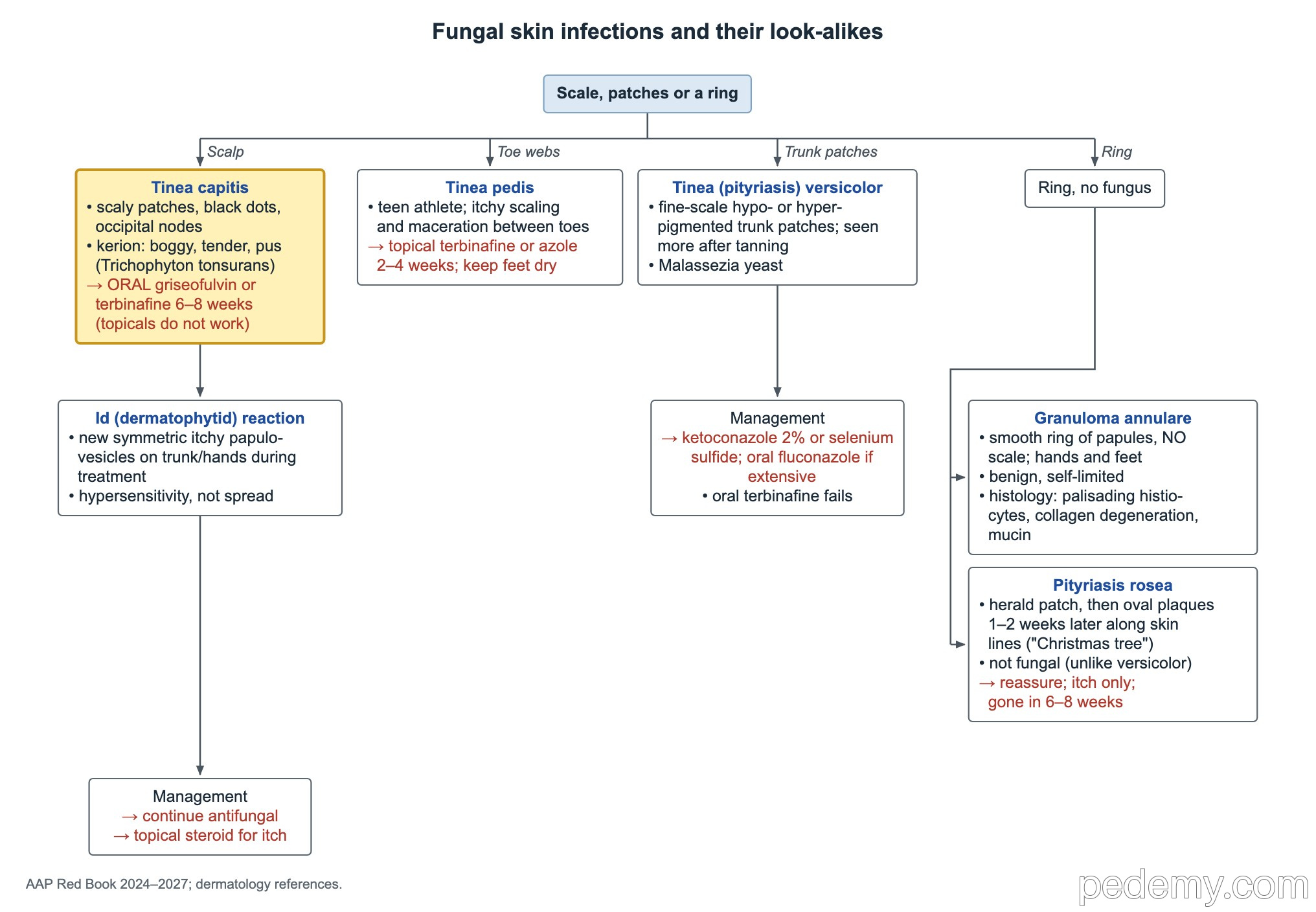
- Tinea capitis: scaly patches with 'black dots' (broken hairs) and occipital nodes; Trichophyton tonsurans does not fluoresce with a Wood lamp.
- Kerion: a boggy, tender, pus-draining scalp mass with hair loss. It is an inflammatory tinea capitis, not an abscess: do not drain it.
- Treatment: oral griseofulvin (take with fatty food such as whole milk) or terbinafine for about 6–8 weeks, plus antifungal shampoo for the household. Topicals alone do not work.
- Id (dermatophytid) reaction: a new symmetric, itchy papulovesicular rash on the trunk and hands during treatment. It is a hypersensitivity reaction, not spread: continue the antifungal and add a topical steroid.
- Tinea pedis: itchy scaling and maceration between the toes in a teen athlete; topical terbinafine or an azole for 2–4 weeks; keep the feet dry.
- Tinea (pityriasis) versicolor: fine-scale hypo- or hyperpigmented trunk patches, more visible after tanning; caused by Malassezia yeast. Treat with ketoconazole 2% or selenium sulfide; oral fluconazole if extensive. Oral terbinafine and griseofulvin do not work.
- Pityriasis rosea is not fungal: herald patch, then oval plaques in a 'Christmas tree' pattern; reassure, gone in 6–8 weeks.
Warts, molluscum and orf
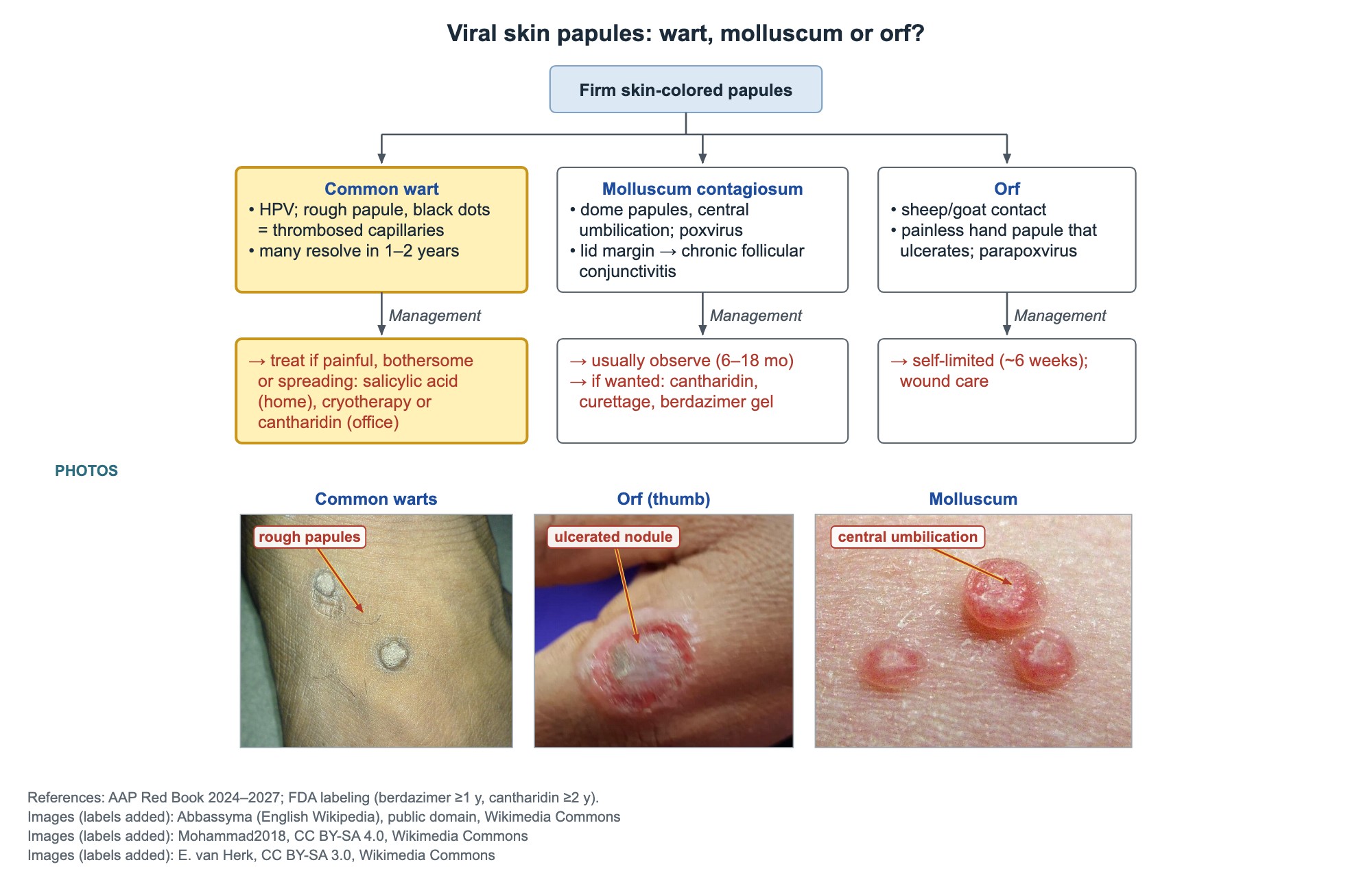
| Lesion | Clues | Management |
|---|---|---|
| Common or plantar wart (HPV) | Rough papule; paring shows black dots (thrombosed capillaries) | Many resolve on their own, often within 2 years. Treat if painful, bothersome or spreading: salicylic acid at home daily after soaking and paring; cryotherapy or cantharidin in the office |
| Molluscum contagiosum (poxvirus) | Pearly dome papules with central umbilication; on the eyelid margin can cause chronic follicular conjunctivitis | Usually observe (clears over 6–18 months); if wanted: cantharidin, curettage or berdazimer gel |
| Orf (parapoxvirus) | Firm hand nodule after handling lambs or goats; weeps then crusts | Self-limited in about 6 weeks; wound care |
Bacterial skin infections
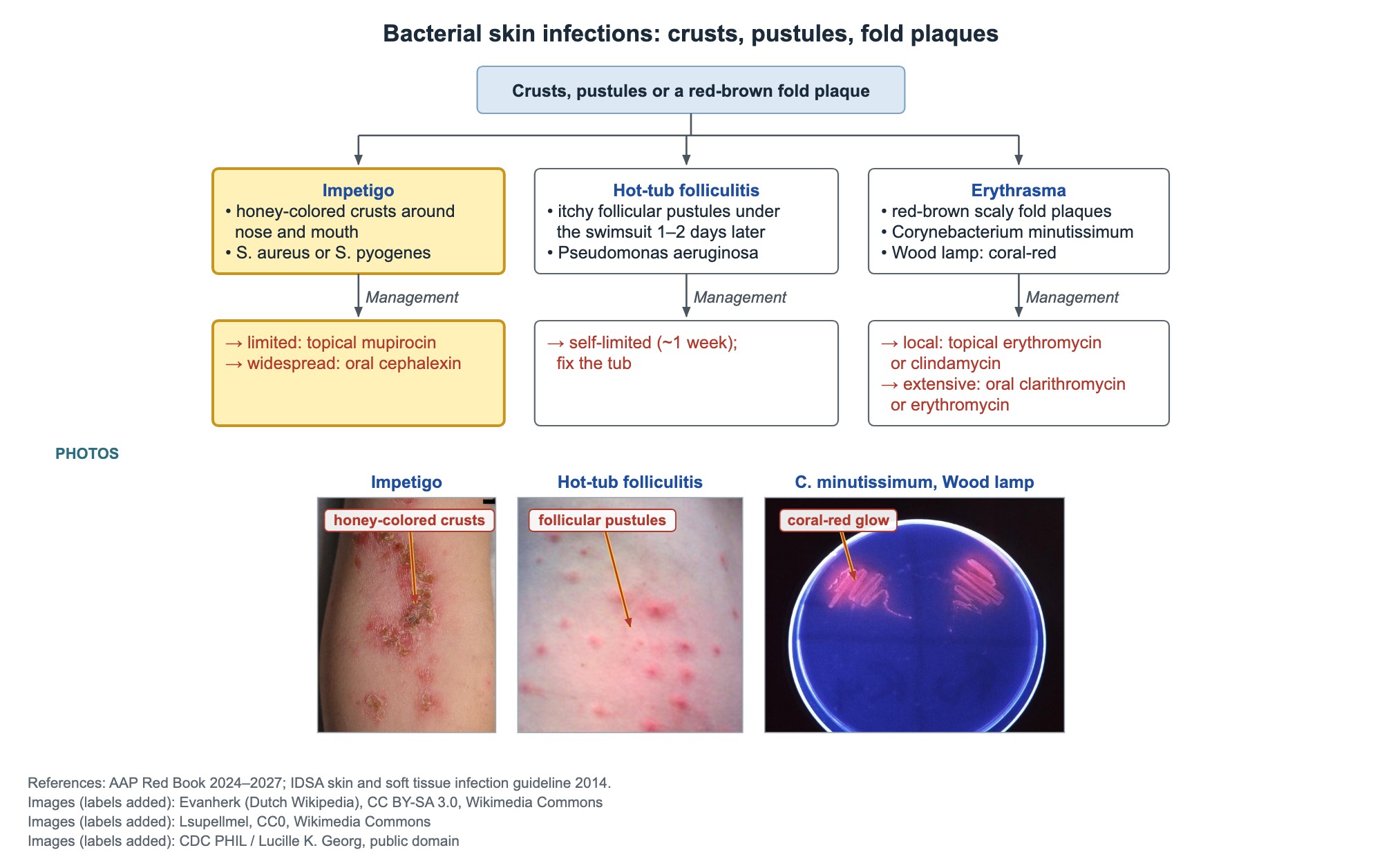
- Nonbullous impetigo: honey-colored crusted erosions around the nose and mouth (S. aureus or S. pyogenes). Limited: topical mupirocin. Widespread: oral cephalexin.
- Hot-tub folliculitis: itchy follicular papules and pustules on the trunk 1–2 days after a hot tub; Pseudomonas aeruginosa. Self-limited in about a week; fix the tub chlorination.
- Erythrasma: brown-red, slightly scaly plaques in skin folds; Corynebacterium minutissimum; coral-red fluorescence under a Wood lamp. Localized: topical erythromycin or clindamycin. Extensive: oral clarithromycin or erythromycin.
Vesicles and widespread papular rashes
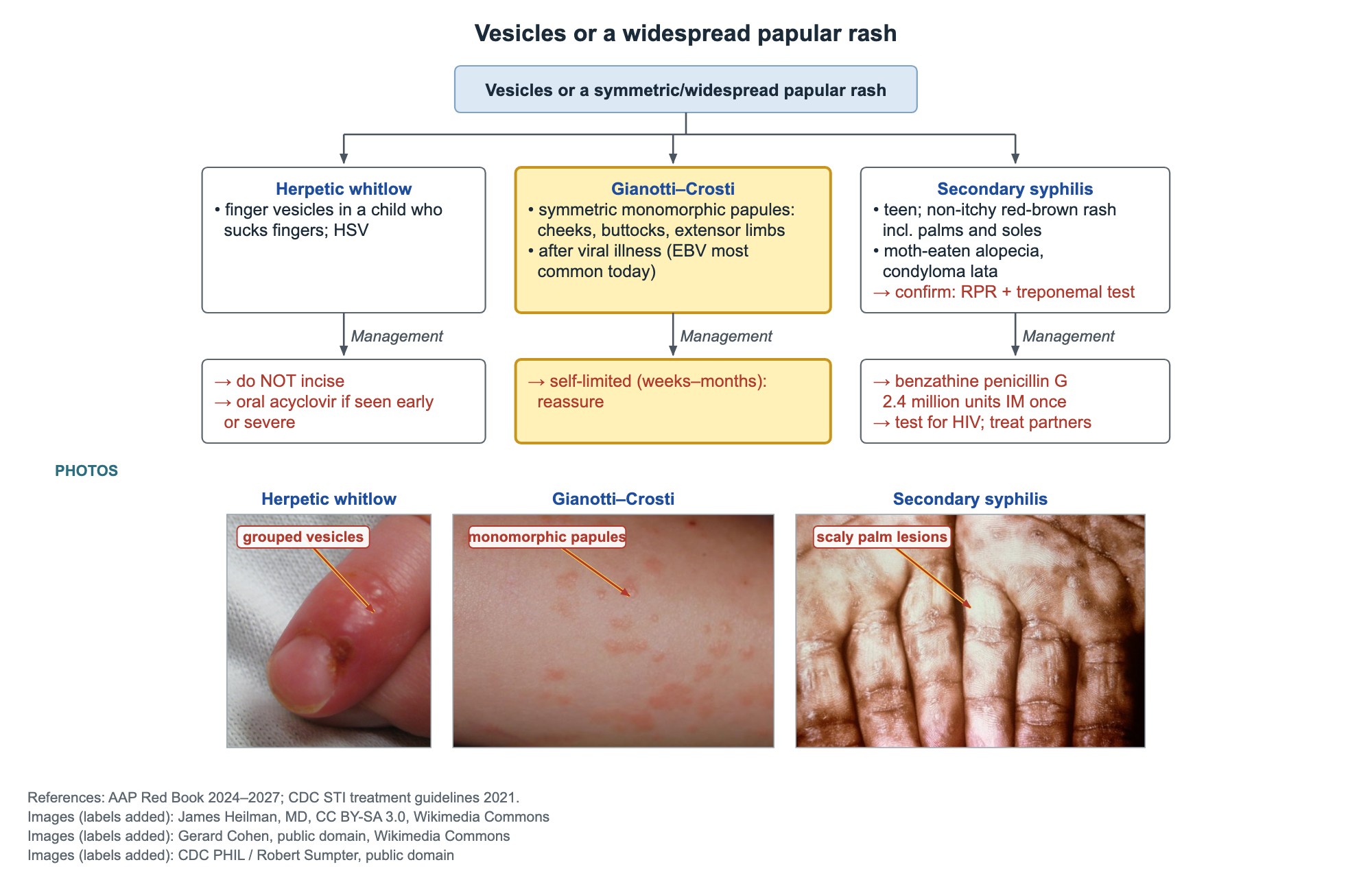
- Herpetic whitlow: painful grouped vesicles on the finger of a child who sucks the thumb (HSV). Do not incise; oral acyclovir if seen early or severe.
- Gianotti–Crosti syndrome (papular acrodermatitis): symmetric monomorphic papules on the cheeks, buttocks and extensor limbs of a young child after a viral illness. EBV is the most common trigger today; hepatitis B is now rare because of vaccination. Self-limited over weeks to months.
- Secondary syphilis: sexually active teen with a non-itchy red-brown rash including the palms and soles, patchy 'moth-eaten' alopecia and condylomata lata. Confirm with RPR plus a treponemal test; treat with benzathine penicillin G 2.4 million units IM once; test for HIV and treat partners.
Common questions
When can a child with scabies go back to school?
The day after the first treatment. Itch may last 2–4 weeks after correct treatment and does not mean the child is still contagious.
Should children with head lice be sent home from school?
No. The child can finish the school day and return once treatment has started. The AAP advises against 'no-nit' policies.
Why is a second head lice treatment needed?
Most products do not kill all eggs. A second dose on day 9–10 kills lice that hatched after the first treatment, before they can lay new eggs.
Study this topic
Sources
- AAP Clinical Report: Head lice (Pediatrics, 2022)
- IDSA: Practice guidelines for skin and soft tissue infections, 2014 update (Clin Infect Dis)
- CDC: Sexually transmitted infections treatment guidelines, 2021 (MMWR)
- AAP Red Book: Report of the Committee on Infectious Diseases
Written for Pedemy in our own words from the sources above; checked November 2026. For education only, not medical advice; check doses and local protocols before treating a patient. Pedemy is independent and not affiliated with or endorsed by the organizations cited.