

Main decision tree
Acne: treat by type
Key points
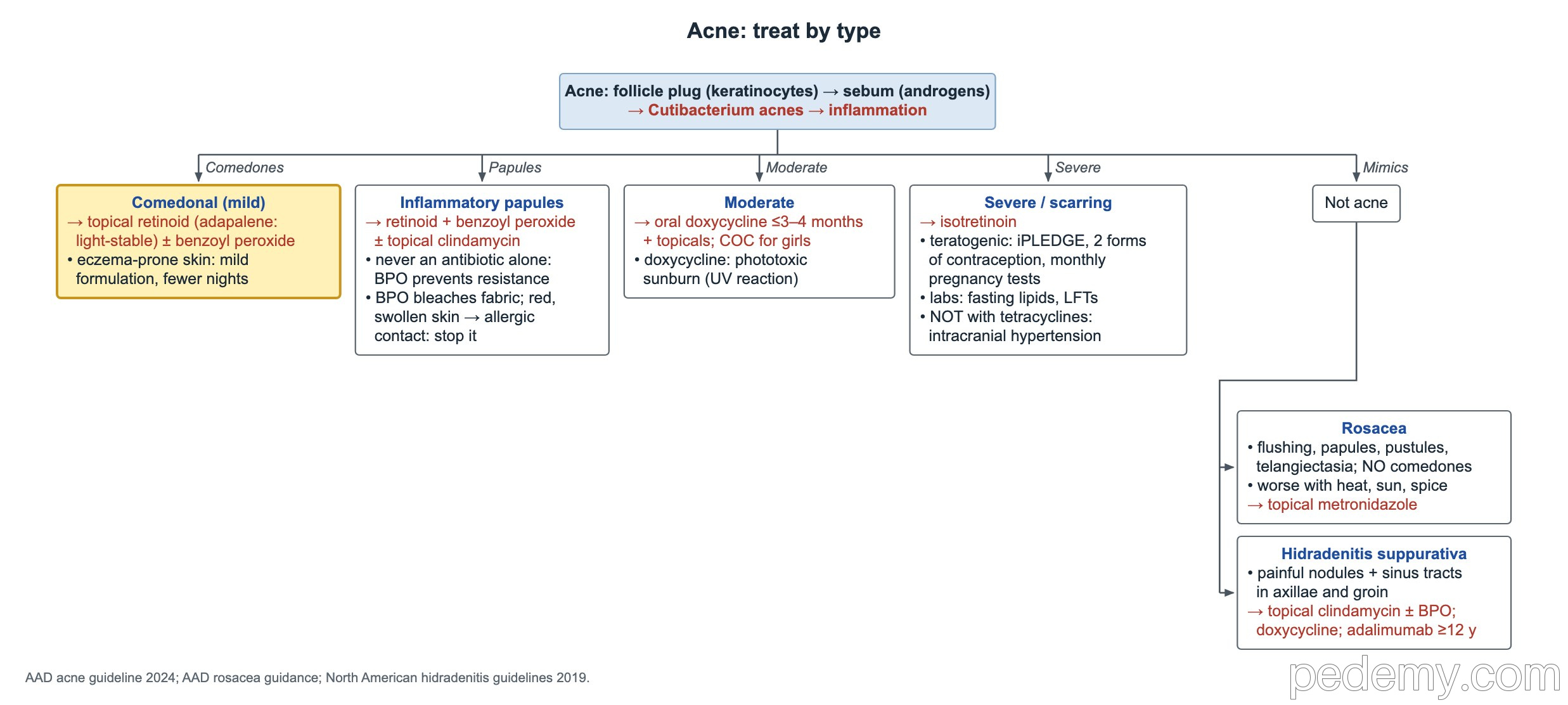
- Comedonal acne: topical retinoid (adapalene is light-stable) ± benzoyl peroxide; never use an antibiotic alone.
- Oral doxycycline for moderate acne: limit to about 3–4 months, always with topical therapy; it causes phototoxic sunburn.
- Isotretinoin: 2 forms of contraception from 1 month before to 1 month after, monthly pregnancy tests, lipids and LFTs at baseline and at peak dose.
- Never combine isotretinoin with a tetracycline: risk of idiopathic intracranial hypertension.
- EM: fixed targets for several days, usually after HSV; SJS/TEN: drug 1–4 weeks earlier, mucosal erosions, skin detachment → stop the drug.
- Mycoplasma-induced rash and mucositis: severe oral and eye mucositis with few skin lesions; ophthalmology in every case.
- Erythema nodosum: tender shin nodules, septal panniculitis; strep throat is the commonest trigger in children.
Acne: treat by type
Acne has 4 steps: follicular hyperkeratinization plugs the pore (microcomedone), androgens raise sebum, Cutibacterium acnes grows, and inflammation follows. Each drug targets one or more steps, so combinations work best.
Start a topical retinoid at low strength on alternate nights in eczema-prone skin and step up as tolerated. Adapalene is photostable and stable with benzoyl peroxide; tretinoin is not.
- Benzoyl peroxide is added to any topical or oral antibiotic to prevent bacterial resistance; it is also the best add-on in eczema-prone skin already on a topical antibiotic.
- Benzoyl peroxide bleaches towels, pillowcases and clothes.
- Doxycycline causes phototoxicity: an exaggerated sunburn within hours of sun that spares covered skin (for example under a swimsuit).
- Rosacea: flushing, papules, pustules and telangiectasia with no comedones, worse with heat, sun and spicy food → topical metronidazole (or azelaic acid or ivermectin), sun protection and trigger avoidance.
- Hidradenitis suppurativa: recurrent painful nodules and sinus tracts in the axillae and groin → topical clindamycin ± benzoyl peroxide wash, an oral tetracycline for wider disease, and adalimumab (approved from 12 years) for moderate to severe disease.
| Acne type | Treatment |
|---|---|
| Comedonal (mild) | Topical retinoid (adapalene) ± benzoyl peroxide |
| Mild inflammatory papules | Retinoid + benzoyl peroxide; add topical clindamycin if not controlled |
| Moderate | Oral doxycycline for about 3–4 months plus topicals; combined oral contraceptive is an option in girls |
| Severe, nodular or scarring | Oral isotretinoin |
Isotretinoin safety
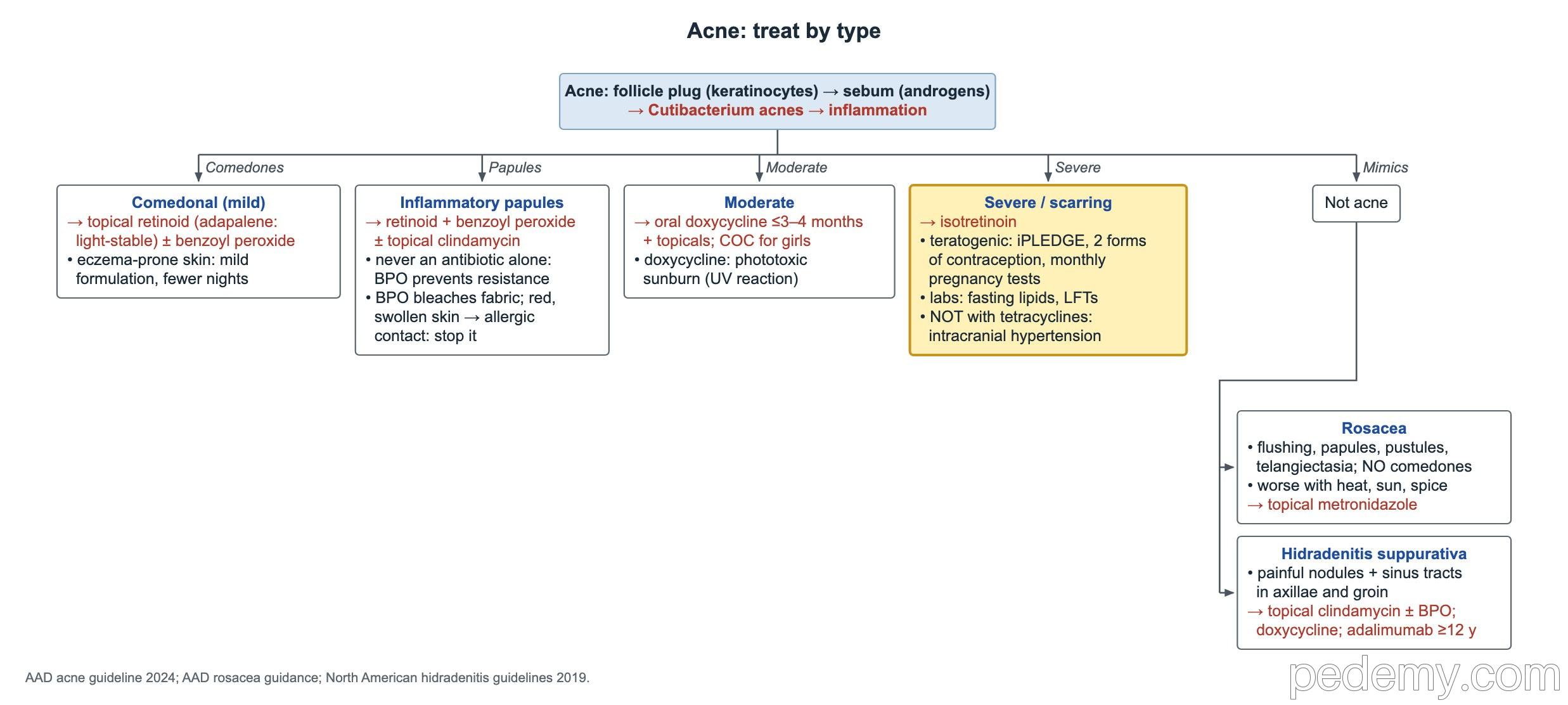
Isotretinoin is for severe or scarring acne, acne with marked psychosocial burden, or acne that fails standard oral and topical treatment. It is a potent teratogen: major birth defects can follow even short exposure in pregnancy.
- iPLEDGE: patients who can become pregnant use 2 forms of contraception (or commit to abstinence) from 1 month before, during, and 1 month after treatment, with monthly pregnancy tests.
- Labs: fasting triglycerides, cholesterol and liver enzymes at baseline, then once at peak dose (about 8 weeks). Routine repeat testing beyond that is not needed if normal.
- Do not combine with doxycycline or minocycline: both raise intracranial pressure and the combination can cause idiopathic intracranial hypertension.
- Common side effects: dry lips and skin, and joint and muscle aches weeks into treatment.
- Ask about mood at each visit.
Targets and blisters: EM, SJS/TEN, MIRM
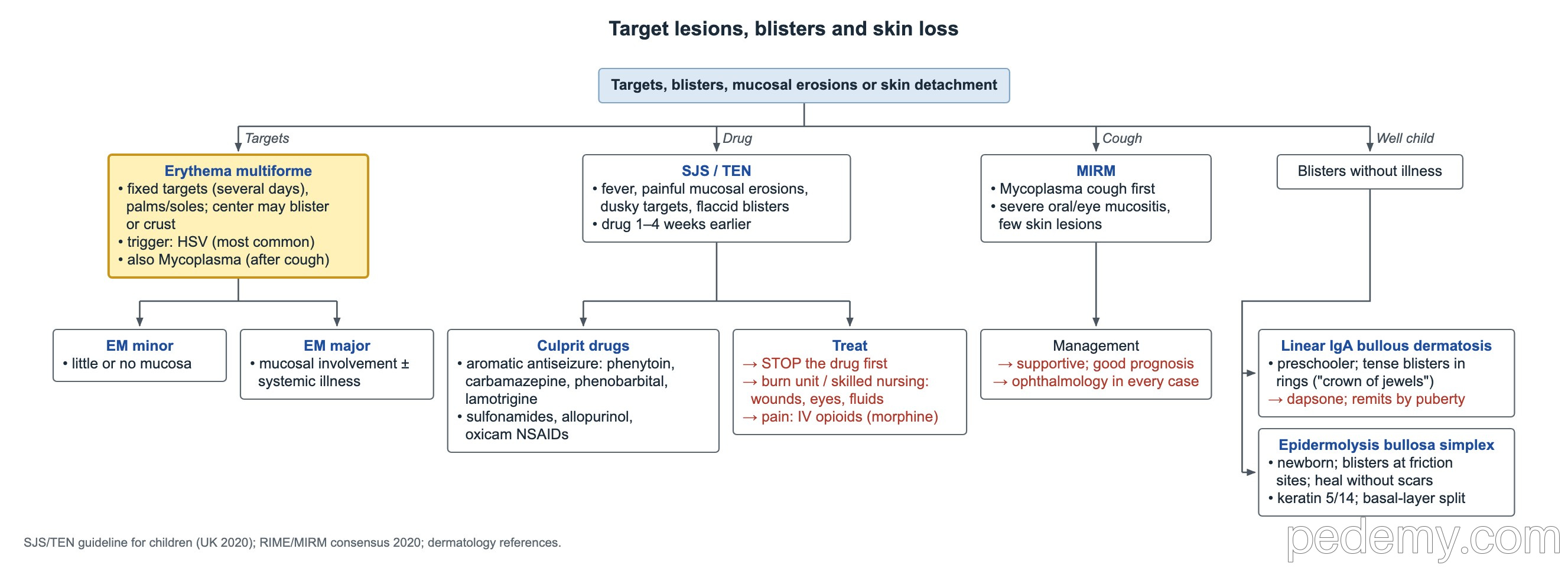
Erythema multiforme (EM) has fixed target lesions that stay in place for several days, often on the palms and soles. The center of a target can blister or crust. The commonest trigger is HSV; Mycoplasma pneumoniae is the key bacterial trigger.
EM minor has little or no mucosal disease. EM major has mucosal involvement and may cause systemic illness. EM is not on a spectrum with SJS.
- MIRM: supportive care and an ophthalmology consult in every case; prognosis is usually good.
- Culprit drugs for SJS/TEN: aromatic antiseizure drugs (phenytoin, carbamazepine, phenobarbital, lamotrigine), sulfonamides, allopurinol and oxicam NSAIDs.
| Condition | Clues | Trigger |
|---|---|---|
| Erythema multiforme | Fixed typical targets, palms and soles; mild or no mucosa | HSV (most common), Mycoplasma |
| SJS / TEN | Fever, painful mucosal erosions, dusky atypical targets, flaccid blisters, skin detachment | Drug started 1–4 weeks earlier; in children Mycoplasma is the commonest infectious trigger |
| MIRM (RIME) | Cough first, then severe oral and eye mucositis with few skin lesions | Mycoplasma pneumoniae (or other infections) |
| Linear IgA bullous dermatosis | Well preschooler; tense blisters in rings ("string of pearls", "crown of jewels") | Usually none; dapsone treats it; usually remits by puberty |
SJS/TEN: first steps
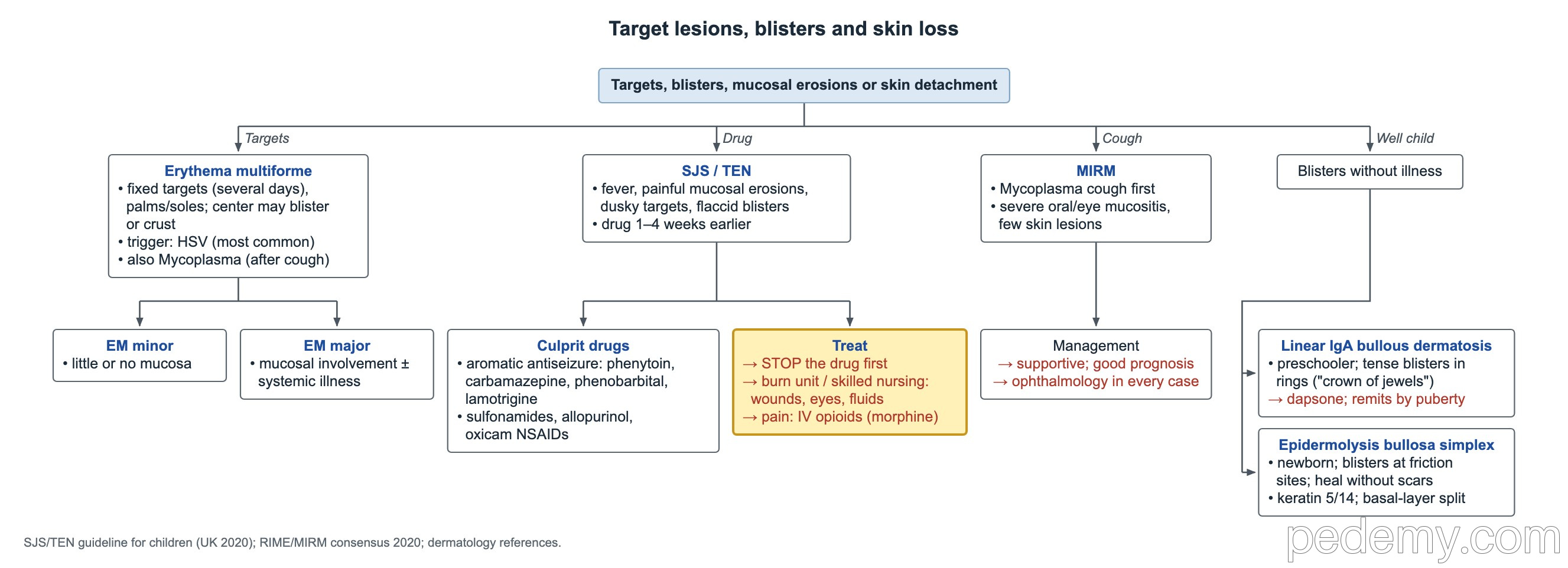
Body surface area of detached skin sets the label: SJS under 10%, SJS/TEN overlap 10–30%, TEN over 30%. A child with fever, mouth and eye erosions, dusky targets and blisters weeks after starting carbamazepine has SJS until proven otherwise.
- Stop the suspected drug immediately; this is the single most important step.
- Admit for supportive care with skilled nursing, often in a burn unit: wound care, fluids, nutrition, eye and mouth care.
- Ophthalmology early to protect the eyes from scarring.
- Pain is severe in extensive disease: give IV opioids such as morphine.
- Avoid the culprit drug and related drugs for life.
Scaly plaques, rings and linear rashes
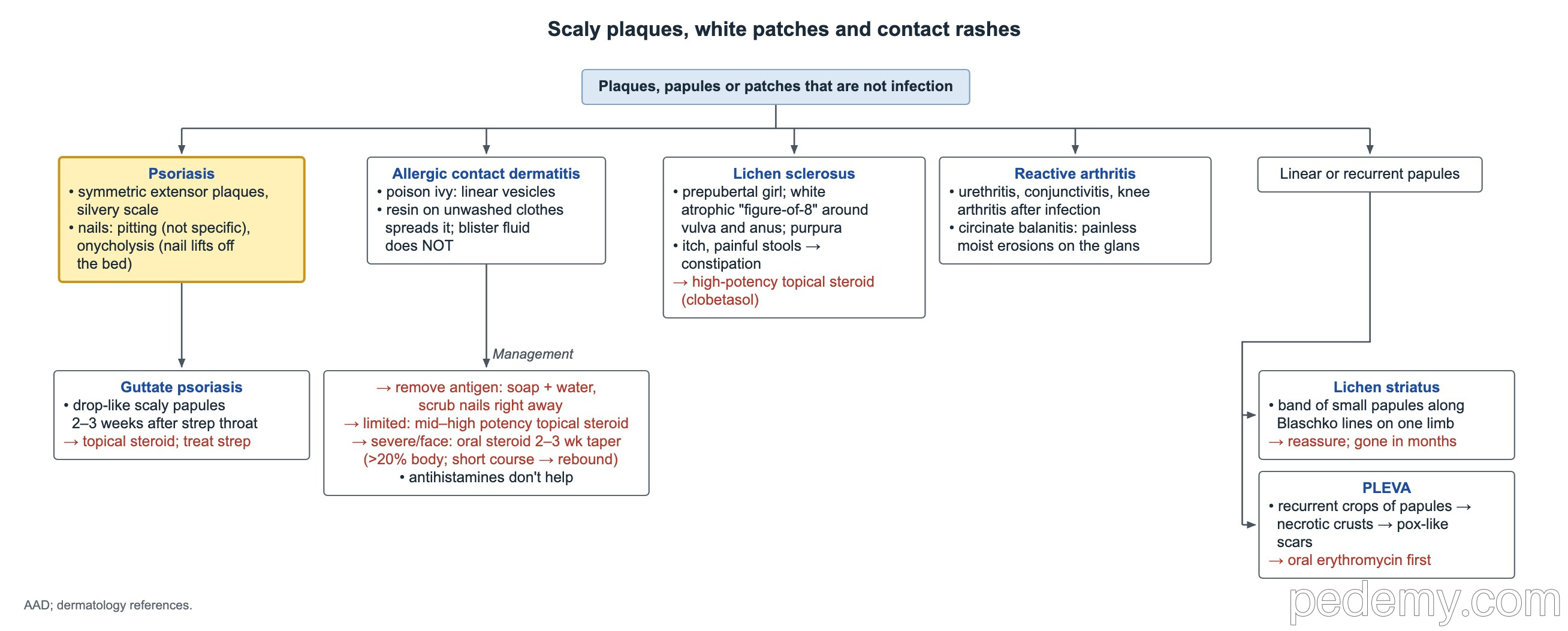
Psoriasis gives symmetric plaques with silvery scale on the extensor surfaces. Nail pitting is common but not specific to psoriasis; onycholysis is separation of the distal nail from the nail bed.
Guttate psoriasis is a shower of small drop-like scaly papules on the trunk 2–3 weeks after group A strep pharyngitis. Treat with topical steroids and treat the strep.
| Rash | Key clue | Management |
|---|---|---|
| Pityriasis rosea | Herald patch, then oval plaques 1–2 weeks later along skin lines (Christmas-tree pattern) | Reassure; treat itch; clears in 6–8 weeks |
| Granuloma annulare | Smooth ring of papules with NO scale, often hands and feet; histology: palisading histiocytes around degenerated collagen with mucin | Benign, asymptomatic, self-limited |
| Tinea corporis | Ring WITH scale | Topical antifungal |
| Lichen striatus | Band of small pink or pale papules along Blaschko lines down one limb | Reassure; clears in months to a year, may leave temporary pale skin |
| PLEVA | Recurrent crops of papules that become necrotic and crusted, healing with pox-like scars | Oral erythromycin first (or phototherapy) |
| Lichen sclerosus | Prepubertal girl; white atrophic figure-of-8 around vulva and anus, purpura, itch, painful stools | Clobetasol ointment, then taper; not a sign of abuse by itself |
| Reactive arthritis | Urethritis, conjunctivitis, knee arthritis after chlamydia or GI infection; circinate balanitis (painless moist erosions on the glans) | Treat the infection; NSAIDs for arthritis |
Contact and light reactions
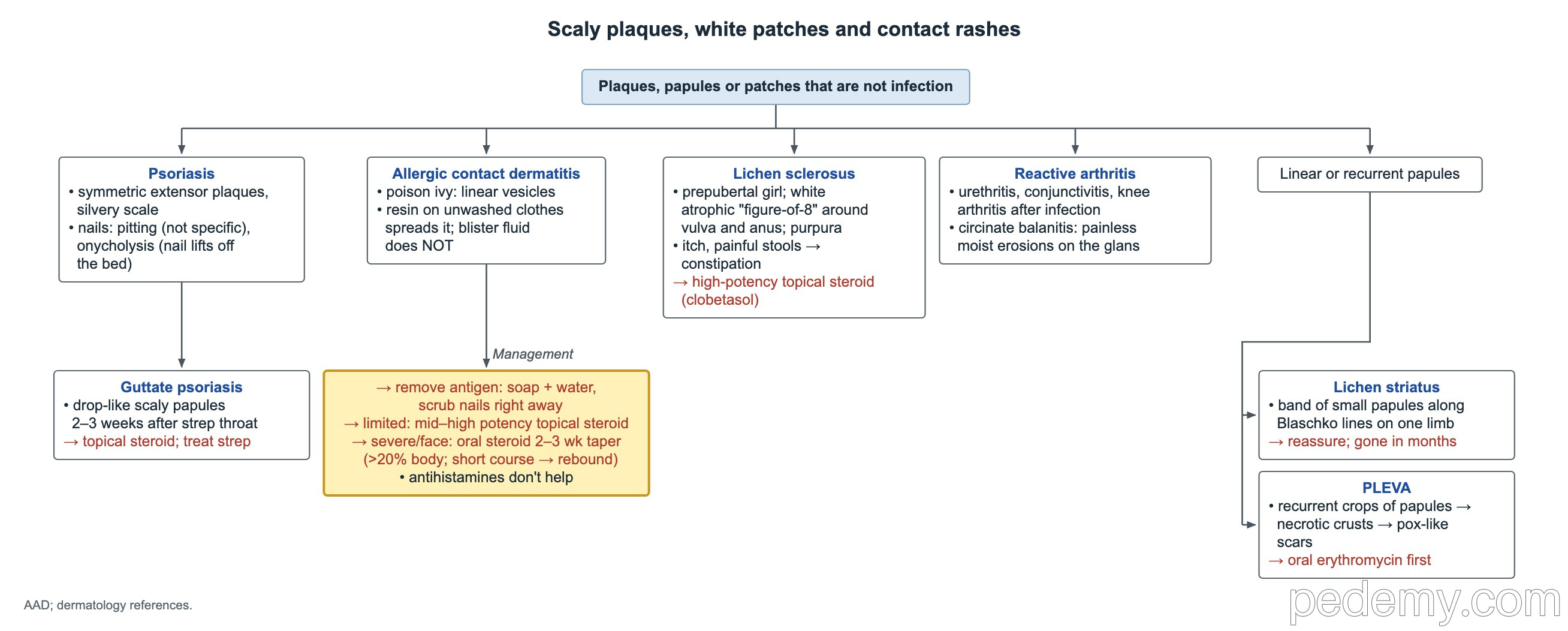
Poison ivy gives linear streaks of vesicles. Resin left on skin, nails, clothes or pets spreads it; fluid from the blisters does not.
Wash the resin off with soap and water and scrub under the nails right away. Use a mid- to high-potency topical steroid for limited disease. Give an oral steroid with a 2–3 week taper for more than about 20% of the body or facial swelling; a short course causes rebound flaring. Antihistamines do not treat the rash.
- A rash that worsens under a topical antibiotic ointment suggests allergic contact dermatitis to neomycin.
- Phytophotodermatitis: streaky redness, blisters, then brown marks where lime juice (plant psoralens) met sunlight. Often mistaken for abuse.
- Polymorphous light eruption: itchy papules on sun-exposed skin 1–2 days into a sunny holiday. Prevent with sunscreen and gradual sun exposure.
- Drug phototoxicity (doxycycline): exaggerated sunburn within hours, sharp border at clothing.
Tender nodules and ulcers
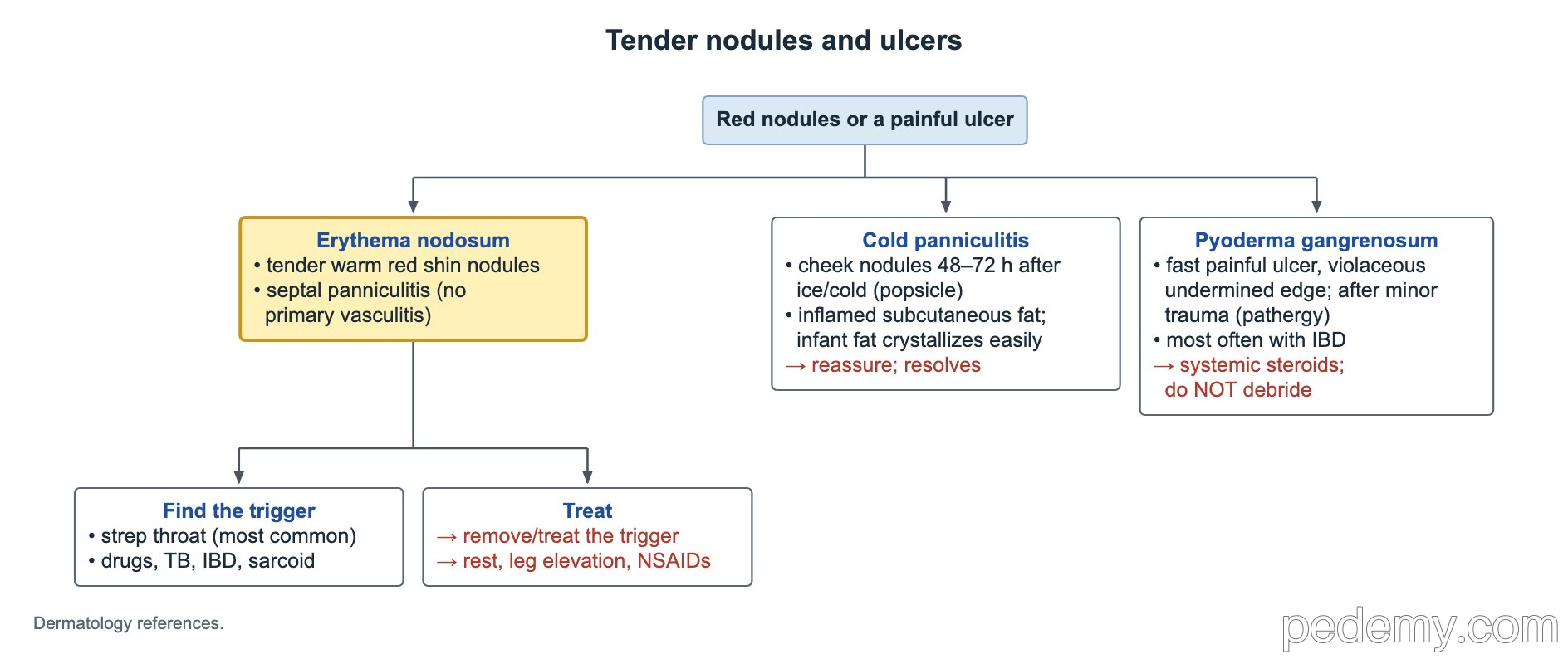
Erythema nodosum gives tender, warm, red nodules on the shins. It is a septal panniculitis without primary vasculitis. Strep pharyngitis is the commonest identifiable trigger in children; also ask about drugs (oral contraceptives), TB, fungal infection, sarcoidosis and inflammatory bowel disease.
Treat or remove the trigger. Rest, leg elevation and NSAIDs relieve symptoms.
| Condition | Clues | Management |
|---|---|---|
| Cold panniculitis | Firm red cheek nodules 1–3 days after a popsicle or ice; lobular panniculitis of the subcutaneous fat; infant fat crystallizes easily in cold | Reassure; resolves without treatment |
| Pyoderma gangrenosum | Fast-growing painful ulcer with a violet undermined edge, worse after minor trauma (pathergy); commonest association is IBD | Systemic corticosteroids (cyclosporine or biologics as alternatives); do not debride |
Common questions
What is the difference between erythema multiforme and Stevens-Johnson syndrome?
EM has fixed, typical target lesions, often on the hands and feet, and is usually triggered by HSV. SJS has dusky atypical targets, blisters, skin detachment and painful mucosal erosions, and is usually triggered by a drug started 1–4 weeks earlier.
Why must isotretinoin never be taken with doxycycline?
Both drugs can raise intracranial pressure. Together they can cause idiopathic intracranial hypertension, with headache and vision changes.
How long does pityriasis rosea last?
The herald patch comes first; the main rash follows 1–2 weeks later and clears on its own in about 6–8 weeks. Only the itch needs treatment.
Study this topic
Sources
- AAD 2024: Guidelines of care for the management of acne vulgaris (J Am Acad Dermatol)
- AAD-NPF 2020: Psoriasis in pediatric patients (J Am Acad Dermatol)
- Society of Dermatology Hospitalists 2020: Supportive care in SJS/TEN (J Am Acad Dermatol)
- Canavan et al. 2015: Mycoplasma-induced rash and mucositis (J Am Acad Dermatol)
- North American hidradenitis suppurativa guidelines 2019, part I (J Am Acad Dermatol)
Written for Pedemy in our own words from the sources above; checked November 2026. For education only, not medical advice; check doses and local protocols before treating a patient. Pedemy is independent and not affiliated with or endorsed by the organizations cited.