

Main decision tree
Birthmarks: hemangioma or malformation?
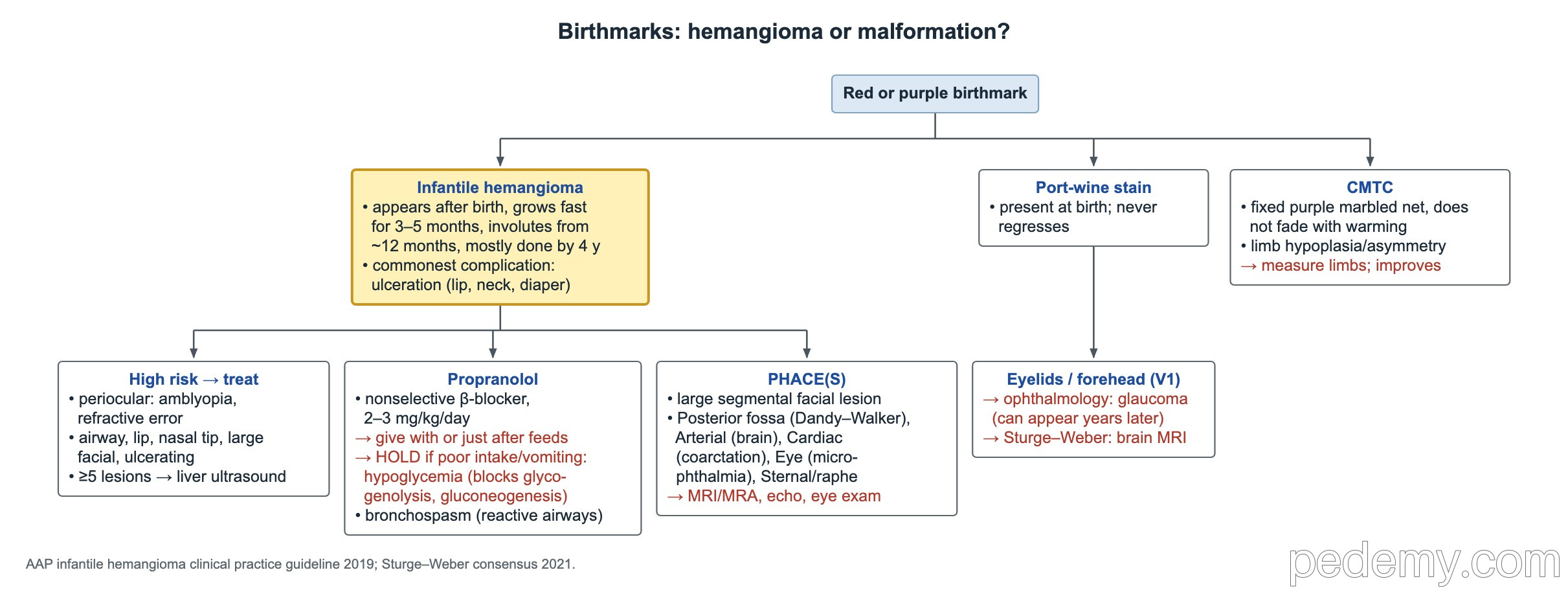
Key points
- Infantile hemangioma grows fastest between 1 and 3 months; most growth is done by 5 months; involution starts around 12 months and is mostly complete by 4 years.
- Refer potentially high-risk hemangiomas early, ideally by 1 month of age.
- Ulceration (lip, neck, diaper area) is the commonest complication.
- Propranolol 2–3 mg/kg/day, given with or just after feeds; hold it when the infant is vomiting or not feeding (hypoglycemia).
- Large segmental facial hemangioma → evaluate for PHACE: MRI/MRA of head and neck, echo, eye exam.
- Port-wine stain on the forehead or eyelids → glaucoma screening and evaluation for Sturge–Weber syndrome.
Infantile hemangioma or malformation?
Infantile hemangiomas are the commonest benign tumor of infancy. They are absent or faint at birth, grow fast in the first months, and then slowly involute. Growth is quickest between 1 and 3 months and is finished by 5 months in most infants. Involution begins around 12 months and is nearly complete by 4 years, often leaving skin changes.
Vascular malformations, such as a port-wine stain, are present at birth, grow with the child and never regress.
- Ulceration is the commonest complication, most often on the lip, neck and diaper area. It is painful and leaves scars.
- Because the window for growth is short, see infants with a potentially problematic hemangioma early, ideally by 1 month of age.
High-risk hemangiomas
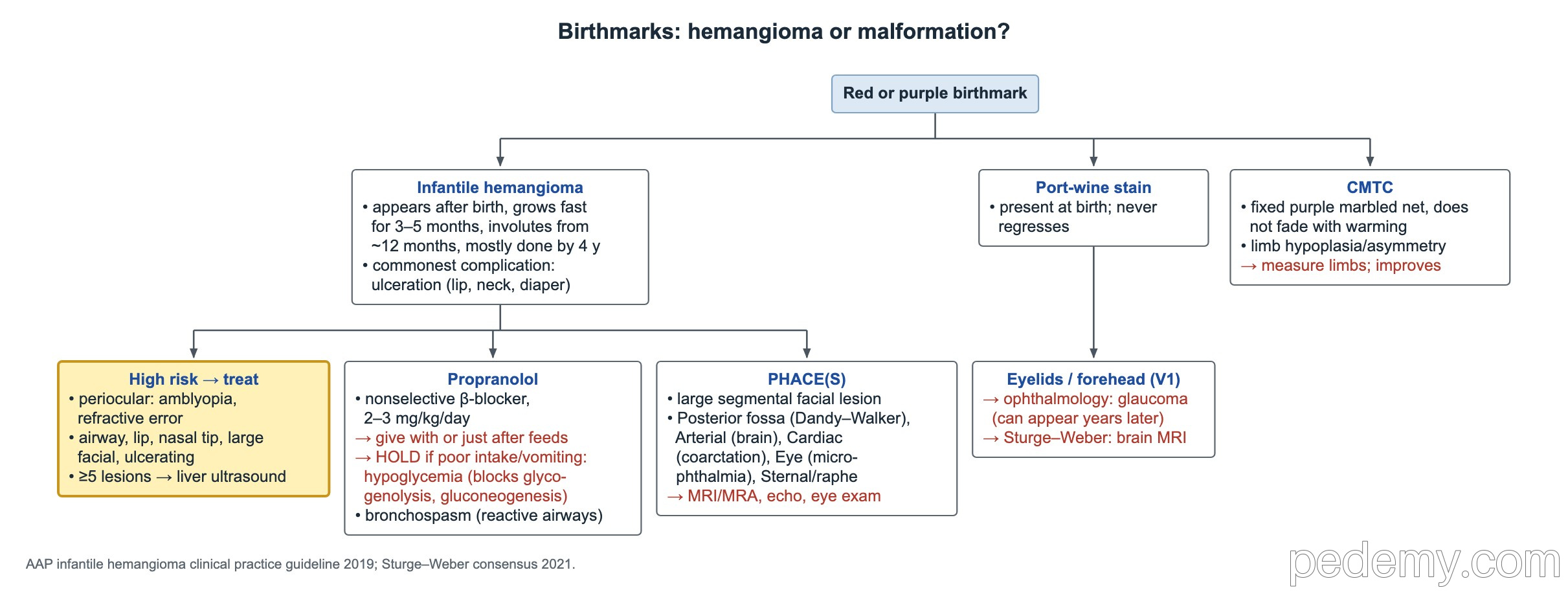
Most hemangiomas need no treatment. Treat or refer those that threaten function, life or appearance.
| Location or type | Risk |
|---|---|
| Periocular or orbital | High risk of eye problems: astigmatism, refractive error and amblyopia |
| Beard area, airway | Airway hemangioma; stridor |
| Lip, nasal tip, large facial | Disfigurement and scarring |
| Ulcerating | Pain, bleeding, scarring |
| 5 or more skin hemangiomas | Liver hemangiomas → liver ultrasound |
| Large segmental facial | PHACE syndrome |
| Segmental lumbosacral | Spinal and genitourinary anomalies (LUMBAR) |
Propranolol
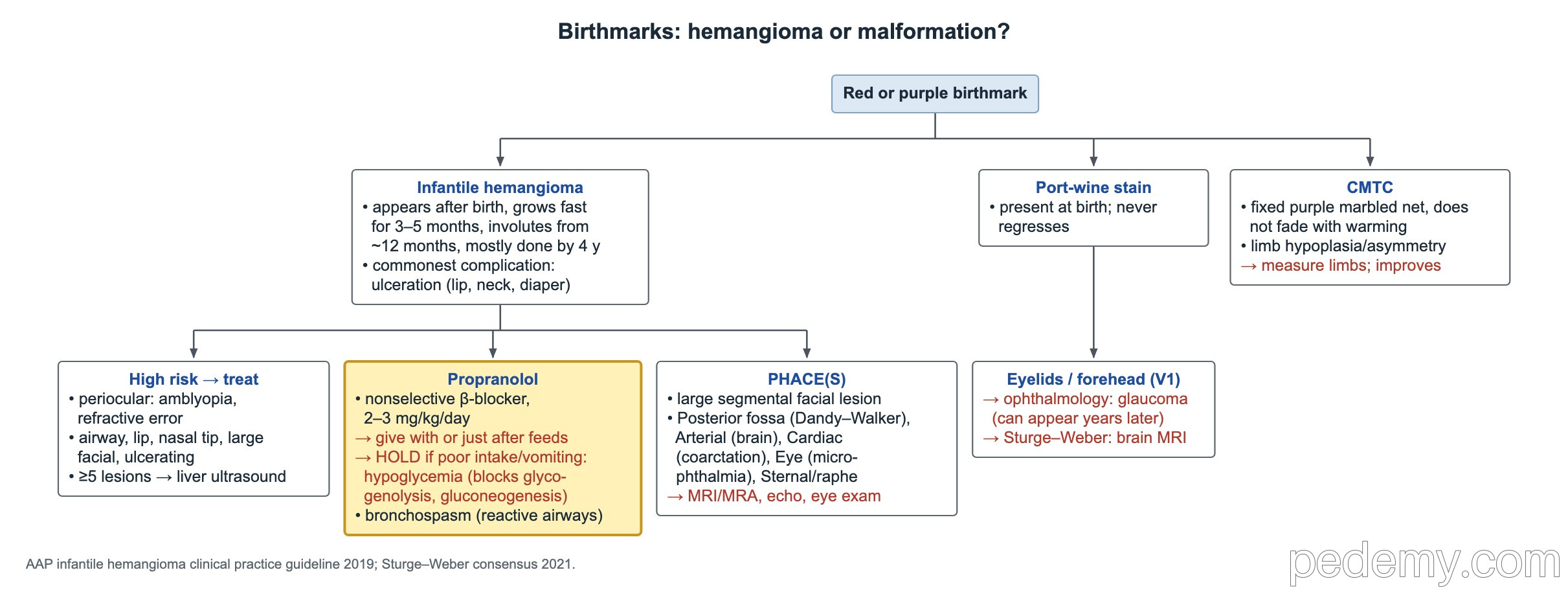
Oral propranolol is the first-line drug for high-risk hemangiomas, at 2–3 mg/kg/day, usually for at least 6 months and often until about 12 months of age. Topical timolol may be used for small, thin, superficial lesions. A routine echo or ECG is not needed before starting in a healthy infant; get an ECG if the heart rate is low or there is a cardiac history.
- Propranolol is a nonselective beta blocker (beta-1 and beta-2).
- Hypoglycemia: it blocks glycogenolysis and gluconeogenesis and masks warning signs. Give it with or just after a feed.
- Hold doses when the infant is vomiting or not feeding well.
- Bronchospasm: beta-2 blockade can worsen wheezing; take care in children with asthma or reactive airways, and hold during wheezing illnesses.
- Other effects: sleep disturbance, cold hands and feet, slow heart rate and low blood pressure.
PHACE syndrome
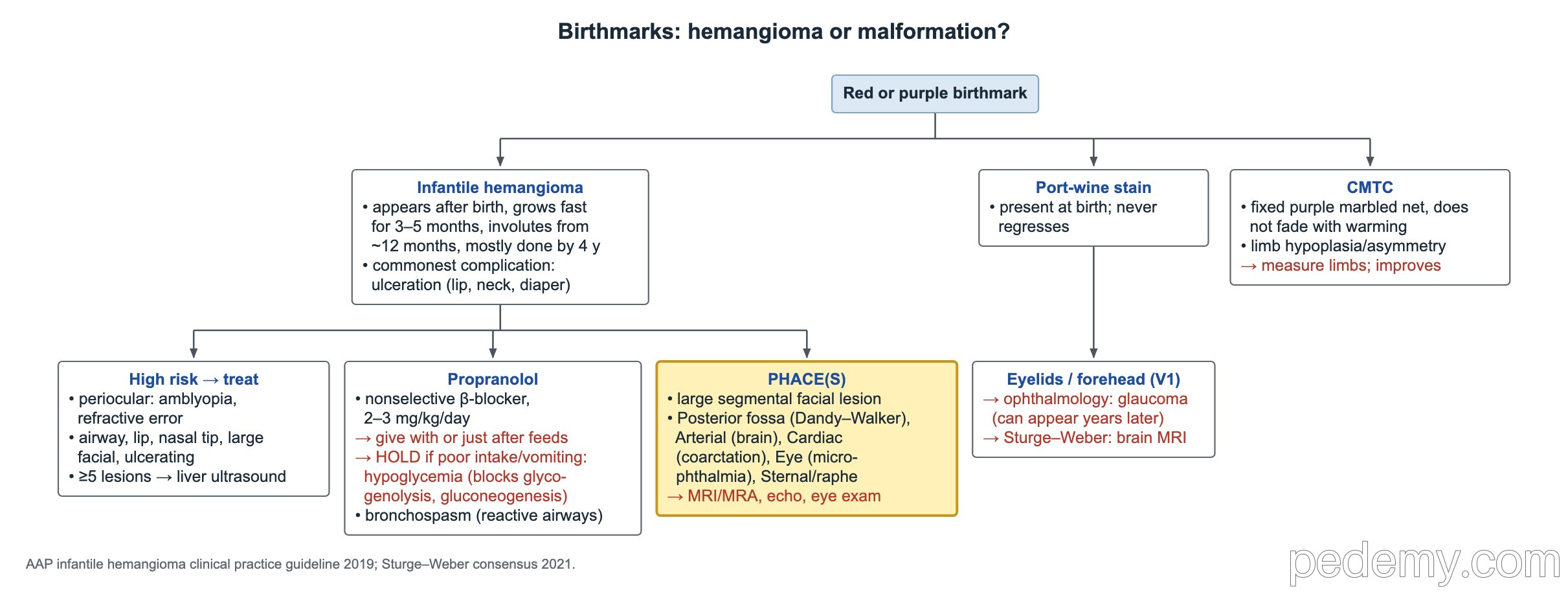
A large segmental hemangioma of the face or scalp can come with structural anomalies. Evaluate with MRI and MRA of the head and neck (including the aortic arch), an echocardiogram and an eye exam. Arterial anomalies raise the stroke risk and change how propranolol is used.
| Letter | Meaning |
|---|---|
| P | Posterior fossa anomalies, such as Dandy–Walker malformation |
| H | Hemangioma: large, segmental, facial |
| A | Arterial anomalies, usually of the head and neck |
| C | Cardiac anomalies, especially coarctation of the aorta |
| E | Eye anomalies, such as microphthalmia |
| S | Sternal defects or supraumbilical raphe |
Port-wine stain and Sturge–Weber syndrome
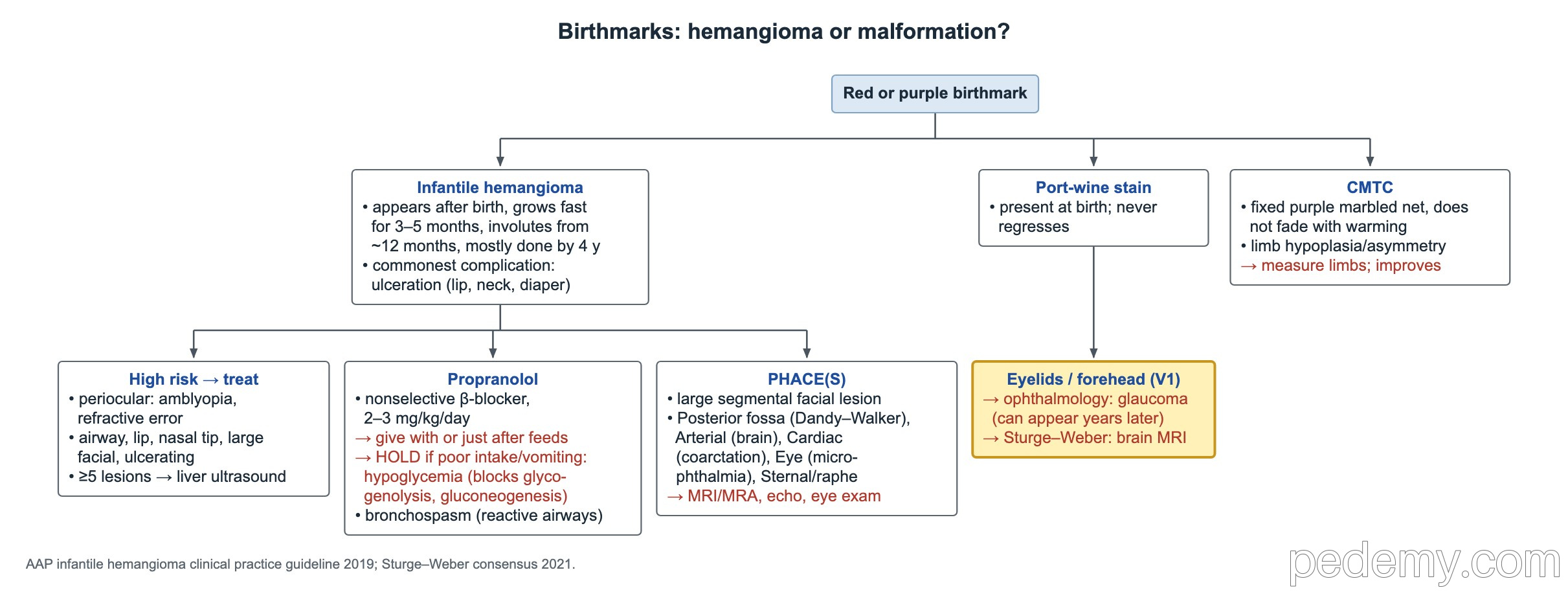
A port-wine stain (capillary malformation) is a flat pink to purple patch present at birth that never fades and may darken and thicken with age.
A port-wine stain on the forehead (V1) or the upper and lower eyelids needs ophthalmology for glaucoma, which is on the same side and can appear years later. The forehead stain also raises the risk of Sturge–Weber syndrome: a leptomeningeal angioma with seizures, hemiparesis and hemispheric atrophy, caused by a somatic GNAQ mutation. Evaluate with brain MRI.
Salmon patch and cutis marmorata telangiectatica congenita
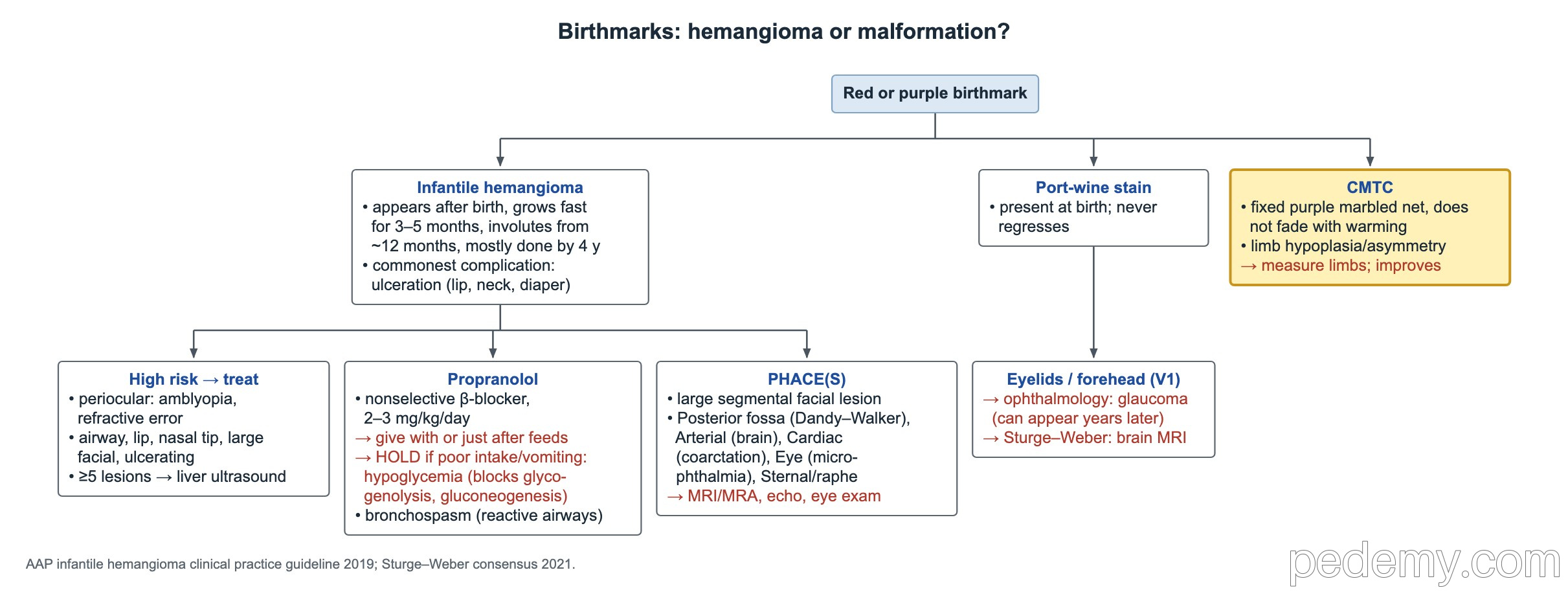
Cutis marmorata telangiectatica congenita (CMTC) is a fixed, purple, marbled net, often on one leg, that does not fade with warming (unlike normal cutis marmorata). The commonest associated finding is hypoplasia or asymmetry of the affected limb, so measure limb length and girth. The pattern usually improves with age.
A salmon patch (nevus simplex) on the nape or eyelids is common and fades. A prominent glabellar or forehead salmon patch is a minor feature of Beckwith–Wiedemann syndrome. A salmon patch on the lower back alone is usually harmless, but with other midline markers (dimple above the gluteal cleft, tuft of hair, lipoma) it suggests occult spinal dysraphism.
Common questions
When does an infantile hemangioma stop growing?
Most growth happens in the first 3 months and is finished by about 5 months. Shrinking starts around 12 months and is mostly complete by 4 years.
Why is propranolol given with feeds?
Propranolol blocks the body's ways of raising blood sugar during fasting. Giving it with or just after a feed, and holding it when the baby is not eating, prevents hypoglycemia.
What is the difference between a hemangioma and a port-wine stain?
A hemangioma appears after birth, grows, then shrinks. A port-wine stain is present at birth, grows with the child and never goes away.
Study this topic
Sources
- AAP 2019: Clinical practice guideline for the management of infantile hemangiomas (Pediatrics)
- Garzon et al. 2016: Updated consensus criteria for PHACE syndrome (J Pediatr)
- Sabeti et al. 2021: Consensus statement for Sturge–Weber syndrome (Pediatr Neurol)
- Brioude et al. 2018: International consensus on Beckwith–Wiedemann spectrum (Nat Rev Endocrinol)
Written for Pedemy in our own words from the sources above; checked November 2026. For education only, not medical advice; check doses and local protocols before treating a patient. Pedemy is independent and not affiliated with or endorsed by the organizations cited.