

Main decision tree
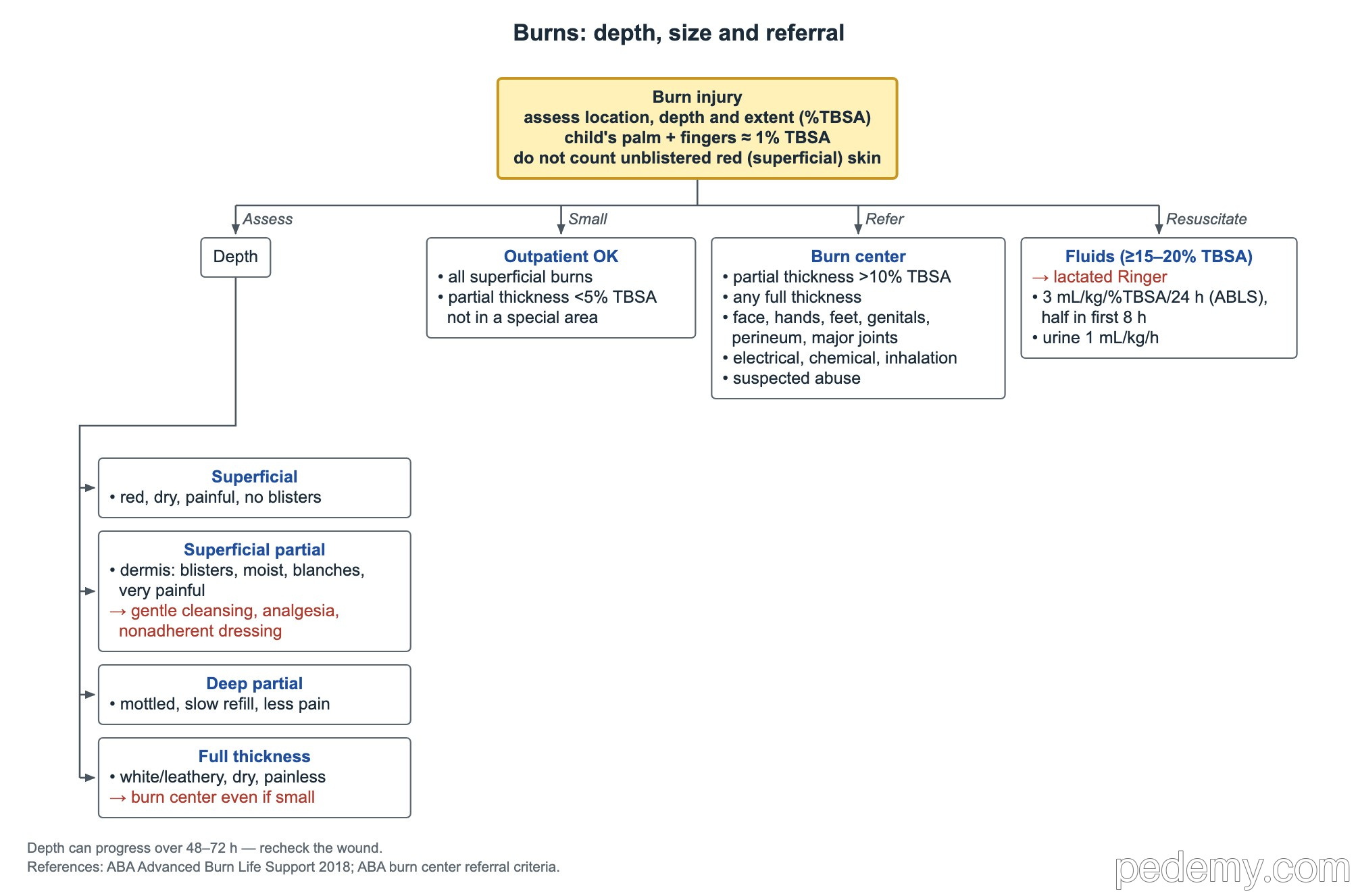
Burns: depth, size and referral
Key points
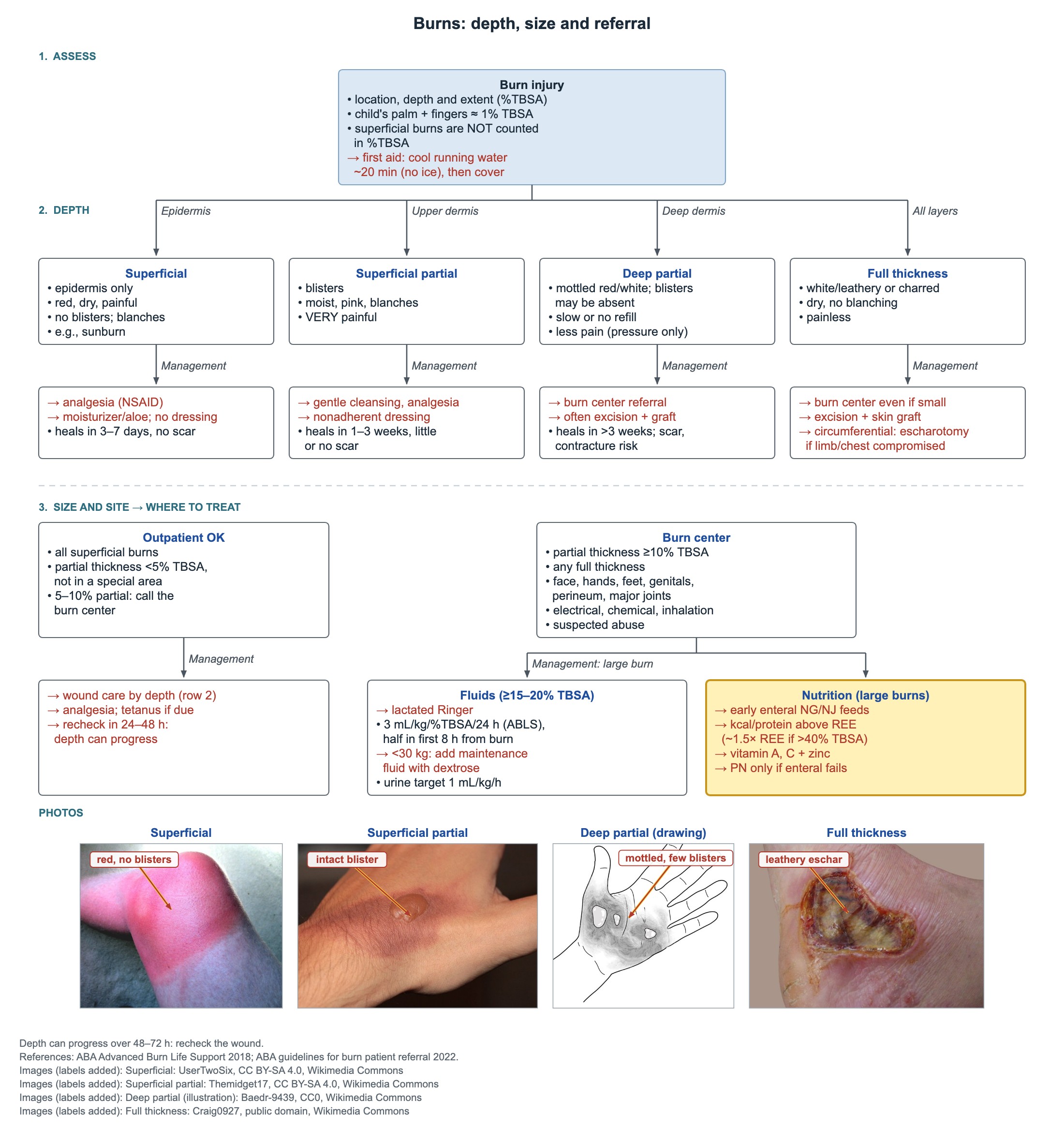
- Size with the child's palm plus fingers ≈ 1% TBSA; do not count superficial (red, unblistered) skin.
- Burn center: partial thickness 10% TBSA or more, any full thickness, face, hands, feet, genitals, perineum, major joints, electrical, chemical, inhalation, suspected abuse.
- Major burn fluids: lactated Ringer 3 mL/kg × %TBSA over 24 hours, half in the first 8 hours; urine goal 1 mL/kg/h.
- Large burns (about 40% TBSA): energy need about 1.5 times REE; early enteral feeds with high protein, vitamins A and C and zinc.
- Stridor, hoarseness, soot or singed hair after a fire → early intubation; racemic epinephrine only buys time.
- CO: 100% oxygen by non-rebreather; closed-space fire with coma, high lactate and hypotension → suspect cyanide, give hydroxocobalamin.
- Drowning arrest is hypoxic: give breaths first; submersion over 5 minutes predicts a poor outcome.
Assessing a burn: site, depth and size
Every burn assessment defines three things: site, depth and size. Site matters because burns of the face, hands, feet, genitals, perineum and major joints need specialist care at any size.
Estimate size as a percentage of total body surface area (TBSA). The child's own palm, including the fingers, is about 1% TBSA. Count partial- and full-thickness areas only; red skin without blisters is not counted.
- Children have a relatively larger head and smaller legs than adults, so use a pediatric chart (Lund–Browder) for large burns.
- Burn depth can progress over 48–72 hours, so recheck the wound.
- Always ask whether the history fits the burn: pattern, immersion lines or delay in care suggest abuse.
Burn depth and treating small burns
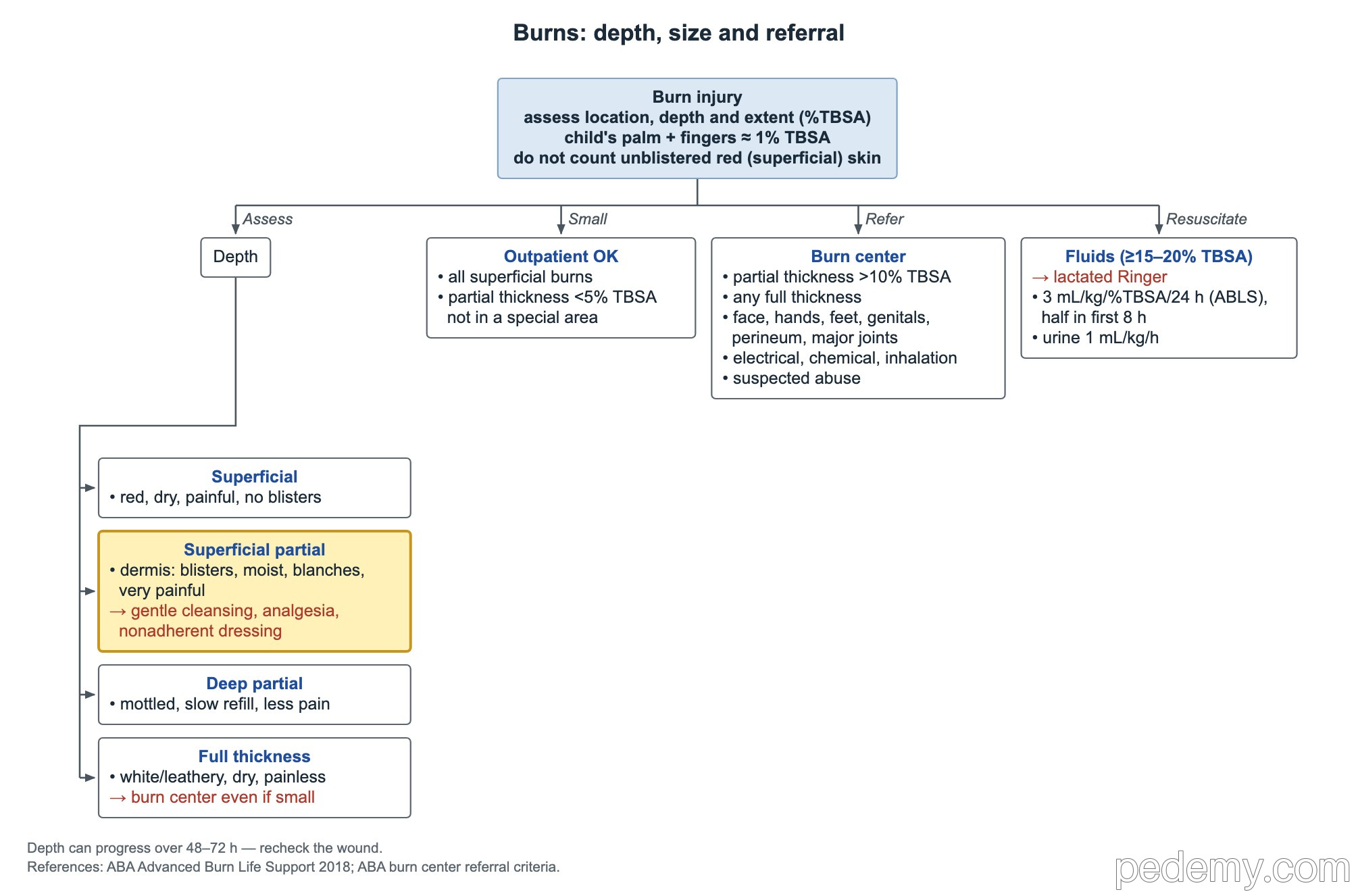
- Outpatient care is suitable for superficial burns and small partial-thickness burns that spare the special areas.
- First aid: cool running water for about 20 minutes (no ice), then cover.
- Give tetanus prophylaxis if due, and recheck in 24–48 hours.
| Depth | Appearance | Treatment |
|---|---|---|
| Superficial (first degree) | Red, dry, painful, no blisters, blanches (sunburn) | Analgesia, moisturizer; heals in 3–7 days |
| Superficial partial thickness | Blisters, moist, pink, blanches, very painful | Gentle cleansing, analgesia, nonadherent dressing; heals in 1–3 weeks |
| Deep partial thickness | Mottled red and white, blisters may be absent, slow or no refill, less pain | Burn center; often excision and grafting |
| Full thickness | White, leathery or charred, dry, painless, no blanching | Burn center even if small; excision and grafting |
Which burns need a burn center
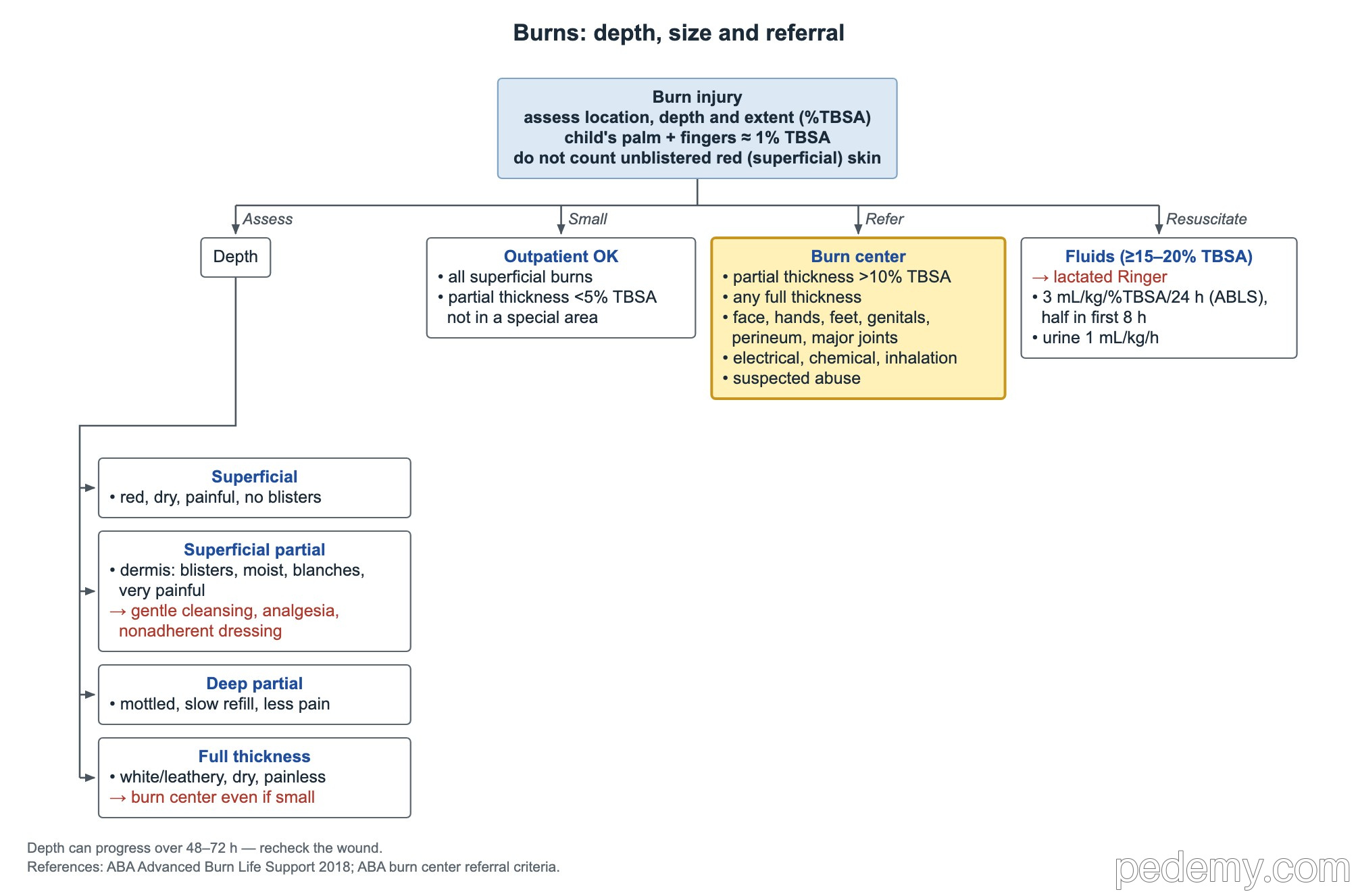
- Partial-thickness burns of 10% TBSA or more.
- Any full-thickness burn, even a small dry, leathery, painless one.
- Burns of the face, hands, feet, genitals, perineum or major joints.
- Electrical (including lightning) and chemical burns.
- Inhalation injury.
- Suspected child abuse, or a home that cannot care for the child.
Fluid resuscitation for major burns
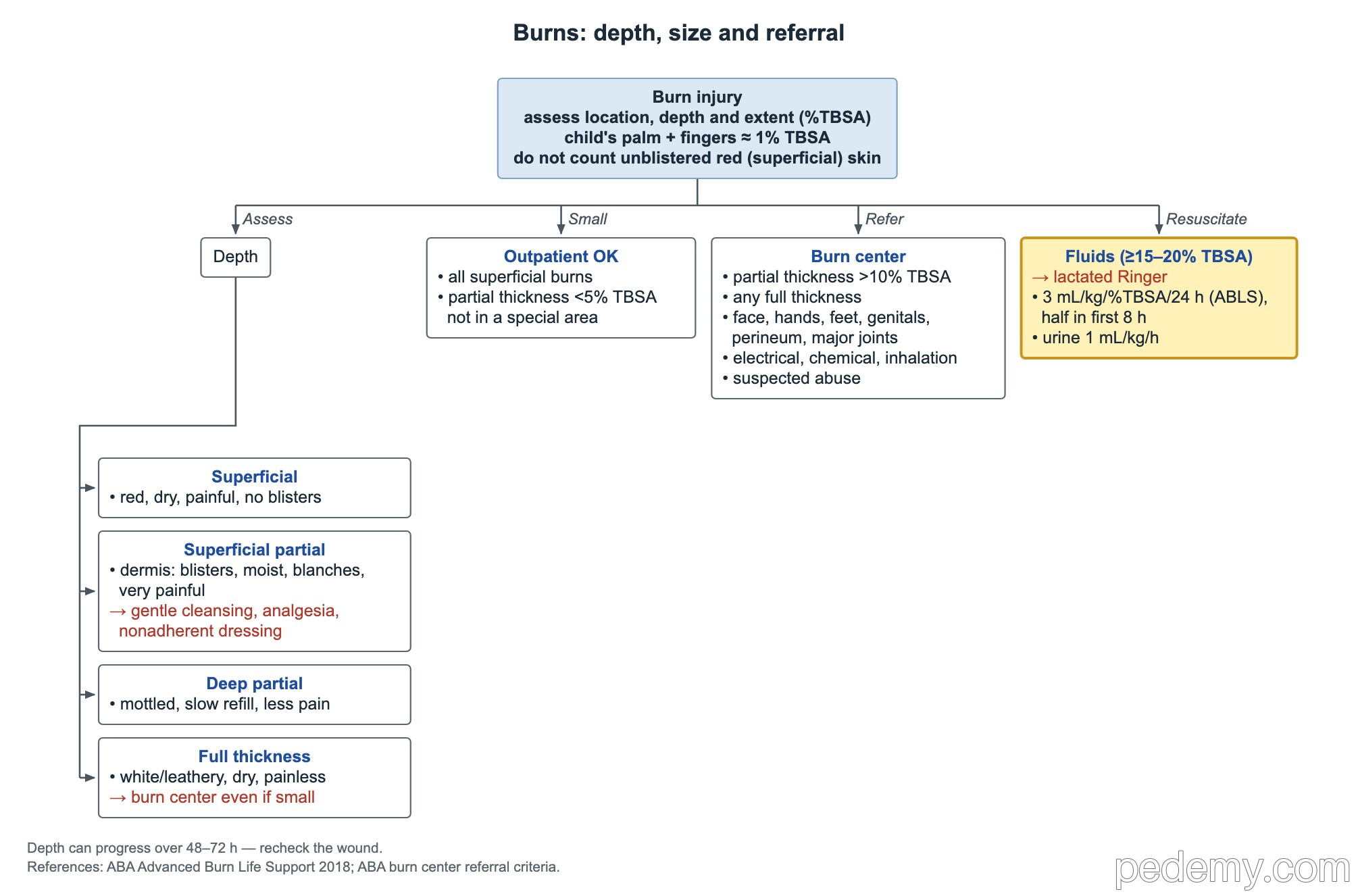
Children with large burns (about 15–20% TBSA or more) need IV resuscitation. Lactated Ringer is the preferred fluid.
- Starting 24-hour volume (ABLS): 3 mL/kg × %TBSA, counted from the time of the burn.
- Give half in the first 8 hours and the rest over the next 16 hours.
- Children under 30 kg also get maintenance fluid with dextrose, because they have small glycogen stores.
- Adjust the rate to urine output: about 1 mL/kg/h in children under 30 kg.
Nutrition after a large burn
- A burn of 40% TBSA or more raises resting energy expenditure (REE) to about 1.5 times normal, and it can approach 2 times.
- Energy and protein goals are above REE, with high protein.
- Start early enteral tube feeds (nasogastric or nasojejunal) in a child who cannot eat enough.
- Use parenteral nutrition only if enteral feeding fails or is not tolerated.
- Supplement vitamin A, vitamin C and zinc to support wound healing.
Smoke inhalation: airway, CO and cyanide
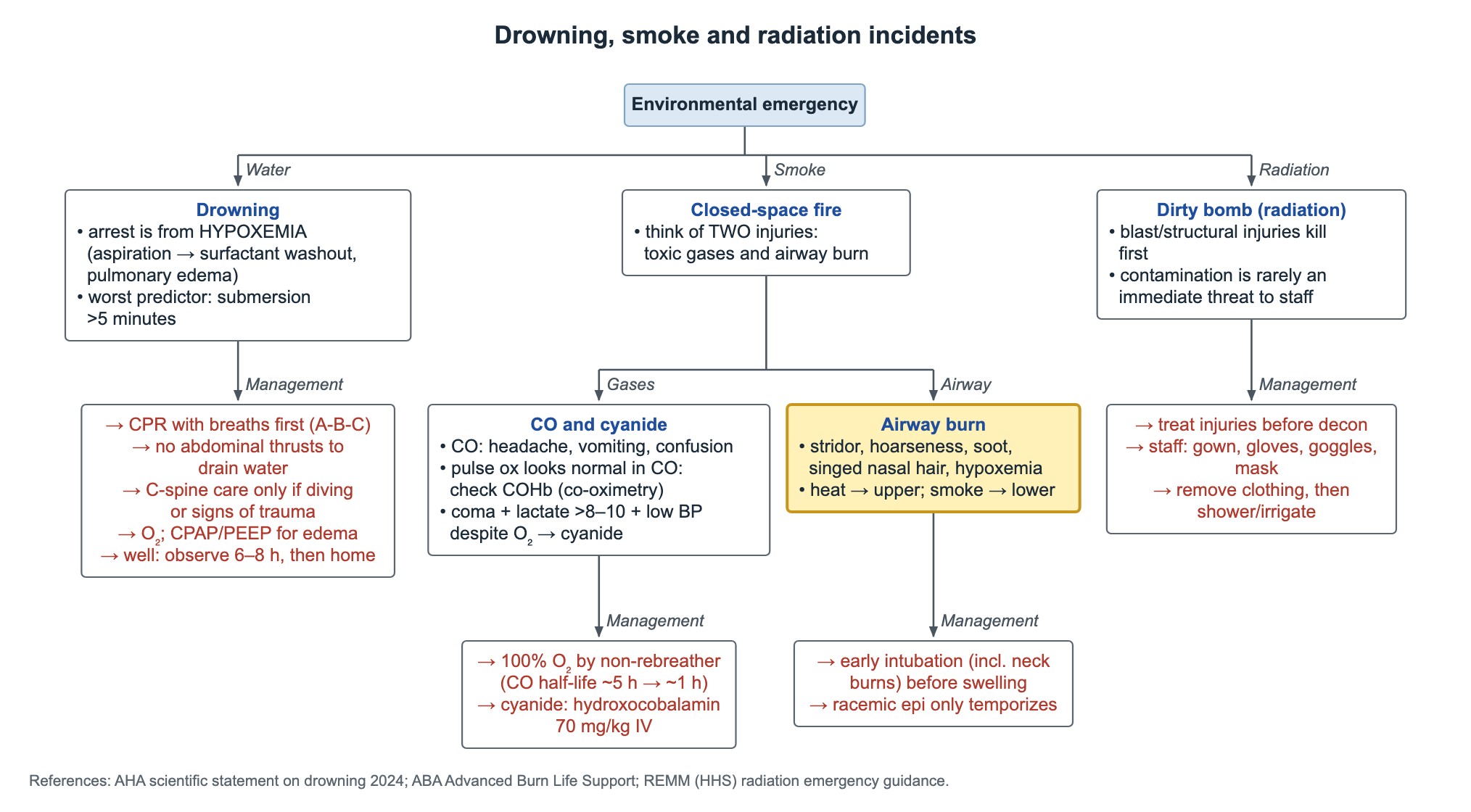
A closed-space fire causes two injuries: a thermal airway burn and poisoning by toxic gases. Heat mainly burns the upper airway; the lower airways are injured chemically by smoke.
- Signs of airway burn: stridor, hoarseness, soot in the mouth or sputum, singed facial or nasal hair, facial burns or blisters, hypoxemia, respiratory distress.
- With these signs, intubate early. Airway swelling progresses fast and later intubation can become impossible.
- A burn that encircles the neck is another reason to intubate early.
- Racemic epinephrine only temporizes stridor from an airway burn; it does not secure the airway.
- Carbon monoxide: headache, vomiting, confusion; pulse oximetry reads falsely normal, so measure carboxyhemoglobin by co-oximetry.
- CO treatment: 100% normobaric oxygen by non-rebreather, even if SpO2 looks normal; it shortens CO half-life from about 5 hours to about 1 hour.
- Consider hyperbaric oxygen for syncope or coma, seizure, a neurologic deficit, cardiac ischemia or a very high COHb.
- Cyanide: coma, lactate above about 8–10 mmol/L and hypotension despite 100% oxygen → hydroxocobalamin 70 mg/kg IV.
Drowning and radiation incidents
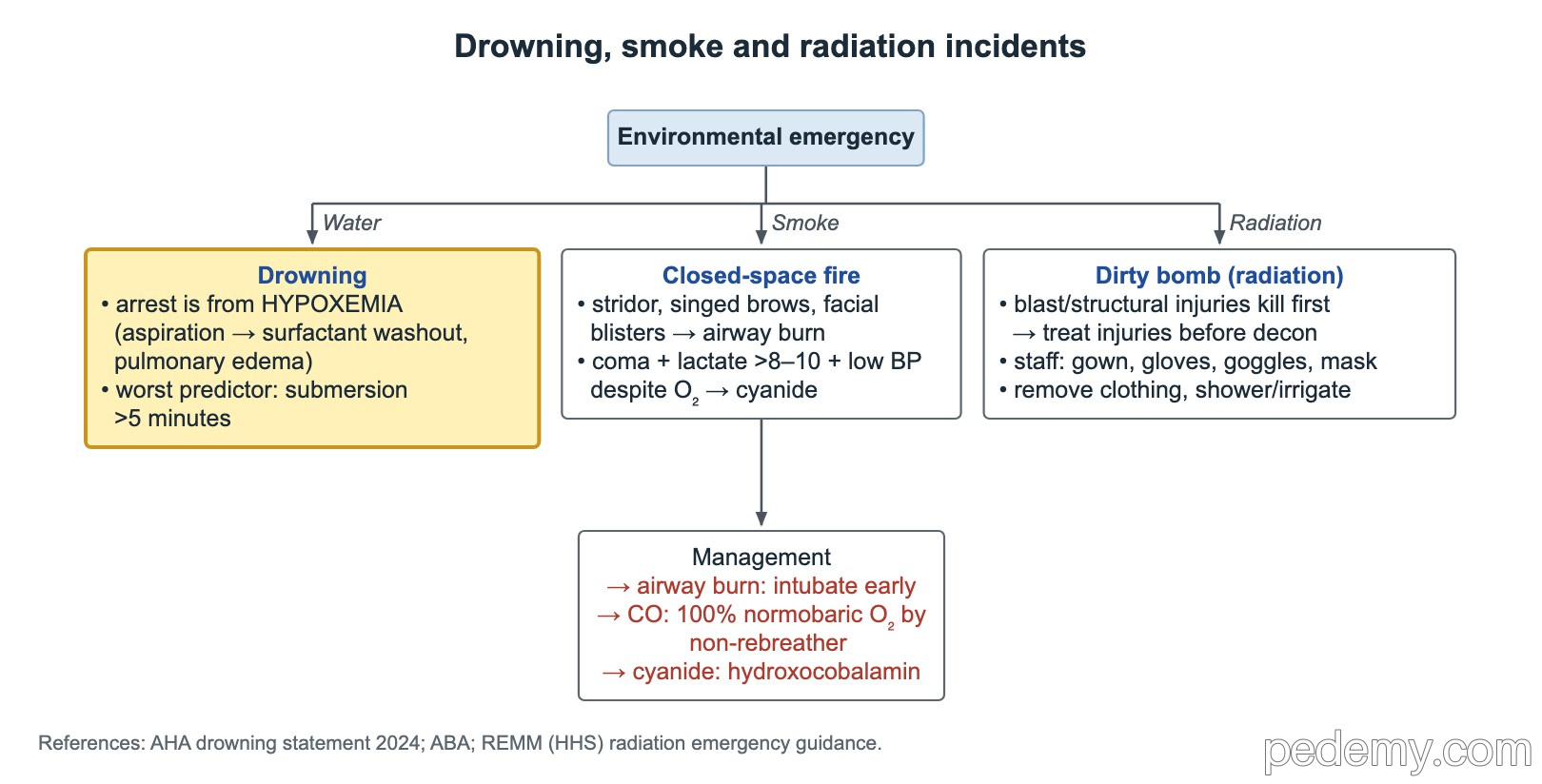
Cardiac arrest after drowning comes from hypoxemia. Aspirated water washes out surfactant and causes pulmonary edema.
- Resuscitate with breaths first (airway and breathing before compressions); do not use abdominal thrusts to drain water.
- Protect the cervical spine only after diving or when there are signs of trauma.
- Give oxygen; CPAP or PEEP helps pulmonary edema.
- Submersion longer than 5 minutes is the strongest predictor of a poor outcome.
- Well-appearing children are observed for several hours (often 6–8) before going home.
- Radiological dispersal device (dirty bomb): blast and structural injuries are the immediate threat to life, so treat injuries before decontamination.
- Radiation contamination is rarely a danger to staff: wear a gown, gloves, eye protection and a mask.
- Decontaminate by removing clothing and washing the skin with soap and water.
Common questions
How do you estimate burn size in a child?
The child's palm including the fingers is about 1% of body surface area. Count only partial- and full-thickness burns, and use a pediatric (Lund–Browder) chart for large burns.
What is the burn fluid formula for children?
The ABLS starting volume is lactated Ringer 3 mL/kg × %TBSA over 24 hours, half in the first 8 hours. Children under 30 kg also get maintenance fluid with dextrose.
Why is pulse oximetry unreliable in carbon monoxide poisoning?
Standard pulse oximeters read carboxyhemoglobin as oxyhemoglobin, so SpO2 can look normal. Measure carboxyhemoglobin with co-oximetry and give 100% oxygen.
Study this topic
Sources
- AHA and AAP 2024: Focused update on resuscitation following drowning (Pediatrics)
- ACEP 2025: Clinical policy on acute carbon monoxide poisoning (Ann Emerg Med)
- SCCM and ASPEN 2017: Nutrition support in the critically ill child (JPEN)
- ISBI Practice Guidelines for Burn Care (Burns 2016)
Written for Pedemy in our own words from the sources above; checked November 2026. For education only, not medical advice; check doses and local protocols before treating a patient. Pedemy is independent and not affiliated with or endorsed by the organizations cited.