

Main decision tree
Pain and procedural sedation: plan, then pick the depth
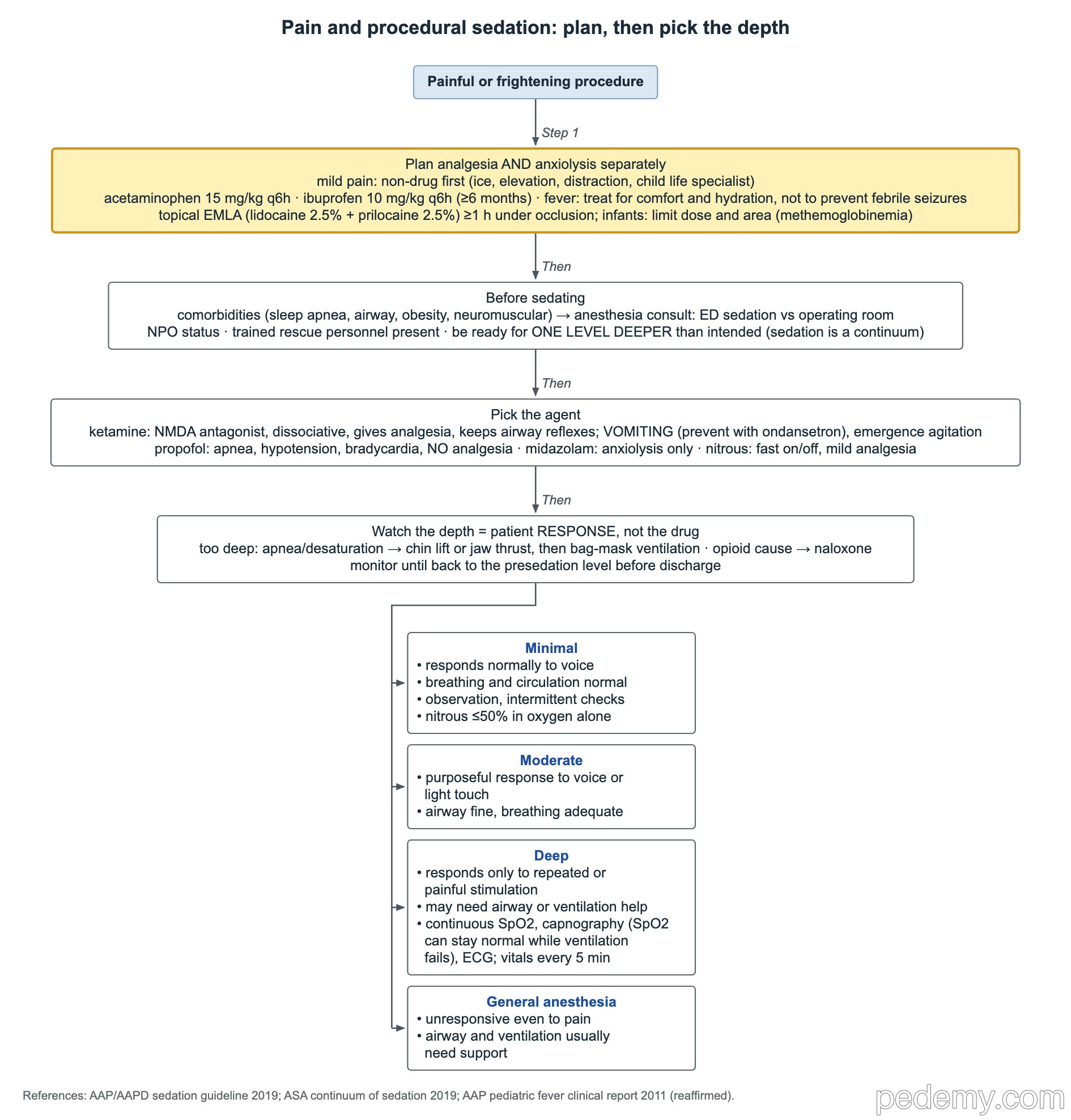
Key points
- Sedation depth is defined by the child's response: minimal (normal response to voice), moderate (purposeful response to voice or light touch), deep (only to repeated or painful stimuli), general anesthesia (no response to pain).
- Deep sedation: continuous pulse oximetry, capnography and ECG, with vital signs at least every 5 minutes.
- On supplemental oxygen, SpO2 can stay normal while ventilation fails; capnography detects apnea earlier.
- Apnea during sedation: chin lift or jaw thrust, then bag-mask ventilation.
- Ketamine (NMDA antagonist) gives dissociation with analgesia and keeps airway reflexes and breathing; blood pressure rises; vomiting is common.
- Propofol causes apnea, hypotension and bradycardia and gives no analgesia.
- Acetaminophen 15 mg/kg every 6 hours (max 75 mg/kg/day); ibuprofen 10 mg/kg every 6–8 hours from 6 months (max 40 mg/kg/day).
Step 1: plan analgesia and anxiolysis separately
Anxiolysis does not treat pain. A child getting a bone marrow biopsy under minimal anxiolysis still needs a real pain plan, such as local anesthetic plus systemic analgesia or deeper sedation.
- Non-drug measures first for mild pain: ice, elevation, distraction, and preparation and play with a child life specialist.
- Acetaminophen 15 mg/kg orally every 6 hours, maximum 75 mg/kg/day.
- Ibuprofen 10 mg/kg orally every 6–8 hours in children 6 months or older, maximum 40 mg/kg/day.
- EMLA cream (lidocaine 2.5% + prilocaine 2.5%) on intact skin at least 1 hour before venipuncture, under an occlusive dressing.
| EMLA in infants and young children | Check |
|---|---|
| Risk | Methemoglobinemia from prilocaine, highest in young infants |
| Before applying | Age and gestation, weight, dose in grams, skin area, duration of contact |
| Interactions | Other drugs that cause methemoglobinemia (for example, sulfonamides, nitrates, dapsone) |
Before sedating
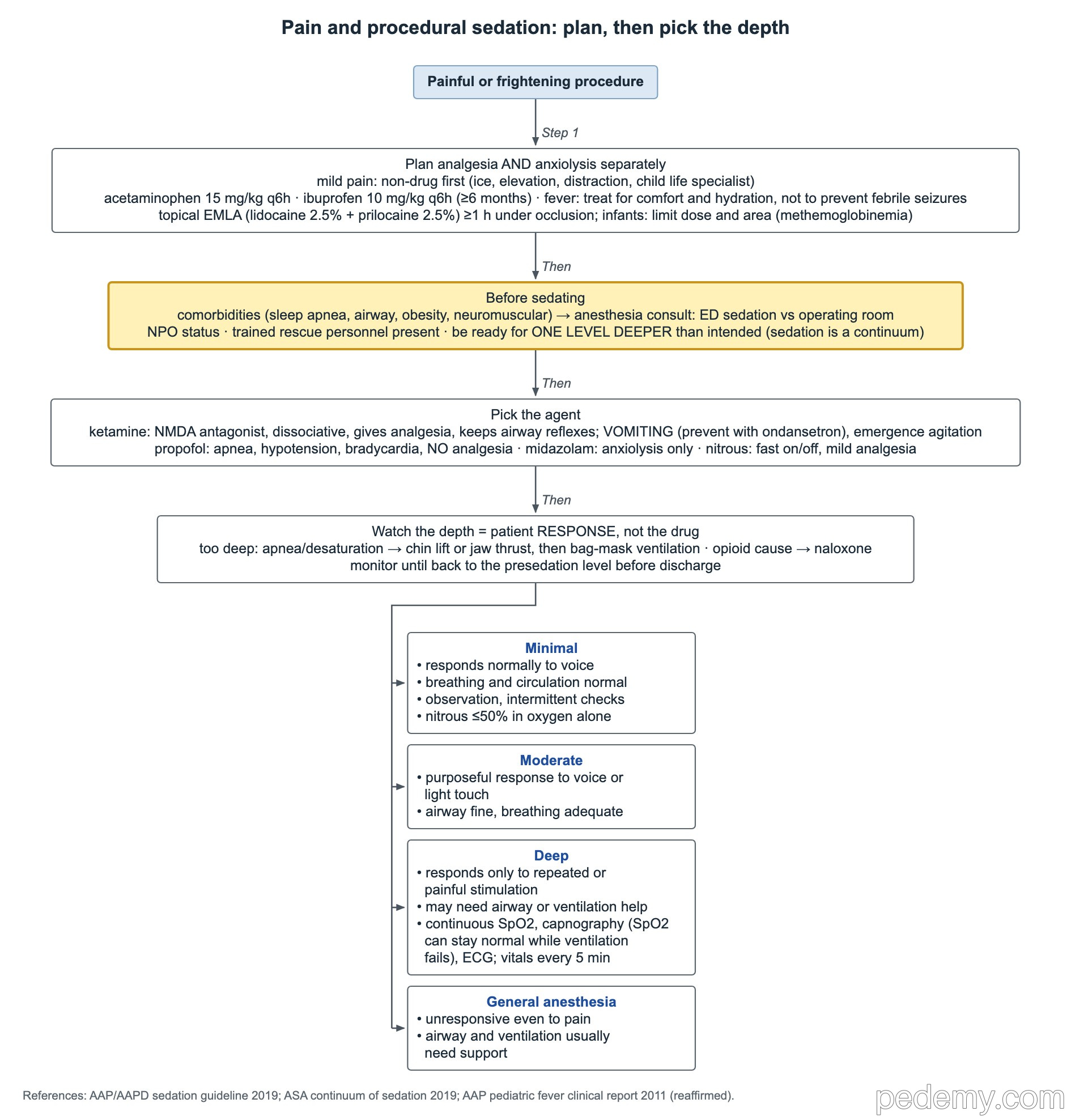
- Assess the airway and comorbidities. Obstructive sleep apnea, a difficult airway, obesity or neuromuscular disease → consult anesthesia about ED sedation vs the operating room.
- Check fasting status and weigh the urgency of the procedure against aspiration risk.
- Have trained monitoring and rescue staff, suction, oxygen and airway equipment ready before starting; a moderate or deep sedation should not proceed without them.
- Sedation is a continuum: the team must be able to rescue a child from one level deeper than intended.
Choosing the agent
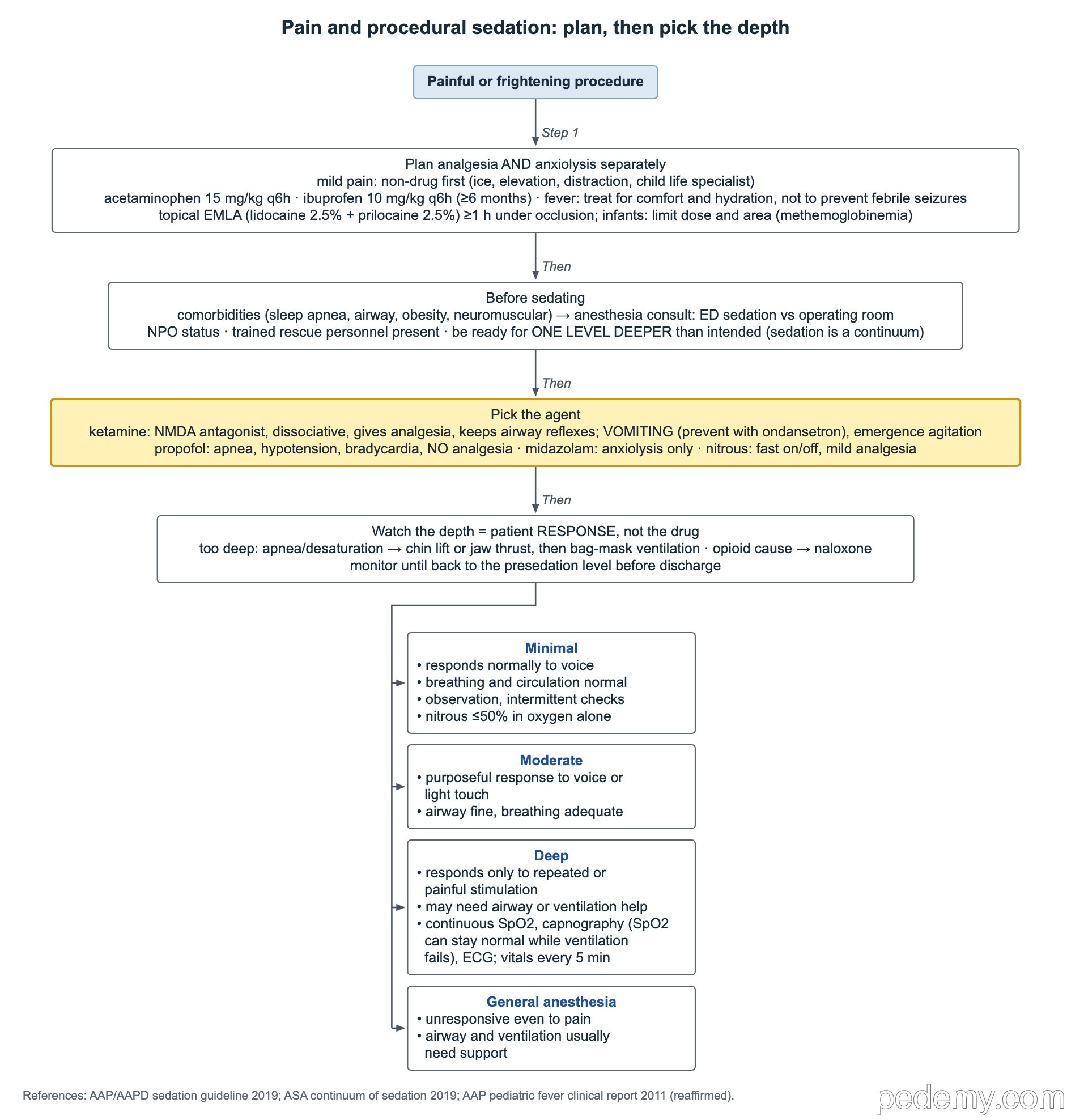
- IV ketamine fits a brief painful ED procedure when breathing and airway reflexes should be kept.
- Acute porphyria is not a blanket contraindication to propofol: porphyria drug lists class it as acceptable.
- Developmental delay alone does not make nitrous oxide the right choice; check mask tolerance, nasal breathing, cooperation and the procedure.
| Agent | Key effects | Watch for |
|---|---|---|
| Ketamine | NMDA antagonist; dissociation plus analgesia; airway reflexes and breathing usually kept; blood pressure and heart rate rise | Vomiting (ondansetron can reduce it), emergence agitation, laryngospasm |
| Propofol | Fast sedation and recovery; no analgesia | Apnea, respiratory depression, hypotension, bradycardia |
| Midazolam | Anxiolysis and amnesia only | Respiratory depression with opioids |
| Nitrous oxide | Anxiolysis with mild analgesia; fast onset and offset | Needs a cooperative child who tolerates a mask and breathes through the nose |
Minimal sedation
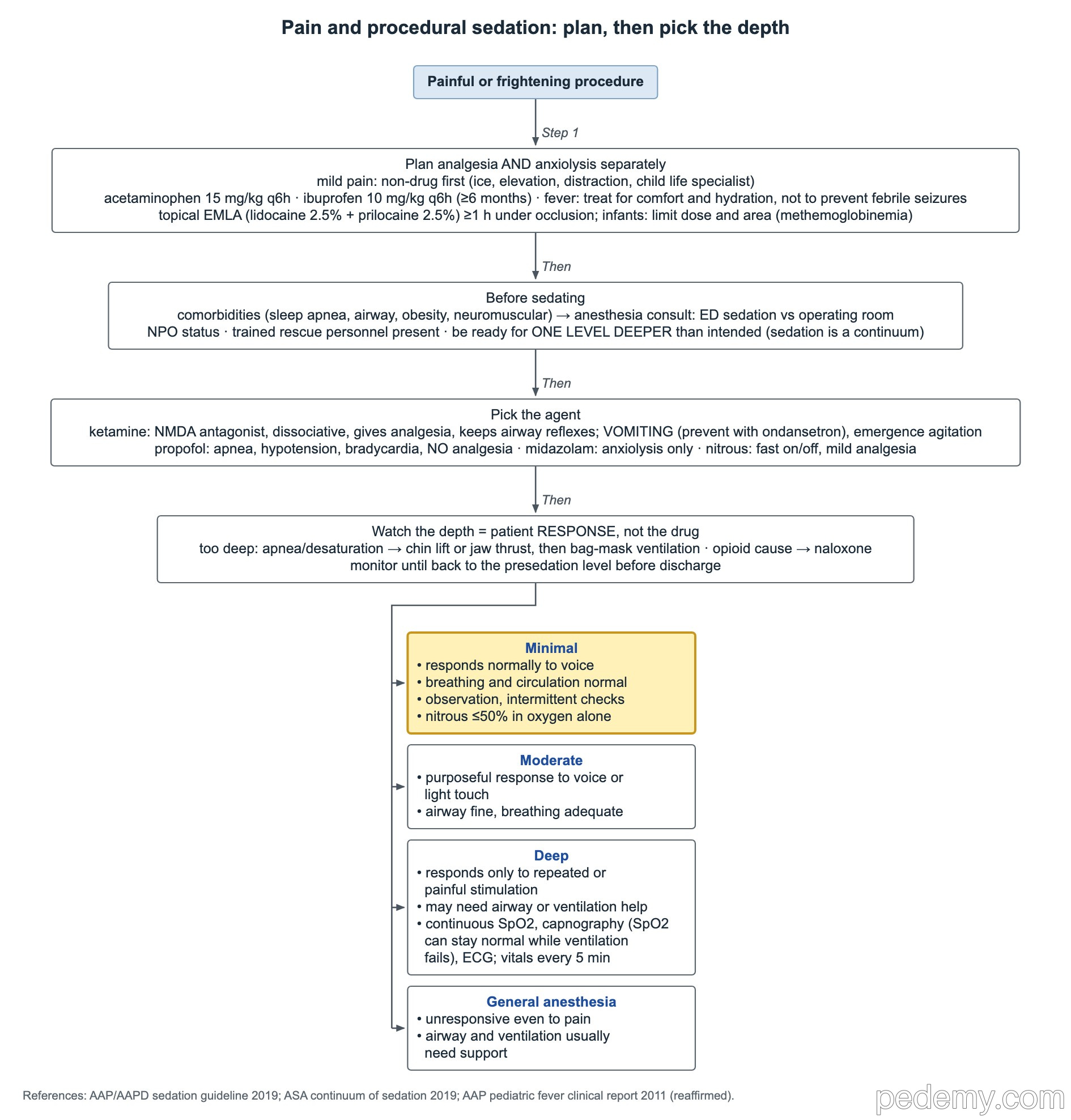
- The child responds normally to voice; breathing and circulation are unaffected.
- Monitoring: observation with intermittent checks of the sedation level.
- Nitrous oxide at 50% or less in oxygen, with no other sedative or opioid, in an otherwise healthy child counts as minimal sedation.
Moderate sedation
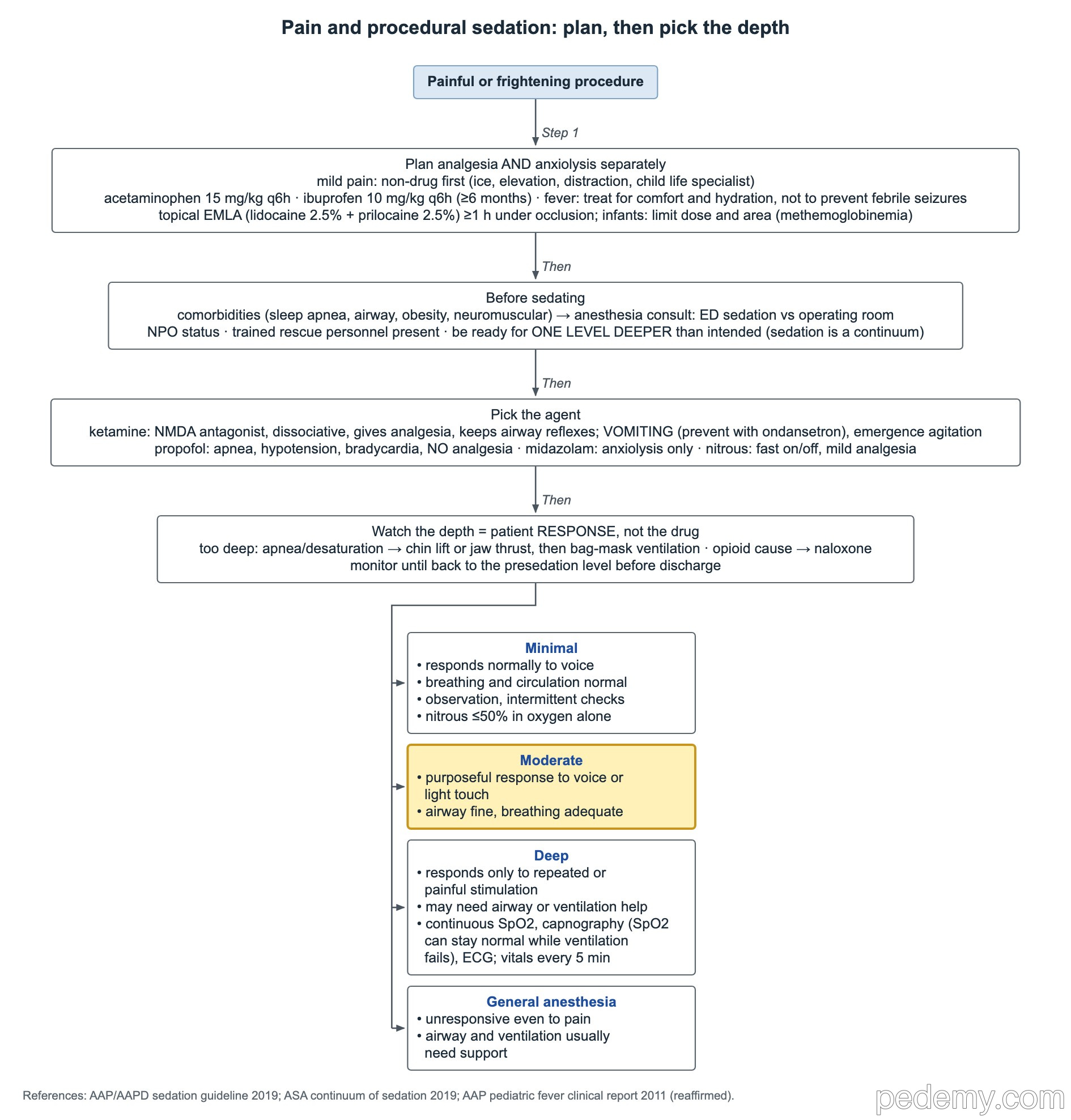
- The child responds purposefully to voice (even loud commands) or light touch and breathes adequately alone.
- The airway needs no intervention.
- Monitoring: continuous pulse oximetry and heart rate, with capnography recommended, and a dedicated observer recording vital signs.
Deep sedation and general anesthesia
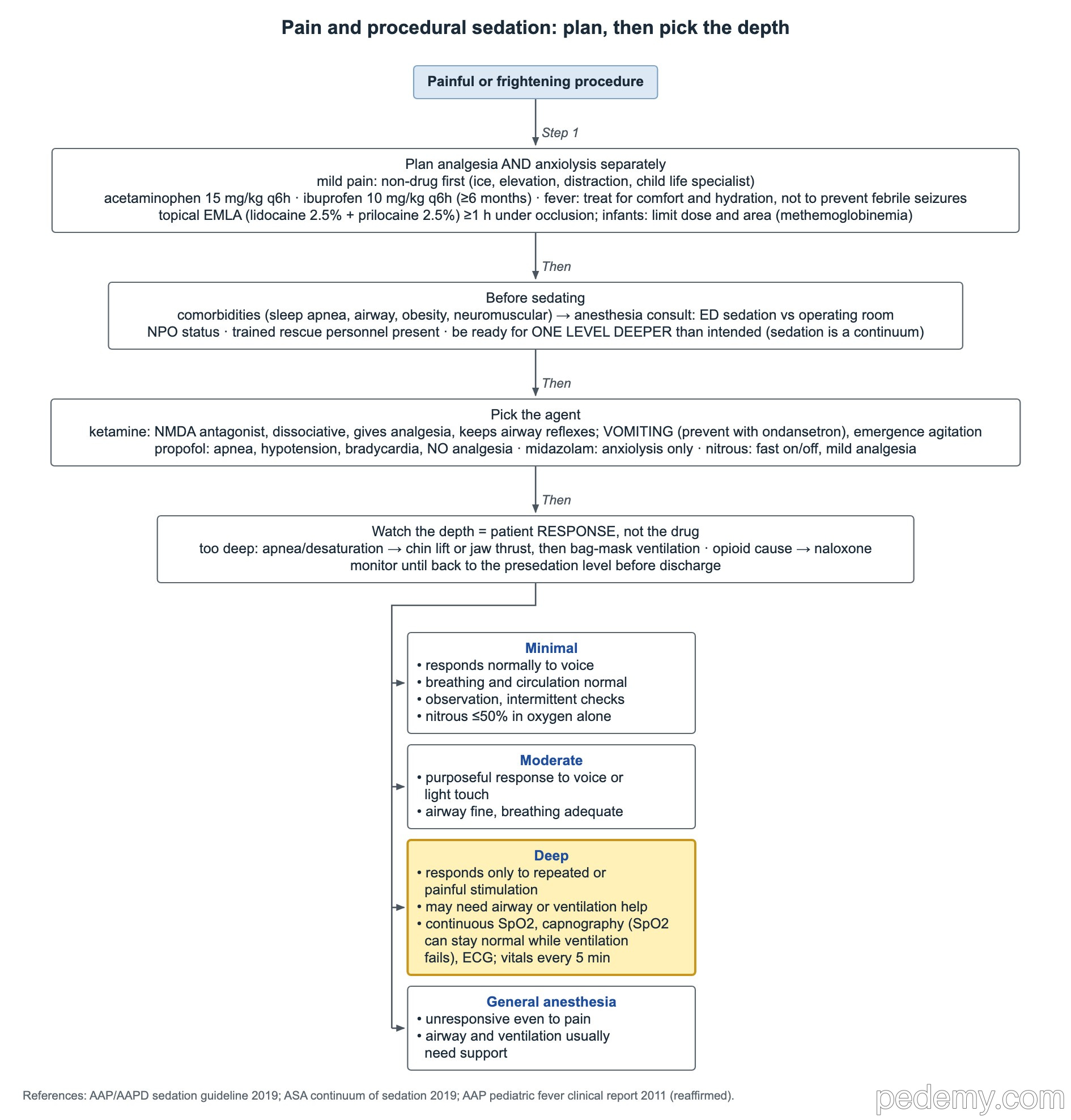
- Deep sedation: the child is not easily roused and responds purposefully only to repeated or painful stimuli; may need help with the airway or breathing.
- Monitoring: continuous pulse oximetry, capnography and ECG; record vital signs at least every 5 minutes; one person's only job is monitoring.
- On supplemental oxygen, SpO2 may stay normal while the child hypoventilates; capnography shows apnea first.
- General anesthesia: no response even to pain; the airway and ventilation usually need support.
Rescue and recovery
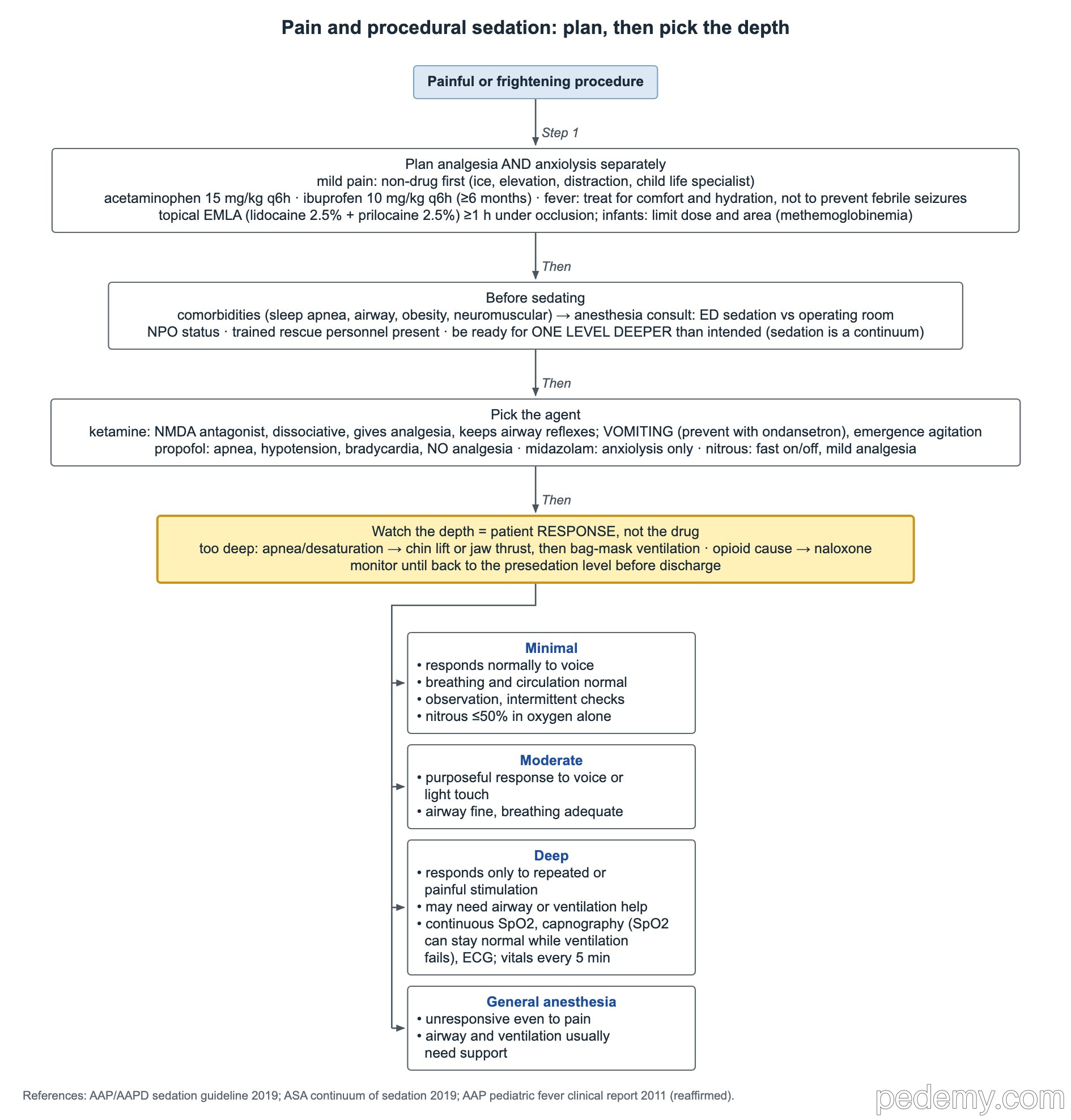
- Judge depth by the child's response, not by the drug or dose given.
- Apnea or desaturation: stop the drug, chin lift or jaw thrust, then bag-mask ventilation with oxygen.
- If an opioid is the cause, give naloxone; for a benzodiazepine, flumazenil is an option.
- Keep monitoring until discharge criteria are met, including return to the presedation level of consciousness.
Common questions
What is the difference between moderate and deep sedation?
In moderate sedation the child responds purposefully to voice or light touch and breathes alone. In deep sedation the child responds only to repeated or painful stimuli and may need airway help.
Why use capnography during sedation?
Because a child on oxygen can keep a normal SpO2 while breathing too little. Capnography shows hypoventilation and apnea before the oxygen saturation falls.
Does ketamine stop breathing?
Usually not. Ketamine keeps airway reflexes and spontaneous breathing in most children, which is why it is popular for short painful ED procedures, but the team must still be ready for laryngospasm or apnea.
Study this topic
Sources
- AAP/AAPD 2019: Guidelines for monitoring and management of pediatric patients during and after sedation (Pediatrics)
- ACEP 2011: Clinical practice guideline for ED ketamine dissociative sedation (Ann Emerg Med)
- AAP 2021: Child life services, policy statement (Pediatrics)
Written for Pedemy in our own words from the sources above; checked November 2026. For education only, not medical advice; check doses and local protocols before treating a patient. Pedemy is independent and not affiliated with or endorsed by the organizations cited.