

Main decision tree
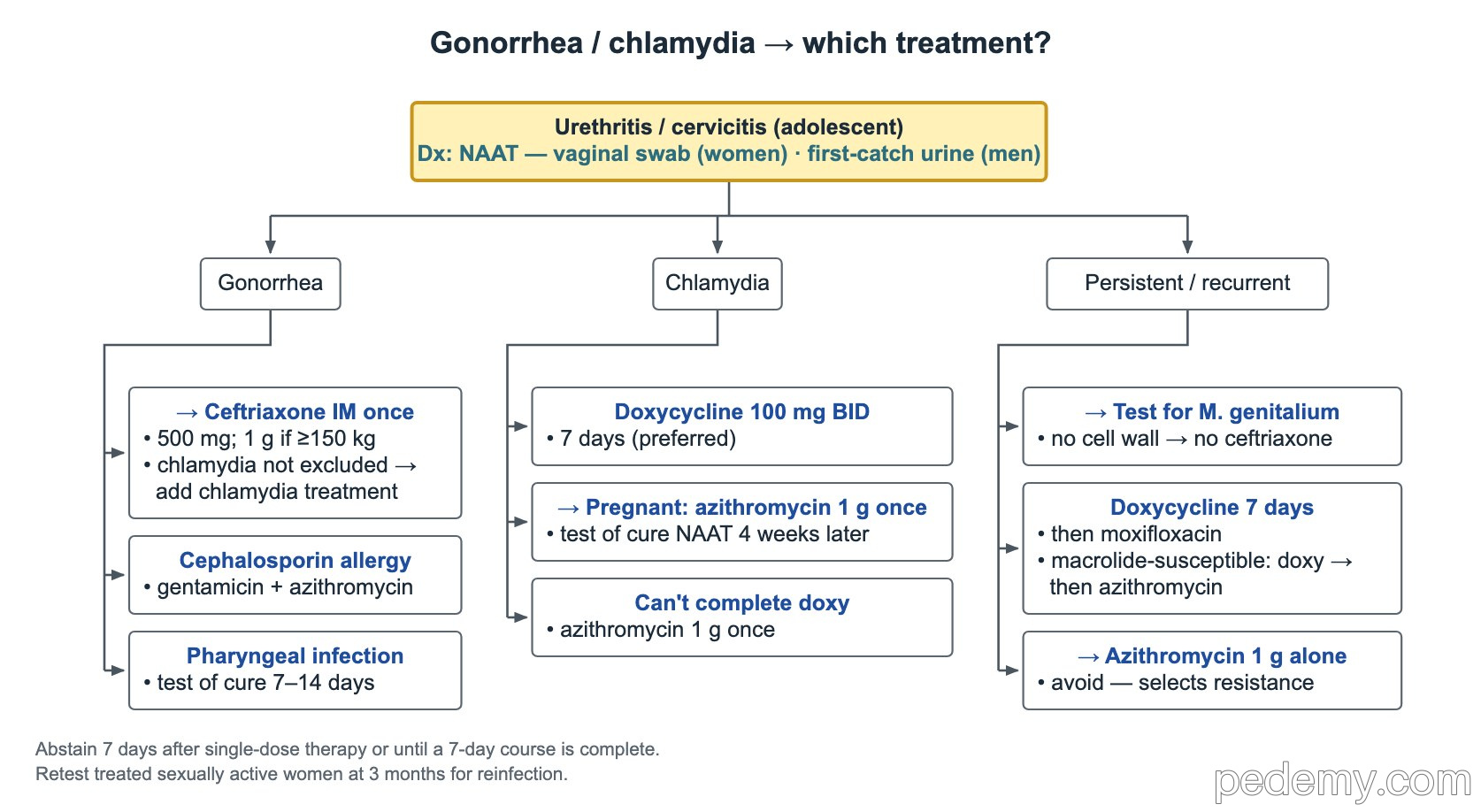
Gonorrhea / chlamydia: which treatment?
Key points
- Best NAAT specimens: vaginal swab in females, first-catch urine in males.
- Gonorrhea: ceftriaxone 500 mg IM once (1 g if ≥150 kg); add doxycycline if chlamydia is not excluded.
- Chlamydia: doxycycline 100 mg orally twice daily for 7 days; azithromycin 1 g once in pregnancy.
- Trichomoniasis: metronidazole 500 mg twice daily for 7 days in females, 2 g once in males.
- M. genitalium: doxycycline 7 days, then moxifloxacin 400 mg daily for 7 days; never azithromycin 1 g alone.
- Test of cure: pharyngeal gonorrhea at 7–14 days; chlamydia in pregnancy at 4 weeks.
- Retest for reinfection about 3 months after treatment; abstain for 7 days and until partners are treated.
Who to test and which specimen
Urethritis or cervicitis in a teen is tested with a nucleic acid amplification test (NAAT) for gonorrhea and chlamydia. NAAT is the most sensitive test and does not need a pelvic exam.
The tree starts with diagnosis, then splits into gonorrhea, chlamydia and persistent or recurrent symptoms.
- Females: vaginal swab (clinician- or self-collected) is the preferred specimen.
- Males: first-catch urine is the preferred specimen.
- Test the rectum and throat by NAAT when there is exposure at those sites.
- Test for trichomoniasis, HIV and syphilis at the same visit when indicated.
Gonorrhea treatment
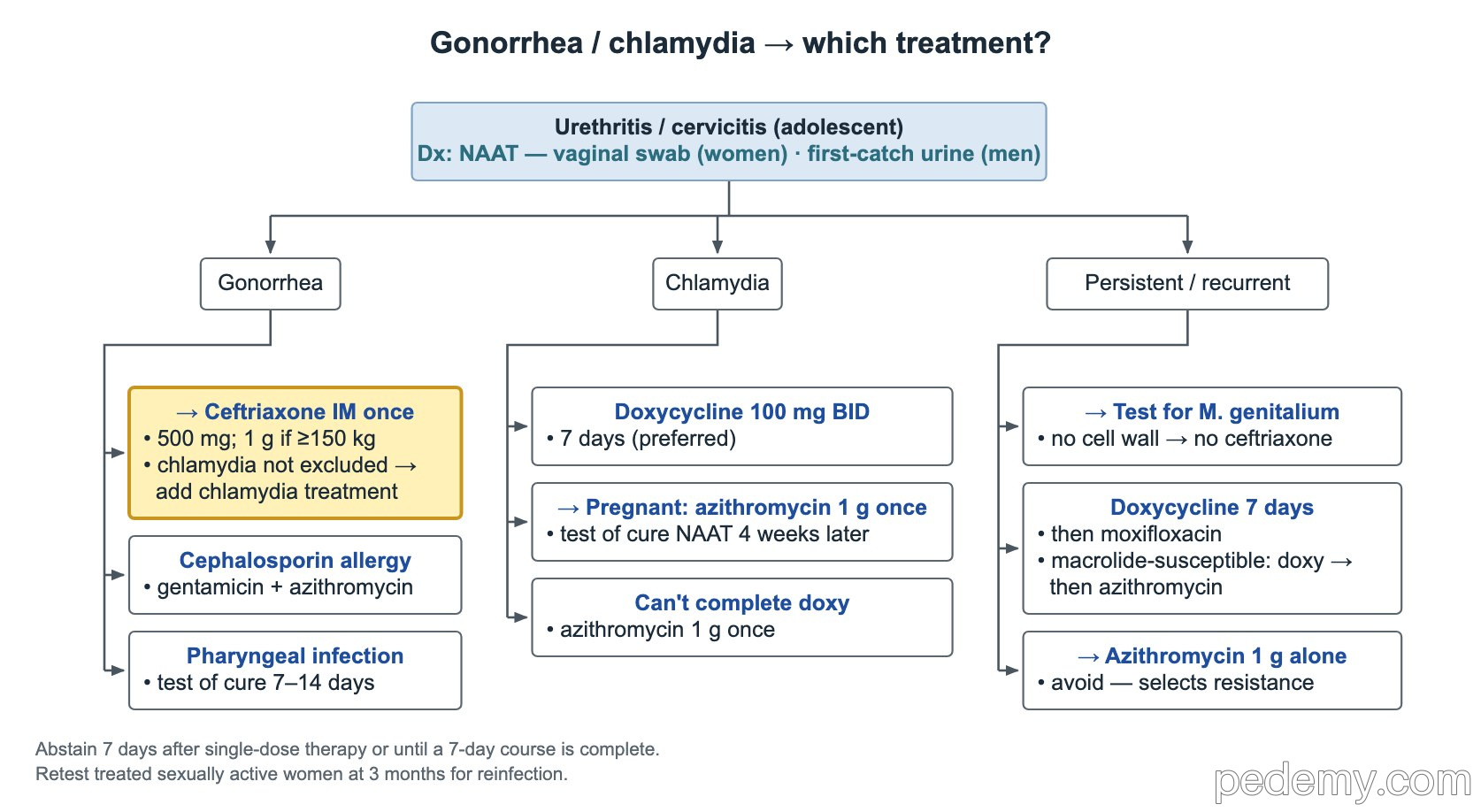
Dual therapy with azithromycin is no longer routine: rising azithromycin resistance and stewardship led CDC to drop it in 2020.
- Uncomplicated urogenital, rectal or pharyngeal infection: ceftriaxone 500 mg IM once if under 150 kg.
- Weight 150 kg or more: ceftriaxone 1 g IM once.
- Chlamydia not excluded: add doxycycline 100 mg orally twice daily for 7 days.
- True cephalosporin allergy (nonpregnant): gentamicin 240 mg IM plus azithromycin 2 g orally, each once.
- Pharyngeal gonorrhea: test of cure by NAAT or culture 7–14 days after treatment.
Chlamydia treatment and pregnancy
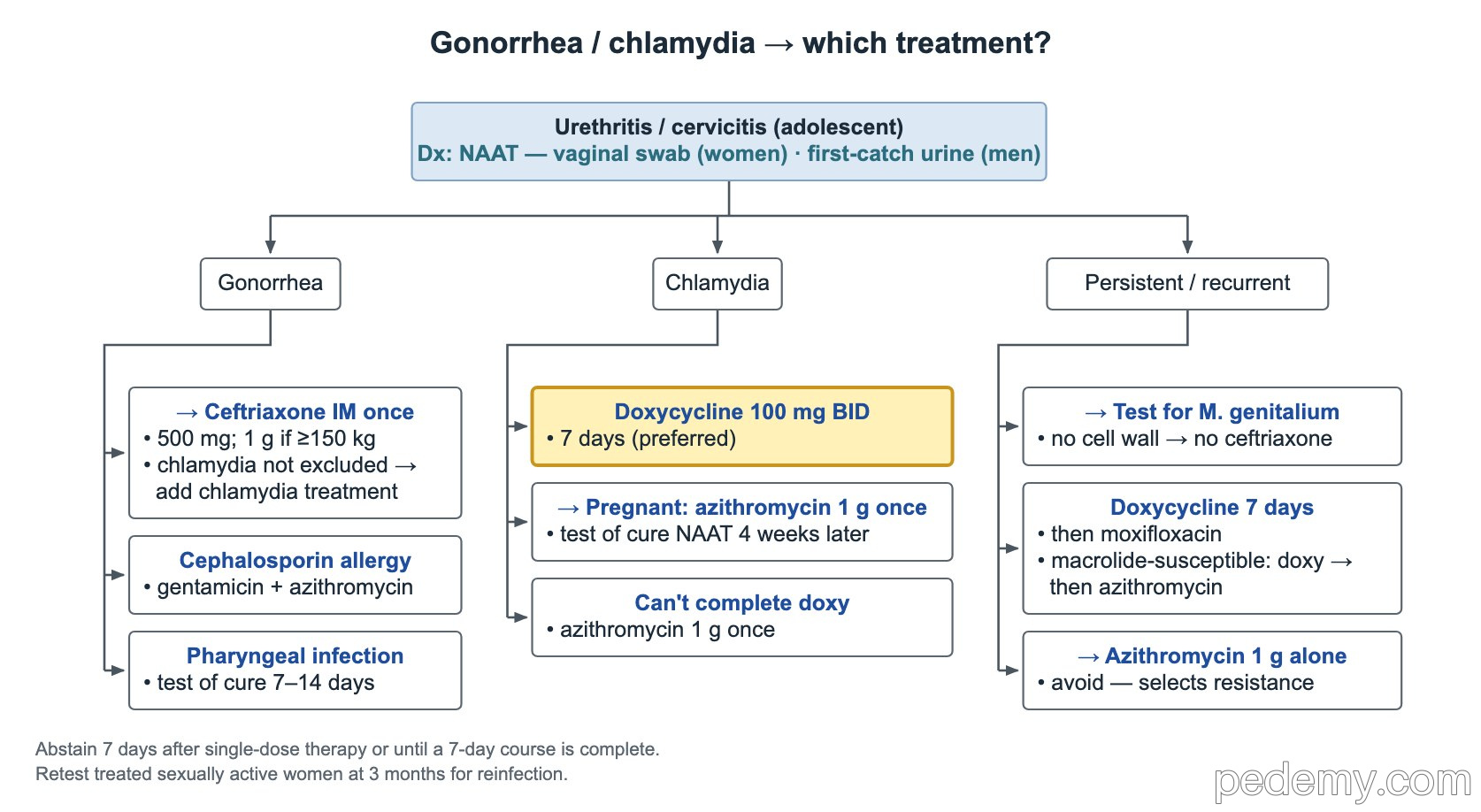
Doxycycline cures rectal chlamydia more reliably than azithromycin, which is why it is now first line.
- Preferred (nonpregnant): doxycycline 100 mg orally twice daily for 7 days.
- Alternative when a 7-day course is unlikely to be finished: azithromycin 1 g orally once.
- Pregnancy: azithromycin 1 g orally once (doxycycline is avoided).
- Pregnancy: test of cure by NAAT 4 weeks after therapy, then retest within 3 months.
Persistent urethritis or cervicitis: Mycoplasma genitalium
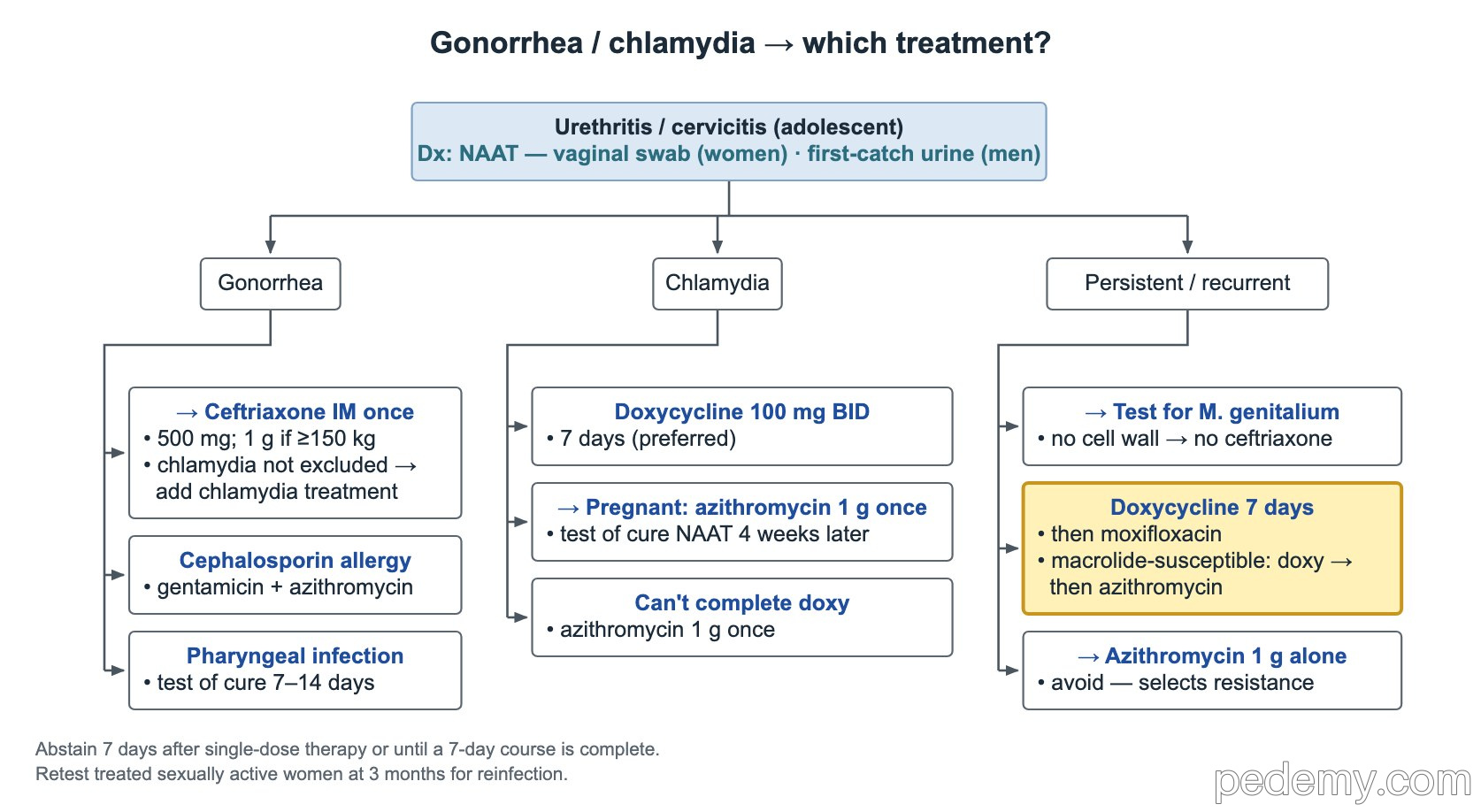
If symptoms persist or come back after treatment for gonorrhea and chlamydia, test for M. genitalium with a NAAT. It has no cell wall, so ceftriaxone and other beta-lactams do not work.
- No resistance testing: doxycycline 100 mg twice daily for 7 days, then moxifloxacin 400 mg once daily for 7 days.
- Macrolide-susceptible strain: doxycycline 7 days, then azithromycin 1 g on day 1 and 500 mg daily for 3 more days.
- If resistance testing is unavailable and moxifloxacin cannot be used: doxycycline then the azithromycin course, with a test of cure 21 days after completion.
- Do not give azithromycin 1 g alone: it selects macrolide resistance.
Vaginal discharge: wet mount and KOH
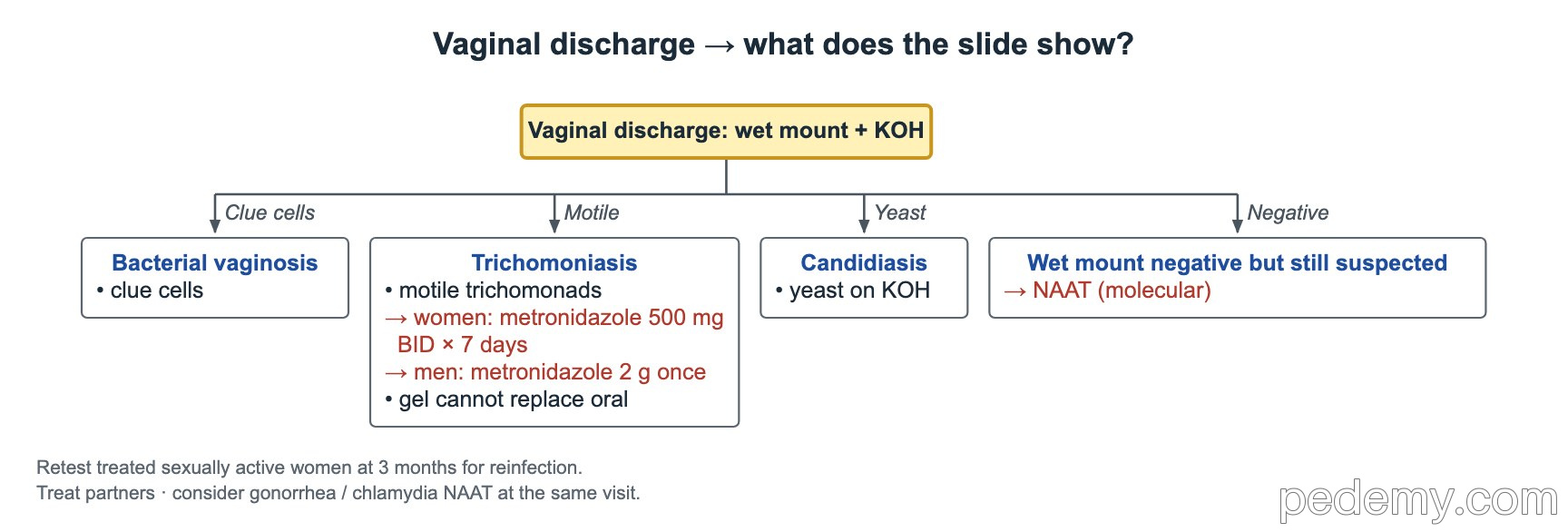
A wet preparation is vaginal fluid mixed with saline and looked at under the microscope; a second slide uses KOH.
| Finding | Diagnosis |
|---|---|
| Clue cells (epithelial cells coated with bacteria) | Bacterial vaginosis |
| Motile trichomonads | Trichomoniasis |
| Yeast or pseudohyphae on KOH | Vulvovaginal candidiasis |
| Negative slide but trichomoniasis still suspected | Send a NAAT: microscopy misses many infections |
Trichomoniasis treatment
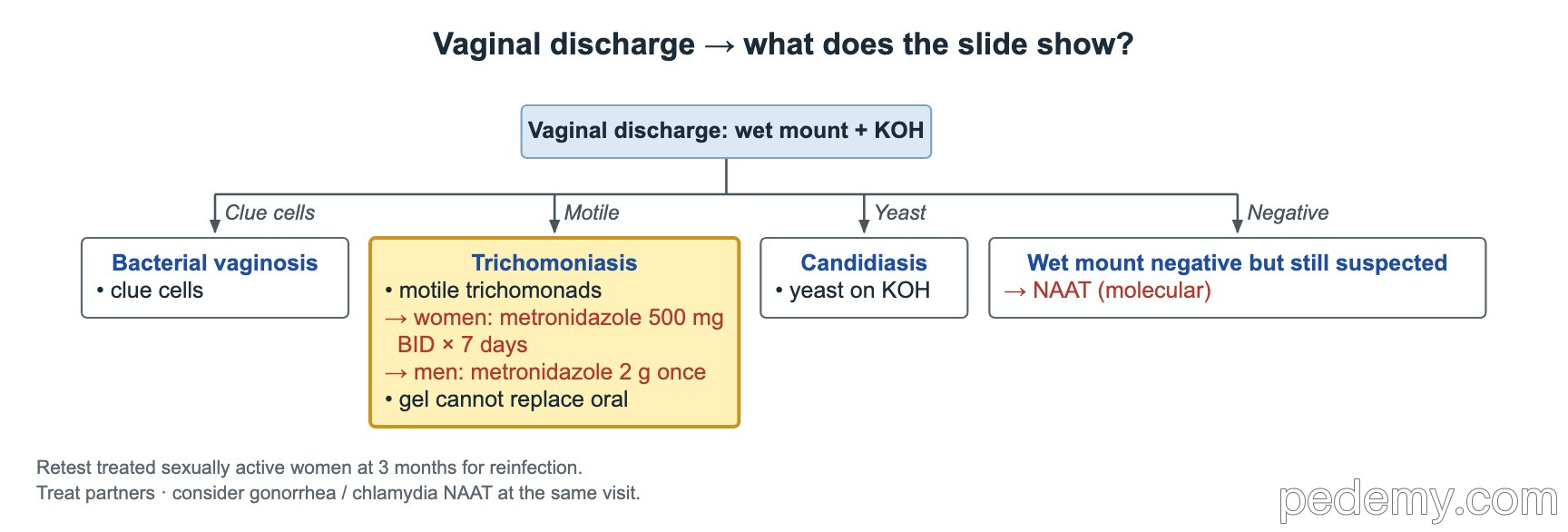
- Females: metronidazole 500 mg orally twice daily for 7 days.
- Males: metronidazole 2 g orally once.
- Vaginal metronidazole gel does not reach curative levels and cannot replace oral therapy.
- Treat partners and retest females about 3 months after treatment.
Follow-up and partners
- Abstain from sex for 7 days after single-dose therapy, or until a 7-day course is finished, symptoms are gone and partners are treated.
- Retest about 3 months after treatment for chlamydia or gonorrhea (all patients) and trichomoniasis (females): reinfection is common.
- Offer expedited partner therapy where allowed by law.
- Routine test of cure is not needed for uncomplicated urogenital infection treated with a recommended regimen, except in pregnancy.
Common questions
What is the ceftriaxone dose for gonorrhea?
500 mg IM once for people under 150 kg and 1 g IM once for 150 kg or more. Add doxycycline if chlamydia has not been ruled out.
Is azithromycin still first line for chlamydia?
No. Doxycycline 100 mg twice daily for 7 days is preferred. Azithromycin 1 g once is an alternative and the choice in pregnancy.
When should a teen be retested after an STI?
About 3 months after treatment, because reinfection is common. A test of cure is needed only for pharyngeal gonorrhea, chlamydia in pregnancy and some M. genitalium regimens.
Study this topic
Sources
- CDC: Sexually Transmitted Infections Treatment Guidelines, 2021 (MMWR Recomm Rep)
- CDC: Update to treatment guidelines for gonococcal infection, 2020 (MMWR)
Written for Pedemy in our own words from the sources above; checked November 2026. For education only, not medical advice; check doses and local protocols before treating a patient. Pedemy is independent and not affiliated with or endorsed by the organizations cited.