

Main decision tree
Ear pain or discharge
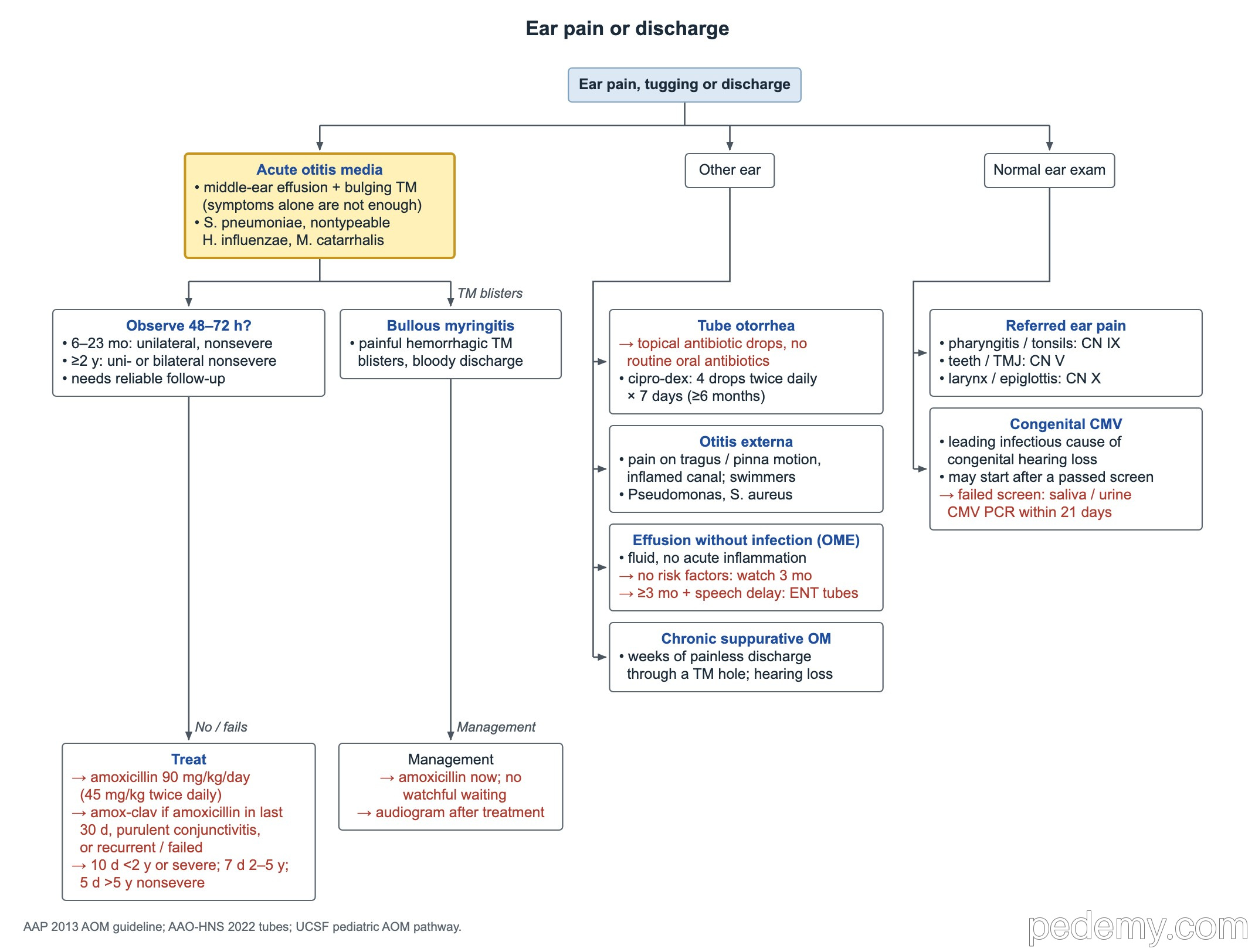
Key points
- AOM needs middle-ear effusion with a bulging eardrum (or new otorrhea); ear tugging and fever alone are not enough.
- Observe 48–72 hours only if nonsevere: unilateral AOM at 6–23 months, unilateral or bilateral at 2 years or older, with reliable follow-up.
- Amoxicillin 80–90 mg/kg/day divided twice daily; amoxicillin–clavulanate if amoxicillin in the past 30 days, purulent conjunctivitis or treatment failure.
- Duration: 10 days if under 2 years or severe; 7 days at 2–5 years; 5–7 days at 6 years or older if nonsevere.
- OME usually clears within 3 months; refer for tubes if bilateral OME lasts 3 months or more with hearing loss or speech delay.
- Tube otorrhea: topical antibiotic drops, not oral antibiotics (ciprofloxacin–dexamethasone 4 drops twice daily for 7 days).
- Congenital CMV is the leading infectious cause of congenital hearing loss; test saliva or urine PCR within 21 days of birth.
Diagnosing acute otitis media
Symptoms such as ear pain, tugging, irritability and fever do not make the diagnosis. You need to see middle-ear effusion with a bulging tympanic membrane, or new otorrhea that is not from otitis externa. Mild bulging with recent ear pain or an intensely red drum also counts.
The three usual bacteria are Streptococcus pneumoniae, nontypeable Haemophilus influenzae and Moraxella catarrhalis.
| Finding | Diagnosis |
|---|---|
| Tender, swollen canal; pain on moving the tragus or pinna | Otitis externa |
| Middle-ear effusion with a bulging, inflamed drum | Acute otitis media |
| Effusion (air-fluid level, amber fluid) without acute inflammation | Otitis media with effusion |
| Retracted drum, type C tympanogram | Eustachian tube dysfunction |
Observe or treat?
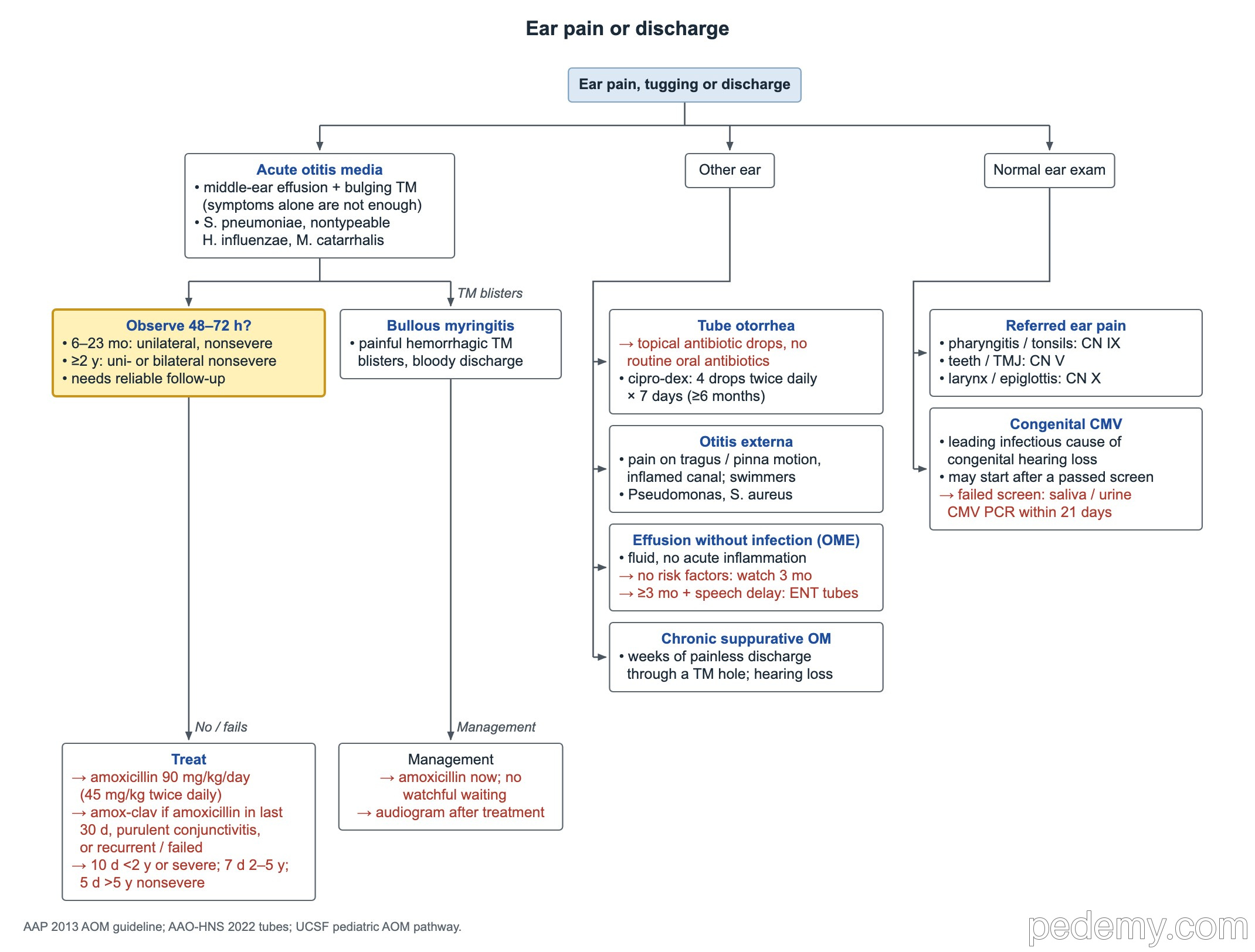
Every child with AOM gets pain relief. Observation without antibiotics for 48–72 hours is a shared decision for nonsevere AOM without otorrhea, and only when follow-up is reliable.
Severe AOM means moderate or severe ear pain, pain for 48 hours or more, or temperature 39 °C (102.2 °F) or higher.
- Under 6 months: treat with antibiotics.
- 6–23 months: treat bilateral or severe AOM; unilateral nonsevere AOM may be observed.
- 2 years or older: unilateral or bilateral nonsevere AOM may be observed.
- Start antibiotics if the child is worse or not better after 48–72 hours.
Antibiotic choice, dose and duration
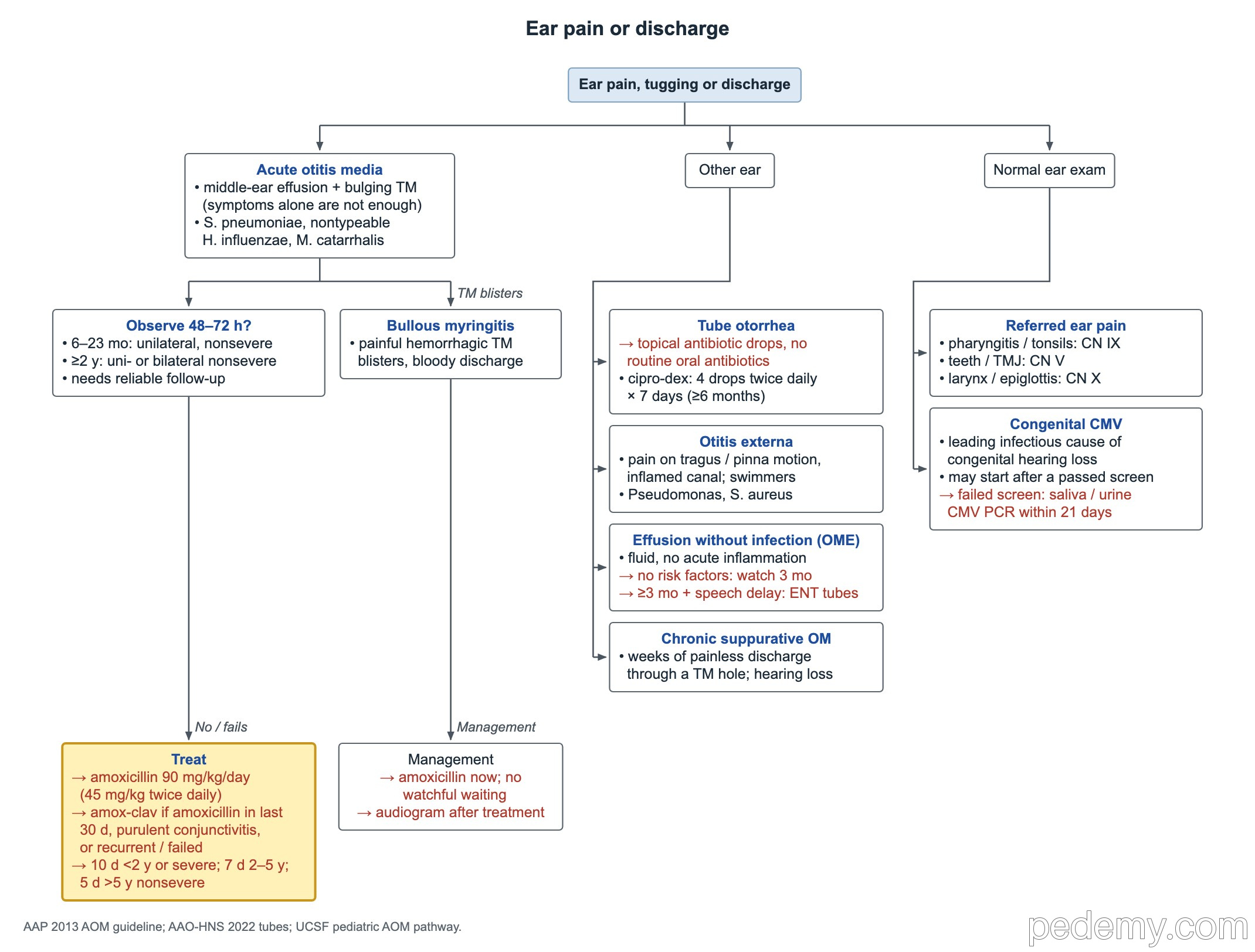
- First line: amoxicillin 80–90 mg/kg/day by mouth divided twice daily (45 mg/kg per dose), commonly capped at 2 g per dose.
- Amoxicillin–clavulanate (90 mg/kg/day of amoxicillin): amoxicillin in the past 30 days, concurrent purulent conjunctivitis, or recurrent or nonresponding AOM.
- Otitis–conjunctivitis syndrome is usually nontypeable H. influenzae, a beta-lactamase producer, so use amoxicillin–clavulanate.
- Non-severe penicillin allergy: cefdinir, cefuroxime, cefpodoxime or ceftriaxone.
- Treatment failure after 48–72 hours of amoxicillin: switch to amoxicillin–clavulanate; then ceftriaxone.
| Age and severity | Duration |
|---|---|
| Under 2 years, or severe at any age | 10 days |
| 2–5 years, nonsevere | 7 days |
| 6 years or older, nonsevere | 5–7 days |
Recurrent AOM, tubes and complications
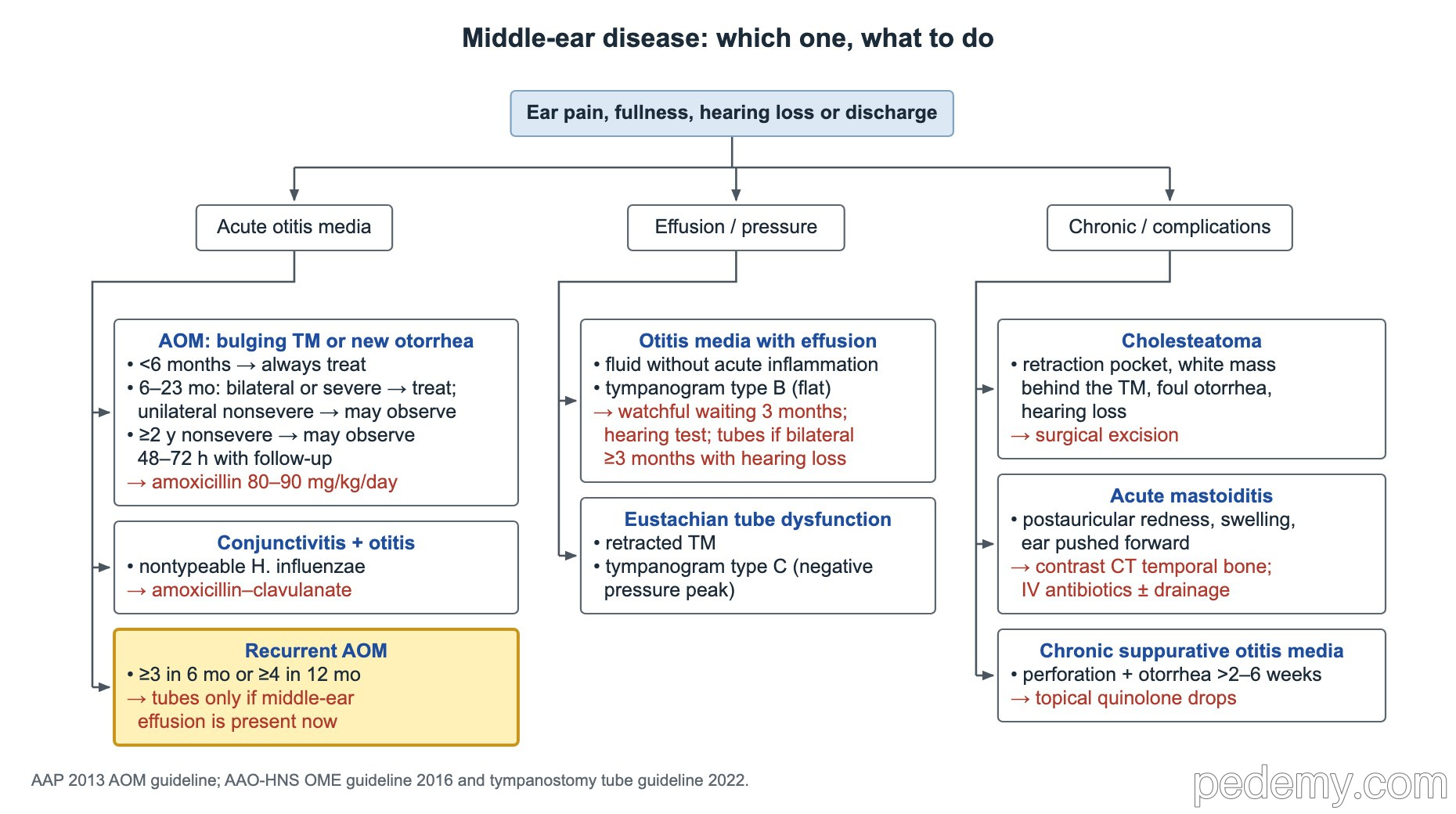
- Recurrent AOM: 3 or more episodes in 6 months, or 4 or more in 12 months with 1 in the past 6 months.
- Offer tympanostomy tubes for recurrent AOM only if middle-ear effusion is present at the visit.
- Uncomplicated tube otorrhea: topical antibiotic drops without routine oral antibiotics. Ciprofloxacin–dexamethasone: 4 drops twice daily for 7 days (age 6 months or older).
- Chronic suppurative otitis media: weeks of painless discharge through a perforation with conductive hearing loss; topical quinolone drops and ENT review. Persistent tube otorrhea also needs ENT.
- Acute mastoiditis: postauricular redness and swelling with the ear pushed forward → contrast CT of the temporal bone, IV antibiotics, surgical drainage if needed.
- Cholesteatoma: retraction pocket, white mass behind the drum, foul painless otorrhea and hearing loss → surgical excision (tympanomastoidectomy).
Otitis media with effusion and tympanograms
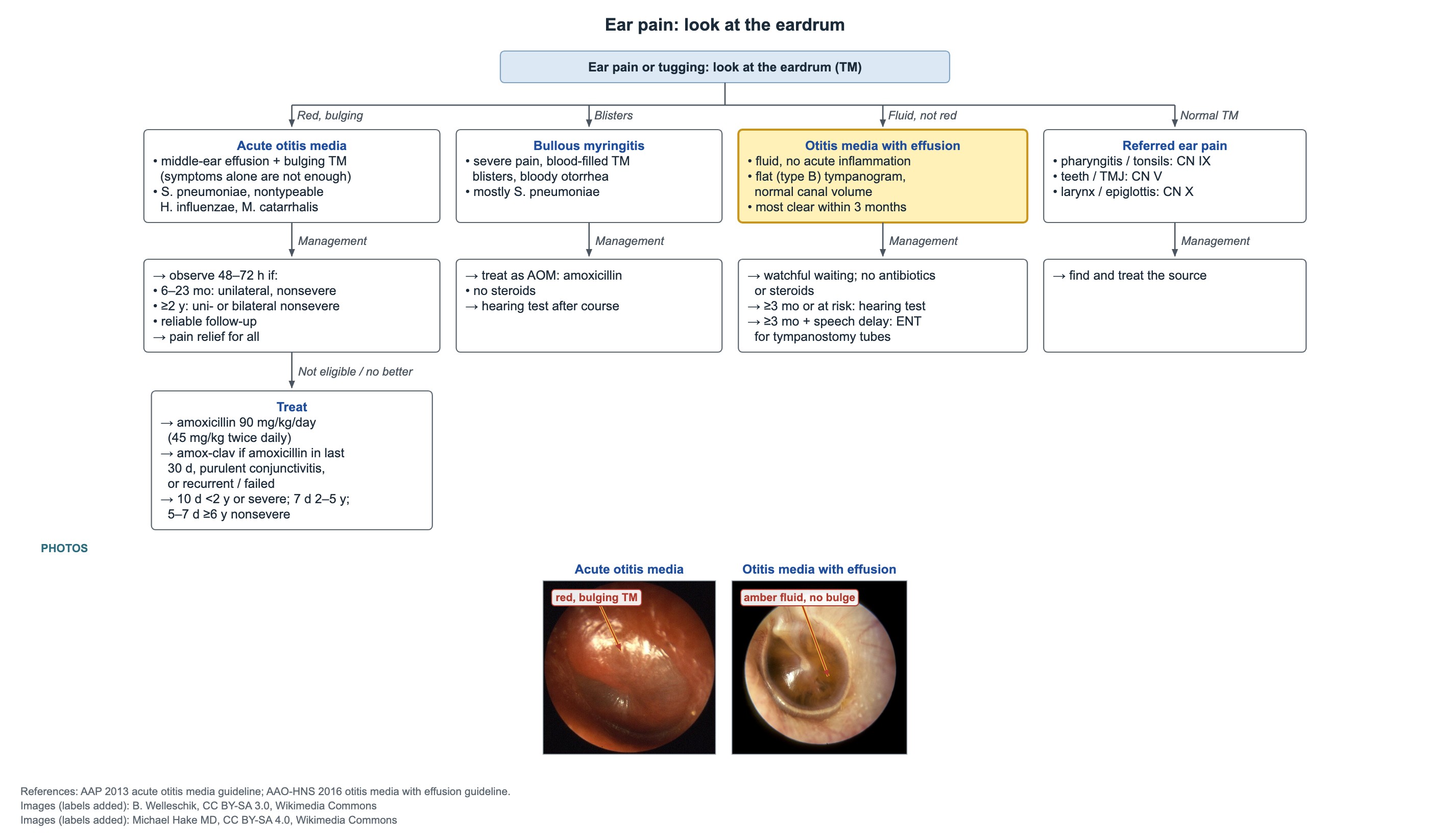
OME is fluid behind the drum without acute inflammation, often after a cold or AOM. Most cases clear within 3 months (12 weeks).
- No risk factors: watchful waiting for 3 months from onset or diagnosis.
- Antibiotics, steroids, antihistamines and decongestants are not recommended.
- Hearing test if OME lasts 3 months or more, or sooner in a child at risk for speech, language or learning problems.
- Refer to ENT for tubes: bilateral OME for 3 months or more with hearing difficulty, or an at-risk child (such as speech delay) with OME likely to persist.
| Tympanogram | Meaning |
|---|---|
| Type A (normal peak) | Normal middle ear |
| Type B (flat), normal canal volume | Middle-ear effusion |
| Type B (flat), large canal volume | Perforation or open tube |
| Type C (peak at negative pressure) | Eustachian tube dysfunction, retracted drum |
Bullous myringitis and referred ear pain
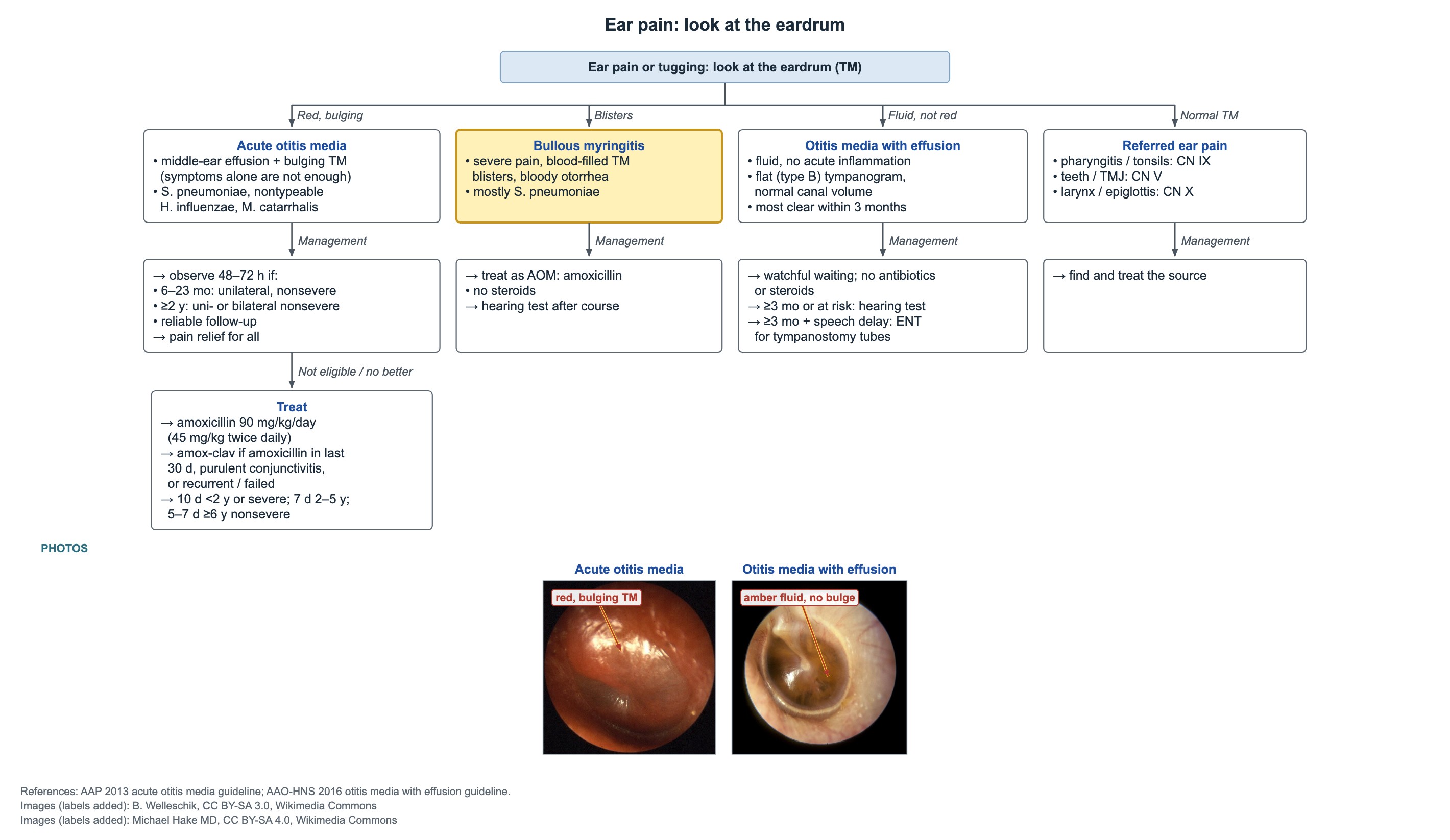
Bullous myringitis causes severe ear pain with blood-filled blisters on the drum and bloody otorrhea. Most cases are bacterial, mostly S. pneumoniae, so treat it like AOM with amoxicillin and do not use watchful waiting.
Systemic steroids have no role. Imbalance settles as the infection clears. Check hearing with an audiogram after treatment.
Ear pain with a normal eardrum is referred pain. A normal drum rules out AOM, even in a child with strep throat.
| Source of pain | Nerve |
|---|---|
| Pharynx, tonsils (for example strep throat) | Glossopharyngeal (CN IX) |
| Teeth, caries, temporomandibular joint | Trigeminal (CN V) |
| Larynx, epiglottis | Vagus (CN X) |
Outer ear, ear trauma and hearing loss
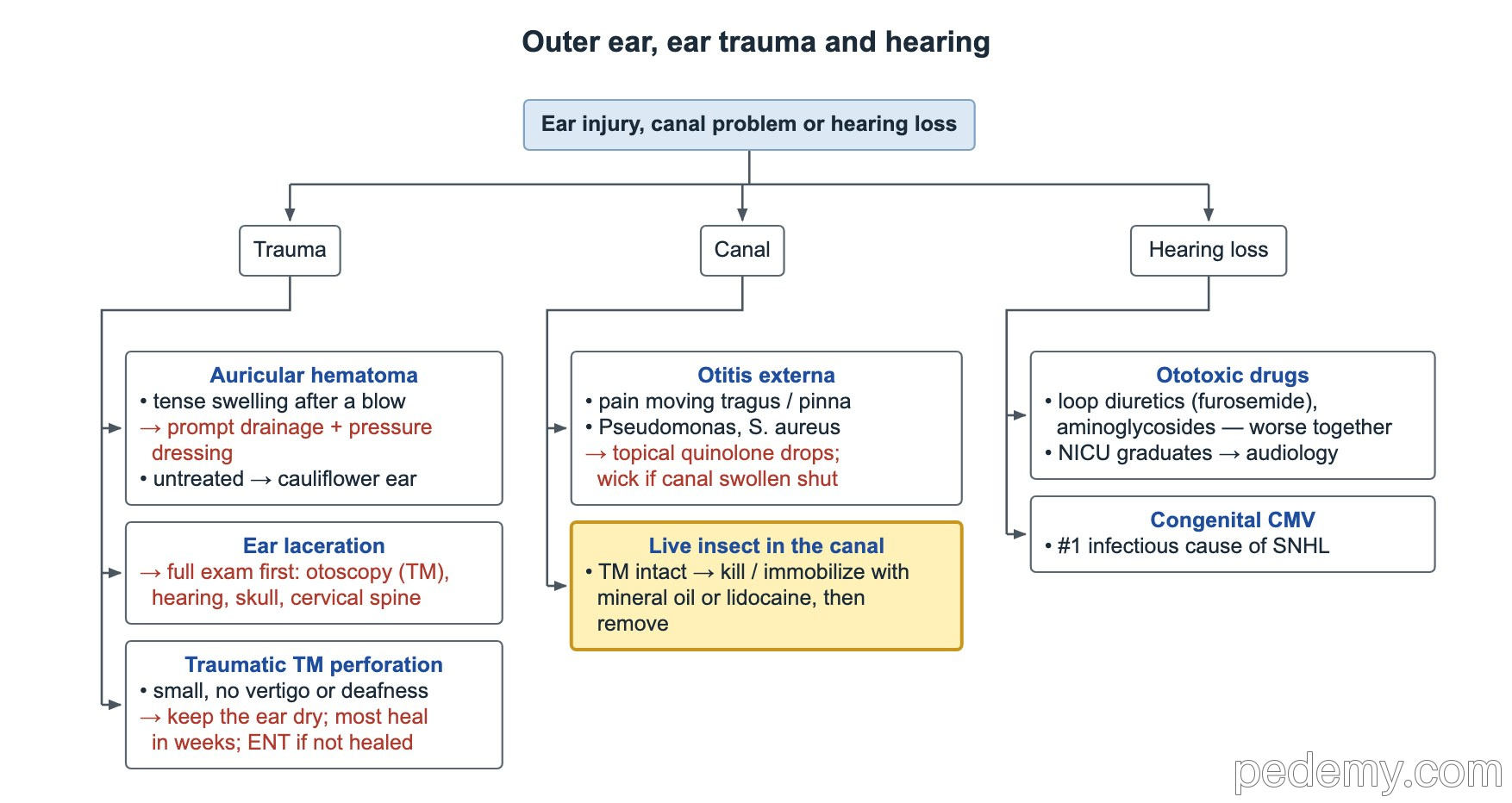
- Otitis externa (swimmer's ear): pain on moving the tragus or pinna, inflamed canal. Pseudomonas aeruginosa and Staphylococcus aureus. Topical antibiotic drops; a wick if the canal is swollen shut.
- Live insect with an intact drum: kill or immobilize it with mineral oil or lidocaine, then remove it.
- Outer-ear laceration: full ear and head exam first, including otoscopy, hearing, skull and cervical spine.
- Auricular hematoma after a blow: prompt drainage and a pressure (bolster) dressing; untreated, it becomes cauliflower ear.
- Small traumatic perforation without vertigo or hearing loss: keep the ear dry; most heal within weeks; ENT if not healed.
- Ototoxic NICU drugs: aminoglycosides (especially more than 5 days) and loop diuretics such as furosemide; risk adds up when combined. NICU graduates need audiology follow-up.
- Congenital CMV is the leading infectious cause of congenital sensorineural hearing loss. Loss can start after a passed newborn screen, so follow hearing for years. After a failed screen, test saliva or urine CMV PCR within the first 21 days of life.
Common questions
What is the amoxicillin dose for an ear infection?
80–90 mg/kg/day divided twice daily. Use amoxicillin–clavulanate if the child had amoxicillin in the past 30 days, has purulent conjunctivitis or did not respond.
How long should a child take antibiotics for an ear infection?
10 days under 2 years or if severe, 7 days at 2–5 years, and 5–7 days at 6 years or older when nonsevere.
When does fluid behind the eardrum need tubes?
When bilateral effusion lasts 3 months or more with hearing difficulty, or sooner in a child at risk, such as one with speech delay.
Can you wait before giving antibiotics for an ear infection?
Yes, for 48–72 hours in nonsevere AOM: unilateral at 6–23 months, unilateral or bilateral at 2 years or older, with reliable follow-up.
Study this topic
Sources
- AAP 2013: The diagnosis and management of acute otitis media (Pediatrics)
- AAO-HNS 2022: Clinical practice guideline: tympanostomy tubes in children (update)
- AAO-HNS 2016: Otitis media with effusion (update), executive summary
Written for Pedemy in our own words from the sources above; checked November 2026. For education only, not medical advice; check doses and local protocols before treating a patient. Pedemy is independent and not affiliated with or endorsed by the organizations cited.