

Main decision tree
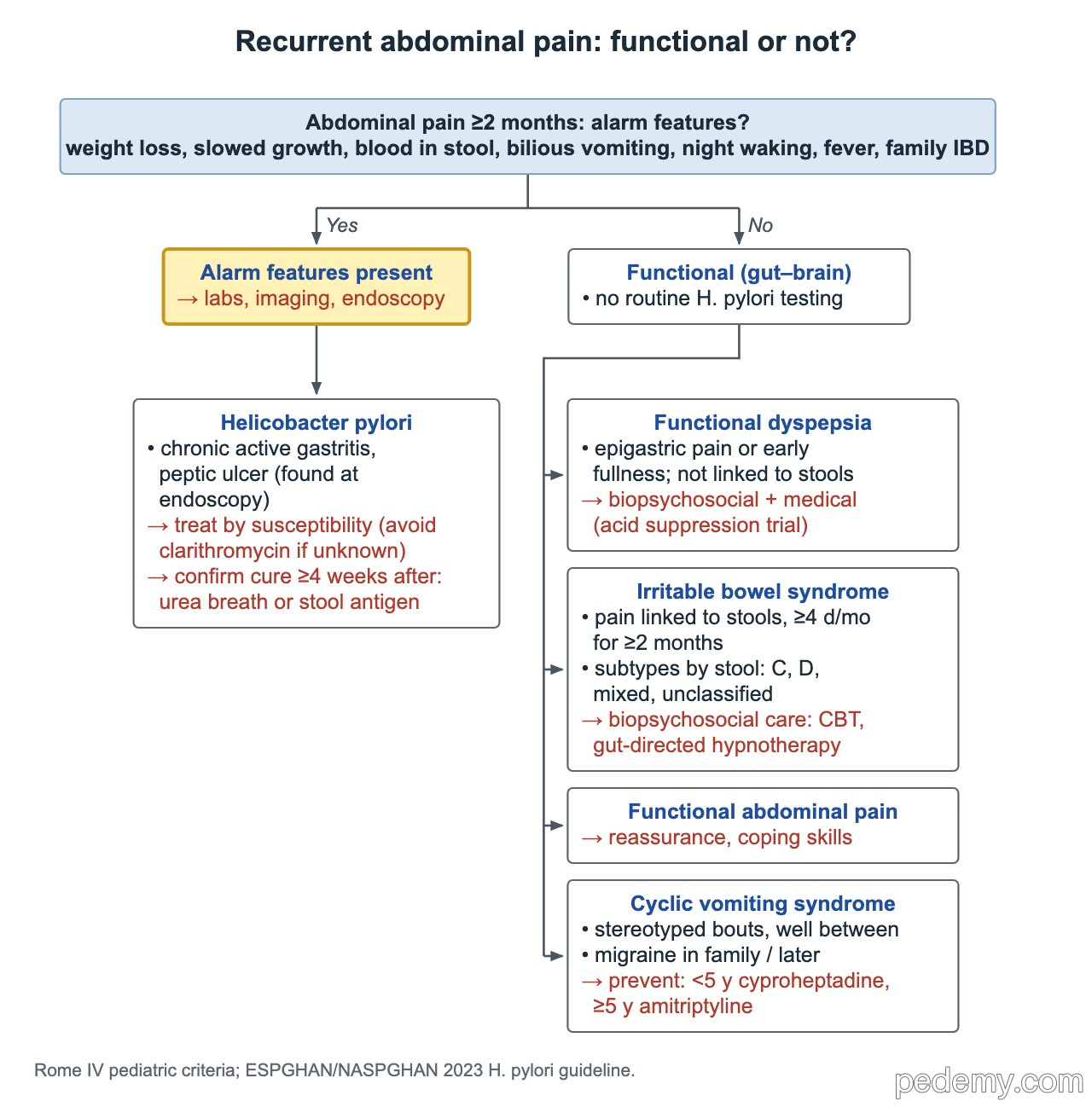
Recurrent abdominal pain: functional or not?
Key points
- Rome IV pain disorders need symptoms for at least 2 months; a positive diagnosis is made without exhaustive testing.
- Alarm features: weight loss, slowed growth, blood in stool, bilious vomiting, night waking, fever, family history of IBD.
- IBS: pain linked to stooling or to a change in stool form or frequency, at least 4 days a month for at least 2 months.
- IBS subtypes by predominant stool: constipation, diarrhea, mixed or unclassified.
- Functional dyspepsia: epigastric pain or early fullness that is not linked to stooling.
- Functional abdominal pain: reassurance and coping skills; CBT and gut-directed hypnotherapy have the best evidence.
- No routine H. pylori testing in functional abdominal pain.
First question: any alarm features?
Take a careful history, check growth and examine the child. If there are alarm features, look for organic disease with labs, imaging or endoscopy as the clinical picture directs.
Without alarm features, and with a normal exam and growth, make a positive diagnosis of a functional disorder. Rome IV dropped the old rule that organic disease must first be excluded by testing.
- Weight loss or slowed linear growth.
- Blood in the stool (hematochezia).
- Recurrent or bilious vomiting.
- Pain that wakes the child at night, fever, or a family history of inflammatory bowel disease.
- Dyspepsia plus any red flag: further testing, often upper endoscopy.
Irritable bowel syndrome
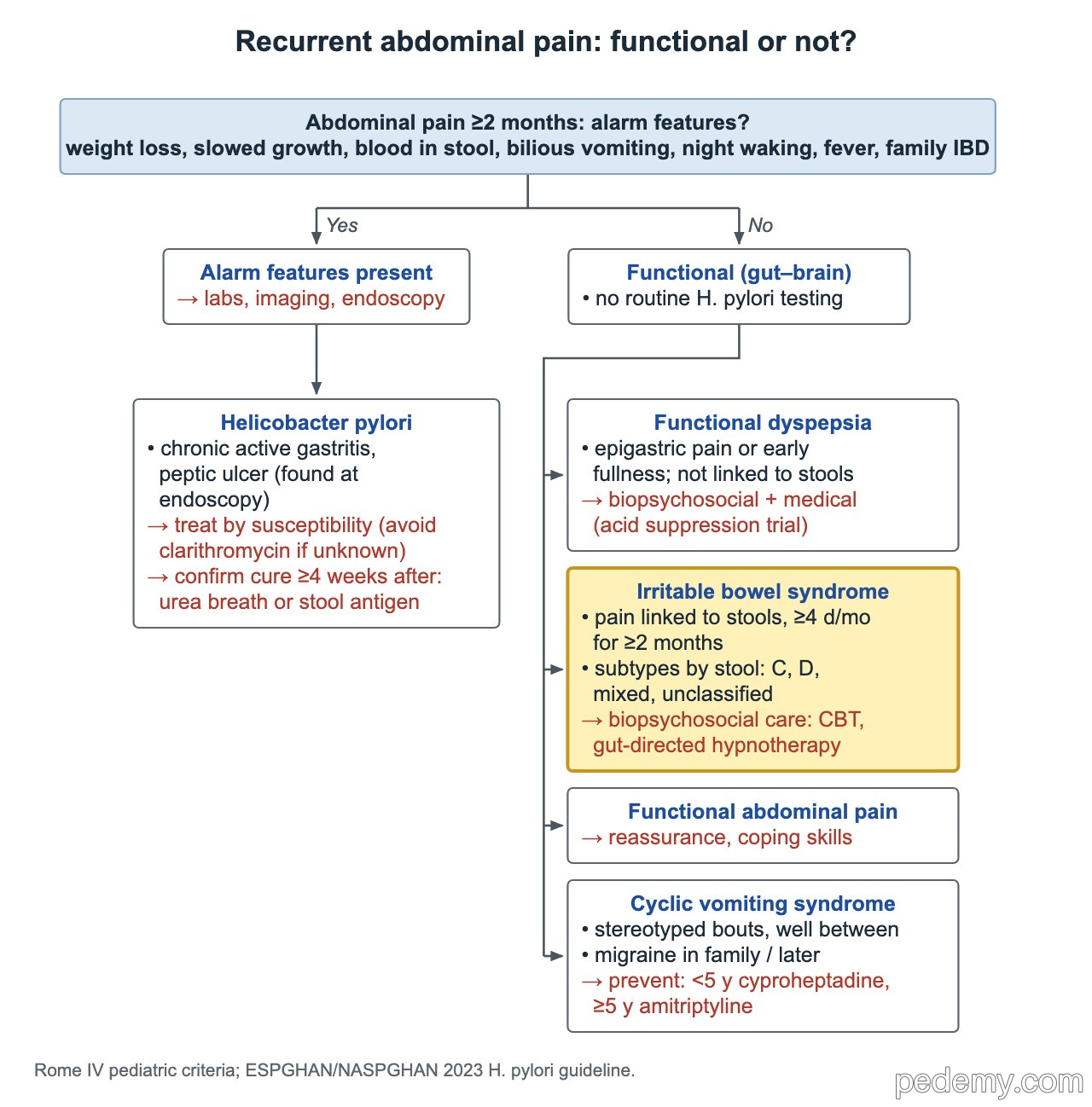
IBS is recurrent pain linked to stooling, or pain with a change in stool frequency or form (for example nonbloody loose stools), in a child who is growing normally.
- Pain at least 4 days a month for at least 2 months.
- Subtypes by the predominant stool pattern: IBS with constipation, with diarrhea, mixed, or unclassified.
- In IBS with constipation, the pain should not resolve when the constipation is treated; if it does, the diagnosis is functional constipation.
- Treatment is biopsychosocial: explain the gut–brain mechanism, keep the child in school, and use cognitive behavioral therapy or gut-directed hypnotherapy.
- Bloody stool or growth failure is never IBS until proven otherwise.
Functional dyspepsia
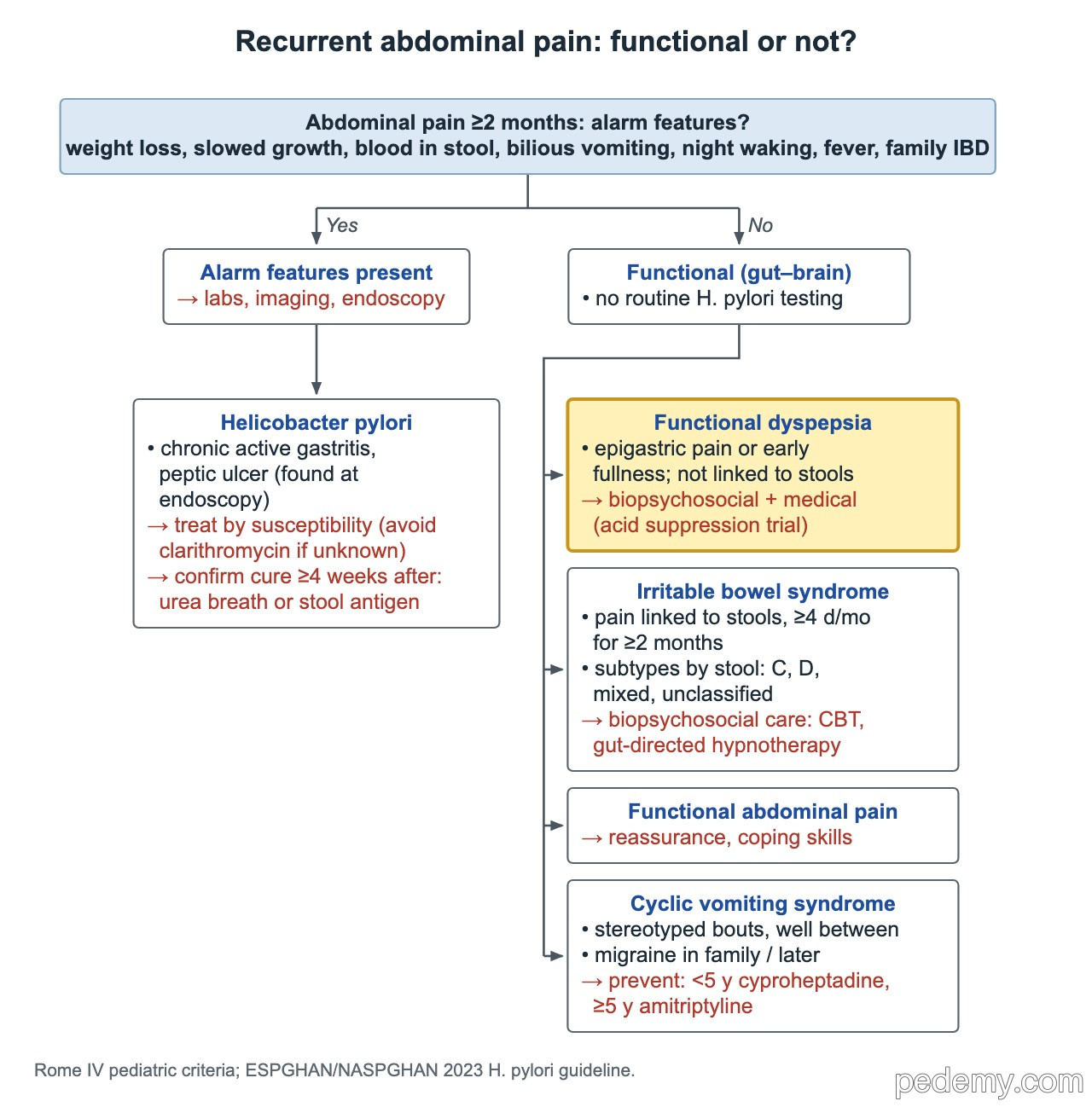
Functional dyspepsia is bothersome epigastric pain, burning, postprandial fullness or early satiety that is not relieved by stooling and is not explained by another condition after appropriate evaluation.
- Symptoms at least 4 days a month for at least 2 months.
- It is a disorder of gut–brain interaction, so care is biopsychosocial.
- Combine psychosocial care with medical treatment, such as an acid suppression trial; psychological therapy alone is not the plan.
Functional abdominal pain
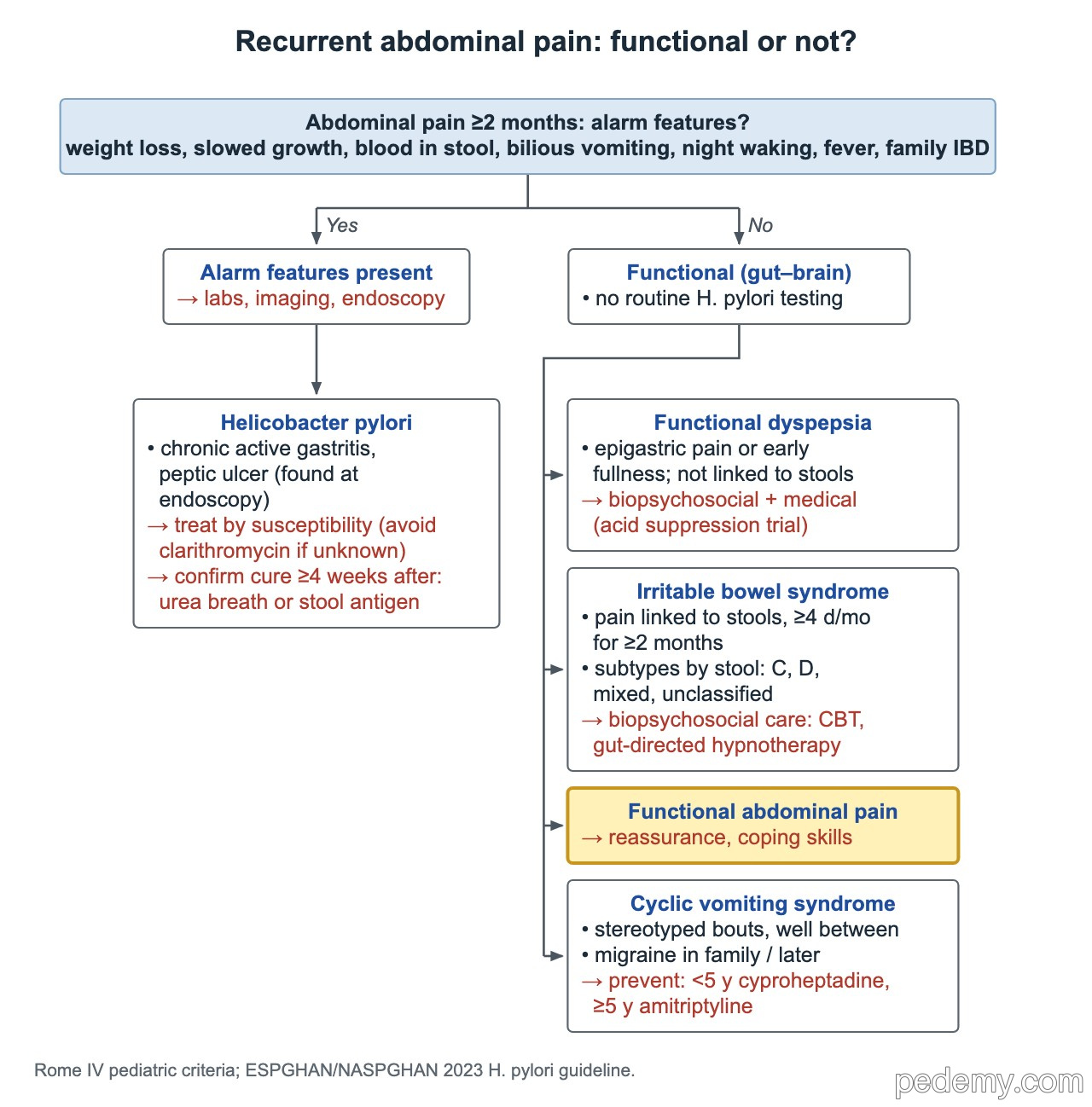
When the pain does not fit IBS, dyspepsia or abdominal migraine, Rome IV calls it functional abdominal pain (not otherwise specified). The child has recurring pain, a normal exam and normal growth, and no red flags.
- First line: reassurance that the pain is real but not dangerous, and coping skills.
- CBT and gut-directed hypnotherapy help the most.
- Do not test routinely for H. pylori: infection does not cause functional abdominal pain.
Rome IV at a glance
| Disorder | Key feature | Main treatment |
|---|---|---|
| Irritable bowel syndrome | Pain linked to stooling or change in stool form or frequency | Biopsychosocial care: CBT, gut-directed hypnotherapy |
| Functional dyspepsia | Epigastric pain or early fullness, not linked to stools | Biopsychosocial care plus medical treatment |
| Functional abdominal pain | Pain without IBS or dyspepsia features | Reassurance, coping skills, CBT |
| Cyclic vomiting syndrome | Stereotyped vomiting bouts, well between; migraine link | Prevention: cyproheptadine under 5 y, amitriptyline 5 y and older |
Common questions
What are the Rome IV criteria for IBS in children?
Abdominal pain at least 4 days a month for at least 2 months, linked to stooling or to a change in stool frequency or form, not explained by another condition after appropriate evaluation.
Should a child with chronic belly pain be tested for H. pylori?
Not routinely. Test only when there are alarm features and an endoscopy is done to look for an organic cause.
What is the best treatment for functional abdominal pain in children?
Reassurance and coping skills, with cognitive behavioral therapy or gut-directed hypnotherapy for children who keep having pain.
Study this topic
Sources
- Rome IV 2016: Functional disorders, children and adolescents (Gastroenterology)
- ESPGHAN/NASPGHAN 2023: Updated guidelines for Helicobacter pylori in children (JPGN)
- NASPGHAN 2008: Consensus statement on cyclic vomiting syndrome (JPGN)
Written for Pedemy in our own words from the sources above; checked November 2026. For education only, not medical advice; check doses and local protocols before treating a patient. Pedemy is independent and not affiliated with or endorsed by the organizations cited.