

Main decision tree
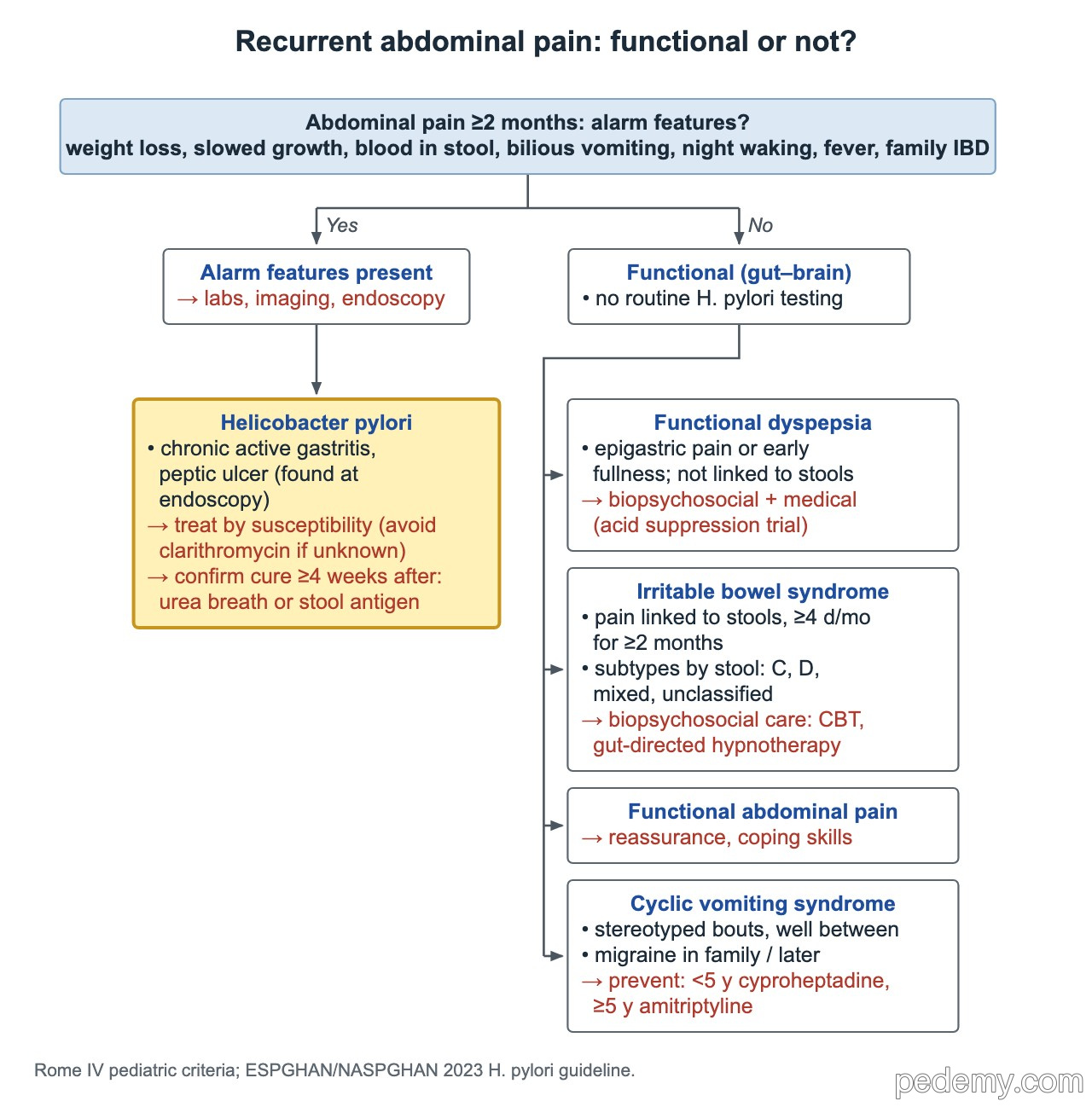
Recurrent abdominal pain: Helicobacter pylori
Key points
- H. pylori is a key cause of chronic active gastritis and peptic ulcer disease in children.
- No routine H. pylori testing, and no test-and-treat, for functional abdominal pain.
- In children the diagnosis is made at endoscopy with gastric biopsies, ideally with culture or molecular susceptibility testing.
- Choose therapy by antibiotic susceptibility; avoid clarithromycin-based regimens when susceptibility is unknown.
- Confirm cure at least 4 weeks after treatment ends with a 13C-urea breath test or a monoclonal stool antigen test.
- Serology is not used: antibodies stay positive after cure.
What H. pylori does and how it is found
H. pylori lives in the gastric mucus layer and causes chronic active gastritis. Some children develop duodenal or gastric ulcers. Infection is usually found at endoscopy done for alarm features, such as GI bleeding or suspected ulcer.
The 2023 joint ESPGHAN/NASPGHAN guideline advises diagnosing infection from gastric biopsies rather than from noninvasive tests, so that the cause of symptoms is seen and susceptibility can be tested.
- Biopsies: histology plus culture or molecular testing for clarithromycin (and other) resistance.
- Noninvasive tests (urea breath test, monoclonal stool antigen) are mainly for checking cure.
- Serum antibody tests are not useful in children: they cannot tell past from current infection.
Who should not be tested
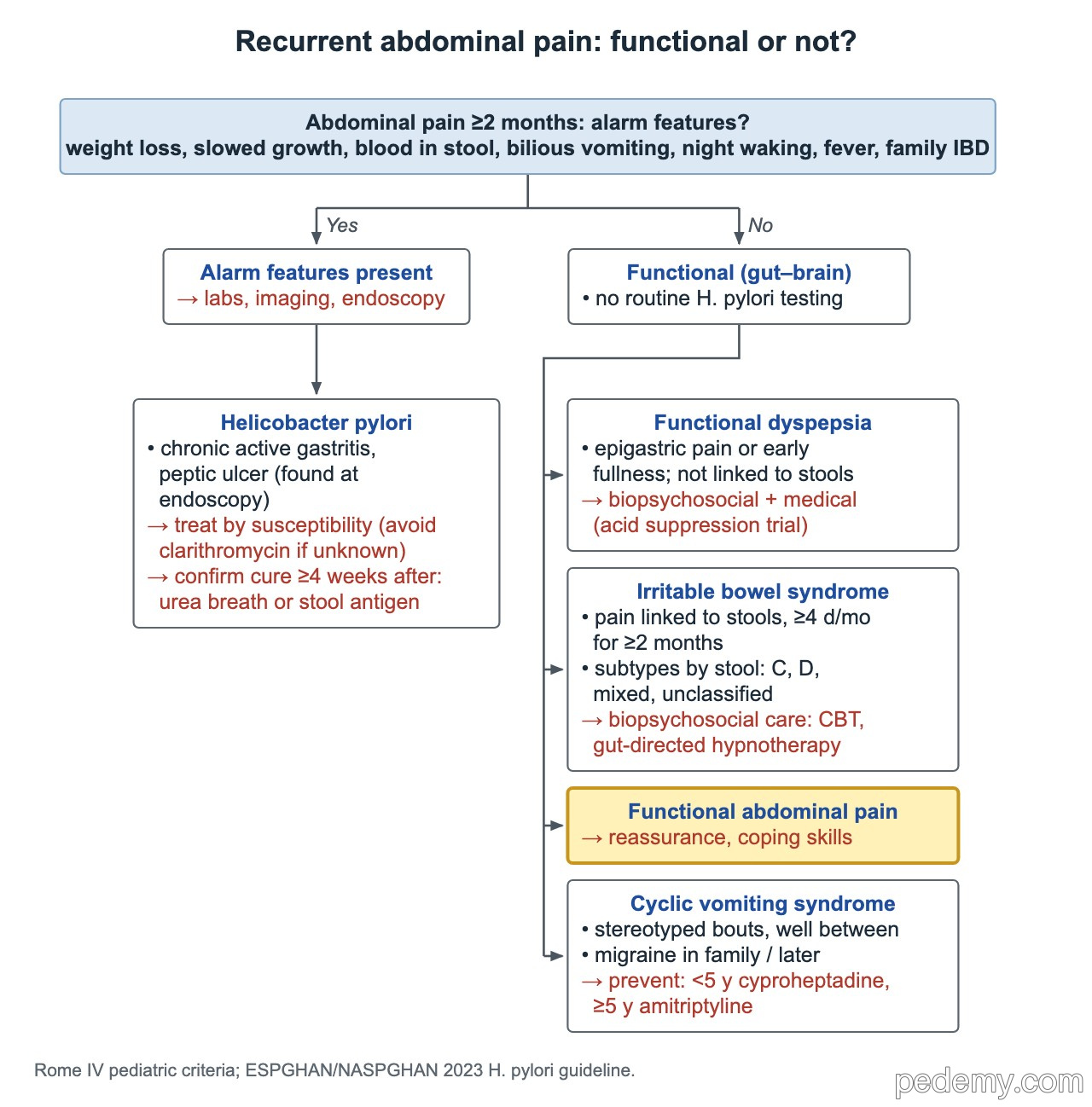
A child with chronic abdominal pain, normal growth, a normal exam and no red flags most likely has a functional disorder. H. pylori does not cause functional abdominal pain, so testing and treating does not relieve it and exposes the child to antibiotics for no gain.
- Functional abdominal pain without alarm features: no H. pylori test.
- Do not use a test-and-treat approach in children.
- Alarm features (weight loss, slowed growth, blood in stool, bilious vomiting) call for evaluation, which may include endoscopy.
Treatment and confirming cure
- Treat when H. pylori is found on biopsy and the child has disease such as peptic ulcer; discuss risks and benefits when it is an incidental finding.
- Pick the regimen by the strain's antibiotic susceptibility. Clarithromycin resistance is common, so avoid clarithromycin when susceptibility is unknown.
- Give a PPI with the antibiotics, for a full 14-day course, and stress adherence.
- Check cure at least 4 weeks after therapy ends with a 13C-urea breath test or a monoclonal stool antigen test.
- Stop PPIs about 2 weeks before the test of cure; they cause false-negative results.
Common questions
Should children with recurrent belly pain be tested for H. pylori?
No. Without alarm features the pain is usually functional, and H. pylori testing or treatment does not help it.
How do you confirm H. pylori is gone in a child?
With a 13C-urea breath test or a monoclonal stool antigen test at least 4 weeks after treatment ends, off PPIs for about 2 weeks.
Study this topic
Sources
- ESPGHAN/NASPGHAN 2023: Updated guidelines for Helicobacter pylori in children and adolescents (JPGN)
- Rome IV 2016: Functional disorders, children and adolescents (Gastroenterology)
Written for Pedemy in our own words from the sources above; checked November 2026. For education only, not medical advice; check doses and local protocols before treating a patient. Pedemy is independent and not affiliated with or endorsed by the organizations cited.