

Main decision tree
Abdominal mass in a child: which tumor?
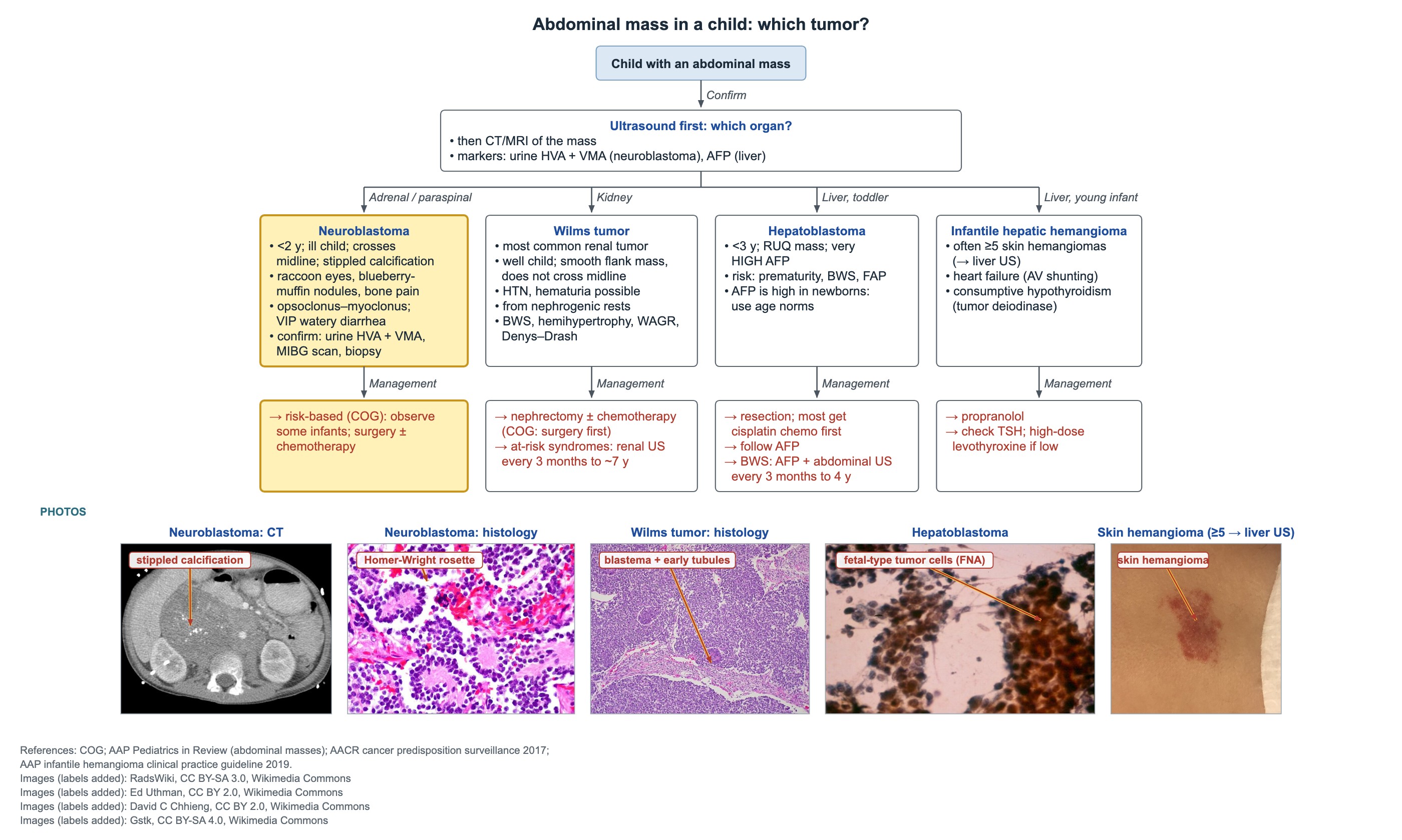
Key points
- Palpable abdominal mass in a child: abdominal ultrasound first, then CT or MRI of the mass.
- Neuroblastoma: sympathetic nervous system tumor of infants and toddlers; crosses the midline; urine HVA and VMA are high.
- Wilms tumor: most common renal malignancy of young children; a well child with a smooth flank mass that does not cross the midline.
- Hepatoblastoma: most common liver malignancy under 3 years; AFP is very high, but AFP is normally high in newborns.
- WAGR, Beckwith–Wiedemann or hemihypertrophy: renal ultrasound every 3 months until the 7th birthday.
- Beckwith–Wiedemann: also AFP plus abdominal ultrasound every 3 months until the 4th birthday for hepatoblastoma.
- Germ cell tumors sit in the midline; AFP and β-hCG help diagnosis and are followed to detect recurrence.
Approach to an abdominal mass
Start with an abdominal ultrasound to show which organ the mass comes from and whether it is solid or cystic. CT or MRI of the mass follows for staging and surgical planning.
A new liver or abdominal mass in a toddler is urgent even when the child looks well or the story sounds like constipation: send the child for same-day evaluation, usually in a pediatric emergency department.
| Tumor | Typical age | Key clue | Marker |
|---|---|---|---|
| Neuroblastoma | Under 2 years | Ill child, mass crosses midline, stippled calcification | Urine HVA and VMA |
| Wilms tumor | About 3–4 years | Well child, smooth flank mass, does not cross midline | None |
| Hepatoblastoma | Under 3 years | Right upper quadrant mass | Very high AFP |
| Infantile hepatic hemangioma | Young infant | Often 5 or more skin hemangiomas | None |
Neuroblastoma
Neuroblastoma arises from neural crest cells of the sympathetic nervous system, most often the adrenal gland or the paraspinal chain. It is the classic solid tumor of infancy.
Confirm with urine HVA and VMA (corrected for urine creatinine), MIBG scan and biopsy. Treatment is risk-based: some infants are only observed, others need surgery with or without chemotherapy.
- Imaging: adrenal or paraspinal mass with stippled calcifications on CT.
- Metastases: bone marrow is the most common site, then cortical bone.
- Periorbital bruising (raccoon eyes) and proptosis: orbital metastases.
- Bluish-purple skin nodules in an infant (blueberry muffin): skin metastases.
- Opsoclonus–myoclonus–ataxia: chaotic eye movements, jerks and unsteadiness; look for a hidden neuroblastoma.
- Watery secretory diarrhea: VIP secreted by neuroblastoma or ganglioneuroma.
Wilms tumor
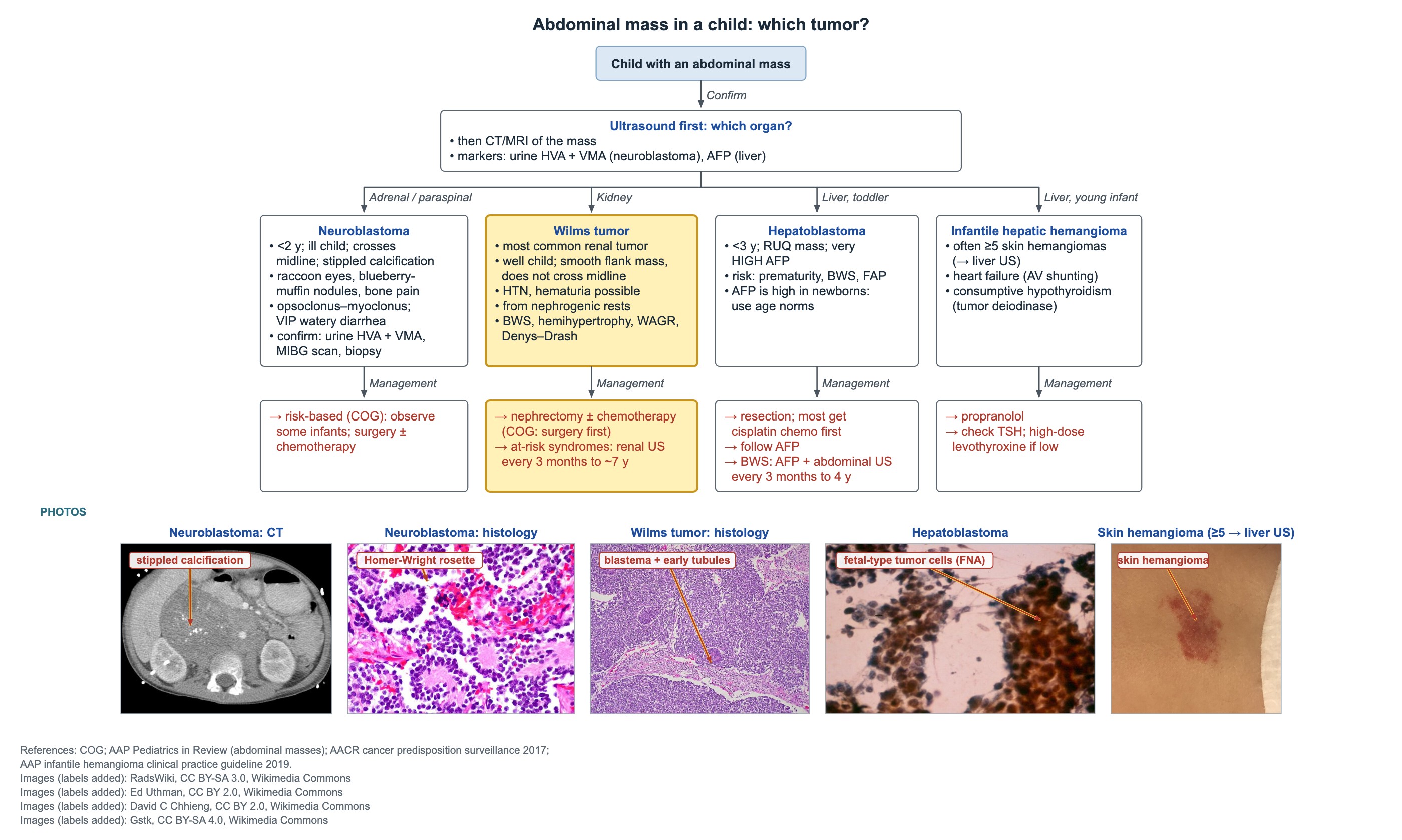
Wilms tumor (nephroblastoma) is the most common primary malignant kidney tumor in young children. It arises from persistent embryonic metanephric cells called nephrogenic rests.
The child usually looks well. Hypertension and hematuria can occur. In North America, treatment starts with nephrectomy, followed by chemotherapy based on stage and histology.
- Predisposing syndromes: WAGR, Denys–Drash, Beckwith–Wiedemann and isolated hemihypertrophy.
- Screening for at-risk syndromes: renal ultrasound every 3 months from diagnosis until the 7th birthday.
Liver tumors: hepatoblastoma and infantile hemangioma
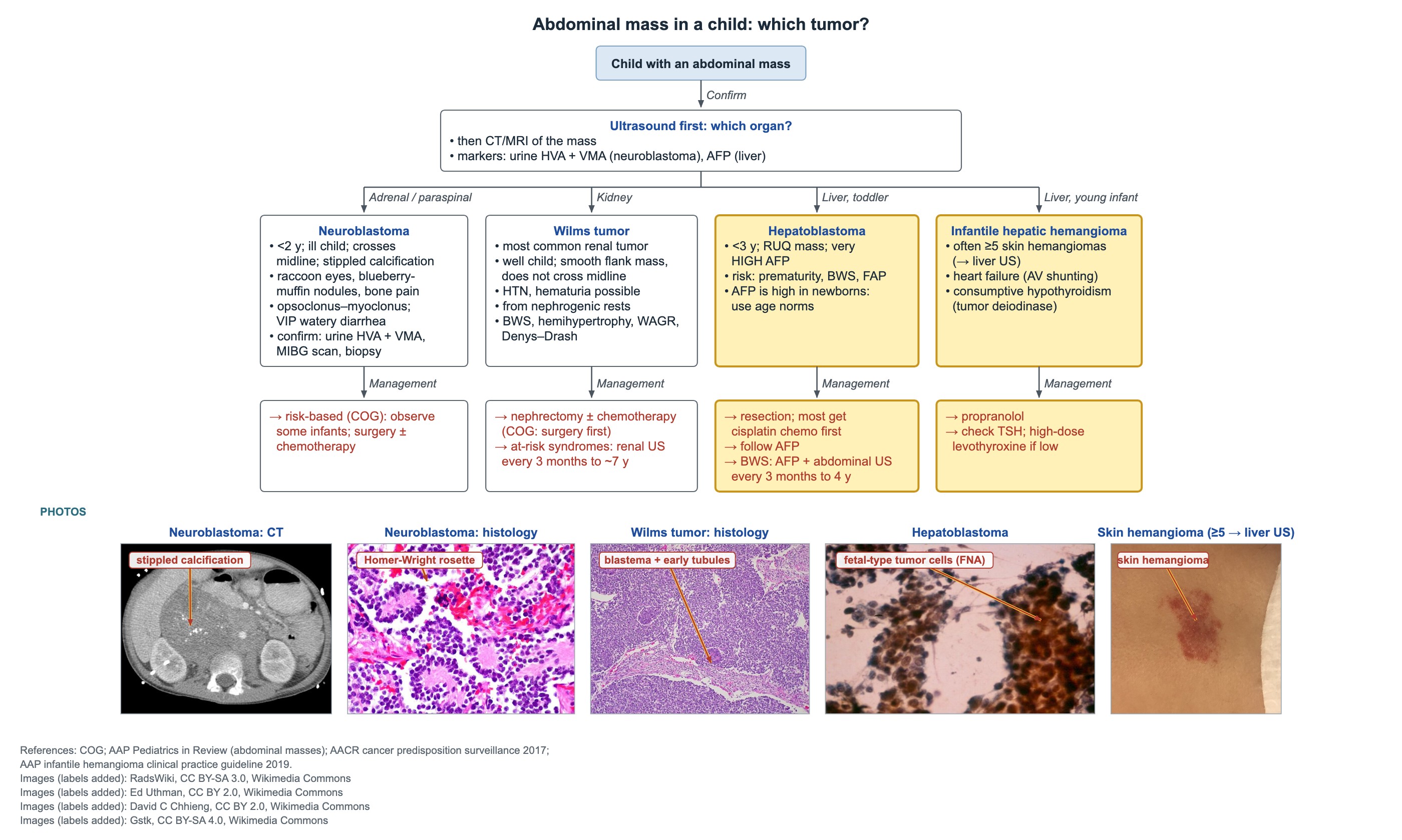
Hepatoblastoma is the most common primary malignant liver tumor in young children, usually under 3 years. AFP is very high and is followed during treatment. A raised AFP in a newborn does not prove cancer: AFP is normally high at birth and falls over the first months, so use age-specific ranges.
Complete surgical resection is required for cure. Most children get cisplatin-based chemotherapy before surgery.
- Risk factors: prematurity or very low birth weight, Beckwith–Wiedemann syndrome and familial adenomatous polyposis.
- Beckwith–Wiedemann: AFP plus full abdominal ultrasound every 3 months until the 4th birthday.
- Hepatic hemangioma is the typical benign vascular liver tumor of infancy; 5 or more skin hemangiomas → liver ultrasound.
- Diffuse hepatic hemangiomas can cause high-output heart failure (shunting) and consumptive hypothyroidism (the tumor inactivates thyroid hormone).
- Hemangioma management: propranolol; check TSH and give high-dose levothyroxine if low thyroid hormone.
Germ cell tumors and teratomas
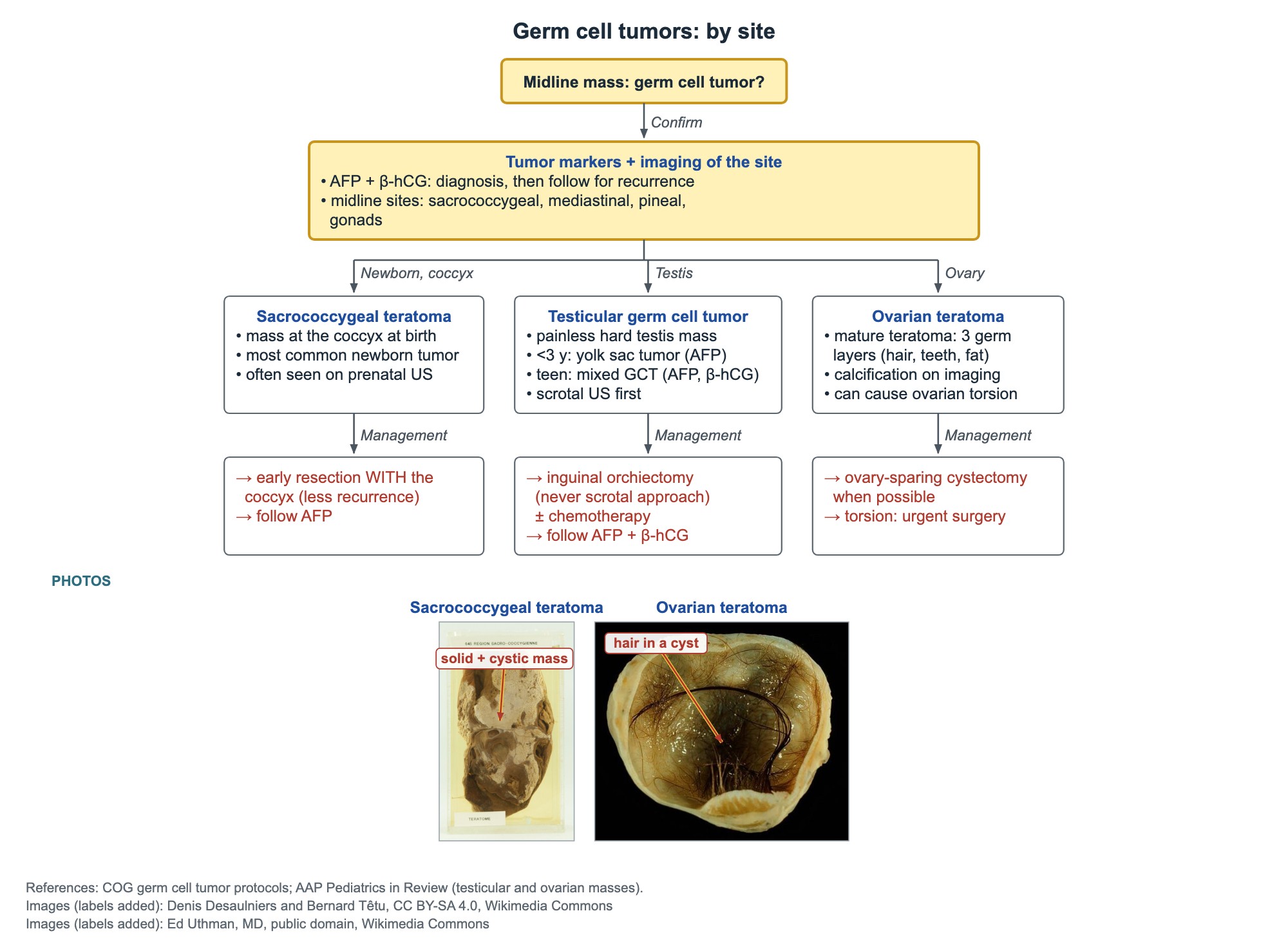
Extragonadal germ cell tumors follow the midline: sacrococcygeal area, mediastinum and pineal region, as well as the gonads. AFP and β-hCG support the diagnosis; in a secreting tumor, keep measuring them after therapy to detect recurrence.
- Sacrococcygeal teratoma: mass at the coccyx at birth, often seen on prenatal ultrasound; resect early with the coccyx; follow AFP.
- Testicular mass in a teen: AFP and β-hCG with a scrotal ultrasound; surgery is by inguinal orchiectomy, never a scrotal approach.
- Yolk sac tumor of the testis in children under 3 years makes AFP.
- Mature (benign) teratoma usually contains all three germ layers (at least two): hair, teeth and fat.
- Ovarian mass with calcifications (teeth) in a girl: mature cystic teratoma (dermoid cyst); it can cause ovarian torsion. Ovary-sparing cystectomy when possible.
Common questions
How can you tell neuroblastoma from Wilms tumor?
Neuroblastoma usually affects children under 2, who often look ill; the mass crosses the midline, has stippled calcifications and raises urine HVA and VMA. Wilms tumor comes from the kidney, usually in a well child, and does not cross the midline.
What is the first test for an abdominal mass in a child?
Abdominal ultrasound. It shows the organ of origin and whether the mass is solid or cystic. CT or MRI and tumor markers follow.
How often should children with Beckwith–Wiedemann syndrome be screened?
Abdominal ultrasound every 3 months until the 7th birthday for Wilms tumor, and AFP every 3 months until the 4th birthday for hepatoblastoma.
Study this topic
Sources
- AACR 2017: Surveillance for overgrowth syndromes and predisposition to Wilms tumor and hepatoblastoma (Clin Cancer Res)
- AAP 2019: Clinical practice guideline for the management of infantile hemangiomas (Pediatrics)
- NCI PDQ: Neuroblastoma treatment (health professional version)
- NCI PDQ: Wilms tumor and other childhood kidney tumors treatment
- NCI PDQ: Childhood liver cancer treatment
Written for Pedemy in our own words from the sources above; checked November 2026. For education only, not medical advice; check doses and local protocols before treating a patient. Pedemy is independent and not affiliated with or endorsed by the organizations cited.