

Main decision tree
Bone and soft-tissue tumors on x-ray
Key points
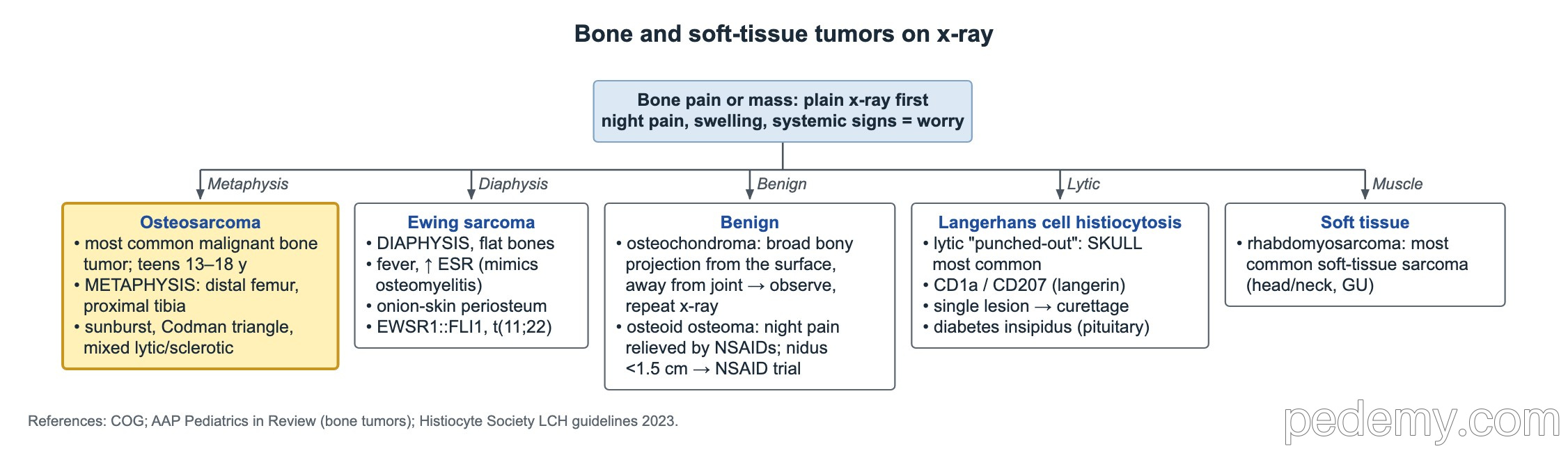
- Bone pain or mass: plain x-ray first; night pain, swelling and systemic signs are red flags.
- Osteosarcoma is the most common primary malignant bone tumor in children and teens; peak age 13–18 years.
- Osteosarcoma: metaphysis of the distal femur or proximal tibia, sunburst periosteal reaction, Codman triangle.
- Ewing sarcoma: diaphysis or flat bones, onion-skin periosteal reaction, fever and raised ESR that mimic osteomyelitis.
- Ewing sarcoma usually carries an EWSR1 fusion, most often EWSR1::FLI1 from t(11;22).
- Rhabdomyosarcoma is the most common soft-tissue sarcoma of childhood; head and neck and genitourinary sites are typical.
Osteosarcoma
Osteosarcoma is the most common primary malignant bone tumor in children and adolescents. It peaks during the teenage growth spurt, at about 13–18 years, and favors the fastest-growing bone ends: the metaphysis of the distal femur and proximal tibia.
The x-ray shows an aggressive metaphyseal lesion that is mixed lytic and sclerotic, with tumor osteoid matrix, a sunburst periosteal reaction and often a Codman triangle.
- Next steps: MRI of the whole bone, chest CT for lung metastases, then biopsy at a sarcoma center.
- Treatment: chemotherapy before and after surgery, with complete surgical resection.
Ewing sarcoma
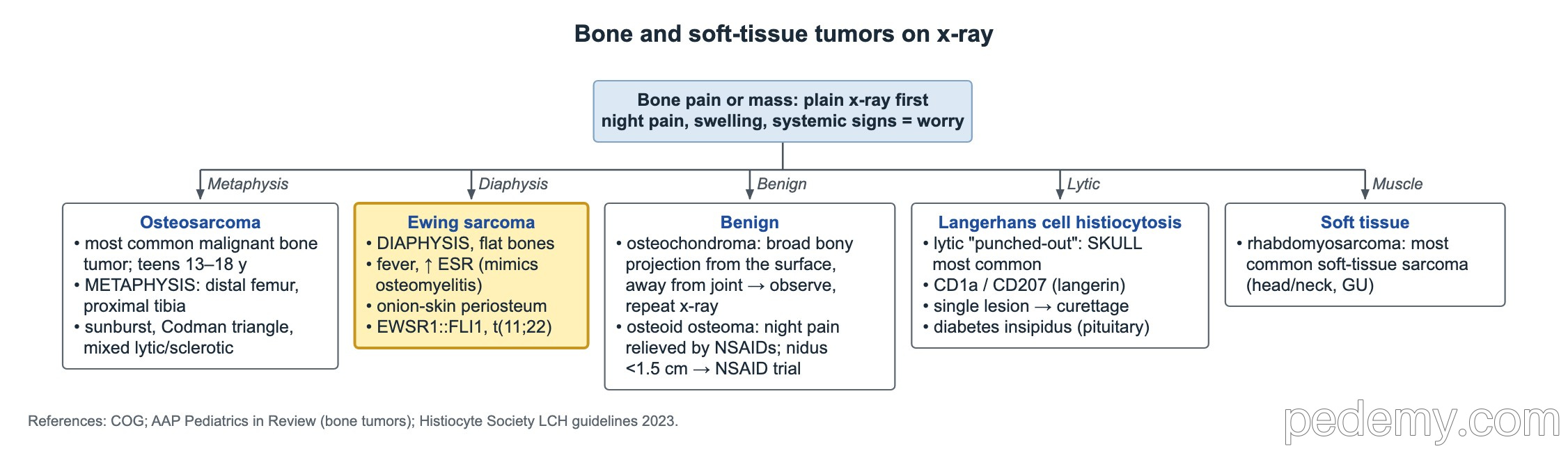
Ewing sarcoma favors the diaphysis of long bones and flat bones such as the pelvis and ribs. Fever, bone pain and a raised ESR can make it look like osteomyelitis.
The x-ray shows a permeative diaphyseal lesion with a layered, onion-skin periosteal reaction. Most tumors carry an EWSR1 fusion; EWSR1::FLI1 from t(11;22) is the most common.
Benign lesions and Langerhans cell histiocytosis
Not every bone lesion is a sarcoma. The same x-ray tree lists the common benign look-alikes.
- Osteochondroma: a broad bony projection from the bone surface pointing away from the joint; observe and repeat the x-ray.
- Osteoid osteoma: night pain relieved by NSAIDs, nidus under 1.5 cm; an NSAID trial is reasonable.
- Langerhans cell histiocytosis: lytic punched-out lesion, the skull most often; CD1a and CD207 (langerin) positive.
Rhabdomyosarcoma
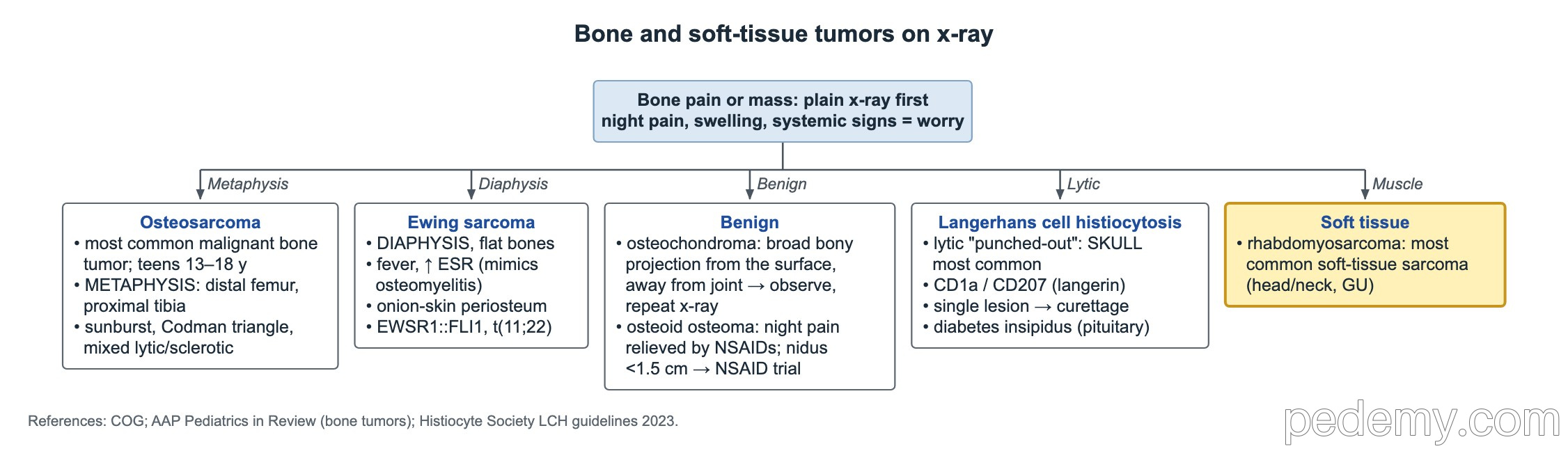
Rhabdomyosarcoma is the most common soft-tissue sarcoma of childhood. It arises from cells that would form skeletal muscle and is most often found in the head and neck (including the orbit) and genitourinary tract.
A painless, enlarging soft-tissue mass needs imaging and biopsy rather than watchful waiting.
Common questions
How do osteosarcoma and Ewing sarcoma differ on x-ray?
Osteosarcoma sits in the metaphysis and makes bone, with a sunburst pattern and Codman triangle. Ewing sarcoma favors the diaphysis and flat bones and shows a layered onion-skin periosteal reaction.
What is the most common bone cancer in teenagers?
Osteosarcoma, usually around the knee: the distal femur or proximal tibia.
Study this topic
Sources
- NCI PDQ: Osteosarcoma and undifferentiated pleomorphic sarcoma of bone treatment
- NCI PDQ: Ewing sarcoma treatment
- NCI PDQ: Childhood rhabdomyosarcoma treatment
Written for Pedemy in our own words from the sources above; checked November 2026. For education only, not medical advice; check doses and local protocols before treating a patient. Pedemy is independent and not affiliated with or endorsed by the organizations cited.