

Main decision tree
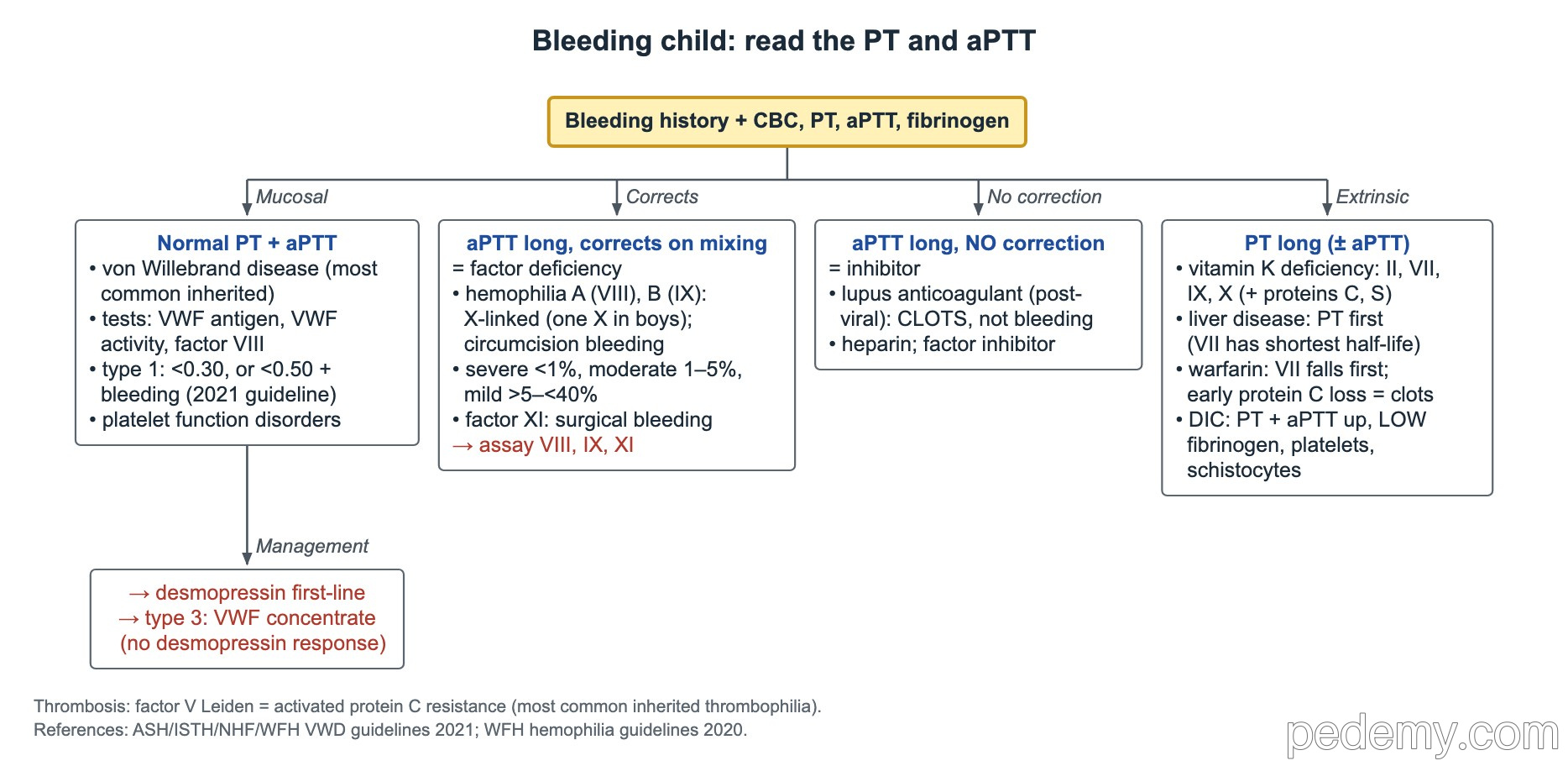
Bleeding child: read the PT and aPTT
Key points
- Von Willebrand disease (VWD) is the most common inherited bleeding disorder; normal PT and aPTT do not exclude it.
- Type 1 VWD (2021 guideline): VWF level <0.30 IU/mL regardless of bleeding, or <0.50 IU/mL with abnormal bleeding.
- Hemophilia A = factor VIII, hemophilia B = factor IX; both X-linked. Severe <1%, moderate 1–5%, mild >5% to <40%.
- A long aPTT that corrects on mixing means a factor deficiency → assay factors VIII, IX and XI.
- A long aPTT that does not correct means an inhibitor; a post-viral lupus anticoagulant causes clots, not bleeding.
- Vitamin K-dependent factors: II, VII, IX, X (plus proteins C and S). Factor VII falls first in liver disease and on warfarin.
- One IM dose of vitamin K at birth prevents vitamin K deficiency bleeding; late VKDB (2 weeks–6 months) causes intracranial hemorrhage.
Read the PT and aPTT
Take a careful bleeding history first: type of bleeding (skin and mucosa versus joints and muscles), bleeding after surgery, dental work or circumcision, heavy menstrual bleeding and family history. Then order a CBC, PT, aPTT and fibrinogen.
Mucosal bleeding with a normal PT and aPTT suggests von Willebrand disease or a platelet function disorder. Joint, muscle or post-surgical bleeding with a long aPTT suggests hemophilia.
- Thrombosis rather than bleeding: factor V Leiden causes activated protein C resistance and is the most common inherited thrombophilia.
| Pattern | Think of |
|---|---|
| Normal PT and aPTT | Von Willebrand disease, platelet function disorder |
| Long aPTT, corrects on mixing | Factor VIII, IX or XI deficiency (also factor XII, which does not cause bleeding) |
| Long aPTT, no correction | Lupus anticoagulant, heparin, factor inhibitor |
| Long PT (± aPTT) | Vitamin K deficiency, liver disease, warfarin, DIC |
Von Willebrand disease: diagnosis
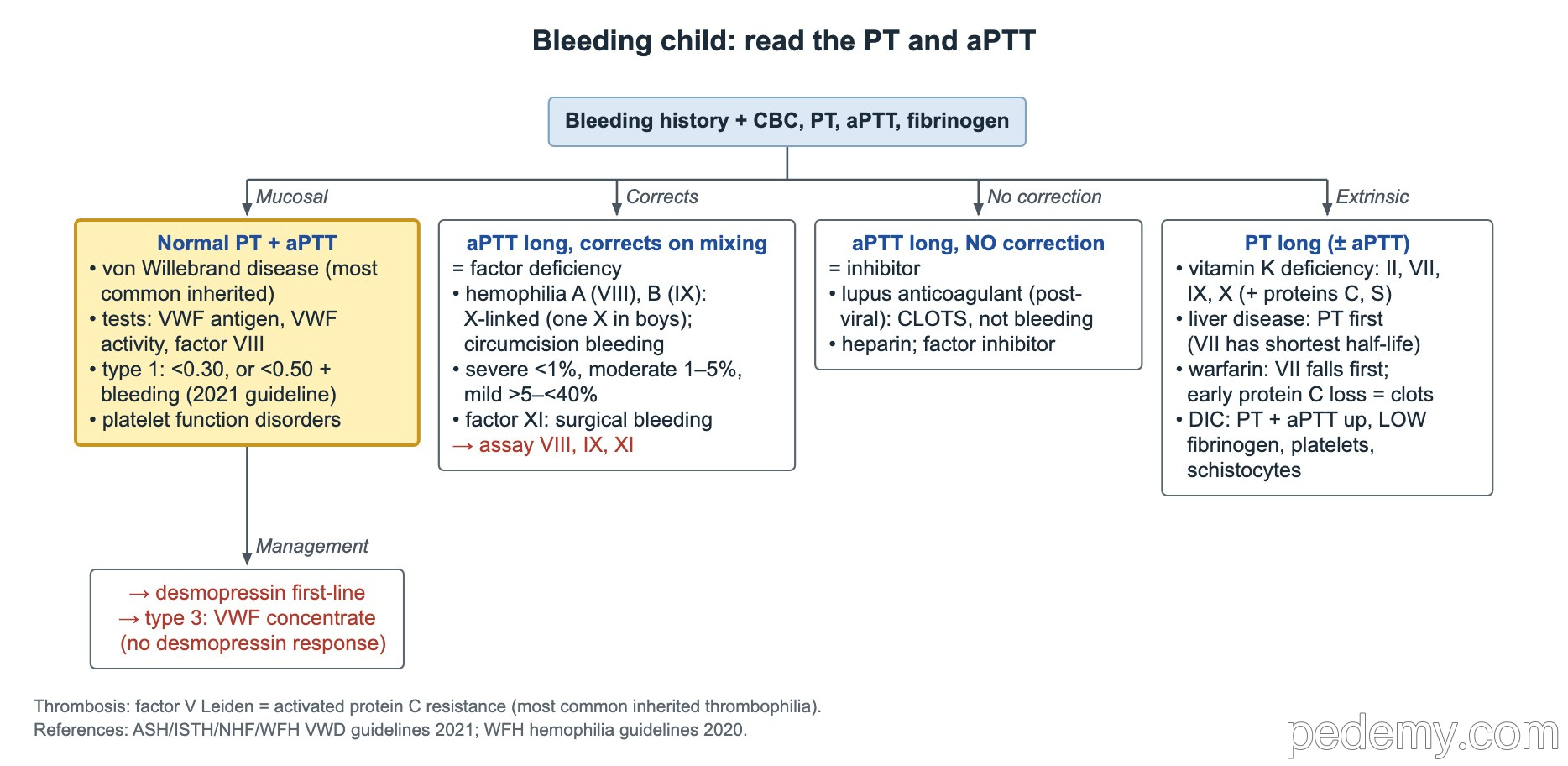
VWF carries factor VIII and helps platelets stick to injured vessel walls. Low or faulty VWF causes easy bruising, nosebleeds, gum bleeding, bleeding after procedures and heavy menstrual bleeding, often from menarche.
The PT and aPTT are often normal, because factor VIII may be only mildly low. When the history suggests a bleeding disorder, order specific VWF tests.
- Core first panel: VWF antigen, platelet-dependent VWF activity and factor VIII activity.
- Type 1: partial quantitative deficiency; antigen and activity fall in proportion. Most common type.
- Type 1 cut-offs: <0.30 IU/mL regardless of bleeding, or <0.50 IU/mL with abnormal bleeding.
- Type 2: qualitative defect; activity is low relative to antigen.
- Type 3: VWF almost absent, with low factor VIII; severe bleeding, including joint bleeds.
- VWF rises with stress, inflammation, pregnancy and estrogen, so a normal result may need repeating.
Von Willebrand disease: treatment
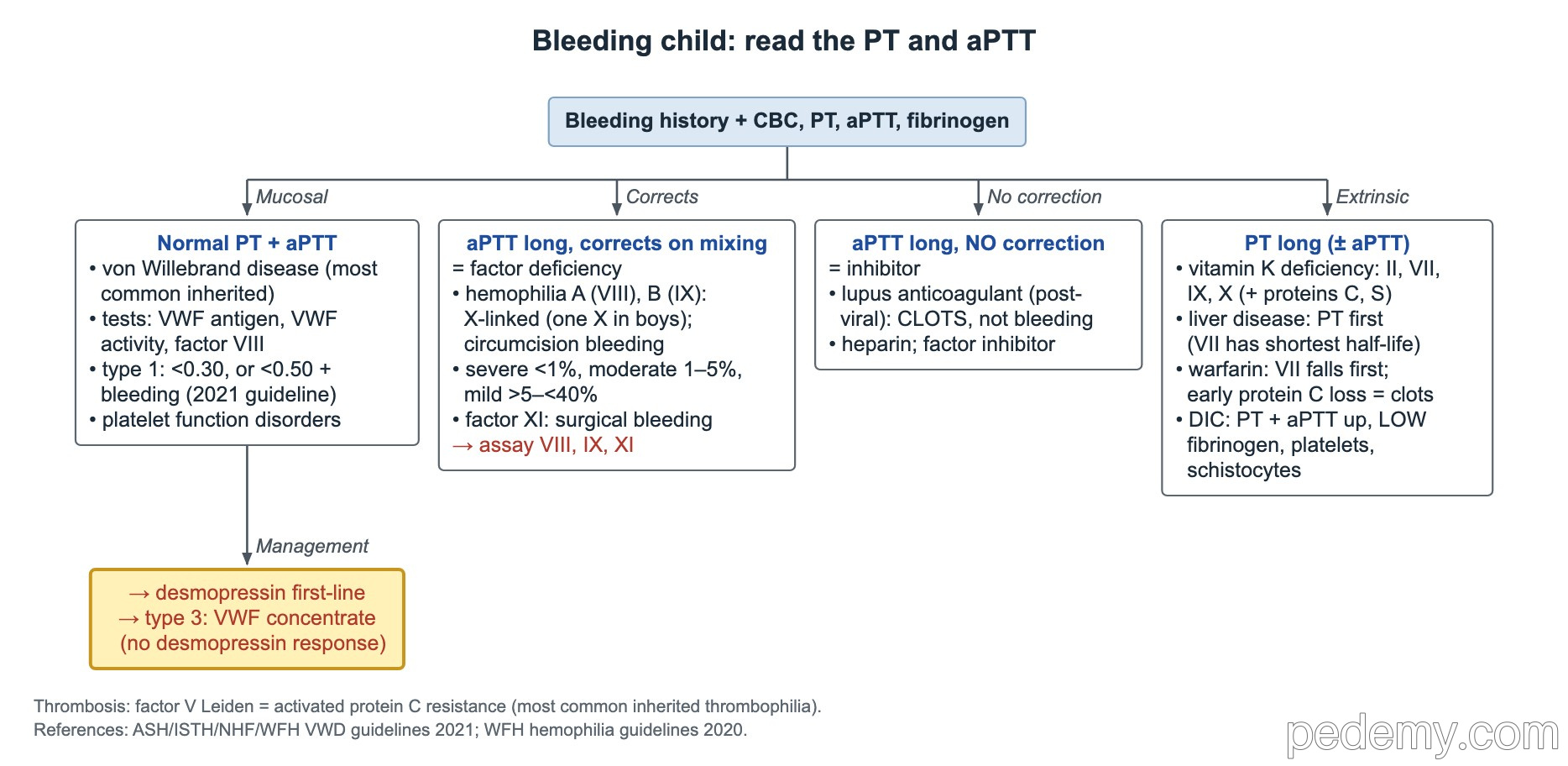
- Desmopressin (DDAVP) is first-line for most type 1 VWD; it releases stored VWF and factor VIII.
- Do a desmopressin trial before relying on it, to confirm the levels rise.
- Limit fluids for 24 hours after desmopressin and watch the sodium: hyponatremia and seizures can occur, especially in young children.
- Type 3 VWD does not respond to desmopressin: use VWF concentrate.
- Tranexamic acid helps mucosal bleeding, dental procedures and heavy menstrual bleeding.
- Hormonal therapy is an option for heavy menstrual bleeding.
Hemophilia and other factor deficiencies
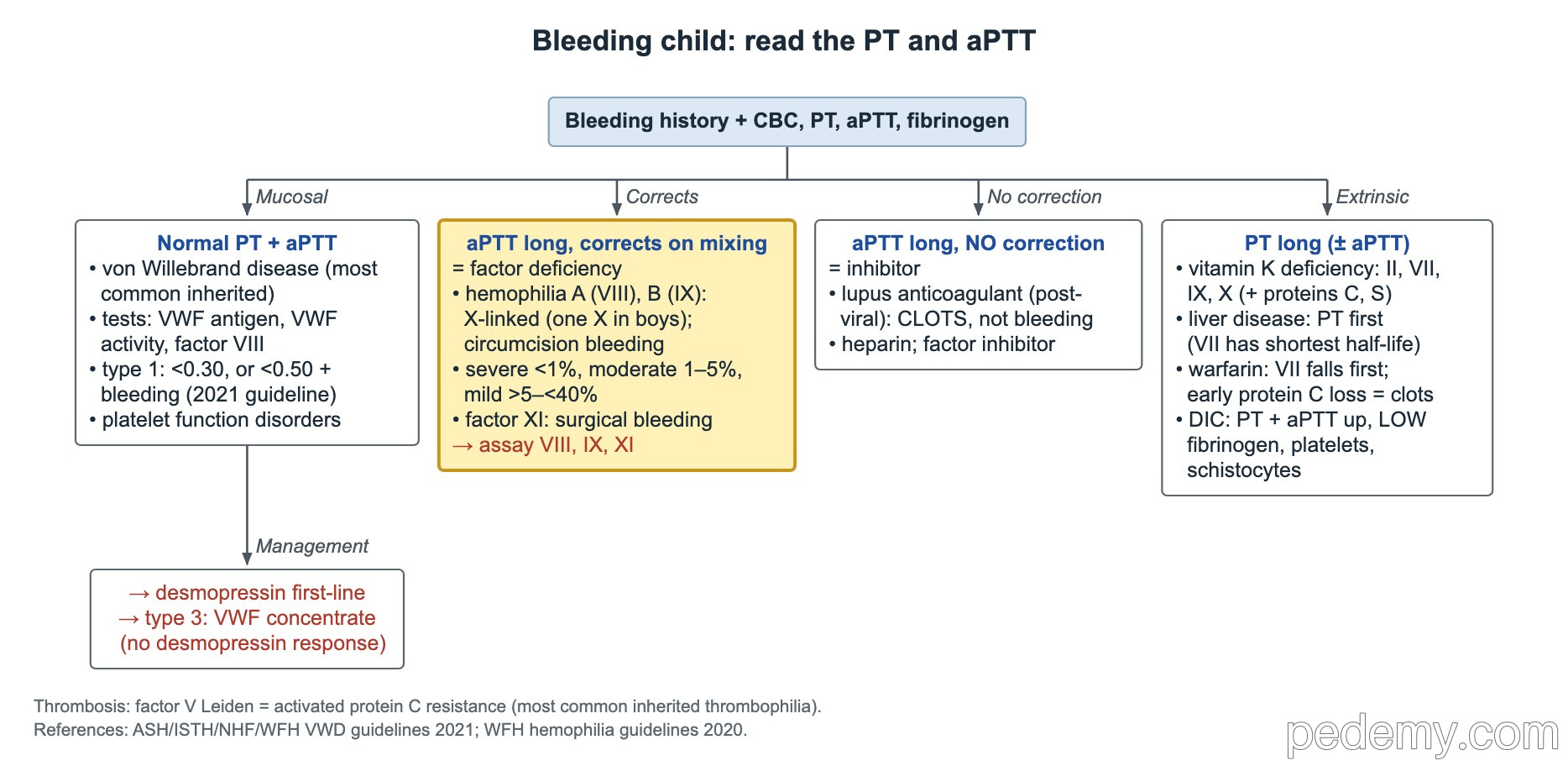
A long aPTT that corrects when the patient's plasma is mixed 1:1 with normal plasma means a missing factor. Correction alone does not prove a bleeding risk: it depends on which factor is low. Factor XII deficiency prolongs the aPTT but does not cause bleeding.
- Hemophilia A: factor VIII deficiency. Hemophilia B: factor IX deficiency.
- Both are X-linked, so severe disease is almost always in boys, who have only one X chromosome.
- Classic clues: bleeding after newborn circumcision, joint bleeds (hemarthrosis) and deep muscle bleeds when toddlers start walking.
- Severity by baseline factor level: severe <1%, moderate 1–5%, mild >5% to <40%.
- Factor XI deficiency: surgical or dental bleeding (for example after tonsillectomy) with normal VWF, VIII and IX; affects both sexes.
- Bleeding with a long aPTT that corrects → assay factors VIII, IX and XI first.
- Treatment: replace the missing factor; children with severe hemophilia get regular prophylaxis to prevent joint damage.
When the aPTT does not correct
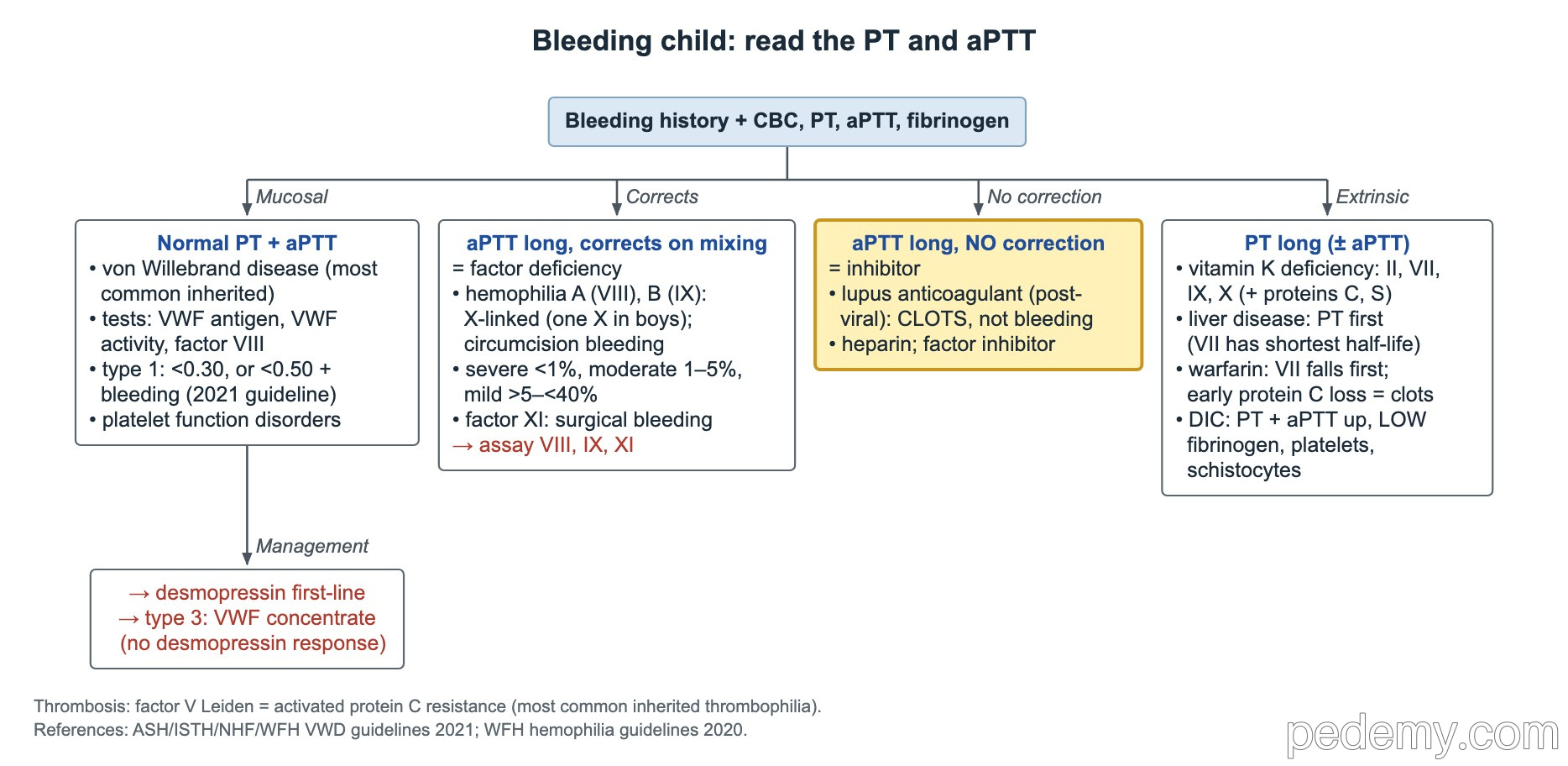
If the aPTT stays long after mixing, something in the plasma is blocking clotting. This points to an inhibitor or a drug, not a missing factor.
- Lupus anticoagulant: common and often transient after a viral illness in children. It prolongs the test tube aPTT but usually does not cause bleeding.
- A lupus anticoagulant with a new clot raises concern for antiphospholipid syndrome.
- Heparin contamination of the sample (for example from a line) is a common cause.
- A specific factor inhibitor (such as an antibody against factor VIII in a treated hemophilia patient) does cause bleeding.
Long PT: vitamin K, liver, warfarin and DIC
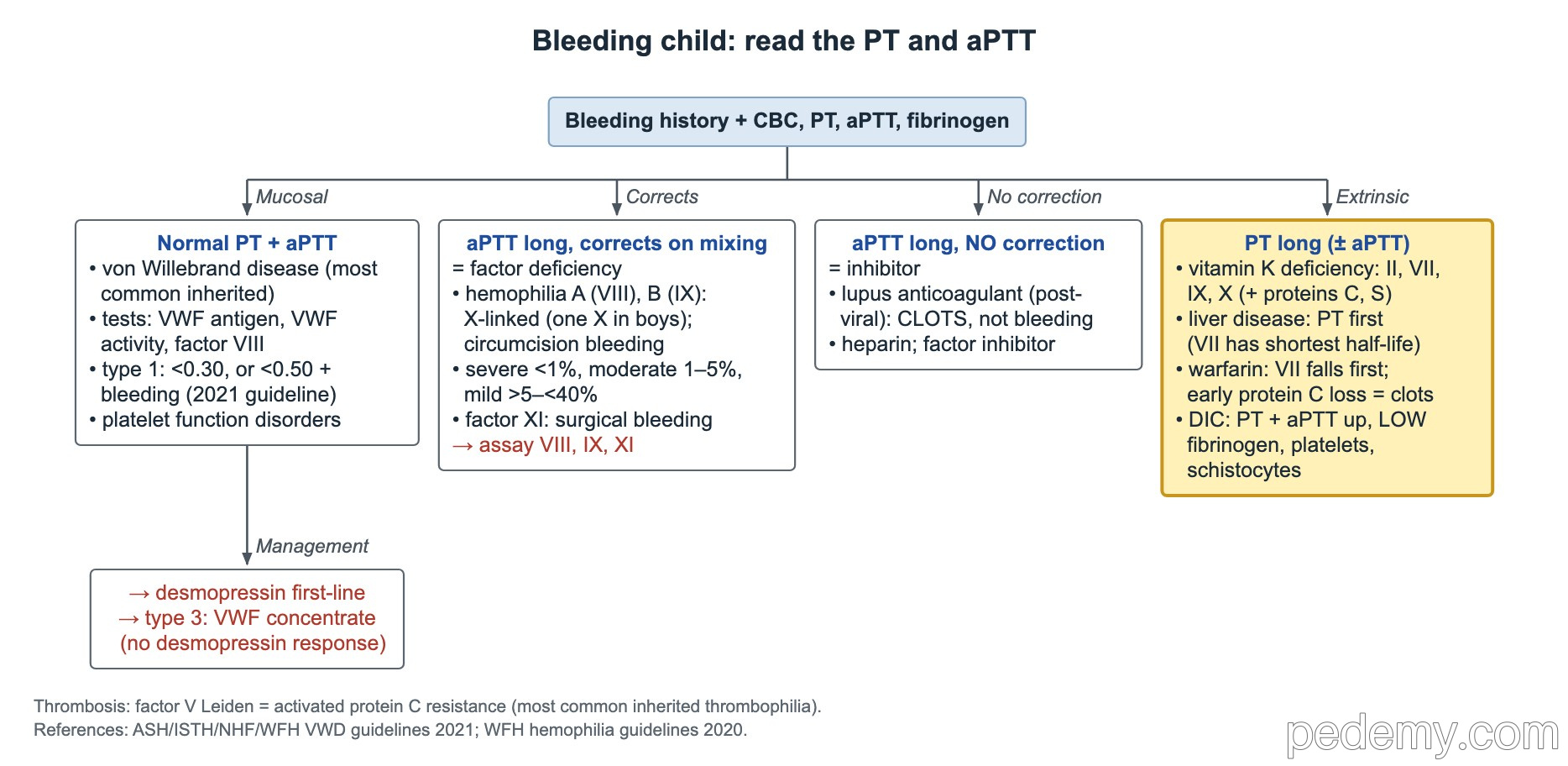
- Vitamin K deficiency lowers factors II, VII, IX and X, and the natural anticoagulants proteins C and S.
- Liver disease: the PT is the earliest marker of poor synthetic function, because factor VII has the shortest half-life.
- Warfarin: factor VII falls first. Protein C also falls early, so warfarin can briefly promote clotting; start heparin alongside it until the INR is in range.
- DIC: long PT and aPTT, low fibrinogen, low platelets and schistocytes on the smear, in a sick child (sepsis, trauma, malignancy). Treat the cause.
Vitamin K deficiency bleeding of the newborn
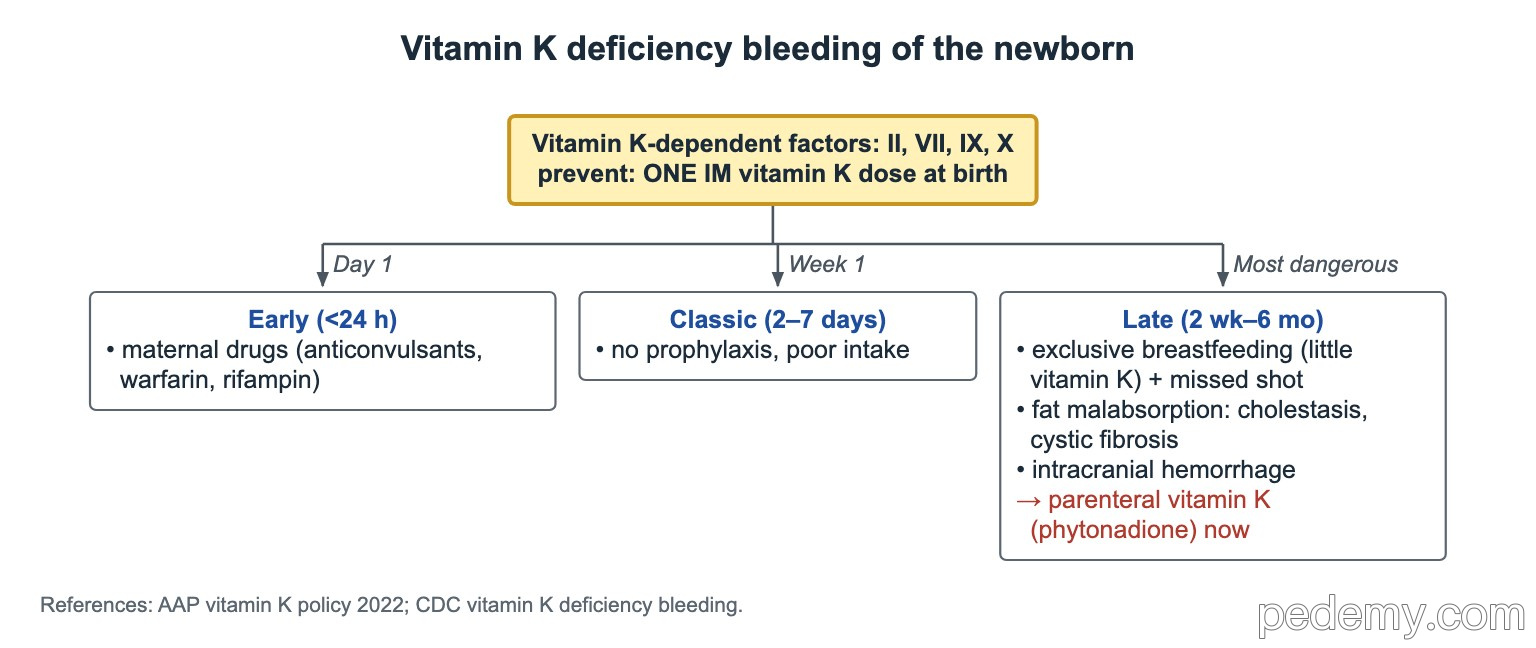
Newborns have low vitamin K stores, little crosses the placenta and breast milk contains little. The AAP recommends a single intramuscular dose of vitamin K for every newborn soon after birth. Oral regimens protect less well.
Prothrombin is factor II, one of the 4 vitamin K-dependent clotting factors.
- Late VKDB is the most dangerous form: intracranial hemorrhage is the feared complication.
- VKDB despite prophylaxis at birth → look for fat malabsorption, such as cholestasis or cystic fibrosis.
- Labs: long PT (and often aPTT) with normal platelets and fibrinogen.
- Treatment: vitamin K (phytonadione) IV or subcutaneously now; add plasma or prothrombin complex concentrate for serious bleeding.
| Type | Timing | Typical cause |
|---|---|---|
| Early | First 24 hours | Maternal drugs that block vitamin K: anticonvulsants, warfarin, rifampin |
| Classic | Days 2–7 | No vitamin K at birth, poor feeding |
| Late | 2 weeks to 6 months, mostly 2–12 weeks | Missed prophylaxis with exclusive breastfeeding, or fat malabsorption (cholestasis, cystic fibrosis) |
Common questions
Can you have von Willebrand disease with a normal PT and aPTT?
Yes. The PT and aPTT are often normal in VWD. If the bleeding history suggests it, order VWF antigen, VWF activity and factor VIII activity.
What is the difference between hemophilia A and B?
Hemophilia A is factor VIII deficiency and hemophilia B is factor IX deficiency. Both are X-linked and look the same clinically, so a factor assay is needed to tell them apart.
Why do newborns get a vitamin K shot?
Newborns have low vitamin K and breast milk contains little. One intramuscular dose at birth prevents vitamin K deficiency bleeding, including late bleeding into the brain.
Study this topic
Sources
- ASH ISTH NHF WFH 2021 guidelines on the diagnosis of von Willebrand disease (Blood Advances)
- ASH ISTH NHF WFH 2021 guidelines on the management of von Willebrand disease (Blood Advances)
- WFH Guidelines for the Management of Hemophilia, 3rd edition (Haemophilia 2020)
- AAP 2022: Vitamin K and the newborn infant (Pediatrics)
Written for Pedemy in our own words from the sources above; checked November 2026. For education only, not medical advice; check doses and local protocols before treating a patient. Pedemy is independent and not affiliated with or endorsed by the organizations cited.