

Main decision tree
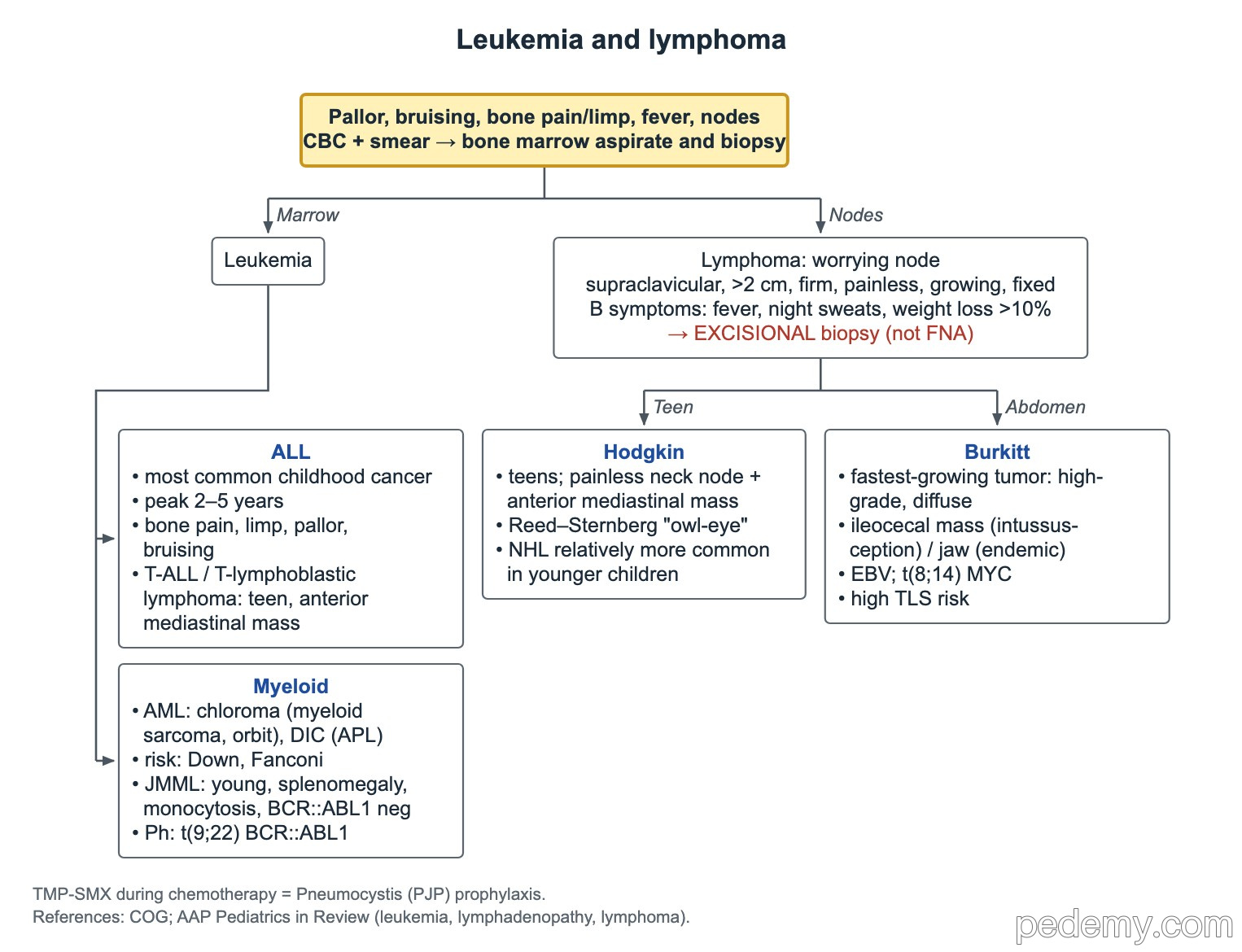
Leukemia and lymphoma
Key points
- ALL is the most common childhood cancer; peak age 2–5 years.
- NCI standard risk ALL: age 1 to <10 years and WBC <50,000/µL; WBC ≥50,000/µL is high risk.
- Suspected acute leukemia → CBC and smear, then bone marrow aspirate and biopsy.
- Worrying node: supraclavicular, >2 cm, firm, painless, fixed or growing → excisional biopsy, not FNA.
- B symptoms: fever, drenching night sweats, weight loss >10% in 6 months.
- Teen with painless neck nodes and an anterior mediastinal mass → Hodgkin lymphoma (Reed–Sternberg cell).
- Burkitt lymphoma: fastest-growing tumor, t(8;14) MYC, EBV link, ileocecal mass, high tumor lysis risk.
When to suspect leukemia or lymphoma
Pallor, bruising, fever, bone pain or a limp point to the marrow. Enlarging nodes or a mass point to lymphoma. Start with a CBC and a blood smear.
If acute leukemia is suspected, the diagnostic test is a bone marrow aspirate and biopsy, with flow cytometry and genetic studies on the sample.
- Bone pain or a limp with abnormal blood counts is leukemia until proven otherwise.
- Children on chemotherapy take TMP-SMX to prevent Pneumocystis jirovecii pneumonia (PJP).
Acute lymphoblastic leukemia (ALL)
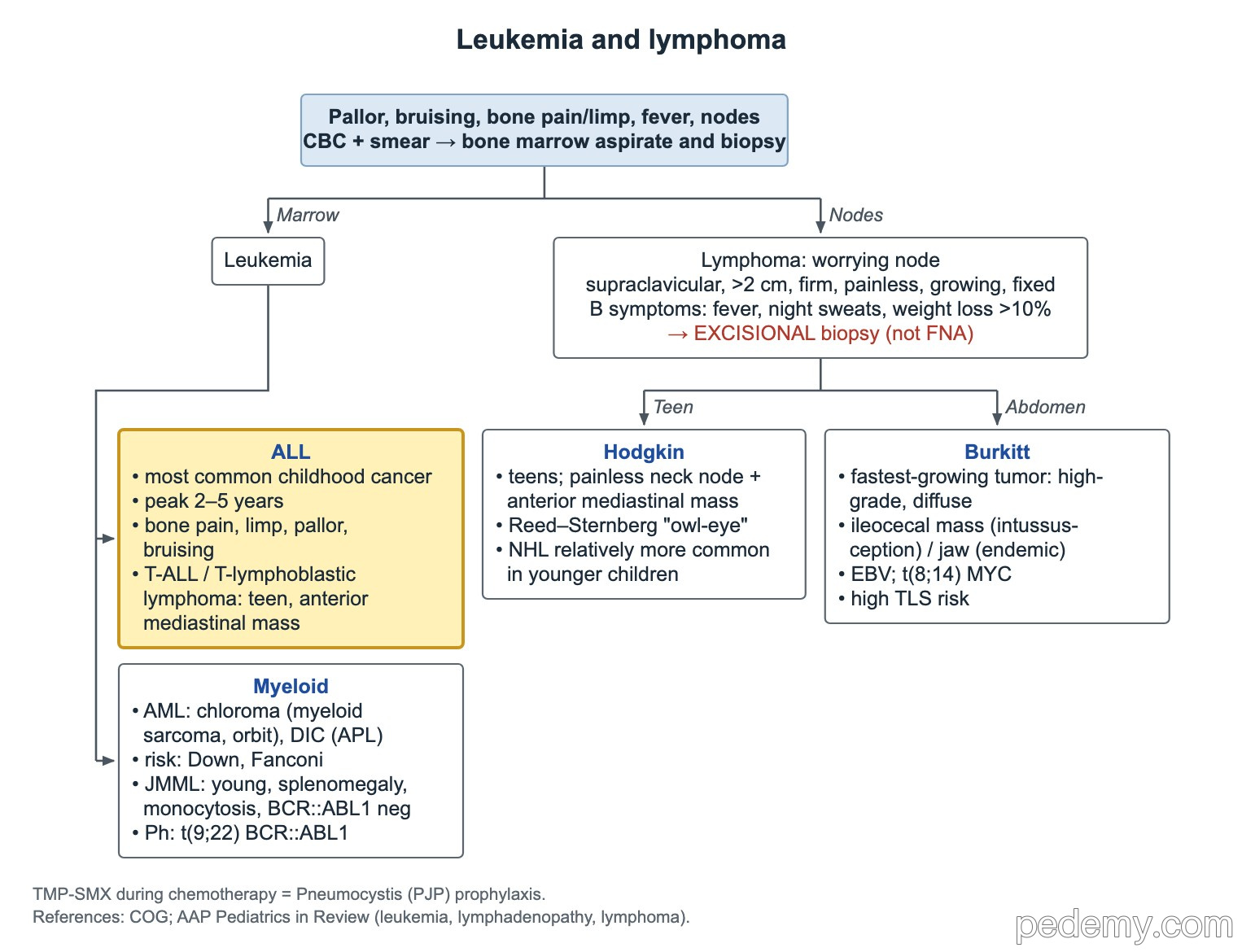
ALL is the most common childhood leukemia and the most common single childhood cancer. It peaks at 2–5 years.
Typical signs come from marrow failure and infiltration: pallor, bruising or petechiae, fever, bone pain and limp, liver and spleen enlargement.
| Feature | Board point |
|---|---|
| Standard risk (NCI) | Age 1 to <10 years and WBC <50,000/µL |
| High risk | Age ≥10 years or WBC ≥50,000/µL; infants <1 year also do worse |
| T-cell ALL / T-lymphoblastic lymphoma | Adolescent, often male, with an anterior mediastinal mass |
| Philadelphia chromosome | t(9;22) makes the BCR::ABL1 fusion; seen in a small share of ALL and defines CML |
AML and other myeloid neoplasms
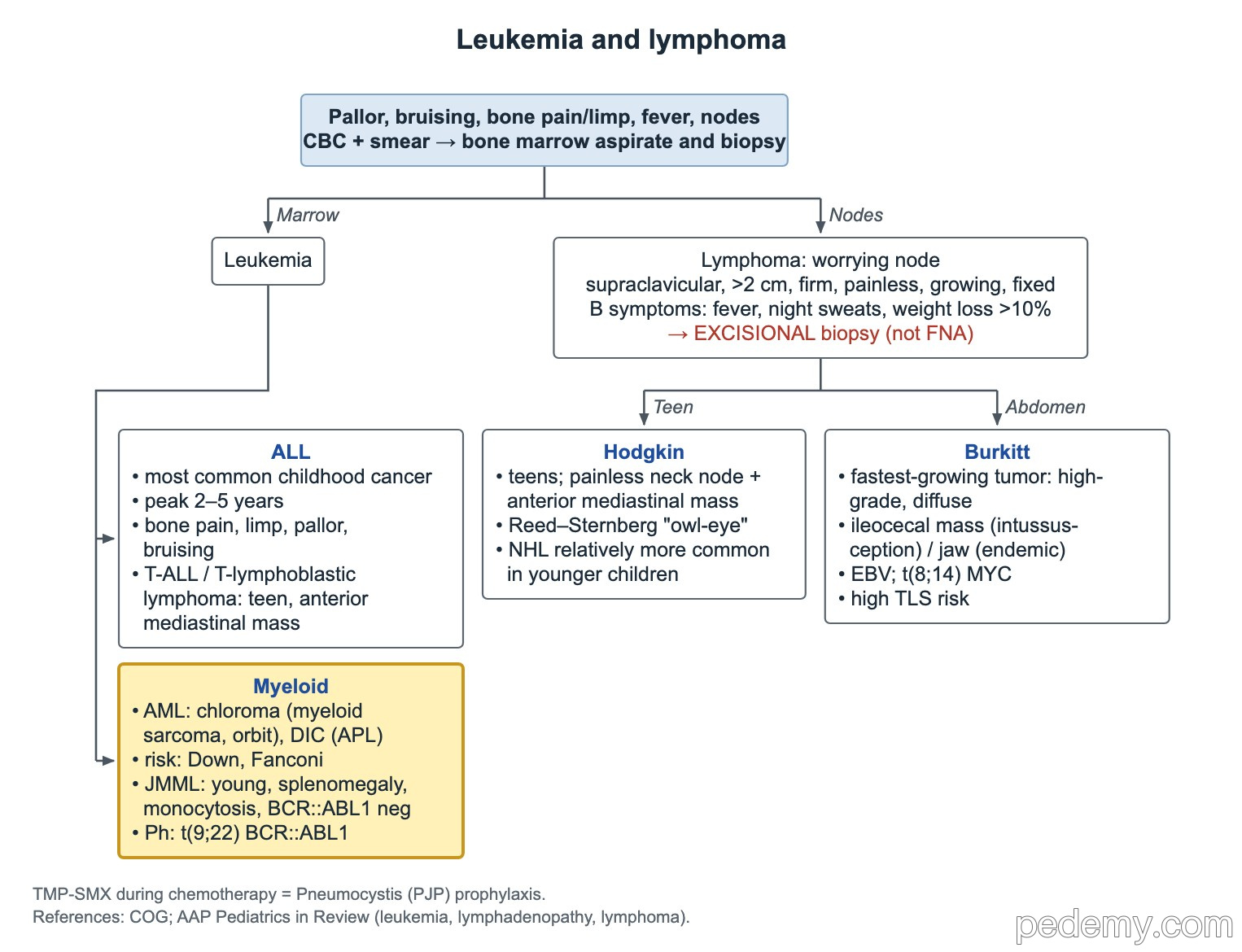
- Myeloid sarcoma (chloroma): a mass of myeloid blasts outside the marrow, for example in the orbit; it goes with AML.
- Acute promyelocytic leukemia (APL) often presents with DIC and bleeding.
- Higher AML risk: Down syndrome and Fanconi anemia.
- Juvenile myelomonocytic leukemia (JMML): young child with splenomegaly, persistent monocytosis and low platelets; BCR::ABL1 is absent.
- JMML is linked to Noonan syndrome (PTPN11; pulmonary stenosis, webbed neck) and to neurofibromatosis type 1.
The worrying lymph node
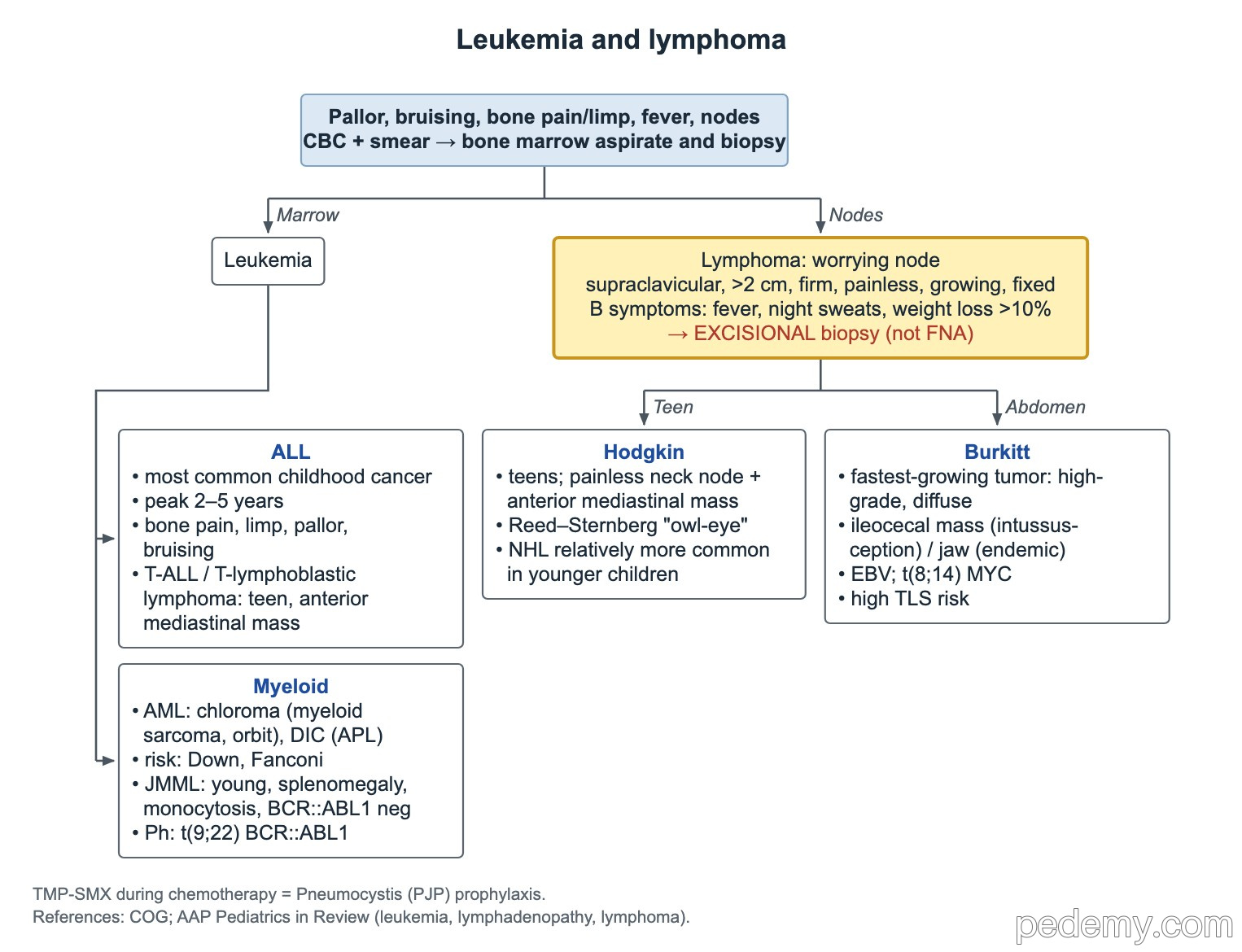
Most enlarged nodes in children are reactive. Worry when a node has features that infection does not explain.
A teenager with a firm, painless, enlarging 3-cm neck node and no clear infection needs prompt specialist review and tissue diagnosis. Excisional biopsy is preferred because a needle sample cannot show the node's structure.
- Supraclavicular location is the most worrying site.
- Size >2 cm, firm or rubbery, painless, fixed, or still growing.
- B symptoms: unexplained fever, drenching night sweats, weight loss >10% in 6 months.
- Get a chest x-ray before sedation for biopsy: a mediastinal mass changes the plan.
Hodgkin lymphoma
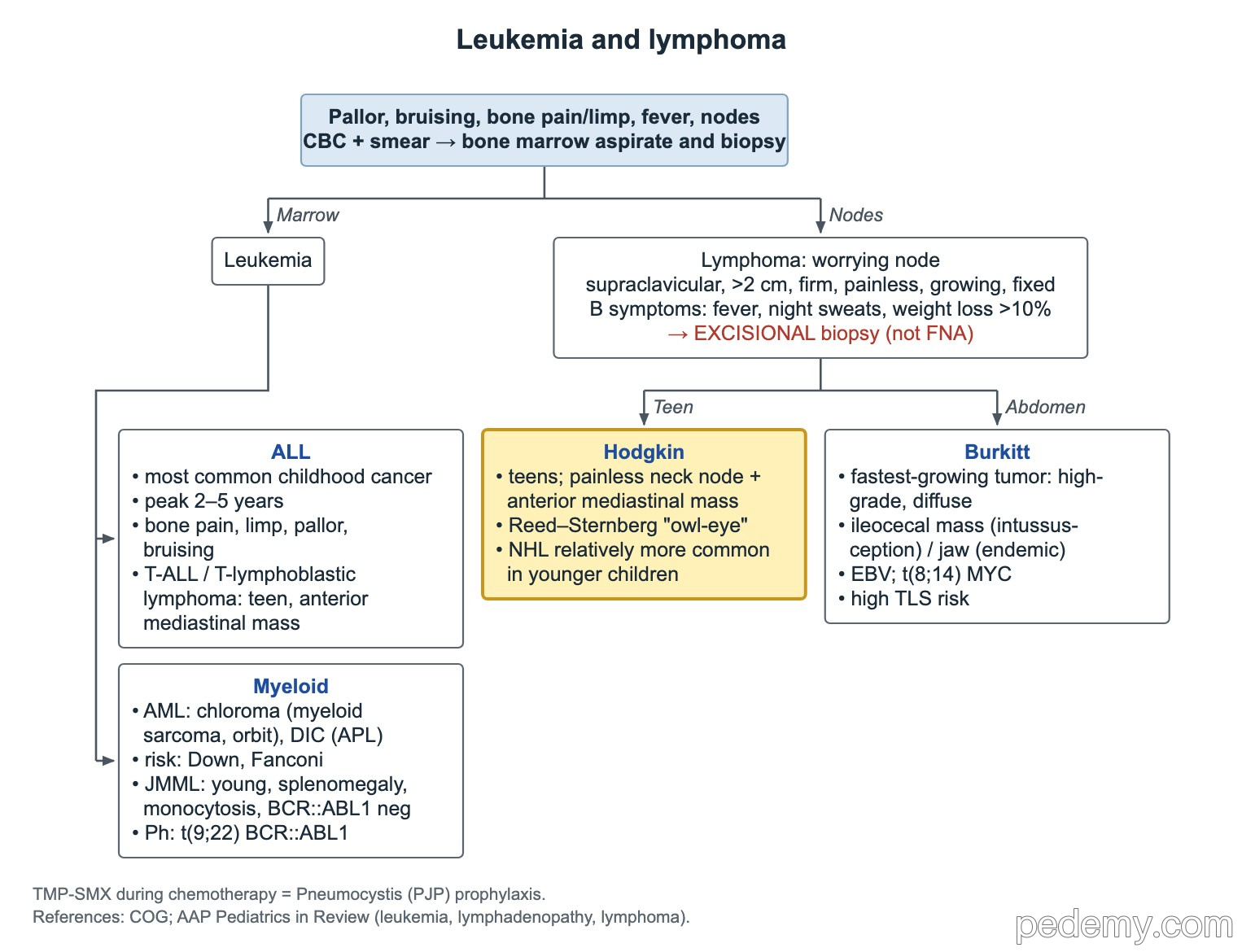
Classic picture: an adolescent with painless neck nodes and an anterior mediastinal mass, sometimes with B symptoms.
The biopsy shows Hodgkin/Reed–Sternberg cells, large cells with paired prominent nucleoli (an “owl-eye” look).
- Age changes the mix: non-Hodgkin lymphoma is relatively more common in younger children; Hodgkin rises sharply in adolescence.
- So no single NHL-to-Hodgkin ratio fits every pediatric age.
Burkitt lymphoma
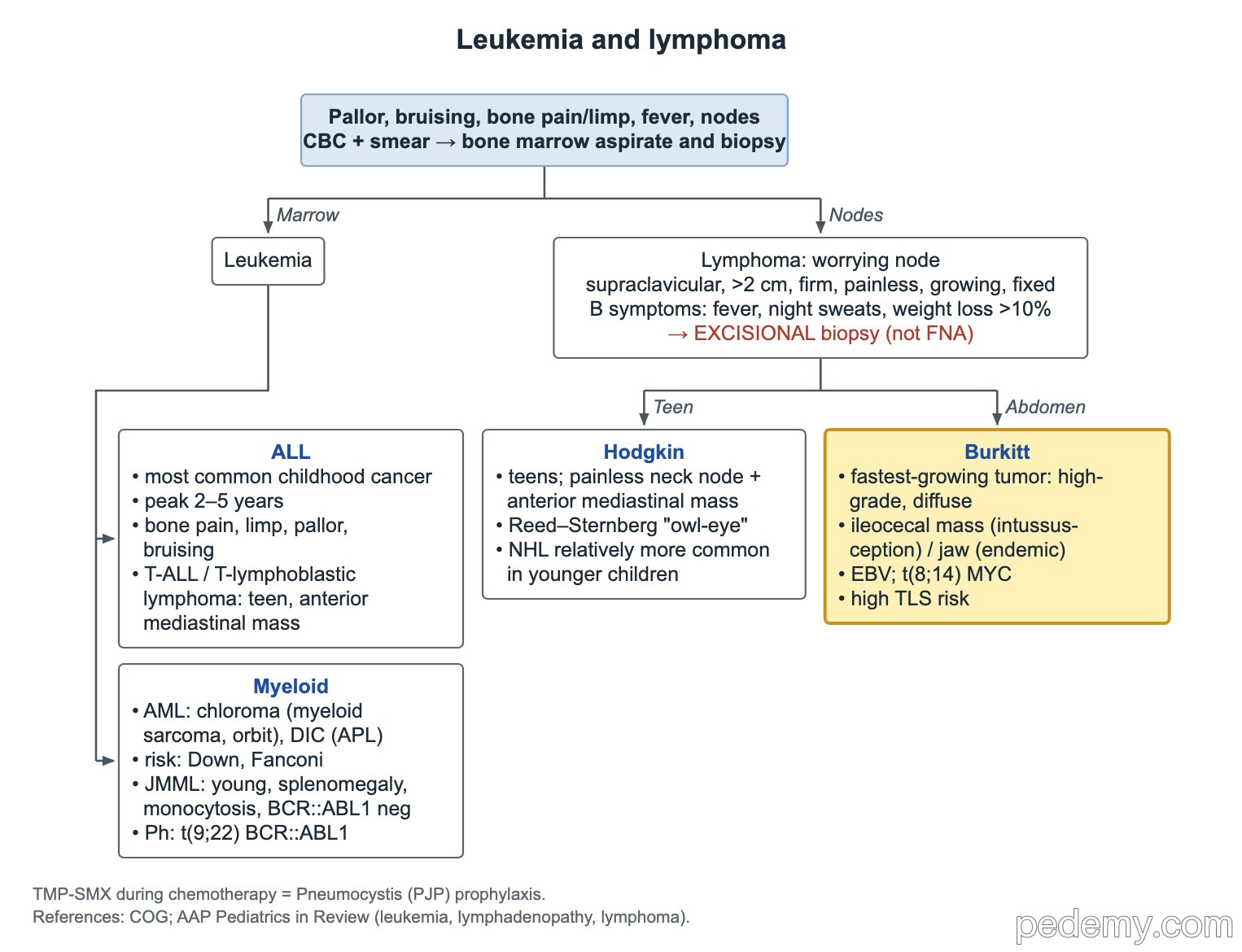
- A mature B-cell lymphoma: high grade, diffuse and the fastest-growing human tumor.
- Sporadic form: rapidly enlarging abdominal (often ileocecal) mass, which can cause intussusception in a child older than the usual age.
- Endemic form: jaw mass.
- Linked to Epstein–Barr virus; t(8;14) moves MYC.
- Very high tumor lysis syndrome risk at diagnosis and at the start of treatment.
Common questions
What is the most common childhood cancer?
Acute lymphoblastic leukemia (ALL). It peaks between 2 and 5 years of age.
Which swollen lymph nodes are concerning in a child?
Supraclavicular nodes, nodes over 2 cm, and nodes that are firm, painless, fixed or keep growing, especially with fever, night sweats or weight loss.
Why do children with leukemia take Bactrim?
TMP-SMX prevents Pneumocystis jirovecii pneumonia during chemotherapy.
Study this topic
Sources
- NCI PDQ: Childhood acute lymphoblastic leukemia treatment (health professional)
- NCI PDQ: Childhood Hodgkin lymphoma treatment (health professional)
- NCI PDQ: Childhood non-Hodgkin lymphoma treatment (health professional)
- NCI PDQ: Juvenile myelomonocytic leukemia treatment
Written for Pedemy in our own words from the sources above; checked November 2026. For education only, not medical advice; check doses and local protocols before treating a patient. Pedemy is independent and not affiliated with or endorsed by the organizations cited.