

Main decision tree
Oncologic emergencies: fever + neutropenia
Key points
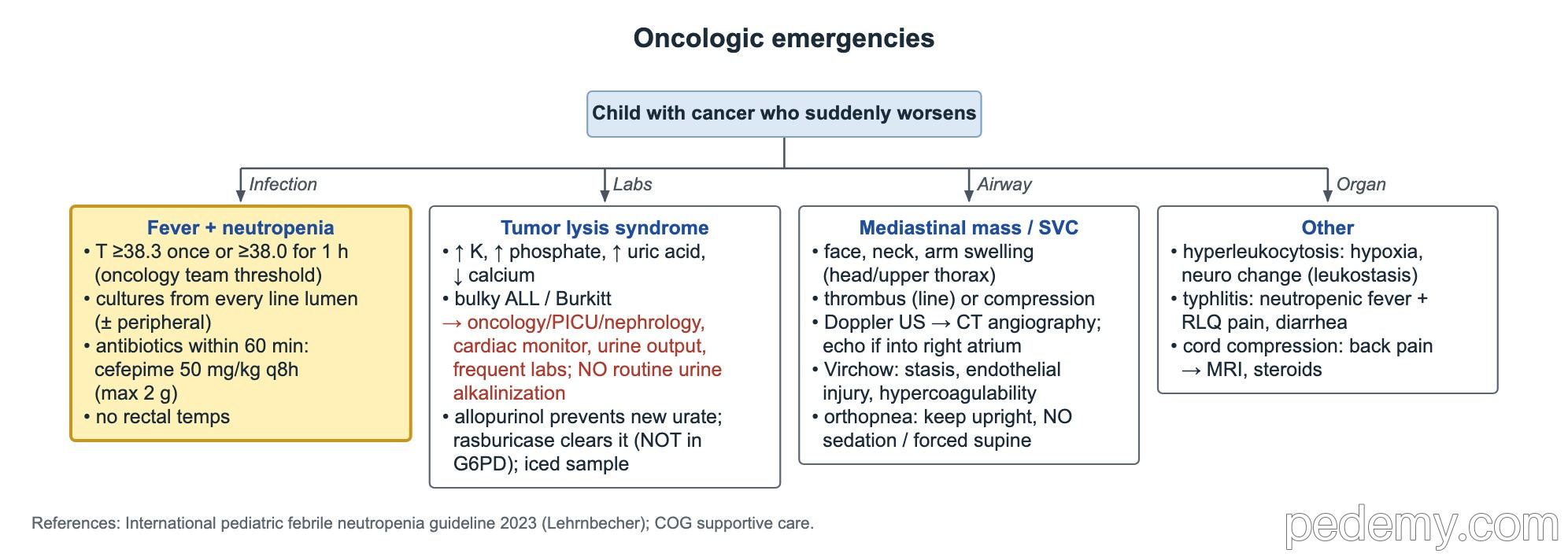
- Fever in neutropenia: one temperature ≥38.3°C (101°F) or ≥38.0°C (100.4°F) for 1 hour; no rectal temperatures.
- Give empiric antibiotics within 60 minutes; cefepime 50 mg/kg IV every 8 hours (max 2 g per dose) is a common choice.
- Tumor lysis syndrome: high potassium, phosphate and uric acid, low calcium.
- Rasburicase breaks down uric acid; allopurinol only stops new uric acid. Rasburicase is contraindicated in G6PD deficiency.
- Routine urine alkalinization is not recommended in tumor lysis.
- Anterior mediastinal mass with orthopnea: keep the child upright; no forced supine position or unplanned sedation.
- SVC syndrome: face, neck, arm and upper chest swelling; Doppler ultrasound first for a line clot, CT angiography to tell clot from mass.
Fever and neutropenia
Neutropenia means an absolute neutrophil count below 500/µL, or one expected to fall below 500. Fever in this setting is an emergency because the child cannot contain bacteria.
Use the oncology team's fever threshold. A common one is a single temperature of 38.3°C (101°F) or higher, or 38.0°C (100.4°F) or higher lasting 1 hour.
- Blood cultures from every lumen of the central line; a peripheral culture is optional.
- Start empiric antibiotics as soon as possible, aiming for within 60 minutes; faster if the child is unstable.
- High-risk febrile neutropenia: monotherapy with an antipseudomonal beta-lactam such as cefepime 50 mg/kg IV every 8 hours (max 2 g per dose) in children ≥2 months with normal kidney function.
- Add a second gram-negative agent or a glycopeptide only if the child is unstable or resistant infection is suspected.
- 2023 international guideline: in a clinically well, afebrile child with low-risk febrile neutropenia and negative cultures at 48 hours, empiric antibiotics can stop even before marrow recovery.
- No rectal temperatures or rectal medicines in neutropenia.
Tumor lysis syndrome
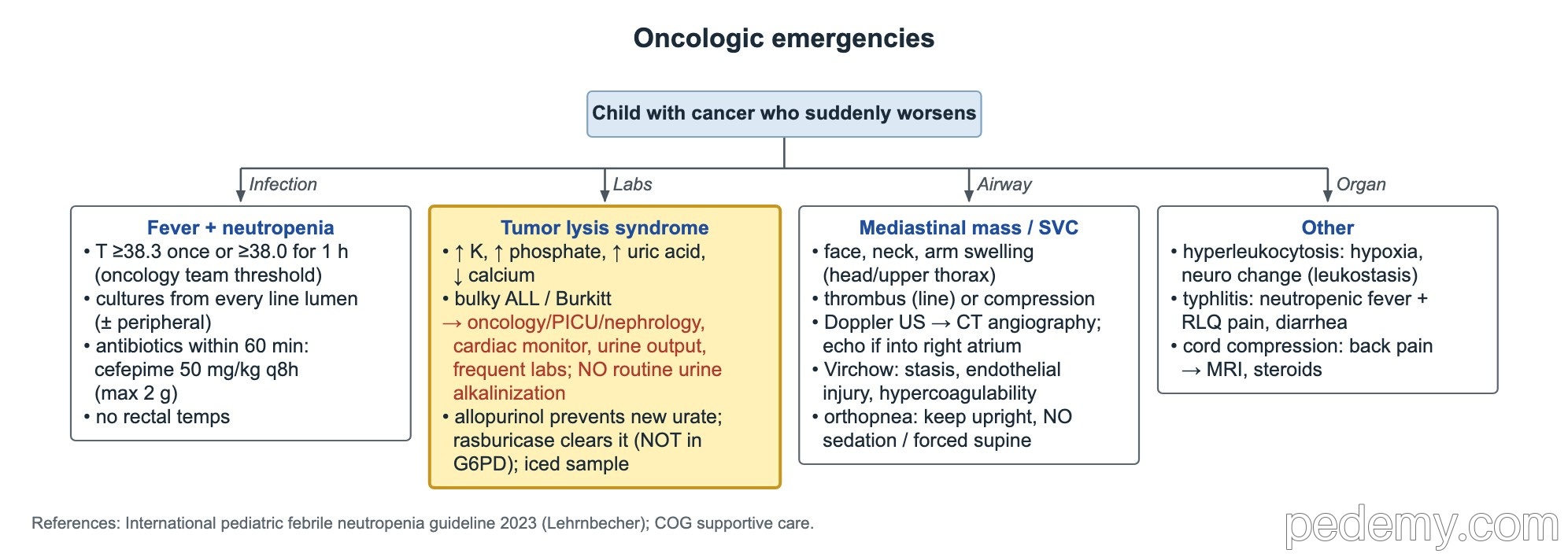
Fast-growing, bulky tumors such as high-count ALL and Burkitt lymphoma release cell contents as they break down, before or soon after treatment starts.
The classic labs are high potassium, high phosphate and high uric acid, with low calcium (phosphate binds calcium). Uric acid and calcium phosphate can block the kidneys.
- Urgent oncology review, with ICU and nephrology input when needed.
- Monitored IV hydration, cardiac monitoring, strict urine output and frequent labs.
- Treat dangerous potassium levels promptly.
- Do not alkalinize the urine routinely.
- Allopurinol prevents new uric acid; rasburicase breaks down uric acid already present.
- Rasburicase is contraindicated in G6PD deficiency (hemolysis and methemoglobinemia).
- After rasburicase, send uric acid in a prechilled heparin tube on ice and process it quickly, or the result is falsely low.
Anterior mediastinal mass and SVC syndrome
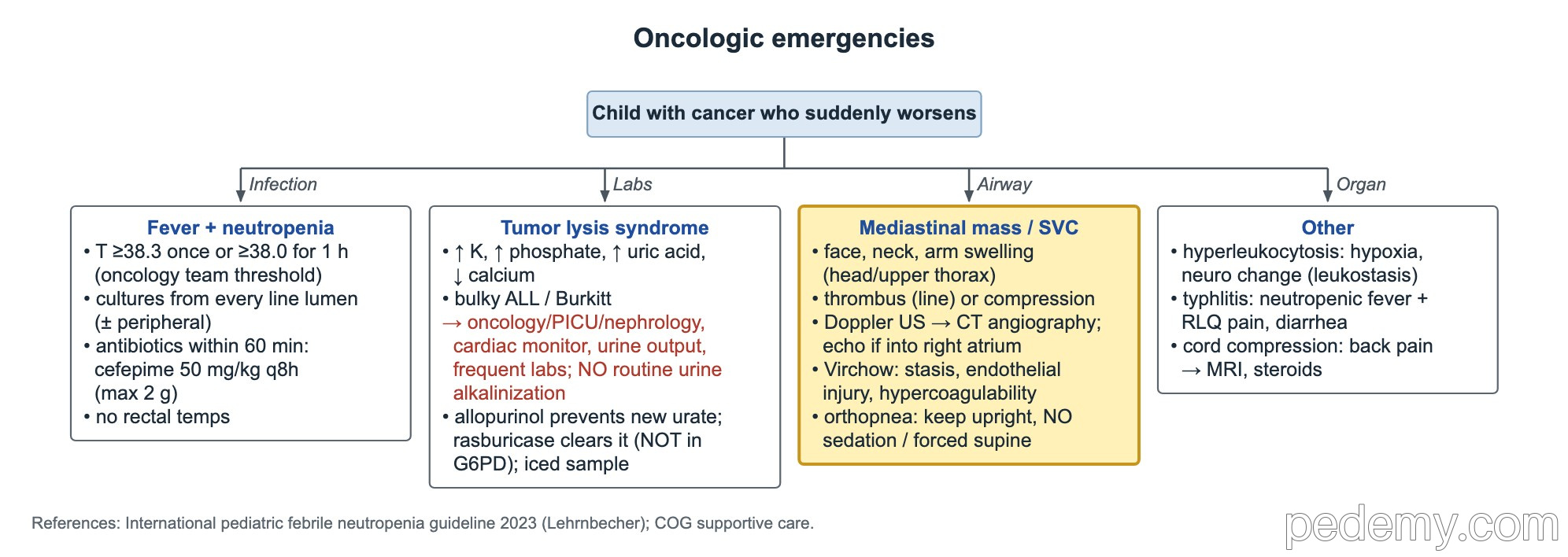
The superior vena cava can be blocked in two ways: a clot inside the vessel, often around a central line, or compression from outside by a mass such as T-cell lymphoblastic lymphoma or Hodgkin lymphoma.
Blocked flow causes swelling of the face, neck, arms and upper chest. The same mass can compress the trachea.
- Central line with new face, neck or arm swelling: start with Doppler ultrasound of the neck and upper chest.
- To tell a clot from an external mass: contrast CT angiography or venography of the chest.
- Clot that may extend into the right atrium: echocardiogram.
- Virchow triad for venous clots: stasis, endothelial injury and hypercoagulability.
- Orthopnea with a mediastinal mass: keep the position of comfort; do not force the child flat and avoid unplanned sedation or anesthesia, which can cause airway collapse.
Hyperleukocytosis, typhlitis and cord compression
| Emergency | Clue | First action |
|---|---|---|
| Hyperleukocytosis / leukostasis | Very high leukemia count (often WBC >100,000/µL) with hypoxia or neurologic change | Call oncology and escalate now; hydration and tumor lysis care; avoid red cell transfusion unless essential (raises viscosity) |
| Neutropenic enterocolitis (typhlitis) | Neutropenic fever with right lower quadrant pain, diarrhea or distension | Imaging (ultrasound or CT shows thick bowel wall), bowel rest, broad-spectrum antibiotics covering anaerobes, surgical review |
| Spinal cord compression | Back pain in a child with cancer, with or without weakness or bladder change | Urgent MRI of the spine and steroids |
Common questions
How fast should antibiotics be given in febrile neutropenia?
As soon as possible, aiming for within 60 minutes of arrival, and sooner if the child is unstable.
Why is rasburicase not given in G6PD deficiency?
Rasburicase makes hydrogen peroxide as it breaks down uric acid, which can cause severe hemolysis and methemoglobinemia in G6PD deficiency.
What are the lab findings of tumor lysis syndrome?
High potassium, high phosphate, high uric acid and low calcium, often with rising creatinine.
Study this topic
Sources
- Guideline for the management of fever and neutropenia in pediatric patients with cancer and HCT recipients: 2023 update (J Clin Oncol)
- Guidelines for the management of pediatric and adult tumor lysis syndrome: an evidence-based review (J Clin Oncol 2008)
Written for Pedemy in our own words from the sources above; checked November 2026. For education only, not medical advice; check doses and local protocols before treating a patient. Pedemy is independent and not affiliated with or endorsed by the organizations cited.