

Main decision tree
Low platelets in children: ITP
Key points
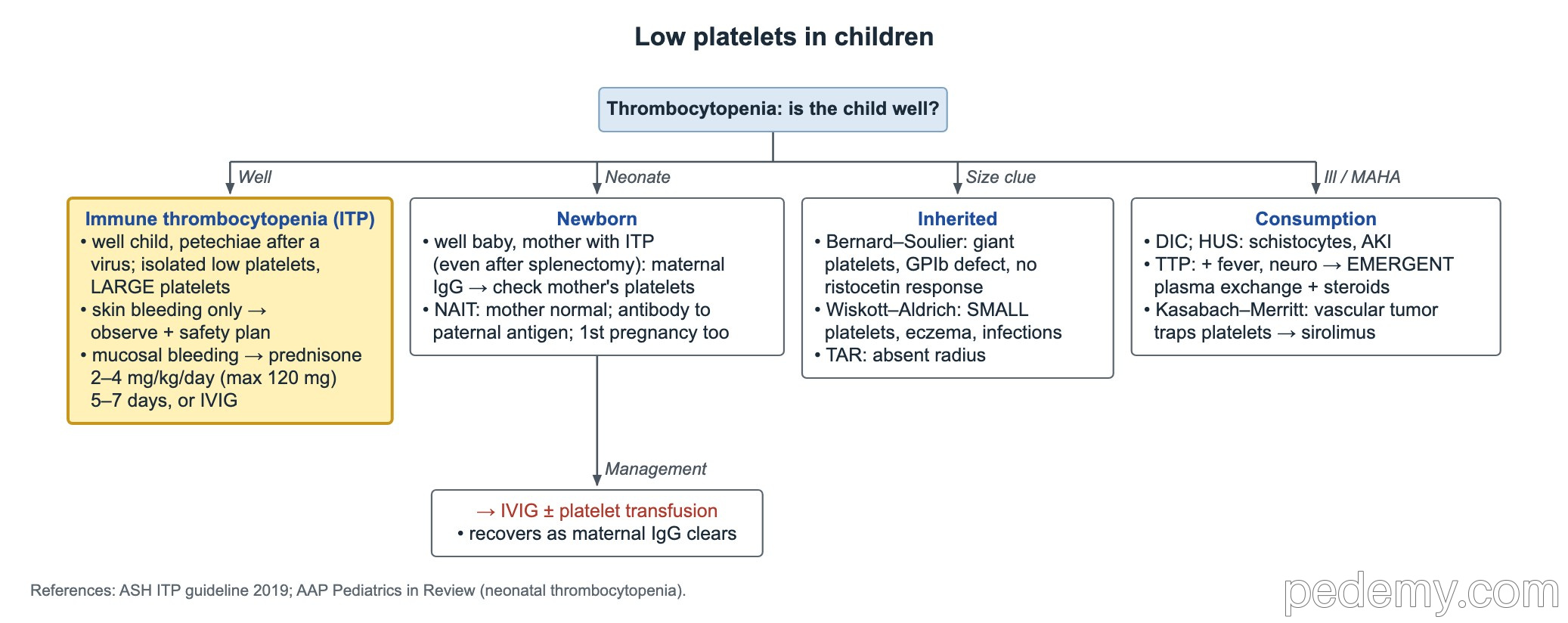
- ITP: well child, petechiae after a viral illness, isolated thrombocytopenia with large platelets; no bone marrow needed.
- ITP with skin bleeding only: observe with a follow-up and safety plan, whatever the platelet count.
- ITP with non-life-threatening mucosal bleeding: prednisone 2–4 mg/kg/day (max 120 mg/day) for 5–7 days, or IVIG.
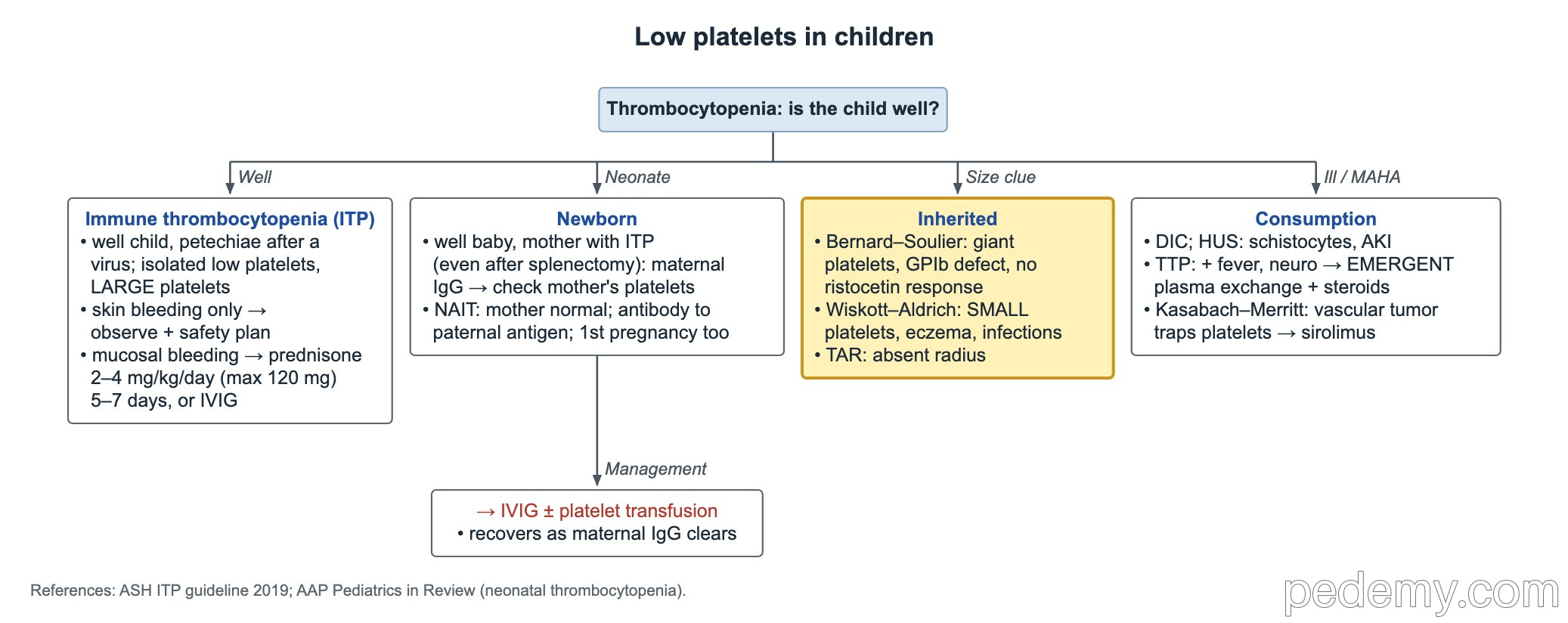
- Small platelets point to Wiskott–Aldrich; giant platelets with no ristocetin response point to Bernard–Soulier.
- Well newborn with low platelets: check the mother's platelet count. Low = maternal ITP; normal = think NAIT.
- HUS: bloody diarrhea, then hemolysis with schistocytes, low platelets and acute kidney injury.
- TTP with fever, neurologic change, hemolysis and low platelets: emergent plasma exchange plus steroids.
Immune thrombocytopenia (ITP)
Childhood ITP typically follows a viral illness. The child looks well, has petechiae and bruises, and the CBC shows isolated thrombocytopenia with large platelets and a normal smear otherwise. Most children recover within months.
- No bone marrow test is needed for a typical presentation.
- Skin bleeding only (bruises, petechiae): observation with a clear follow-up and safety plan, not treatment based on the count alone.
- Non-life-threatening mucosal bleeding when treatment is chosen: prednisone 2–4 mg/kg/day by mouth, maximum 120 mg/day, for 5–7 days; IVIG is an alternative.
- Life-threatening bleeding: platelet transfusion together with IVIG and IV steroids.
- Avoid NSAIDs and aspirin, and limit contact sports while counts are low.
- Atypical features (big spleen or nodes, other low cell lines, bone pain, abnormal smear) need further work-up.
Inherited platelet disorders
| Disorder | Platelets | Other clues |
|---|---|---|
| Bernard–Soulier syndrome | Low count, giant platelets | Defective GPIb-IX-V; no platelet response to ristocetin; mucosal bleeding |
| Wiskott–Aldrich syndrome | Low count, SMALL platelets | Eczema and recurrent infections; X-linked |
| TAR syndrome | Low count, few megakaryocytes | Absent radii with thumbs present |
| ITP (for contrast) | Low count, large platelets | Well child after a viral illness |
Low platelets in a well newborn
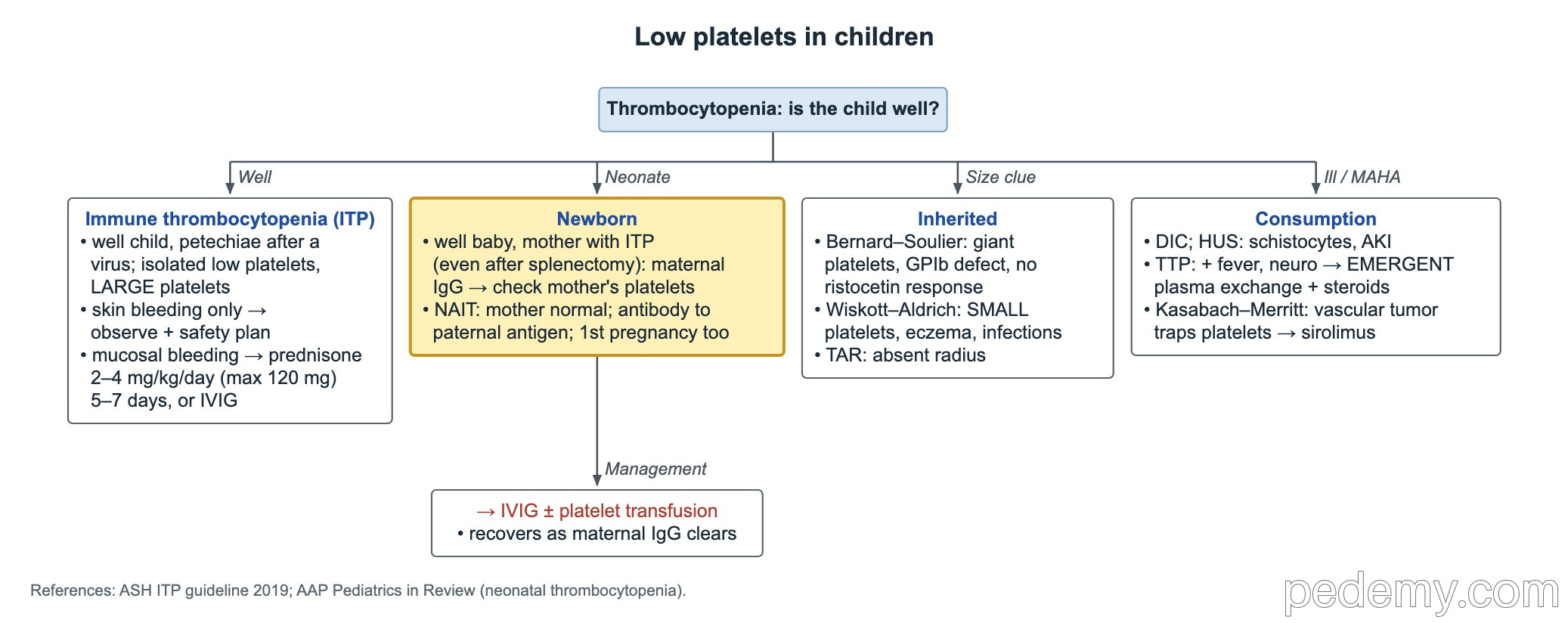
In a healthy-appearing newborn with low platelets, the first lab to check is the mother's platelet count. A sick newborn with low platelets needs a search for sepsis, DIC or necrotizing enterocolitis instead.
- Maternal ITP: maternal IgG crosses the placenta. The mother may have a normal count if she had a splenectomy for ITP, so ask about that history.
- Neonatal alloimmune thrombocytopenia (NAIT): the mother has a normal count but makes IgG against a platelet antigen the fetus inherited from the father.
- NAIT often affects the first pregnancy, and later affected pregnancies tend to be worse.
- NAIT carries a risk of intracranial hemorrhage, sometimes before birth; get a head ultrasound.
Treating neonatal immune thrombocytopenia
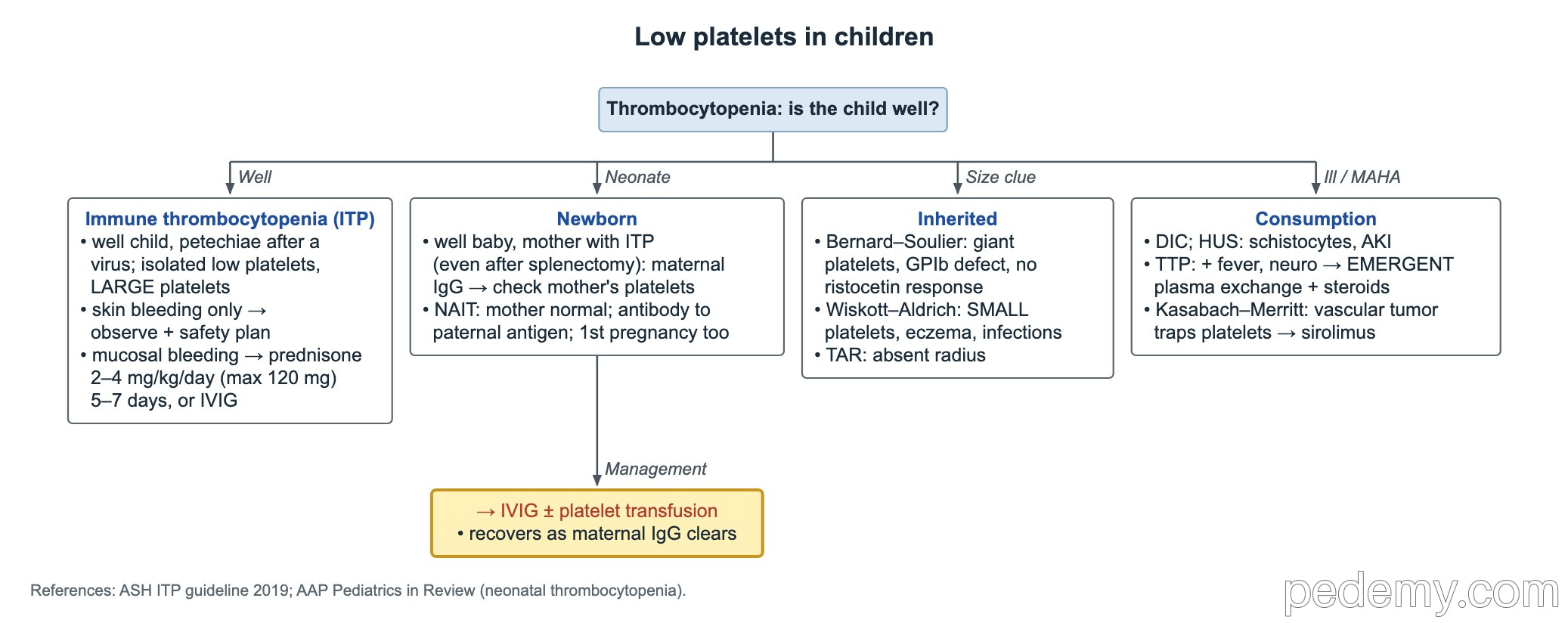
- Bleeding or a very low count: IVIG and/or platelet transfusion.
- In NAIT, antigen-compatible platelets are best, but do not delay transfusion for them in a bleeding baby.
- Counts recover over weeks as the maternal IgG is cleared.
Consumption: HUS, TTP and Kasabach–Merritt
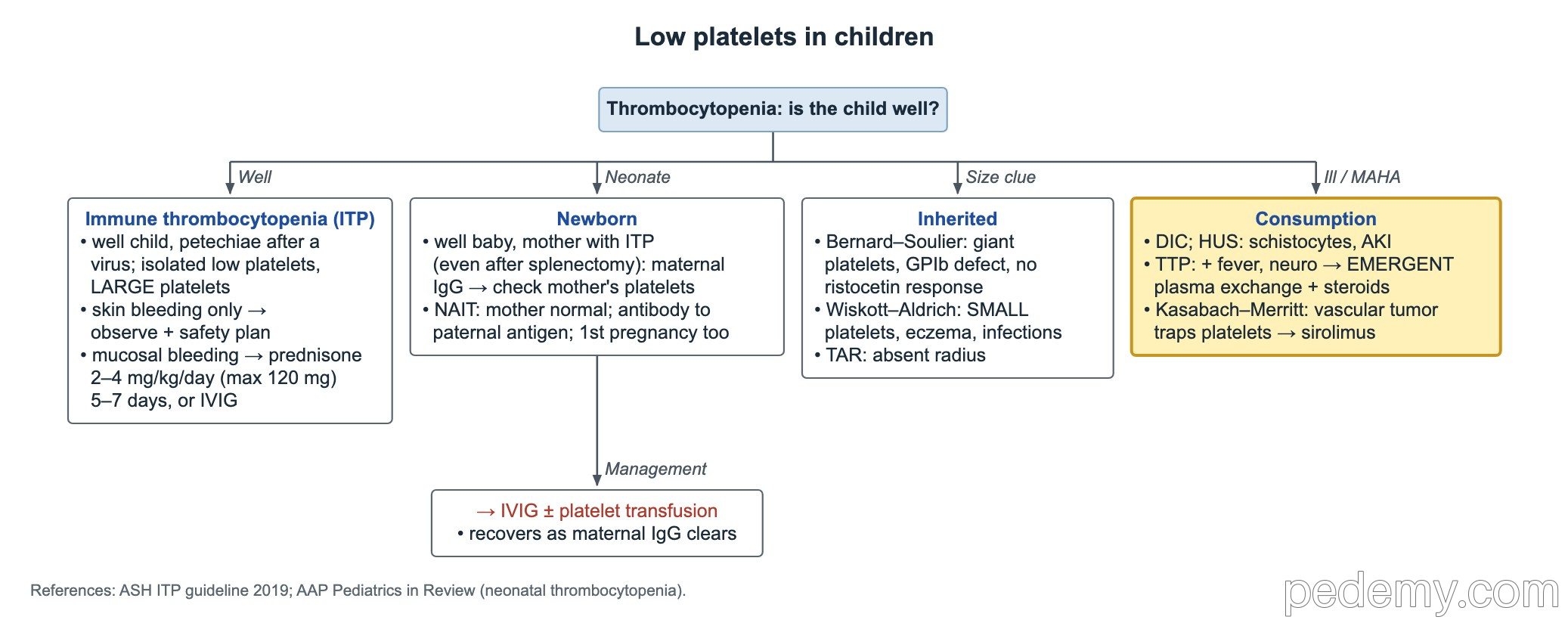
- HUS: bloody diarrhea from Shiga toxin-producing E coli, followed by hemolytic anemia with schistocytes, low platelets and acute kidney injury. Care is supportive.
- TTP: severe deficiency of ADAMTS13. Fever, neurologic change, hemolysis and low platelets need emergent plasma exchange plus corticosteroids.
- DIC: long PT and aPTT, low fibrinogen, low platelets and schistocytes in a sick child.
- Kasabach–Merritt phenomenon: a large vascular tumor (kaposiform hemangioendothelioma or tufted angioma, not a common infantile hemangioma) traps platelets, causing severe thrombocytopenia. Main drug: sirolimus.
Smear clues
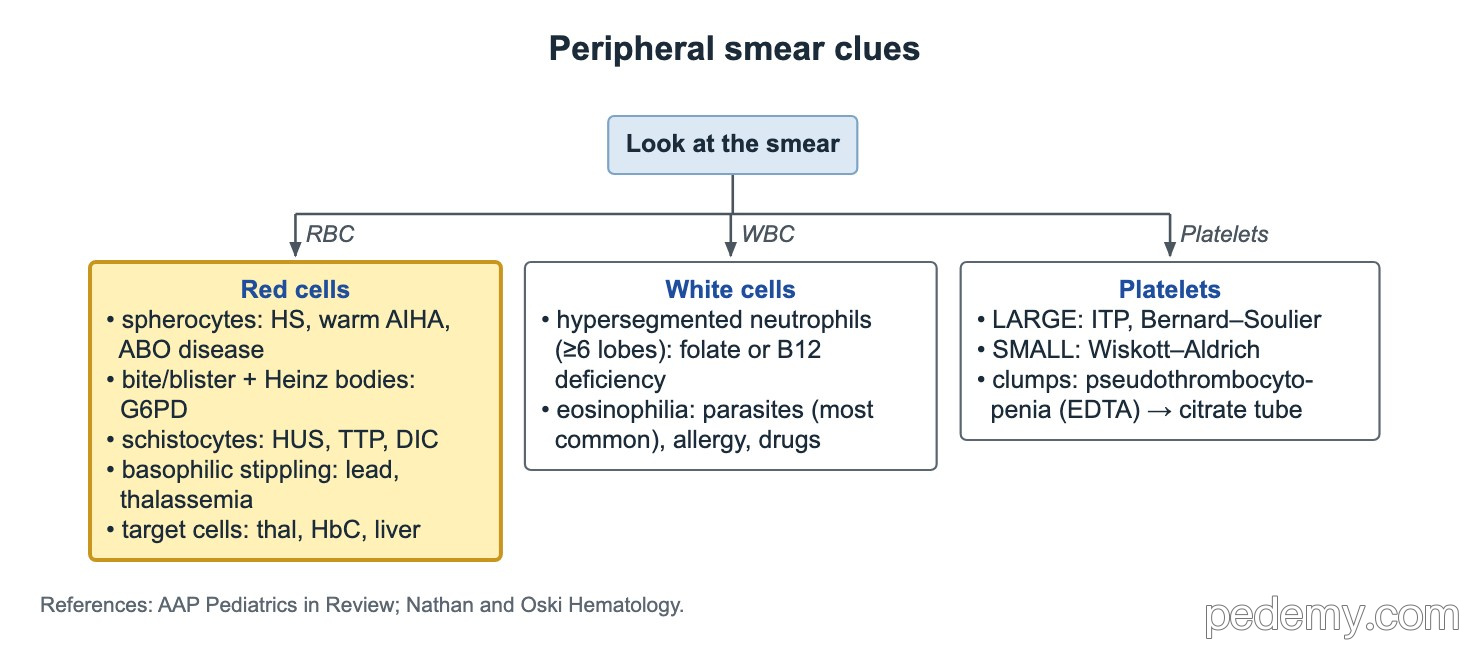
| Smear finding | Think of |
|---|---|
| Schistocytes | HUS, TTP, DIC |
| Spherocytes | Hereditary spherocytosis, warm AIHA, ABO disease |
| Bite and blister cells, Heinz bodies | G6PD deficiency |
| Basophilic stippling | Lead poisoning, thalassemia |
| Target cells | Thalassemia, HbC, liver disease |
Common questions
Does every child with ITP need treatment?
No. Children with only skin bleeding are observed with a follow-up plan, whatever the platelet count. Treatment is for mucosal or more serious bleeding.
Does a child with ITP need a bone marrow test?
Not with a typical picture: a well child with isolated low platelets and a normal smear otherwise. Atypical features need further work-up.
What is the difference between neonatal ITP and NAIT?
In neonatal ITP the mother has ITP and her antibodies cross the placenta. In NAIT the mother's platelets are normal, but she makes antibodies against a paternal platelet antigen on the baby's platelets.
Study this topic
Sources
- ASH 2019 guidelines for immune thrombocytopenia (Blood Advances)
- Updated international consensus report on primary immune thrombocytopenia (Blood Advances 2019)
- ISTH 2020 guidelines for the treatment of thrombotic thrombocytopenic purpura (J Thromb Haemost)
Written for Pedemy in our own words from the sources above; checked November 2026. For education only, not medical advice; check doses and local protocols before treating a patient. Pedemy is independent and not affiliated with or endorsed by the organizations cited.