

Main decision tree
Transfusion: dose, then watch for reactions
Key points
- 10 mL/kg of packed red cells raises the hemoglobin by about 2 g/dL in a child who is not bleeding.
- Stable hospitalized children: transfuse red cells when the hemoglobin is below 7 g/dL.
- Prophylactic platelets in a child with low marrow production: when the count is below 10,000/µL.
- Fever, pain, dark urine or hypotension during a transfusion → stop it, keep the IV open and send the unit plus a patient sample to the blood bank.
- Acute hemolysis = ABO mismatch (recipient IgM); delayed hemolysis at 3–14 days = IgG to minor red cell antigens such as Kidd.
- Irradiation inactivates donor lymphocytes (prevents transfusion-associated GVHD); leukoreduction removes white cells (fewer febrile reactions, HLA sensitization and CMV transmission).
- Sickle cell disease: HbS-negative blood matched for Rh (C, E) and K, and no simple transfusion above Hb 10–11 g/dL.
Acute hemolytic reaction: stop the transfusion
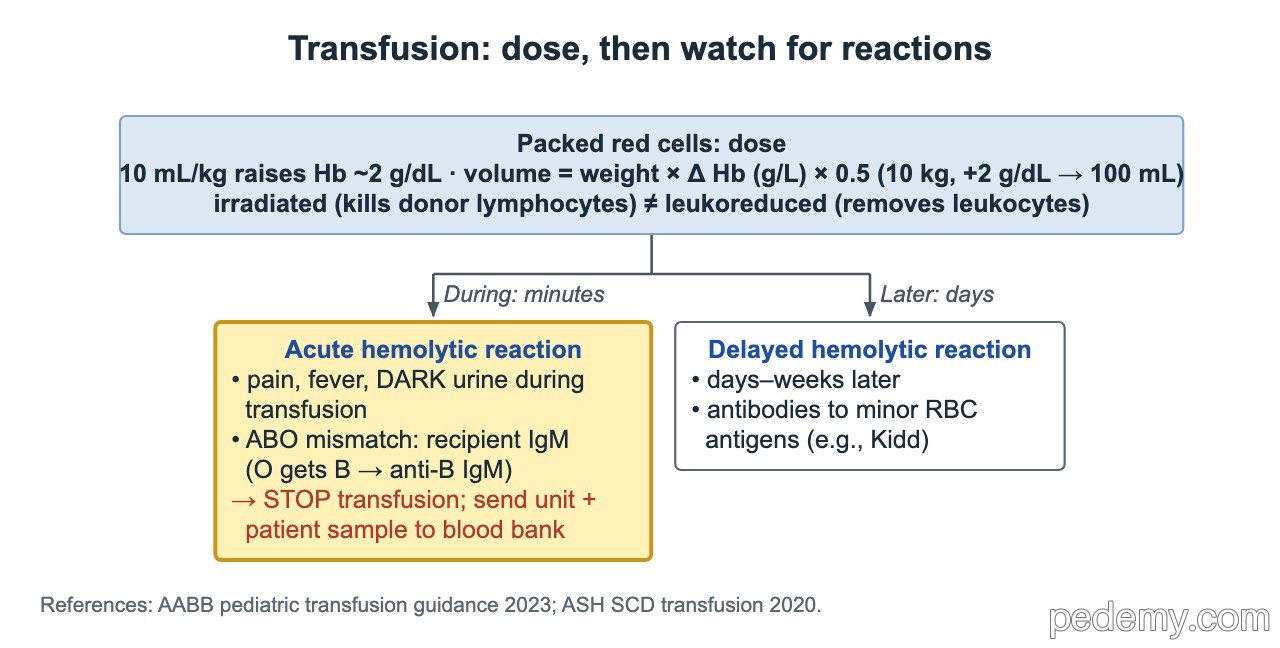
The tree starts with the dose, then splits by timing: reactions during the transfusion (minutes) and reactions days later. The highlighted box is the acute hemolytic reaction.
Acute hemolysis is almost always an ABO mismatch caused by a labeling or bedside identification error. The recipient's preformed IgM binds the donor red cells, fixes complement and destroys them inside the vessels. Example: a group O patient has anti-A and anti-B, so group B cells are destroyed by anti-B IgM.
- Signs: fever, chills, back or flank pain, pain along the IV, hypotension, and dark urine from hemoglobinuria. DIC and kidney injury can follow.
- First action: stop the transfusion immediately and keep the line open with normal saline.
- Check the patient's identity against the unit label, assess and resuscitate, and tell the clinical team and the blood bank.
- Send the remaining blood unit and a fresh patient blood sample to the blood bank for a repeat type, crossmatch and direct antiglobulin test (DAT).
- Check urine for hemoglobin, and labs for hemolysis (bilirubin, LDH, haptoglobin) and DIC.
- Give fluids to keep urine flowing and protect the kidneys.
Other reactions during or soon after a transfusion
Any new fever, rash, breathing trouble or low blood pressure during a transfusion is treated the same way at first: stop, assess, notify the blood bank. The pattern then points to the cause.
- A first-time recipient does not need routine premedication with diphenhydramine or steroids. Look at past reactions before deciding.
| Reaction | Clues | Key point |
|---|---|---|
| Febrile nonhemolytic | Fever and chills, stable patient | Most common; leukoreduced blood lowers the risk; rule out hemolysis and sepsis first |
| Allergic (urticarial) | Hives and itch only | Antihistamine; the transfusion may restart if hives are the only sign |
| Anaphylaxis | Wheeze, hypotension within minutes | Epinephrine; think of IgA deficiency with anti-IgA antibodies → washed or IgA-deficient products |
| TRALI | Hypoxia and bilateral infiltrates within 6 hours, often fever and low blood pressure | Not fluid overload; supportive care |
| TACO | Hypoxia with high blood pressure and signs of fluid overload | Slow the rate, diuretic; small infants and chronic anemia are at risk |
| Septic | High fever, rigors, shock | Platelets carry the highest risk because they are stored at room temperature; culture the unit and the patient |
Delayed hemolytic reaction
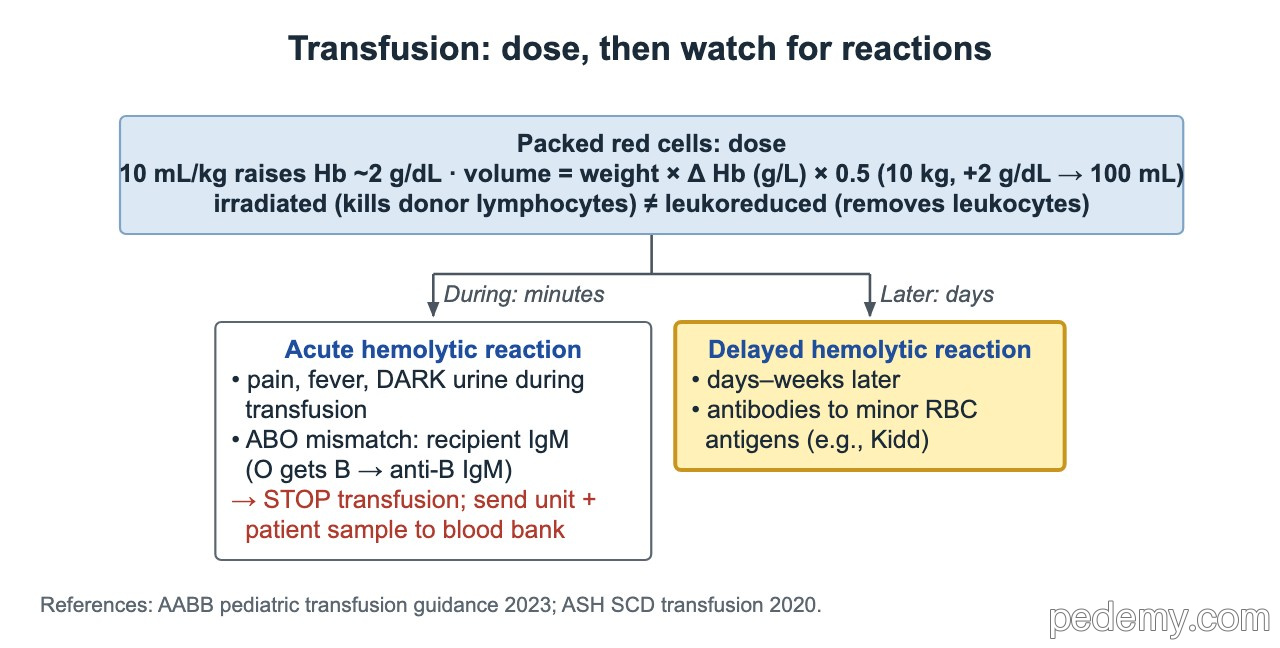
A delayed hemolytic reaction appears 3–14 days after a transfusion. The patient was sensitized to a minor red cell antigen (for example Kidd, Rh or Kell) by an earlier transfusion or pregnancy; the antibody was too low to detect at crossmatch and rises again after re-exposure (an anamnestic IgG response).
Hemolysis is mostly outside the vessels, so the picture is milder: fever, jaundice, dark urine and a hemoglobin that falls back below the expected level. The DAT turns positive and a new alloantibody is found.
- Children with sickle cell disease are at the highest risk because they get many transfusions and the donor and recipient antigens often differ.
- In sickle cell disease the hemoglobin can fall below the level before the transfusion (hyperhemolysis), with new pain; this needs hematology input and more blood may make it worse.
- Record every new antibody so future units are antigen-negative.
How much packed red cells to give
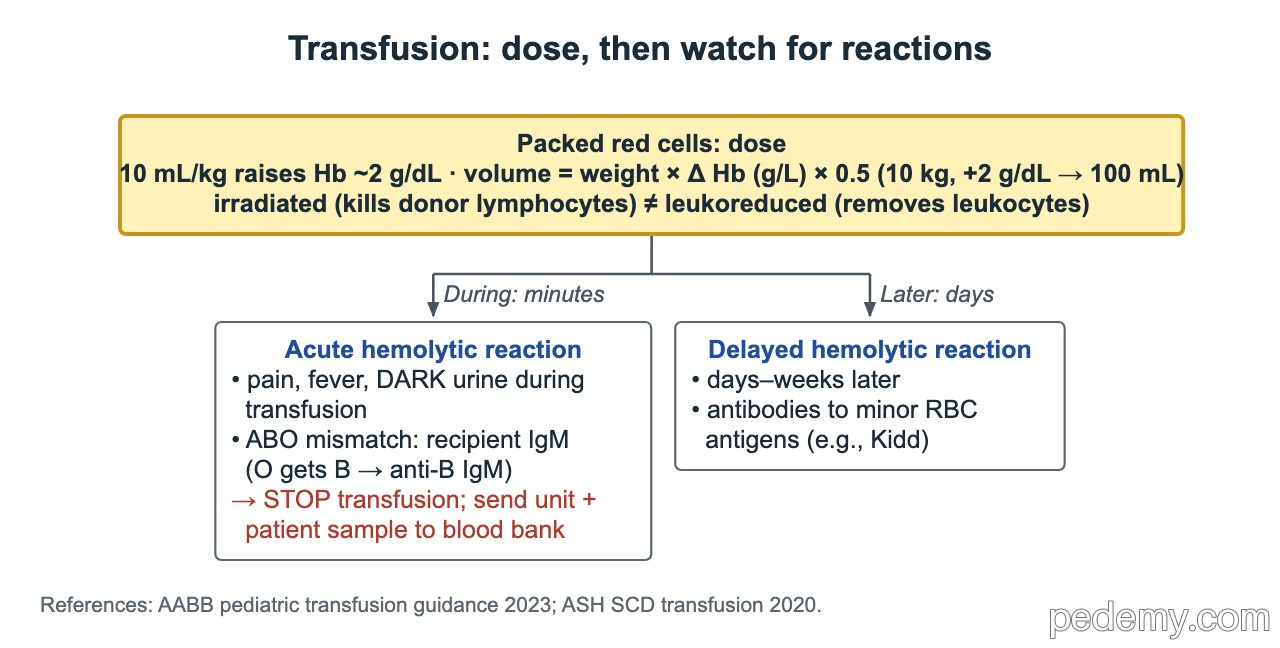
A practical rule: 10 mL/kg of packed red cells raises the hemoglobin by about 2 g/dL in a child who is not bleeding. The result varies with the product's hematocrit and the patient.
To work out a volume: volume (mL) = weight (kg) × desired rise in Hb (g/L) × 0.5. For a 10 kg child and a rise of 2 g/dL (20 g/L): 10 × 20 × 0.5 = 100 mL.
- Usual pediatric volume is 10–15 mL/kg, given over about 3–4 hours; each unit should finish within 4 hours of leaving the blood bank.
- Give smaller volumes more slowly in severe chronic anemia or heart failure to avoid fluid overload.
When to transfuse
Restrictive thresholds are as safe as liberal ones for most children and avoid unneeded exposure to donor blood.
- Red cells: hemoglobin below 7 g/dL in a stable hospitalized child, including children in intensive care.
- Higher thresholds or clinical judgment for active bleeding, shock, cyanotic heart disease, preterm newborns and some cancers.
- Platelets: prophylactic transfusion below 10,000/µL in a child with low production (for example after chemotherapy).
- Higher platelet targets before procedures, with active bleeding or with fever and sepsis.
- Do not transfuse platelets routinely in immune thrombocytopenia (ITP) unless there is life-threatening bleeding.
Irradiated, leukoreduced and other special products
These terms are not interchangeable. Irradiation inactivates donor lymphocytes so they cannot divide and attack the patient. Leukoreduction filters out most donor white cells.
| Product | What it prevents | Main uses |
|---|---|---|
| Irradiated | Transfusion-associated GVHD | Stem cell transplant recipients, congenital T-cell immunodeficiency (SCID, DiGeorge), intrauterine and newborn exchange transfusions, blood from relatives, Hodgkin lymphoma, purine analog chemotherapy |
| Leukoreduced | Febrile reactions, HLA sensitization, CMV transmission | Most products in the US; oncology, transplant and chronically transfused patients |
| Washed | Reactions to plasma proteins | Recurrent severe allergic reactions, IgA deficiency with anti-IgA |
| HbS-negative, antigen-matched | Sickling of donor cells, alloimmunization | Sickle cell disease |
Transfusion in sickle cell disease
Children with sickle cell disease need more careful red cells and a clear target agreed with hematology.
- Use HbS-negative units matched at least for Rh (C, E or C/c, E/e) and K; extended matching is preferred.
- Review the antibody history before every transfusion; antibodies can fade and be missed.
- Do not raise the hemoglobin above about 10–11 g/dL with a simple transfusion: high viscosity can cause stroke or acute chest syndrome.
- Exchange transfusion lowers HbS without raising viscosity; it is used for acute stroke and severe acute chest syndrome.
- Chronic transfusion keeps HbS below 30% after an abnormal TCD or a stroke; watch for iron overload and start chelation when needed.
Common questions
How much does 10 mL/kg of packed red cells raise the hemoglobin?
About 2 g/dL in a child who is not bleeding. The exact rise depends on the unit's hematocrit and the patient.
What is the first step in a suspected transfusion reaction?
Stop the transfusion, keep the IV open with saline, check the patient's identity against the unit, assess and resuscitate, and notify the blood bank. Send back the unit and a new patient sample.
What is the difference between irradiated and leukoreduced blood?
Irradiation inactivates donor lymphocytes and prevents transfusion-associated GVHD. Leukoreduction removes most white cells and lowers the risk of febrile reactions, HLA sensitization and CMV transmission.
Study this topic
Sources
- AABB 2023 international guidelines: red blood cell transfusion (JAMA)
- TAXI-CAB 2022: plasma and platelet transfusion in critically ill children (Pediatr Crit Care Med)
- ASH 2020 guidelines: transfusion support in sickle cell disease (Blood Advances)
Written for Pedemy in our own words from the sources above; checked November 2026. For education only, not medical advice; check doses and local protocols before treating a patient. Pedemy is independent and not affiliated with or endorsed by the organizations cited.