

Main decision tree
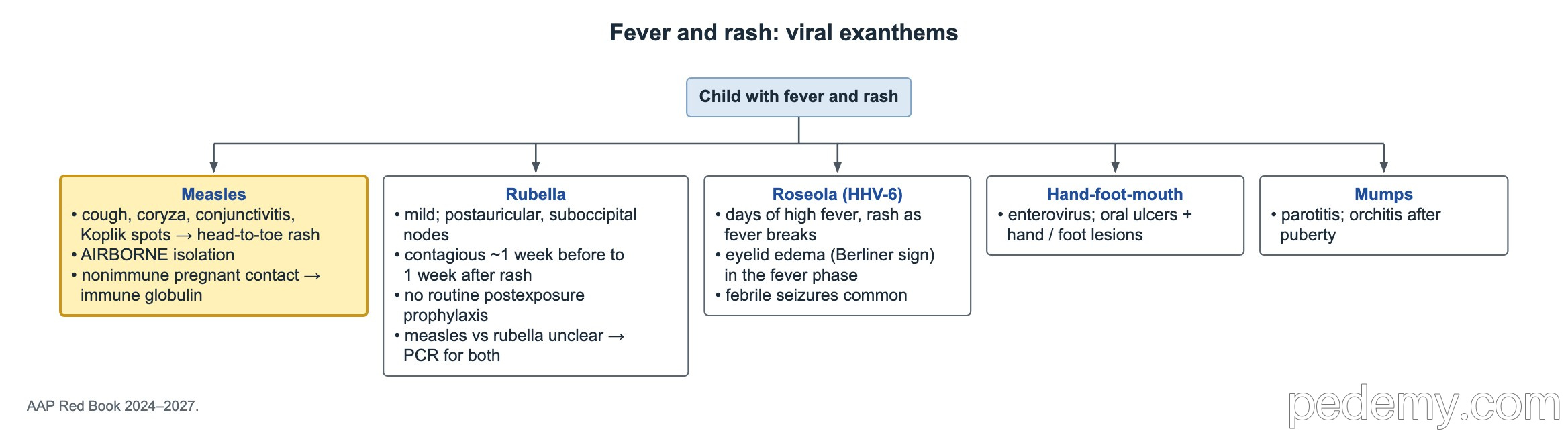
Fever and rash: viral exanthems
Key points
- Measles: high fever with cough, coryza and conjunctivitis, Koplik spots, then a rash from the hairline down; contagious 4 days before to 4 days after the rash; airborne isolation.
- About 90% of nonimmune close contacts of measles become infected.
- Rubella: mild illness with postauricular and suboccipital nodes; contagious about 1 week before to 1 week after the rash; no routine post-exposure prophylaxis.
- Roseola (HHV-6): 3–5 days of high fever, then a rash as the fever breaks; febrile seizures are common.
- Parvovirus B19 is contagious before the slapped-cheek rash, not after it appears.
- Varicella: incubation about 14 days (10–21); contagious 1–2 days before the rash until all lesions crust; airborne plus contact precautions.
- New fever or spreading painful redness after day 3–4 of chickenpox: think invasive group A strep or necrotizing fasciitis.
Measles
Measles starts with 2–4 days of high fever and the 3 Cs: cough, coryza and conjunctivitis. Koplik spots, tiny white specks on red buccal mucosa, appear just before the rash. The maculopapular rash starts at the hairline and spreads down to the trunk and limbs.
- Contagious from 4 days before to 4 days after rash onset; immunocompromised children shed virus for the whole illness.
- Airborne precautions (negative-pressure room, N95) for the infectious period; for the entire illness in immunocompromised children.
- Attack rate in nonimmune close contacts is about 90%.
- Diagnosis: RT-PCR of a throat or nasopharyngeal swab (and urine) plus measles IgM. RT-PCR for both measles and rubella separates them when the picture is unclear.
- Post-exposure: MMR within 72 hours for eligible contacts 6 months and older, or immune globulin within 6 days.
- Nonimmune pregnant contact: IV immune globulin; MMR is contraindicated in pregnancy. Severely immunocompromised contacts also get IV immune globulin.
- All children with measles get vitamin A for 2 days (200,000 IU from 12 months; 100,000 IU at 6–11 months; 50,000 IU under 6 months).
- Complications: otitis media, pneumonia (the main cause of death), encephalitis, and subacute sclerosing panencephalitis (SSPE) years later, with behavior change, myoclonus and periodic EEG complexes, most often after measles in infancy.
Rubella and mumps
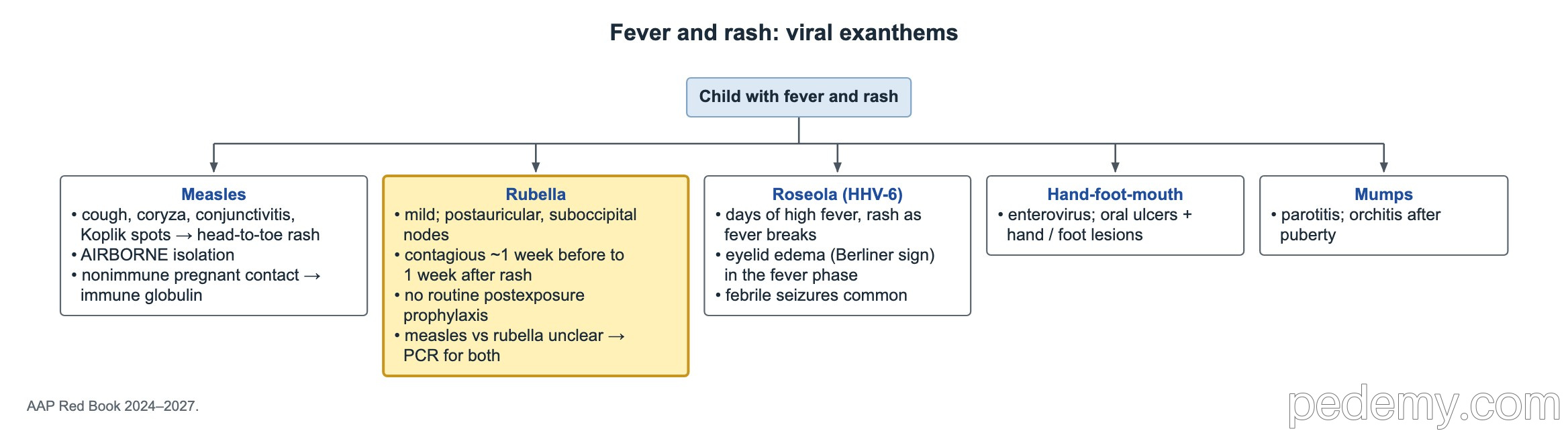
- Rubella is mild: low fever, a pink rash from the face downward and tender postauricular and suboccipital nodes. Adolescent girls may get arthralgia.
- Rubella is contagious from about 1 week before to 1 week after the rash; a child with postnatal rubella returns to school 7 days after the rash began.
- No routine post-exposure vaccine or immune globulin is recommended for rubella contacts; update MMR if due.
- The main danger is to a nonimmune pregnant contact: congenital rubella syndrome (cataracts, deafness, PDA).
- Mumps: parotitis that hides the angle of the jaw and lifts the earlobe. Isolate for 5 days after the swelling starts.
- Mumps complications: orchitis, mostly after puberty; also aseptic meningitis, pancreatitis and hearing loss.
Roseola and hand-foot-mouth disease
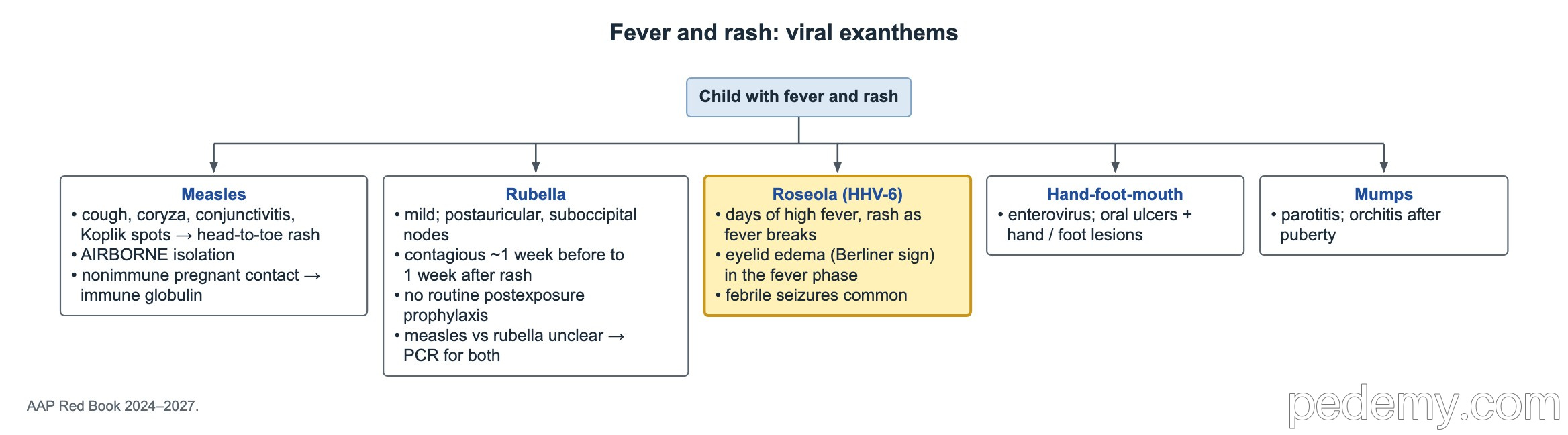
- Roseola (HHV-6, sometimes HHV-7): child aged 6 months to 3 years with 3–5 days of high fever, then a pink truncal rash as the fever breaks.
- Fever-phase clues: eyelid swelling (Berliner sign) and red papules on the soft palate.
- Febrile seizures are the main complication of roseola.
- Hand-foot-mouth disease (enteroviruses, often coxsackievirus): oral ulcers with papules or vesicles on the palms and soles, all at the same stage, with little itch.
- Enterovirus vesicles on the palms and soles help separate it from varicella, which is itchy, starts on the scalp, face and trunk, and has lesions at different stages.
- Both are treated supportively; watch for dehydration from painful mouth ulcers.
Parvovirus B19
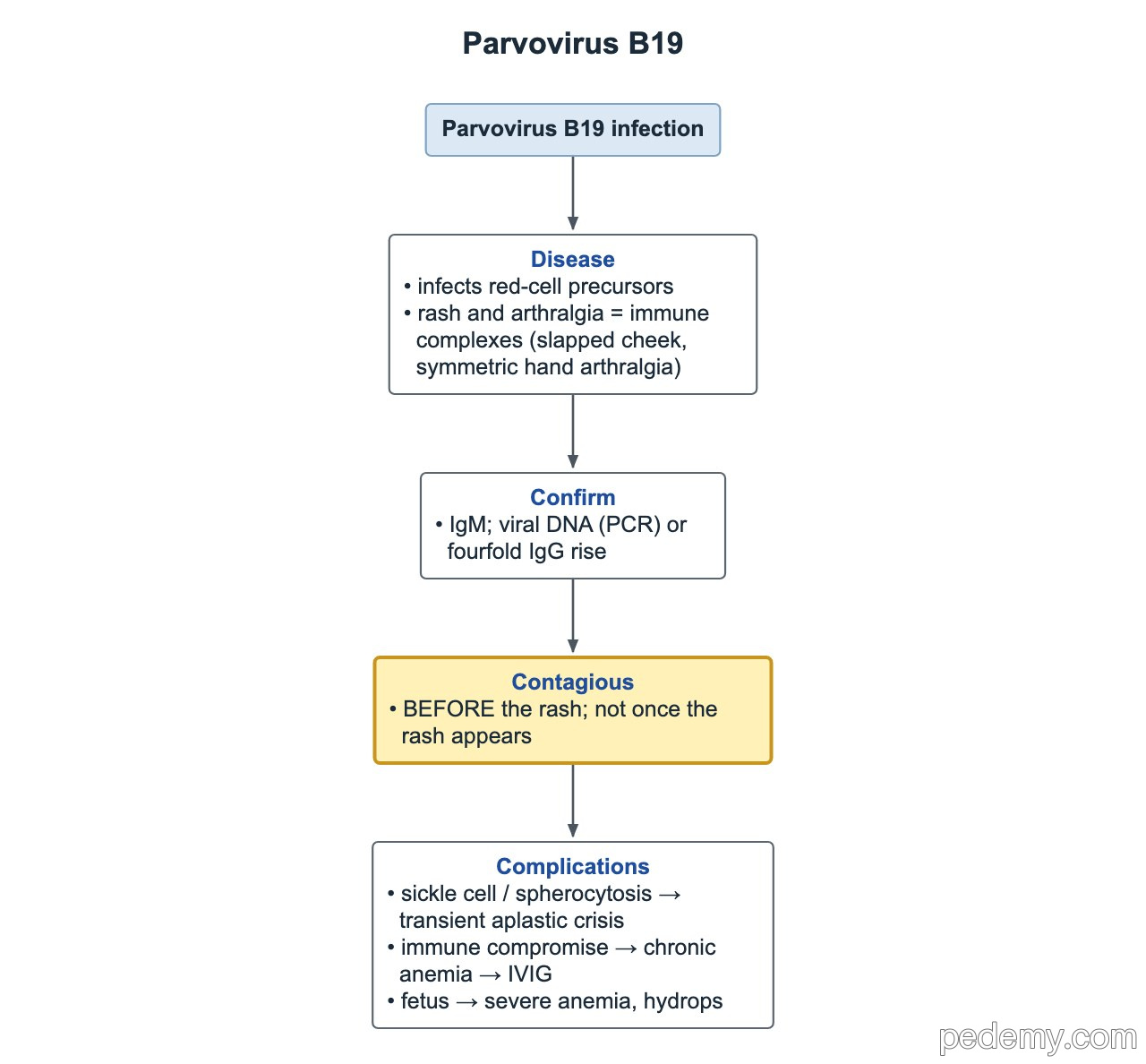
Parvovirus B19 replicates in red-cell precursors. The rash and joint pain come later and are caused by immune complexes, which is why the child is no longer contagious once the rash appears.
- Erythema infectiosum (fifth disease): bright slapped cheeks, then a lacy rash on the arms and legs that can come back with heat or sun for weeks.
- Teens and adults: symmetric small-joint arthralgia of the hands; papular-purpuric gloves-and-socks syndrome with fever and painful purpura of the hands and feet.
- Confirm with parvovirus IgM; B19 DNA by PCR or IgG seroconversion (fourfold rise) also support acute infection.
- Sickle cell disease or spherocytosis: transient aplastic crisis.
- Immunocompromised child without antibodies (for example after transplant): chronic red-cell aplasia; treat with IV immune globulin.
- Pregnancy: fetal anemia and nonimmune hydrops fetalis.
Varicella and herpes zoster
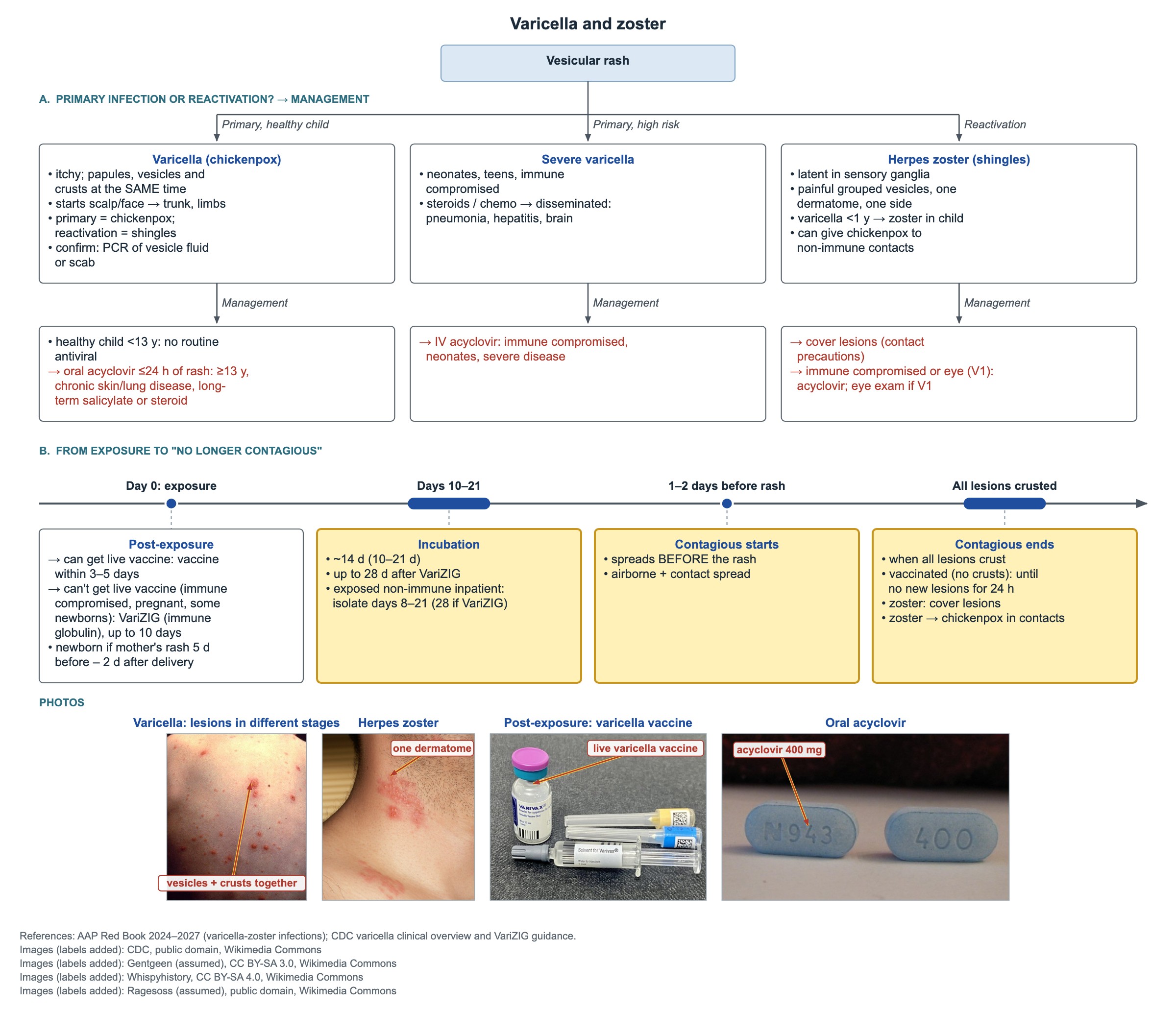
Varicella-zoster virus causes chickenpox as the first infection and shingles when it reactivates from sensory (dorsal root and cranial nerve) ganglia.
- Chickenpox: itchy papules, vesicles and crusts at the same time, starting on the scalp and face and spreading to the trunk and limbs.
- Confirm uncertain cases with PCR of vesicle fluid or crust.
- Incubation about 14 days (10–21 days; up to 28 days after VariZIG).
- Contagious from 1–2 days before the rash until all lesions have crusted. Hospitalized children need airborne plus contact precautions.
- Breakthrough varicella in vaccinated children: mild, often under 50 lesions, mostly macules and papules that may never crust; contagious until no new lesions for 24 hours. Risk is higher if the first dose was given before 15 months or with recent steroids.
- Most severe disease: neonates, adolescents and immunocompromised children (steroids, chemotherapy), who risk pneumonia, hepatitis and encephalitis.
- Treatment: no routine antiviral for healthy children under 13 years; oral acyclovir within 24 hours of rash for age 13 and older, chronic skin or lung disease, or long-term salicylate or steroid use; IV acyclovir for immunocompromised children and neonates.
- Post-exposure: varicella vaccine within 3–5 days for those who can receive it; VariZIG up to 10 days after exposure for nonimmune immunocompromised children, pregnant people and certain newborns.
- Herpes zoster: painful grouped vesicles in one dermatome on one side. Chickenpox in the first year of life raises the risk of zoster in childhood.
- Zoster can give chickenpox to nonimmune contacts (about 2 weeks later). In a healthy child with localized zoster, keep lesions covered until crusted.
- Ramsay Hunt syndrome: ear pain, vesicles in the ear canal and facial palsy, sometimes with tinnitus and vertigo; treat with acyclovir or valacyclovir plus corticosteroids.
HSV skin and mouth infections
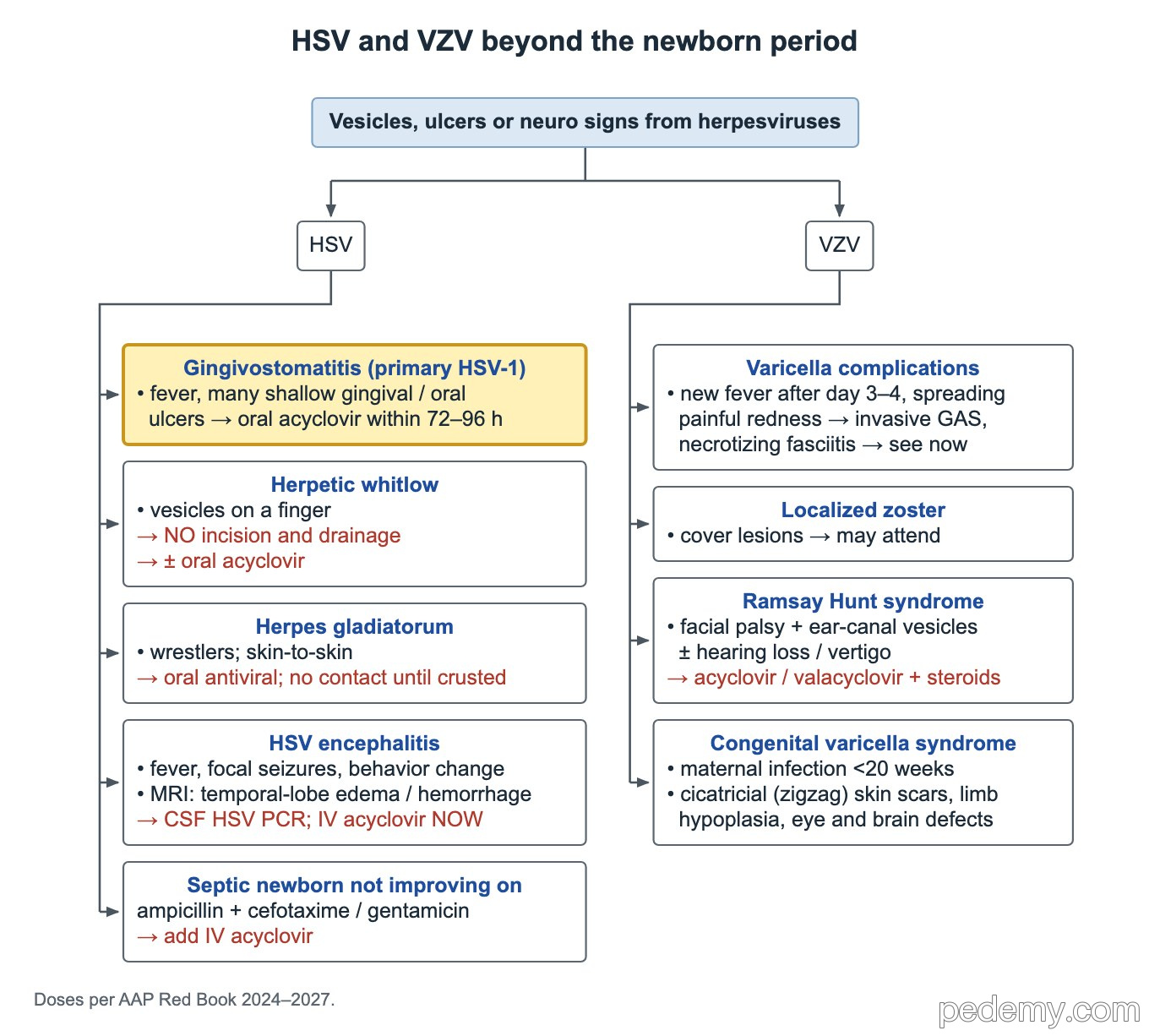
- Primary HSV-1 gingivostomatitis: toddler with fever and many shallow ulcers on the gums and mouth; oral acyclovir helps if started within 72–96 hours.
- Herpetic whitlow: vesicles on a finger. Do not incise and drain; supportive care with or without oral acyclovir. Health care workers with whitlow should not care for newborns until it heals.
- Herpes gladiatorum: grouped vesicles on the face, neck or arms of wrestlers. Oral antiviral; return to wrestling when all lesions are crusted and no new lesions for 72 hours.
- HSV encephalitis: fever, focal seizures and behavior change; temporal-lobe changes on MRI; send CSF HSV PCR and start IV acyclovir at once.
Bacterial rashes and other look-alikes
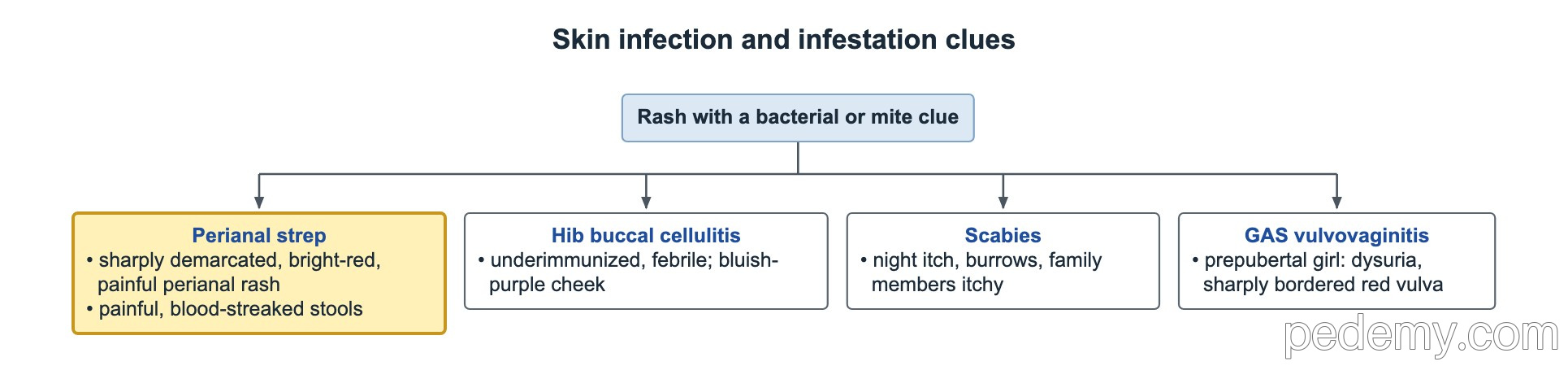
- Scarlet fever and perianal strep are treated with penicillin or amoxicillin for 10 days.
- Confirm group A strep with a rapid antigen test or culture of the throat or perianal skin.
| Condition | Clue |
|---|---|
| Scarlet fever (group A strep) | Sandpaper rash worse in skin folds (Pastia lines), circumoral pallor, strawberry tongue; palms and soles spared; later peeling |
| Perianal group A strep | Sharply bordered, bright-red, painful perianal rash; painful, blood-streaked stools |
| Hib buccal cellulitis | Underimmunized febrile child with a bluish-purple cheek |
| Invasive GAS after varicella | New fever after day 3–4 of chickenpox with spreading, painful redness: see now for necrotizing fasciitis |
| EBV with amoxicillin | Teen with sore throat, posterior nodes and a big spleen gets a rash after amoxicillin; usually not a true penicillin allergy |
| COVID toes | Purple-red painful pernio-like macules on the toes during SARS-CoV-2 infection |
Common questions
How long is a child with measles contagious?
From 4 days before the rash starts until 4 days after it appears. Immunocompromised children can shed virus for the whole illness.
When can a child with chickenpox go back to school?
When all lesions have crusted. Vaccinated children with breakthrough varicella whose spots never crust can return when no new lesions have appeared for 24 hours.
Is a child with fifth disease contagious?
Contagiousness is greatest before the slapped-cheek rash. Once the rash appears, a healthy child is usually no longer contagious and can attend school.
What is the incubation period of chickenpox?
About 14 days, with a range of 10–21 days. It can be up to 28 days after VariZIG.
Study this topic
Sources
- CDC: Clinical overview of measles
- CDC: Clinical overview of chickenpox (varicella)
- ACIP 2013: Prevention of measles, rubella, congenital rubella syndrome and mumps (MMWR)
- AAP Red Book 2024–2027: Report of the Committee on Infectious Diseases
Written for Pedemy in our own words from the sources above; checked November 2026. For education only, not medical advice; check doses and local protocols before treating a patient. Pedemy is independent and not affiliated with or endorsed by the organizations cited.