

Main decision tree
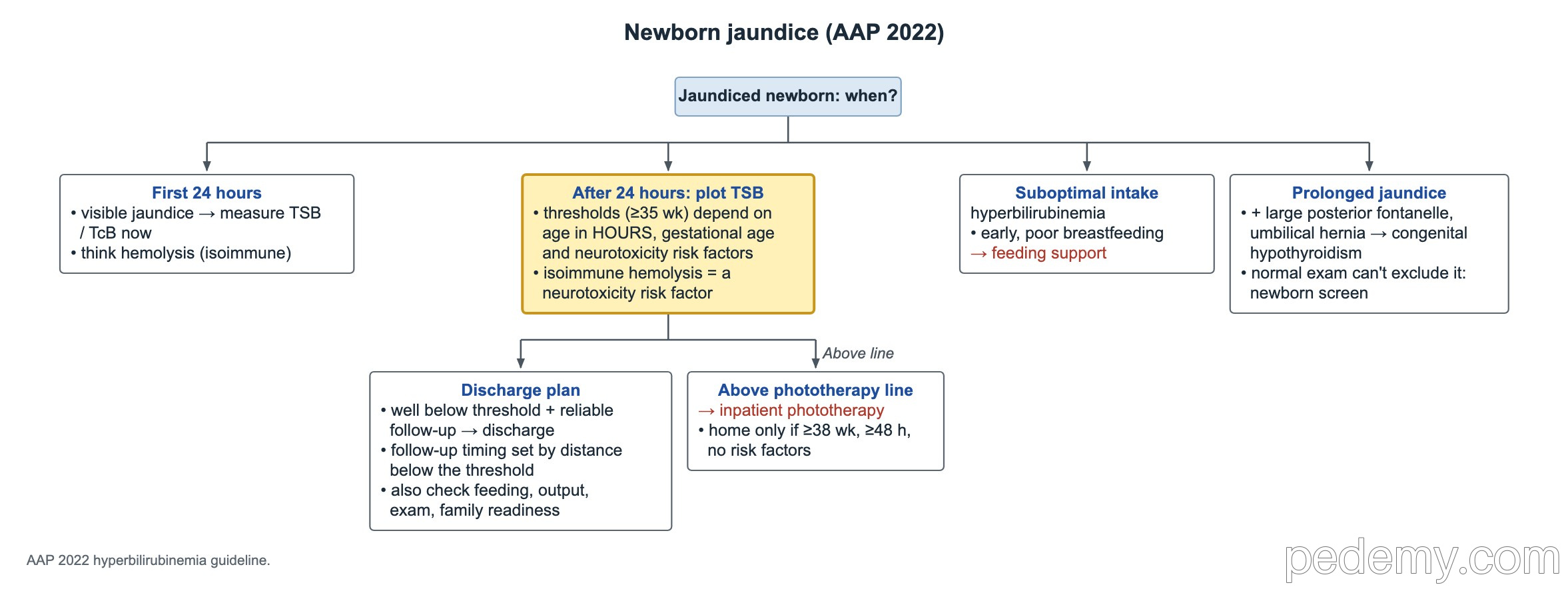
Newborn jaundice (AAP 2022)
Key points
- Check glucose in at-risk newborns (late preterm, SGA, LGA, infant of a diabetic mother) and in any baby with symptoms.
- Symptoms: jitteriness, poor feeding, lethargy, hypotonia, apnea, cyanosis, hypothermia, seizures.
- Glucose repeatedly below 60 mg/dL after 48 hours is not normal transition: look for a persistent cause.
- Hyperinsulinism: glucose infusion above 8 mg/kg/min, low ketones, and a glucose rise over 30 mg/dL after glucagon.
- Visible jaundice in the first 24 hours is never physiologic: measure bilirubin now and look for hemolysis.
- AAP 2022: phototherapy thresholds depend on age in hours, gestational age and neurotoxicity risk factors.
- Jaundice beyond 2 weeks: check total and direct bilirubin; a direct value above 1 mg/dL needs a cholestasis work-up.
Who needs a glucose check
After birth, glucose falls for the first hours and then rises as the baby feeds. Screening targets babies whose transition is likely to fail.
- Late preterm (34–36 6/7 weeks), small or large for gestational age, and infants of diabetic mothers.
- Any baby with symptoms, or with sepsis, hypothermia or perinatal stress.
- Feed early, within the first hour, and check glucose about 30 minutes after the first feed.
- Bedside meters are least accurate at low values; confirm with a laboratory sample without delaying treatment.
Treating low glucose in the first 24 hours
The AAP 2011 approach uses lower cut-offs in the first 4 hours than from 4 to 24 hours. Feeding is first-line for a well baby; IV dextrose is for symptoms or very low values.
- IV glucose: 200 mg/kg (2 mL/kg of 10% dextrose), then an infusion of about 5–8 mg/kg/min.
- Aim for 45 mg/dL or more before feeds in the first day.
- Severe or prolonged symptomatic hypoglycemia can injure the parieto-occipital cortex and white matter, with later vision and developmental problems.
| Age | Glucose | Action (asymptomatic baby) |
|---|---|---|
| 0–4 hours | Below 25 mg/dL | Feed and recheck in 1 hour; still below 25 → IV glucose |
| 0–4 hours | 25–40 mg/dL after recheck | Feed again or IV glucose as needed |
| 4–24 hours | Below 35 mg/dL | Feed and recheck in 1 hour; still below 35 → IV glucose |
| 4–24 hours | 35–45 mg/dL after recheck | Feed again or IV glucose as needed |
| Any age, with symptoms | Below 40 mg/dL | IV glucose now |
Persistent hypoglycemia and hyperinsulinism
- After 48 hours, keep glucose above 60 mg/dL; above 70 mg/dL when a genetic hypoglycemia disorder is suspected (PES 2015).
- Draw the critical sample during hypoglycemia, before treatment: glucose, insulin, beta-hydroxybutyrate, free fatty acids, cortisol, growth hormone.
- Hyperinsulinism: low ketones and fatty acids (insulin blocks fat breakdown), need for more than 8 mg/kg/min of glucose, and a rise over 30 mg/dL after glucagon.
- Infants of diabetic mothers have transient hyperinsulinism from fetal exposure to high glucose.
- Perinatal-stress hyperinsulinism (SGA, asphyxia) can last weeks and often responds to diazoxide, which opens beta-cell KATP channels.
- Also think of Beckwith–Wiedemann syndrome (macroglossia, omphalocele, overgrowth), hypopituitarism and glycogen storage disease.
Jaundice: measure, plot, decide
The AAP 2022 guideline covers infants born at 35 weeks or later. Every newborn gets a bilirubin measurement (transcutaneous or serum) before discharge, and the value is plotted against the hour-specific threshold.
- Visible jaundice in the first 24 hours: measure bilirubin now; think isoimmune hemolysis.
- Use serum bilirubin when the skin reading is 15 mg/dL or more, or within 3 mg/dL of the phototherapy threshold.
- Neurotoxicity risk factors lower the threshold: albumin below 3.0 g/dL, isoimmune hemolytic disease, G6PD deficiency or other hemolysis, sepsis, and clinical instability in the last 24 hours.
- Escalation of care starts when bilirubin is within 2 mg/dL of the exchange threshold: intensive phototherapy, labs, and IVIG for isoimmune disease.
- Exchange transfusion at the exchange threshold or with signs of acute bilirubin encephalopathy.
Physiologic, feeding-related or pathologic?
| Type | Timing and clues | Management |
|---|---|---|
| Physiologic | After 24 hours; peaks around day 3–5 in term babies; gone by 1–2 weeks | Routine follow-up |
| Suboptimal intake | First week; poor breastfeeding, large weight loss, few wet diapers | Feeding support; supplement with expressed milk if needed |
| Breast milk jaundice | From the end of week 1; thriving baby, normal stools; can last 2–3 months | Keep breastfeeding |
| ABO hemolysis | Mother O, baby A or B; DAT often weakly positive; can occur in a first pregnancy | Earlier phototherapy; counts as a neurotoxicity risk factor |
| Rh (anti-D) hemolysis | Rh-negative mother sensitized in an earlier pregnancy; can cause hydrops | Early phototherapy; IVIG and exchange if rising |
Discharge and follow-up
The follow-up time depends on how far the last bilirubin is below the phototherapy threshold and on the baby's age: the closer to the line and the younger the baby, the sooner the recheck. Check feeding, output, weight and the family's follow-up plan as well as the number.
Prolonged jaundice
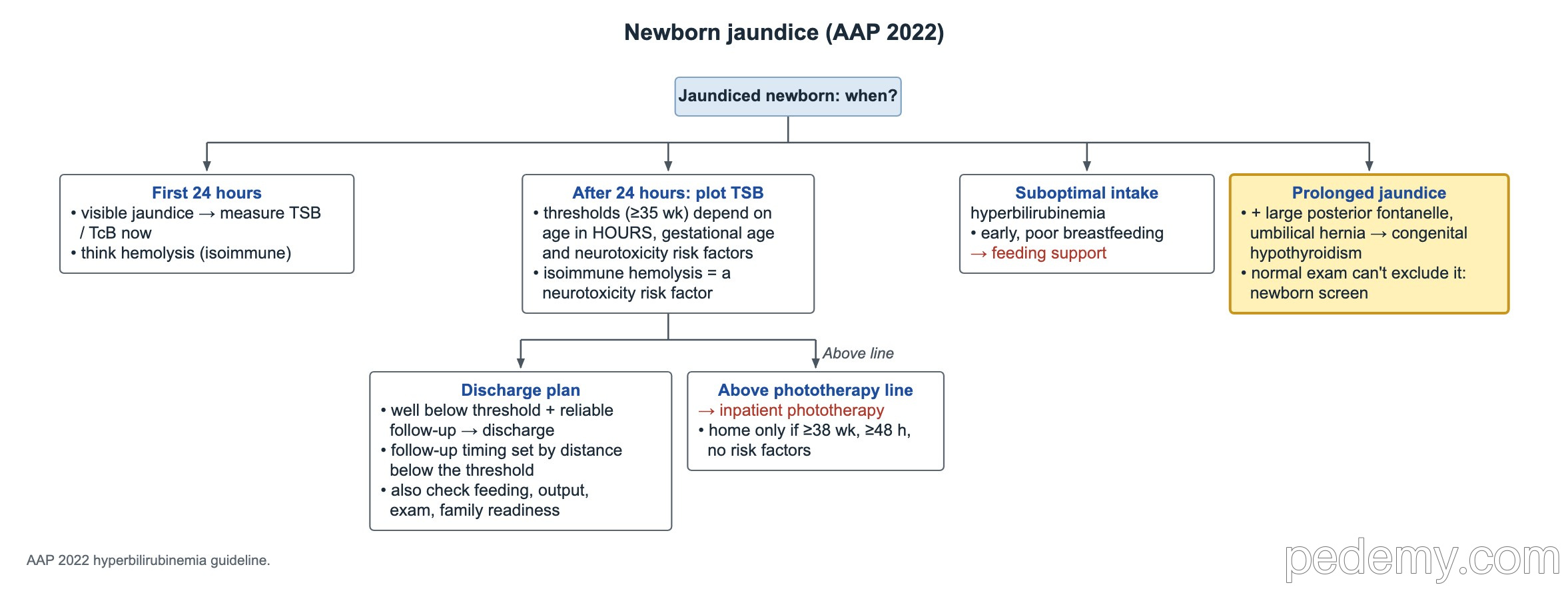
- Jaundice past 2 weeks in a term baby (3 weeks in a preterm baby): measure total and direct bilirubin.
- Direct (conjugated) bilirubin above 1.0 mg/dL is abnormal: pale stools and dark urine point to cholestasis, and biliary atresia must be found early.
- Check the newborn screen and thyroid tests: prolonged jaundice with a large posterior fontanelle and umbilical hernia suggests congenital hypothyroidism.
- A normal examination does not exclude congenital hypothyroidism.
Common questions
What glucose level should a newborn have after 48 hours?
Above 60 mg/dL, and above 70 mg/dL if a persistent genetic hypoglycemia disorder is suspected (Pediatric Endocrine Society 2015).
Is jaundice in the first 24 hours normal?
No. Jaundice visible before 24 hours needs an immediate bilirubin measurement and a search for hemolysis.
Can a jaundiced baby get phototherapy at home?
Under AAP 2022, home phototherapy is an option only for well, feeding babies of 38 weeks or more and at least 48 hours old, with no neurotoxicity risk factors, a bilirubin just above the threshold and daily bilirubin checks.
Study this topic
Sources
- AAP 2022: Management of hyperbilirubinemia in the newborn infant 35 or more weeks of gestation (Pediatrics)
- AAP 2011: Postnatal glucose homeostasis in late-preterm and term infants (Pediatrics)
- Pediatric Endocrine Society 2015: Persistent hypoglycemia in neonates, infants and children (J Pediatr)
- AAP 2023: Congenital hypothyroidism, screening and management (Pediatrics)
Written for Pedemy in our own words from the sources above; checked November 2026. For education only, not medical advice; check doses and local protocols before treating a patient. Pedemy is independent and not affiliated with or endorsed by the organizations cited.