

Main decision tree
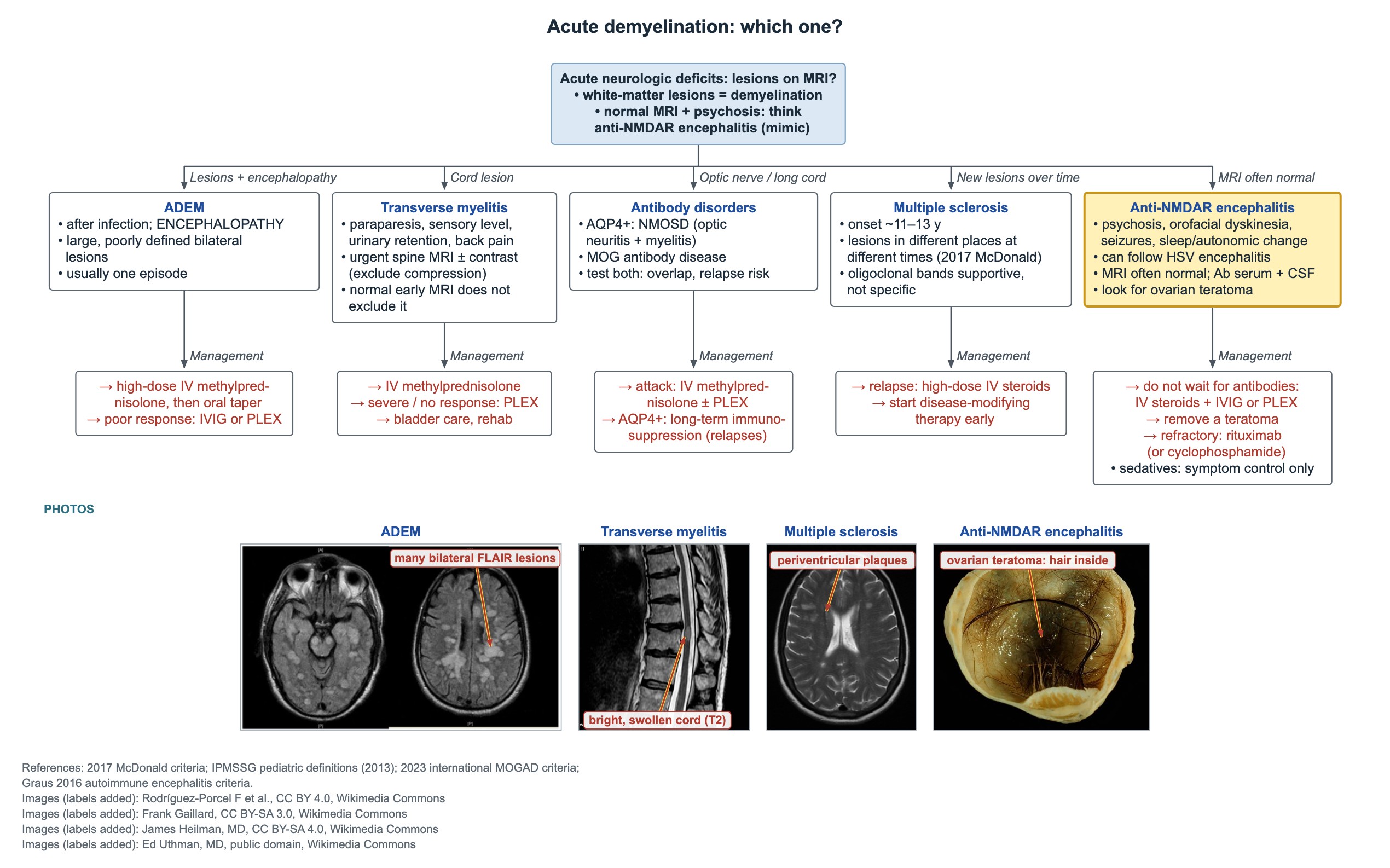
Acute demyelination: which one? (anti-NMDAR)
Key points
- Anti-NMDA receptor encephalitis is the most common antibody-mediated encephalitis in children.
- Classic teen picture: new psychosis or agitation, orofacial dyskinesias, seizures, sleep and autonomic change.
- Brain MRI is often normal; EEG usually shows slowing; extreme delta brush is specific but uncommon in children.
- Send neuronal antibodies on both serum and CSF; CSF testing is more sensitive for NMDA receptor antibodies.
- Look for an ovarian teratoma in every girl or young woman with anti-NMDA receptor encephalitis.
- Once infection is excluded, start IV steroids plus IVIG or plasma exchange without waiting for antibodies.
- No response to first-line therapy: rituximab or cyclophosphamide.
Recognize anti-NMDA receptor encephalitis
The tree sorts acute neurologic illness by MRI. White-matter lesions point to demyelination; a normal MRI with psychosis points to anti-NMDA receptor encephalitis, a common mimic.
Think of it in a previously well child or teen with subacute behavior change over days to weeks, especially when movements or seizures follow.
- Psychiatric: agitation, psychosis, insomnia, catatonia, mutism.
- Movement: orofacial dyskinesias (repetitive mouth and tongue movements), choreoathetosis, dystonia.
- Seizures and reduced consciousness.
- Autonomic instability: swings in heart rate, blood pressure and temperature; central hypoventilation.
- Younger children often present with seizures, abnormal movements or sleep change rather than psychosis.
Tests and what they show
First exclude infection, above all HSV encephalitis, with CSF PCR. A normal MRI does not rule out autoimmune encephalitis.
| Test | Typical finding |
|---|---|
| NMDA receptor antibodies | Send on serum AND CSF; CSF is more sensitive |
| CSF | Often mild lymphocytic pleocytosis or oligoclonal bands; can be normal |
| Brain MRI | Often normal, or nonspecific T2/FLAIR changes |
| EEG | Diffuse slowing; extreme delta brush is specific but rare in children |
| Tumor search | Pelvic ultrasound or MRI for ovarian teratoma |
Treatment
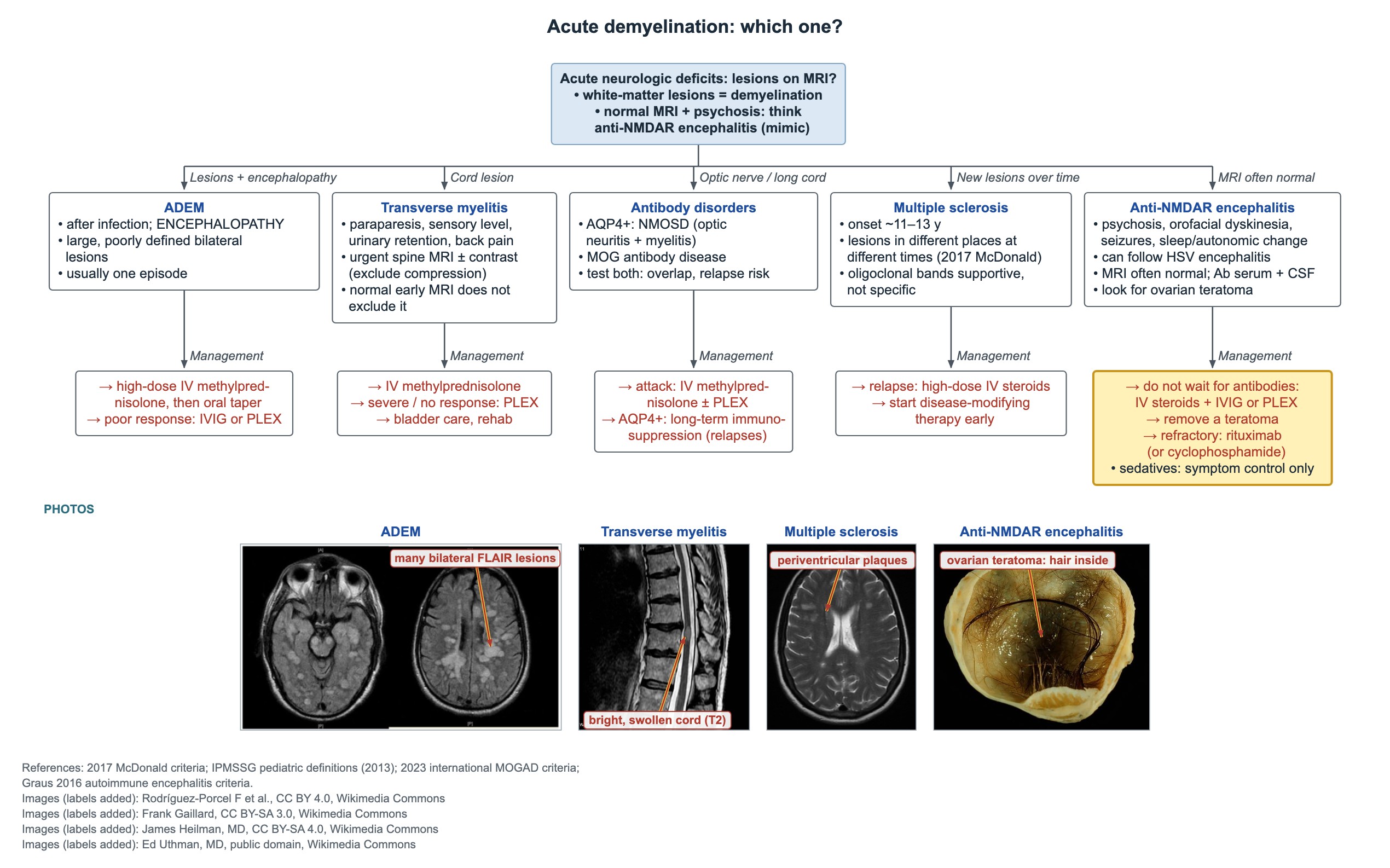
Recovery is slow, often over months, and relapses can occur. Many children need ICU care during the acute phase.
- First line, as soon as infection is excluded: high-dose IV methylprednisolone plus IVIG, or plasma exchange.
- Do not wait for antibody results; delay worsens outcome.
- Remove a teratoma if one is found.
- Little or no response after first-line therapy: rituximab (or cyclophosphamide).
- Sedatives and antipsychotics control agitation and sleep only; they do not treat the disease.
- Watch for neuroleptic sensitivity: antipsychotics can worsen rigidity and autonomic instability.
After HSV encephalitis
A child who recovered from HSV encephalitis and then develops new choreoathetosis, behavior change or seizures weeks later may have anti-NMDA receptor encephalitis triggered by the infection, not an HSV relapse.
Repeat CSF HSV PCR and test serum and CSF for NMDA receptor antibodies. Treat as autoimmune encephalitis when the PCR is negative and antibodies are present.
Common questions
Is the MRI abnormal in anti-NMDA receptor encephalitis?
Often not. Brain MRI is normal in many children, so a normal scan does not exclude the diagnosis.
Should treatment wait for antibody results?
No. Once infection is excluded, start IV steroids plus IVIG or plasma exchange while antibody results are pending.
What tumor is linked to anti-NMDA receptor encephalitis?
Ovarian teratoma. It is less common in young children than in adolescent girls and women, but every female patient should be screened.
Study this topic
Sources
- Cellucci T et al. Clinical approach to the diagnosis of autoimmune encephalitis in the pediatric patient (Neurol Neuroimmunol Neuroinflamm 2020)
- Graus F et al. A clinical approach to diagnosis of autoimmune encephalitis (Lancet Neurol 2016)
Written for Pedemy in our own words from the sources above; checked November 2026. For education only, not medical advice; check doses and local protocols before treating a patient. Pedemy is independent and not affiliated with or endorsed by the organizations cited.