

Main decision tree
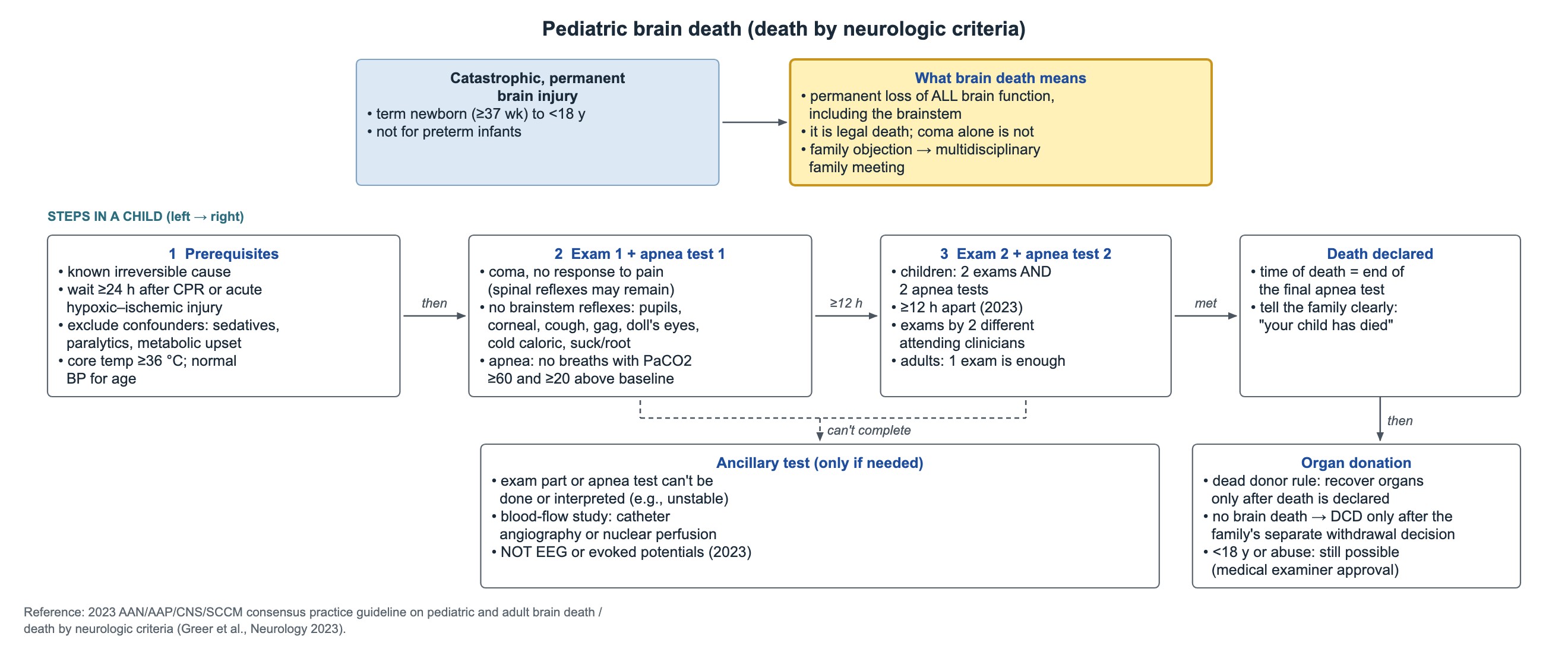
Pediatric brain death (death by neurologic criteria)
Key points
- Brain death is permanent loss of all brain function, including the brainstem; coma alone is not death.
- Applies from term newborns (37 weeks or more) to adults; it is not used in preterm infants.
- Prerequisites: known irreversible cause, no confounders, core temperature 36 °C (96.8 °F) or higher, normal blood pressure for age.
- Wait at least 24 hours after CPR or another acute hypoxic-ischemic injury before evaluating.
- Children: 2 examinations by 2 different attending clinicians at least 12 hours apart, each with an apnea test.
- Apnea test: no breathing with PaCO2 60 mm Hg or higher and at least 20 mm Hg above baseline.
- Ancillary tests are cerebral blood-flow studies, used only when the exam or apnea test cannot be completed; EEG no longer counts.
What brain death means
The tree runs left to right: catastrophic permanent brain injury, prerequisites, two exams with apnea tests, then death is declared. An ancillary test is used only if part of the evaluation cannot be done.
A child in coma who still has any brainstem function is not brain dead. A child who meets the criteria has died, and the time of death is when the final apnea test is completed.
- Absent responses alone are not enough: the cause must be known and permanent, and every prerequisite met.
- If a family objects, for example for religious reasons, hold a multidisciplinary family meeting with clear, honest communication.
Prerequisites before the exam
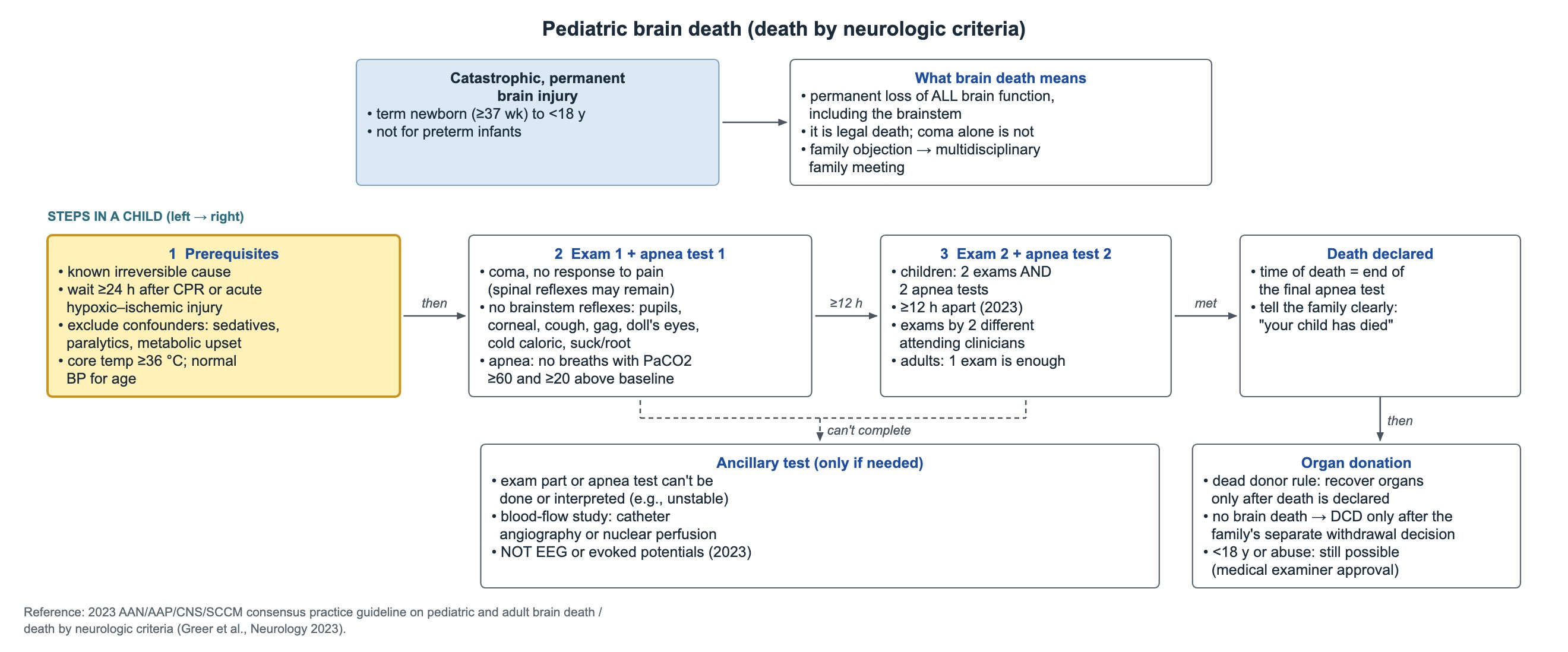
- A known, irreversible cause of catastrophic brain injury, confirmed on imaging.
- Wait 24 hours or more after CPR or an acute hypoxic-ischemic injury.
- Exclude drug confounders: sedatives, opioids, paralytics (check with a nerve stimulator), toxins.
- Correct metabolic confounders: severe electrolyte, glucose, acid-base or endocrine disturbance.
- Core temperature 36 °C (96.8 °F) or higher.
- Blood pressure normal for age, without shock.
The examination and apnea test
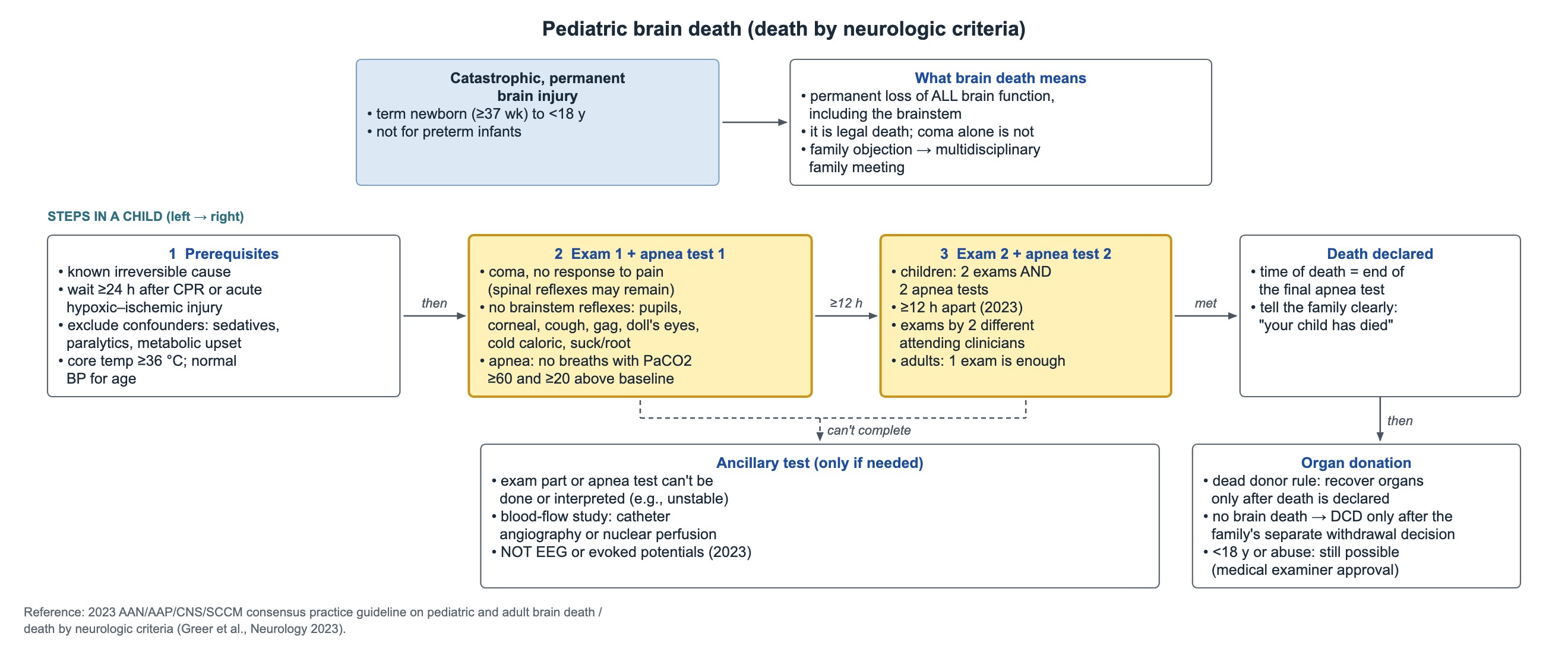
A ventilated child who breathes over the ventilator or coughs on suctioning has brainstem function and is not brain dead.
- Coma: no response to deep central and peripheral pain. Spinal reflexes may remain and do not exclude brain death.
- No brainstem reflexes: pupils fixed, no corneal, cough, gag, oculocephalic (doll's eyes) or oculovestibular (cold caloric) responses; in infants, no sucking or rooting.
- Apnea test: no breathing effort with PaCO2 60 mm Hg or higher and at least 20 mm Hg above baseline.
- Children under 18 years: 2 examinations by 2 different attending clinicians, at least 12 hours apart, each with an apnea test.
- Adults: one examination is enough.
Ancillary tests
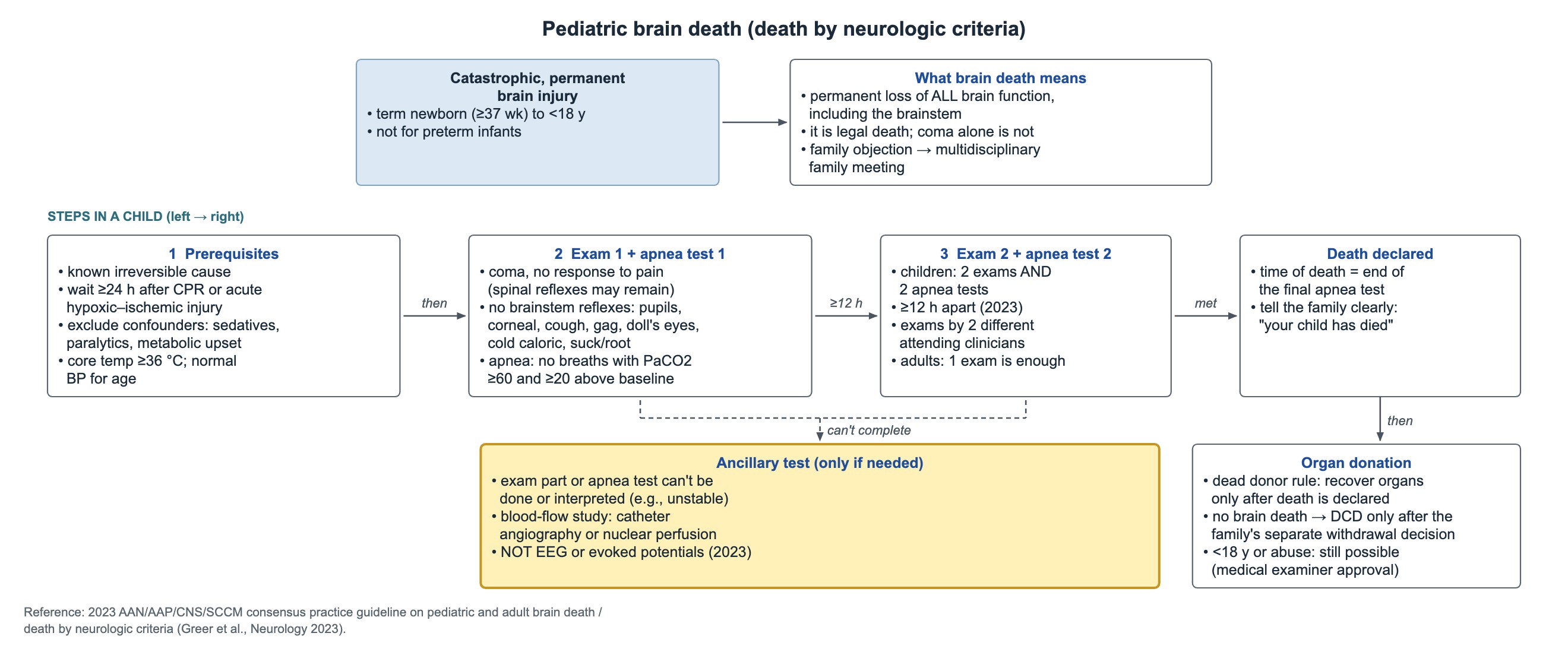
Ancillary testing does not replace the clinical exam. Use it only when part of the exam or the apnea test cannot be done or interpreted, for example when the child becomes unstable during apnea testing or has severe facial trauma.
- Accepted: cerebral blood-flow studies, such as 4-vessel catheter angiography or radionuclide perfusion imaging.
- Not accepted in the 2023 guideline: EEG and evoked potentials.
Organ donation
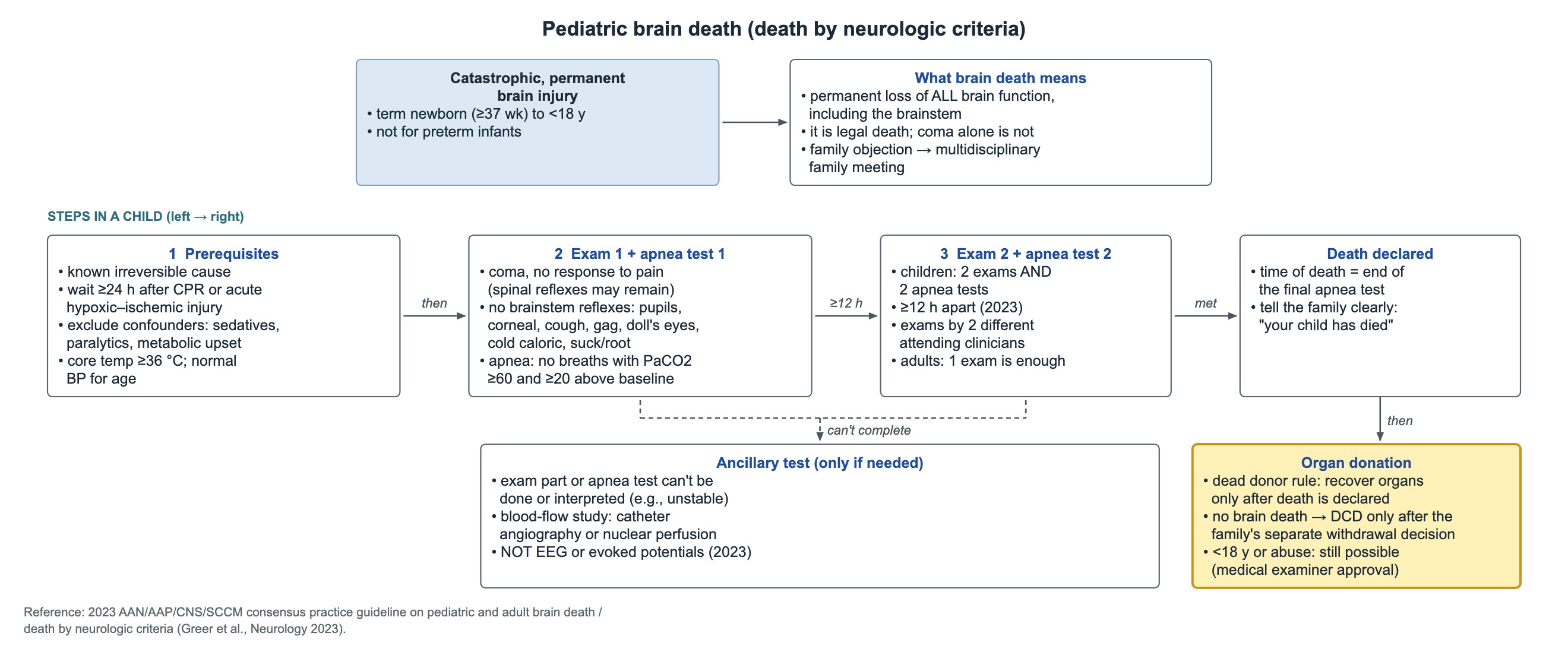
- Dead donor rule: vital organs are recovered only after death is declared, by neurologic or circulatory criteria.
- The physician who declares death must not be part of the transplant team.
- Donation after circulatory death (DCD) is possible when a child is not brain dead: the family first decides on its own to withdraw life support, then death follows withdrawal, usually within about 60–90 minutes for organs to be usable.
- Children under 18 can donate with parent or guardian consent.
- Fatal abusive head trauma does not exclude donation; the medical examiner must approve.
Common questions
How many brain death exams are needed in a child?
Two, by two different attending clinicians, at least 12 hours apart, each with an apnea test (2023 guideline). Adults need one.
Is EEG used to confirm brain death?
No longer. Under the 2023 guideline the only ancillary tests are cerebral blood-flow studies, used when the exam or apnea test cannot be completed.
Can a child who is not brain dead donate organs?
Yes, through donation after circulatory death, once the family has independently chosen to withdraw life support.
Study this topic
Sources
- Greer DM et al. Pediatric and adult brain death/death by neurologic criteria consensus guideline (Neurology 2023)
- AAP policy statement: Pediatric organ donation and transplantation across the care continuum (Pediatrics 2023)
Written for Pedemy in our own words from the sources above; checked November 2026. For education only, not medical advice; check doses and local protocols before treating a patient. Pedemy is independent and not affiliated with or endorsed by the organizations cited.