

Main decision tree
Hydrocephalus and cerebral palsy
Key points
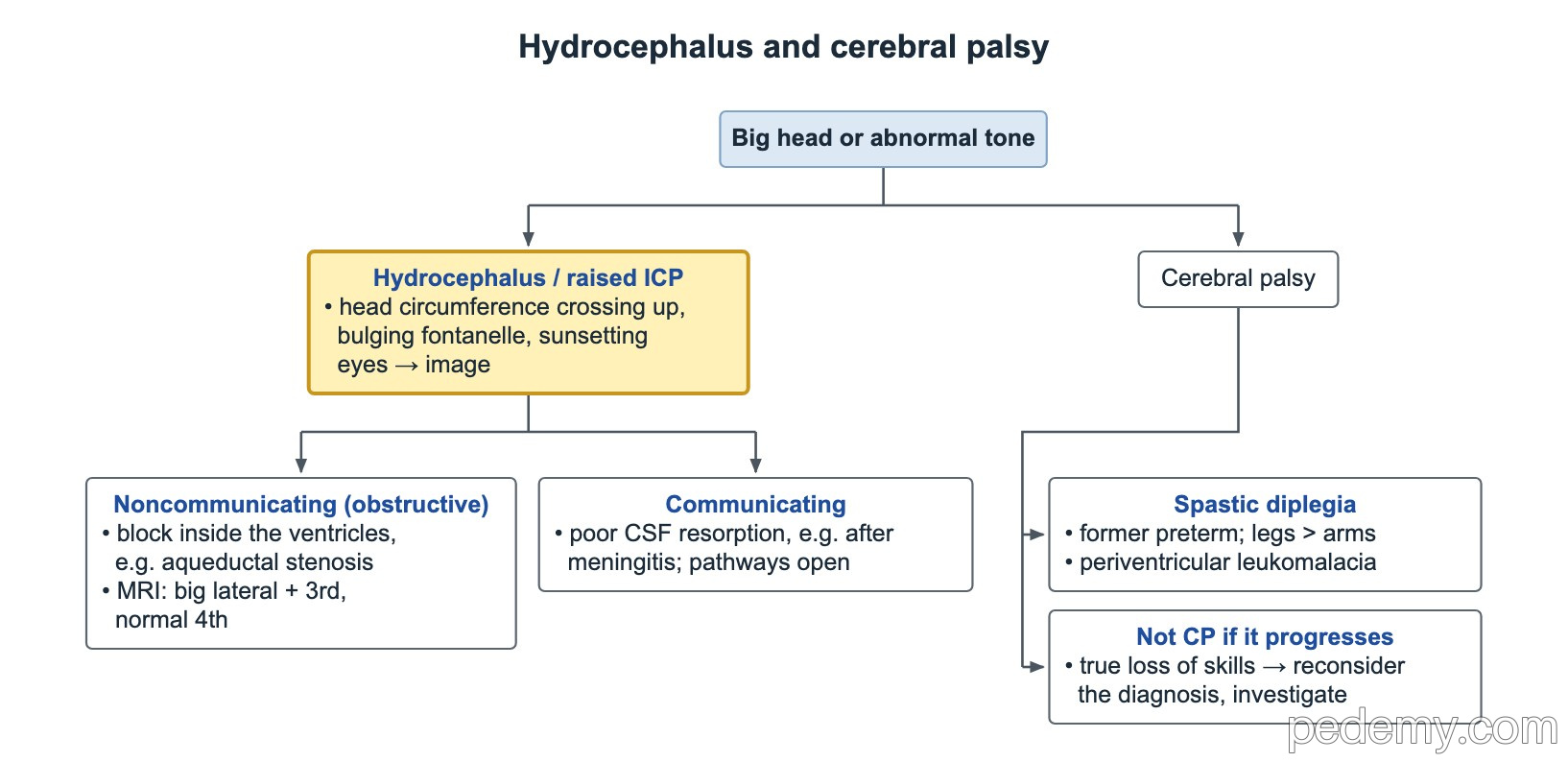
- Hydrocephalus in infants: head circumference crossing percentiles upward, bulging fontanelle, sunsetting eyes.
- Noncommunicating (obstructive): block inside the ventricles, e.g. aqueductal stenosis → big lateral and 3rd ventricles, normal 4th.
- Communicating: poor CSF resorption, e.g. after meningitis or hemorrhage, with open pathways.
- Aqueductal stenosis: endoscopic third ventriculostomy or a VP shunt.
- Shunt infection: vancomycin plus cefepime, ceftazidime or meropenem, and remove or externalize the shunt.
- Strongest CP risk factor: very preterm birth and low birth weight.
- Former preterm + legs stiffer than arms = spastic diplegia from periventricular leukomalacia; true regression is not CP.
Recognize hydrocephalus
The tree starts from a big head or abnormal tone. A head that is growing fast points to hydrocephalus; abnormal tone after an early brain injury points to cerebral palsy.
- Infants (open sutures): head circumference crossing percentile lines upward, full or bulging fontanelle, split sutures, sunsetting eyes, irritability, vomiting, poor feeding.
- Older children (closed sutures): headache, morning vomiting, lethargy, papilledema, 6th nerve palsy.
- Image promptly: head ultrasound through an open fontanelle, or MRI (CT if MRI is not available quickly).
Communicating vs noncommunicating
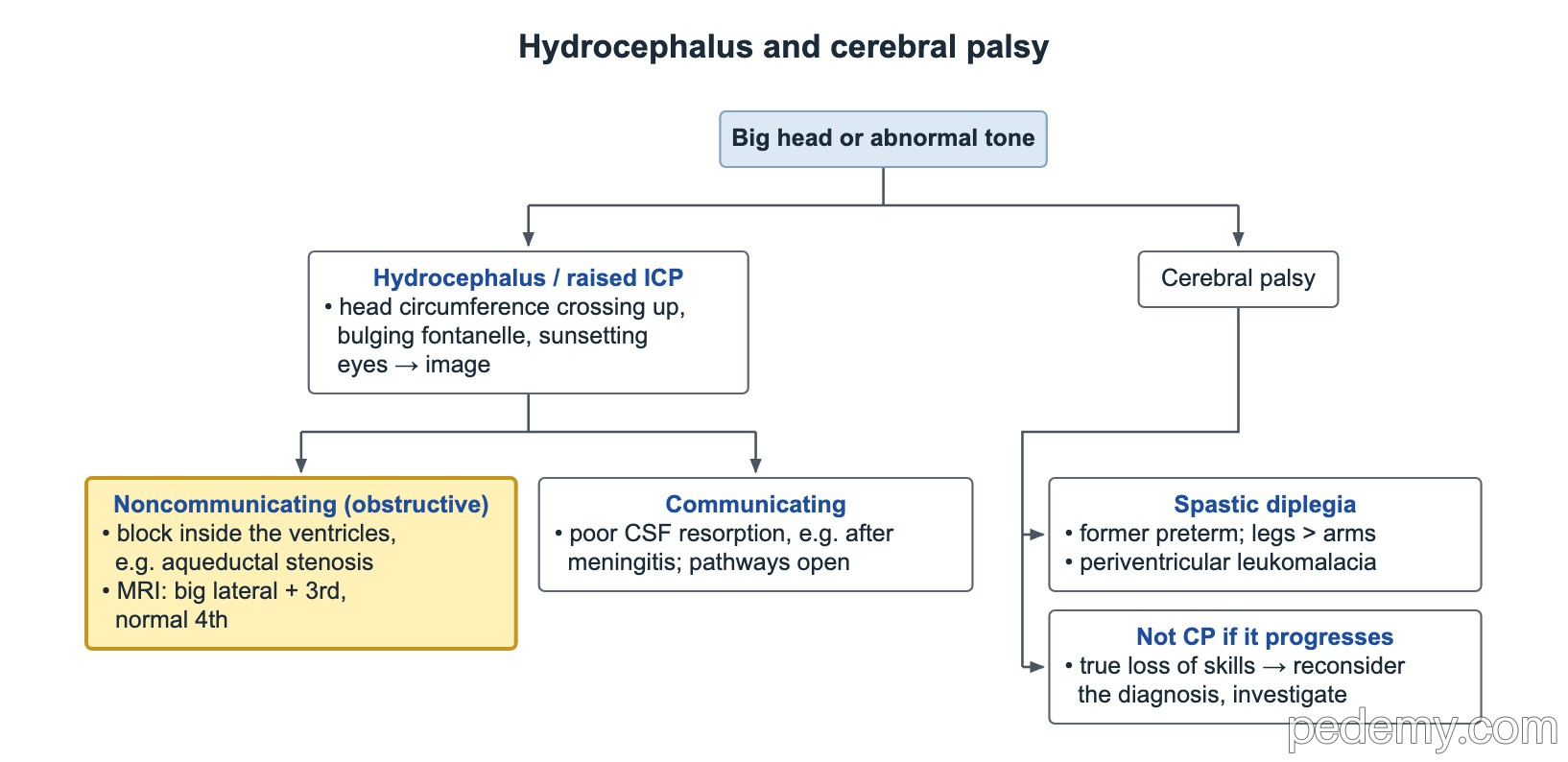
| Type | Problem | Example and imaging |
|---|---|---|
| Noncommunicating (obstructive) | Block within the ventricular system | Aqueductal stenosis: large lateral and 3rd ventricles, normal 4th; posterior fossa tumor |
| Communicating | CSF cannot be absorbed; pathways open | After meningitis or intraventricular hemorrhage: all ventricles enlarged |
Treatment: ETV or shunt
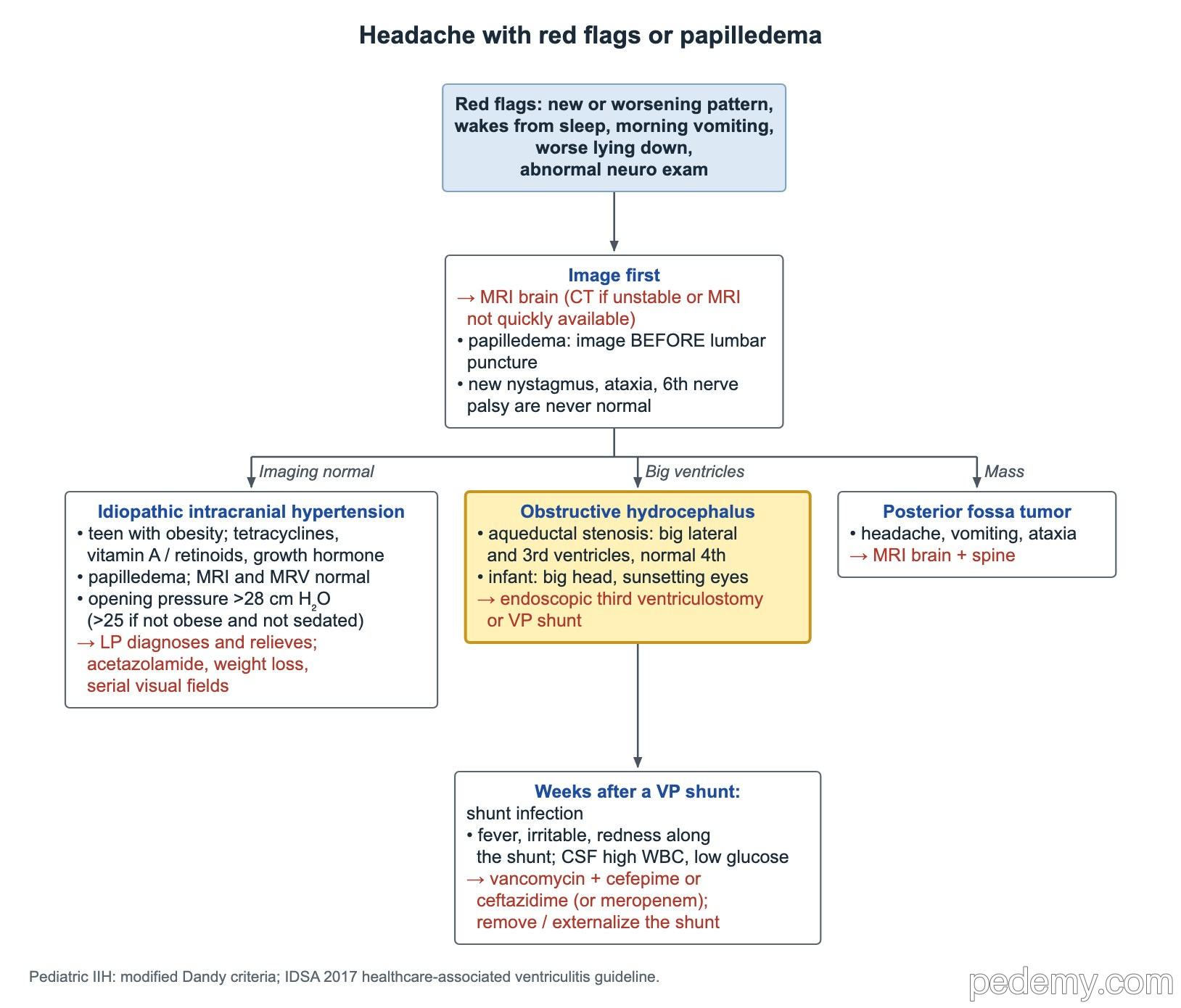
- Obstructive hydrocephalus from aqueductal stenosis: endoscopic third ventriculostomy (ETV) makes a bypass for CSF and avoids a lifelong implant.
- ETV works best in older infants and children with obstructive causes; young infants and communicating hydrocephalus more often need a shunt.
- Ventriculoperitoneal (VP) shunt: the usual choice when ETV is unlikely to work.
- Shunt failure (blockage) shows the same signs as the original hydrocephalus: headache, vomiting, lethargy, a growing head.
Shunt infection
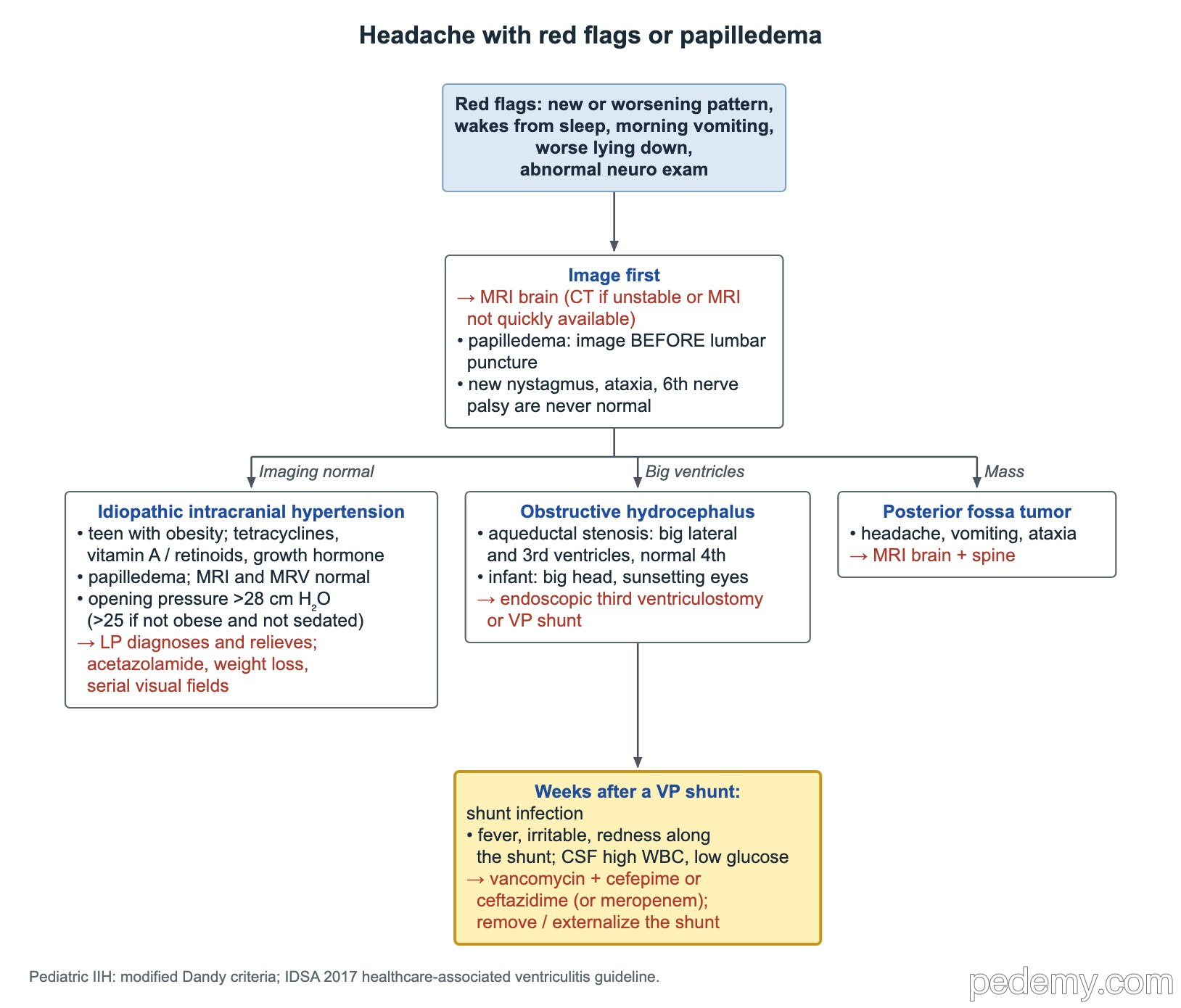
Most shunt infections appear within weeks to months of surgery. Signs are fever, irritability, redness along the shunt tract and shunt malfunction. Shunt CSF shows high WBC and low glucose.
- Most common organisms: coagulase-negative staphylococci (such as Staphylococcus epidermidis), then Staphylococcus aureus.
- Empiric therapy: vancomycin plus an antipseudomonal beta-lactam (cefepime or ceftazidime, or meropenem).
- Remove the infected shunt or externalize it to an external drain; place a new shunt after CSF cultures clear.
Cerebral palsy: risk and early diagnosis
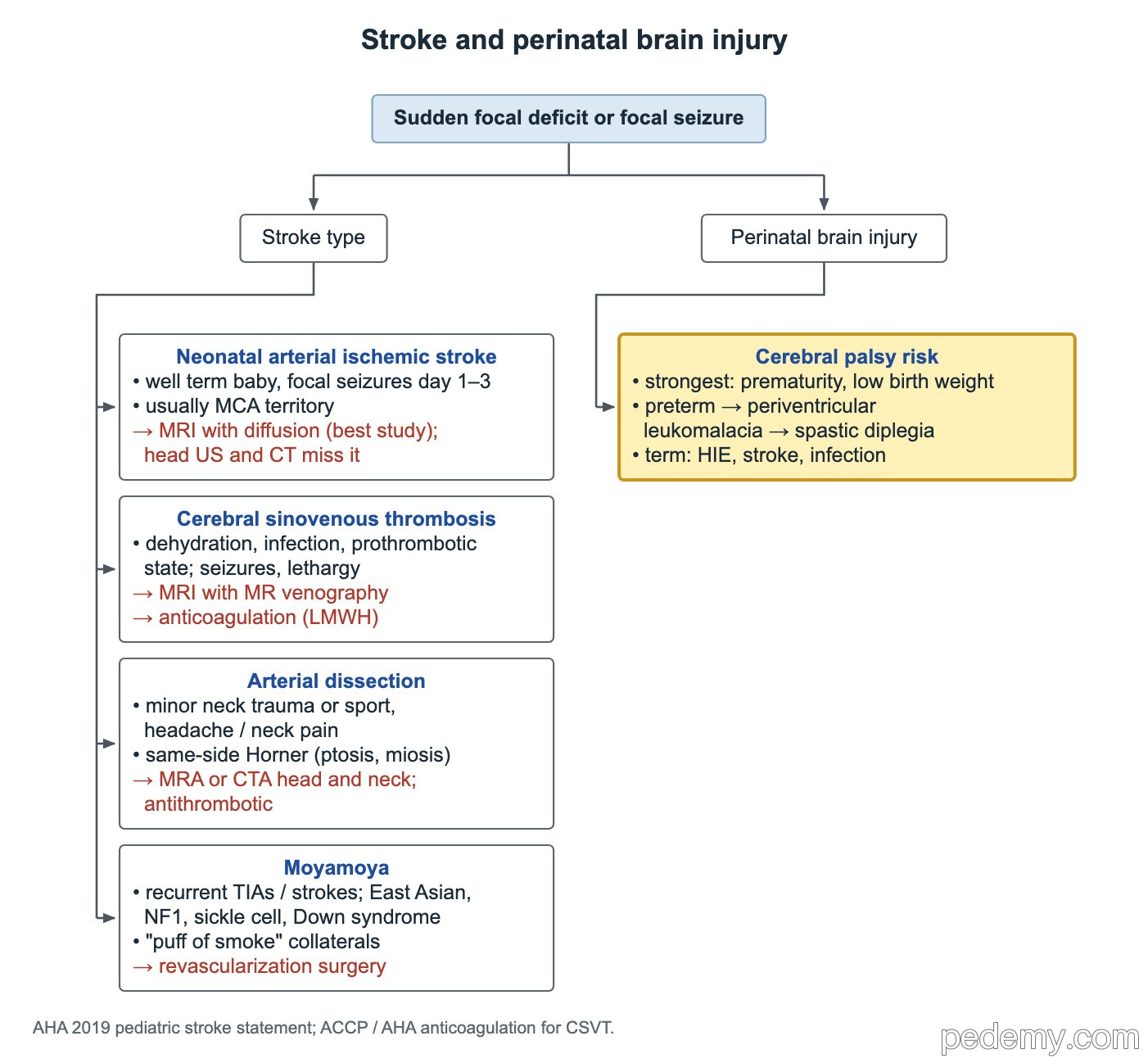
- Strongest risk: prematurity and low birth weight; risk rises as gestational age falls (for example, birth at 28 weeks).
- Preterm: periventricular leukomalacia (white-matter injury) → spastic diplegia.
- Term: hypoxic-ischemic encephalopathy, perinatal stroke, infection.
- High-risk infants can be diagnosed before 6 months corrected age by combining MRI, the General Movements Assessment and the Hammersmith Infant Neurological Examination (HINE); early diagnosis allows early therapy.
Spastic diplegia, and when it is not CP
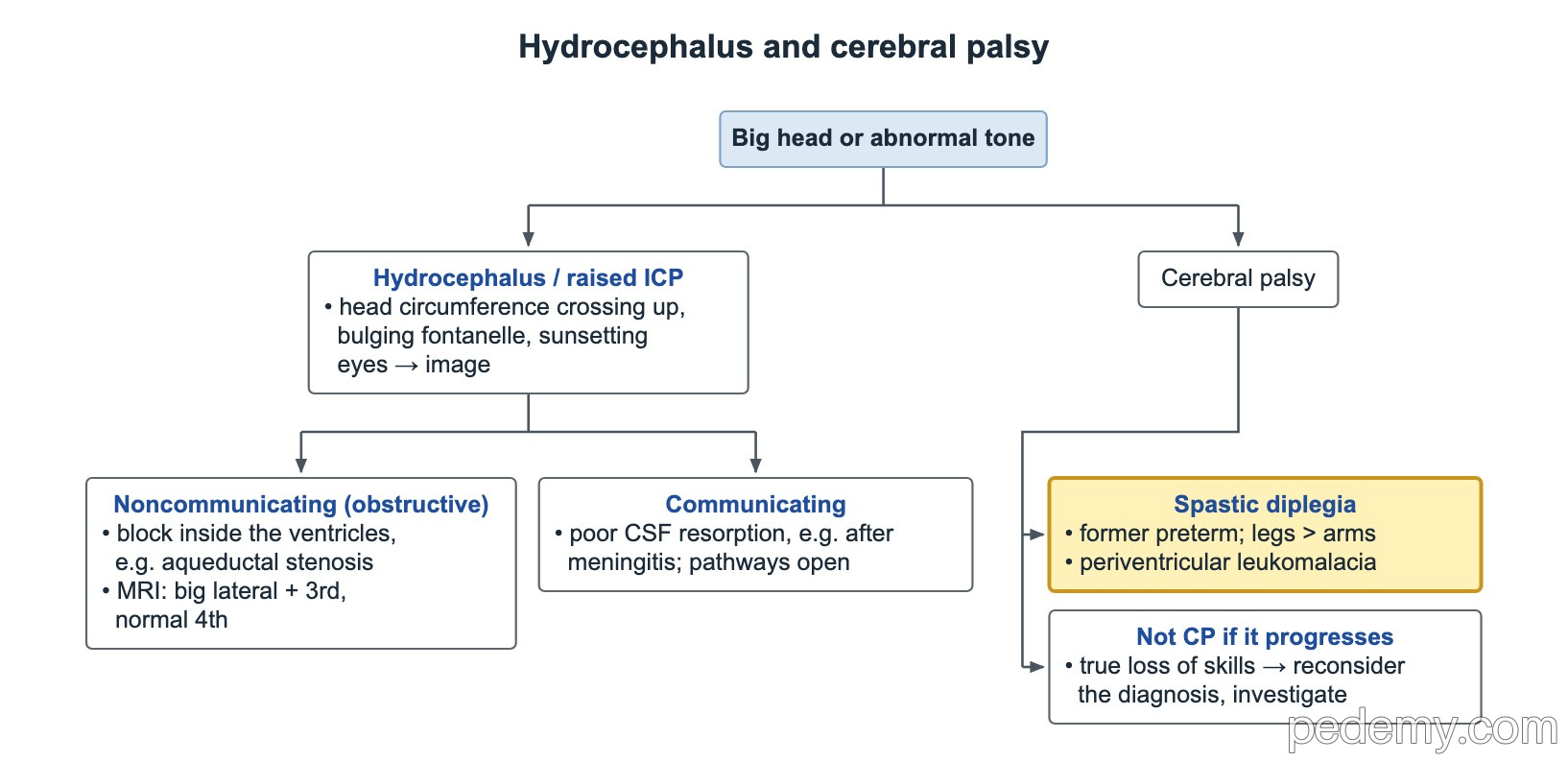
Spastic diplegia is the classic CP of the former preterm infant: spasticity and brisk reflexes affect the legs much more than the arms, causing toe walking and scissoring. It comes from periventricular leukomalacia, because the leg fibers run closest to the ventricles.
- CP is non-progressive: the brain injury does not worsen, although the movement pattern changes as the child grows.
- True loss of skills that were already gained is not CP: reconsider the diagnosis and investigate for a progressive disorder (metabolic, genetic, neurodegenerative or spinal cord).
Common questions
What is the difference between communicating and noncommunicating hydrocephalus?
Noncommunicating hydrocephalus is a block inside the ventricles, such as aqueductal stenosis. Communicating hydrocephalus is poor CSF absorption with open pathways, often after meningitis or hemorrhage.
What type of cerebral palsy do preterm babies get?
Spastic diplegia, with legs more affected than arms, caused by periventricular leukomalacia.
What antibiotics treat a VP shunt infection?
Empiric vancomycin plus cefepime, ceftazidime or meropenem, with removal or externalization of the shunt.
Study this topic
Sources
- Novak I et al. Early, accurate diagnosis and early intervention in cerebral palsy (JAMA Pediatr 2017)
- Tunkel AR et al. IDSA 2017 guidelines for healthcare-associated ventriculitis and meningitis (Clin Infect Dis)
Written for Pedemy in our own words from the sources above; checked November 2026. For education only, not medical advice; check doses and local protocols before treating a patient. Pedemy is independent and not affiliated with or endorsed by the organizations cited.