

Main decision tree
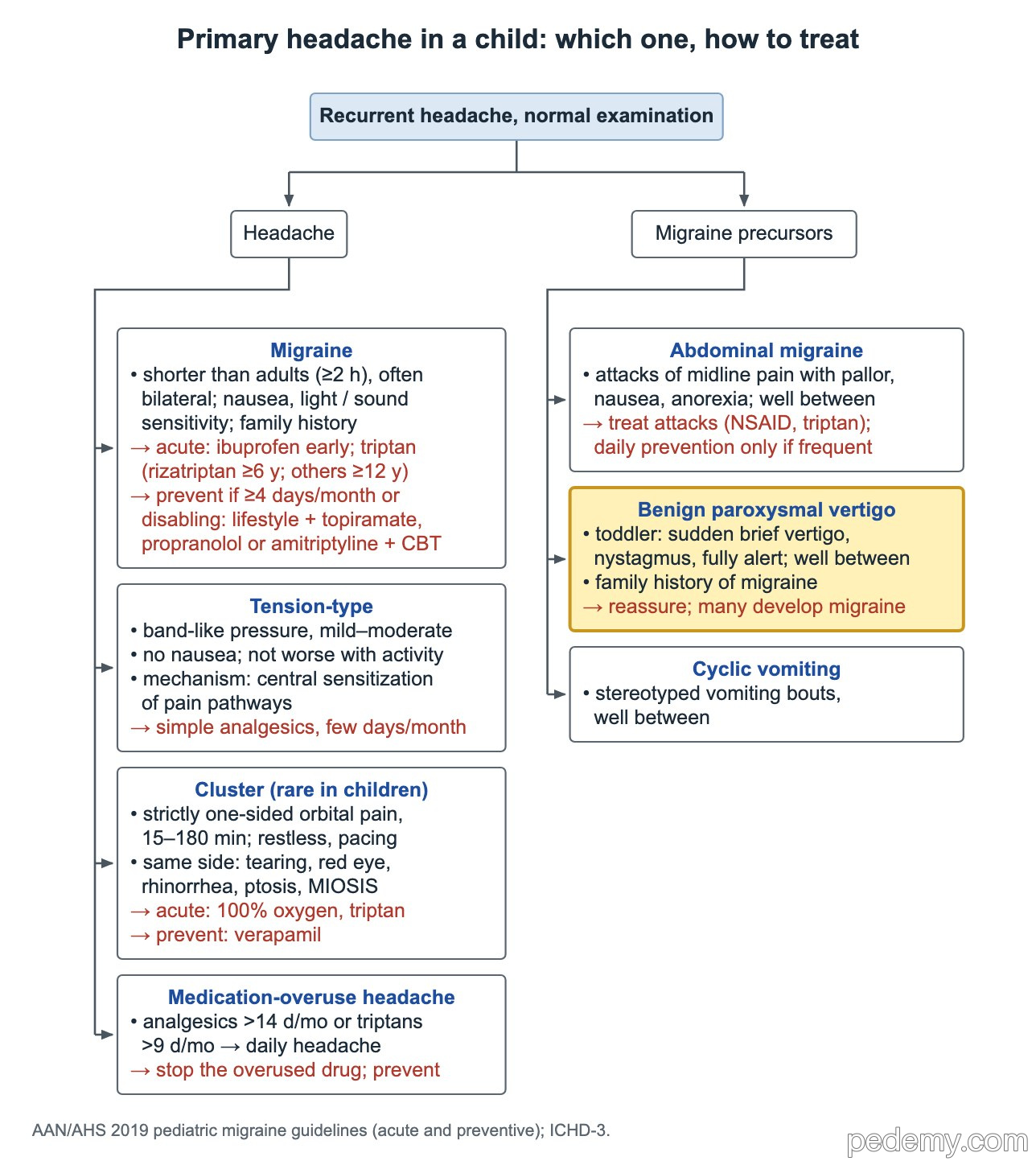
Primary headache in a child: which one, how to treat
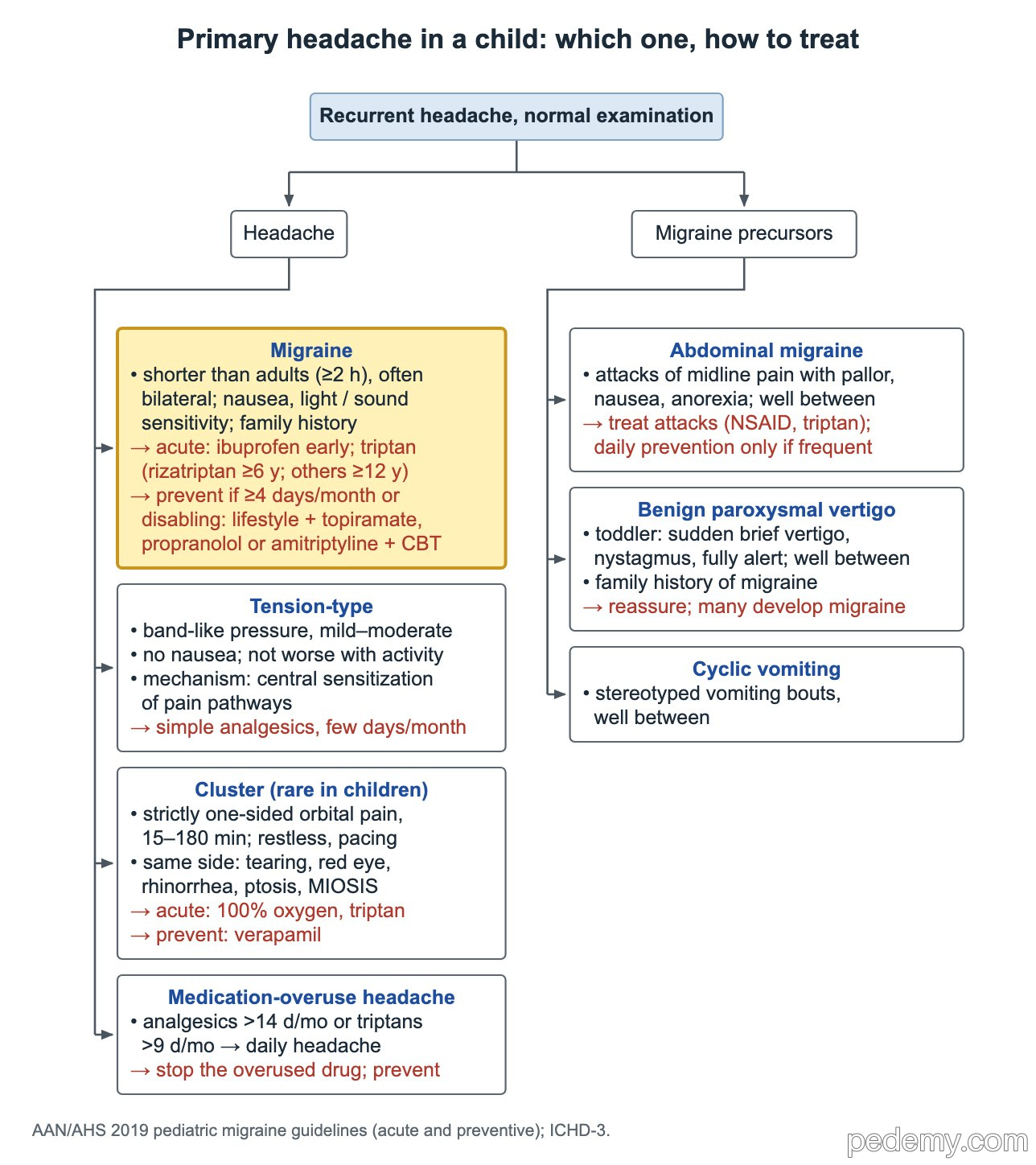
Key points
- Pediatric migraine: at least 5 attacks lasting 2–72 hours, often bilateral, with nausea/vomiting or both light and sound sensitivity.
- Acute: ibuprofen early; rizatriptan is FDA-approved from 6 years, most other triptans from 12 years.
- Prevent if 4 or more headache days a month or disabling: lifestyle plus topiramate, propranolol or amitriptyline with CBT.
- Medication overuse: simple analgesics on 15+ days or triptans/combinations on 10+ days a month for over 3 months; keep use to ≤14 and ≤9 days.
- Cluster: one-sided orbital pain 15–180 minutes with tearing and ptosis/miosis; 100% oxygen acutely, verapamil to prevent.
- Red flags or papilledema: image first (MRI; CT if MRI is not quickly available) before any lumbar puncture.
- IIH: obese teen, papilledema, normal MRI/MRV, opening pressure >28 cm H2O; acetazolamide and weight loss.
Migraine: diagnosis and treatment
The tree starts with a recurrent headache and a normal exam, then separates migraine, tension-type, cluster and medication-overuse headache from the migraine precursors of early childhood.
Migraine is the classic activity-limiting headache with nausea and light and sound sensitivity, often with a family history.
- Acute: ibuprofen early in the attack (acetaminophen is an alternative).
- Triptan if analgesics fail: rizatriptan is FDA-approved for ages 6–17; almotriptan, zolmitriptan nasal spray and sumatriptan/naproxen are approved from 12 years.
- Preventive treatment if attacks occur on 4 or more days a month or are disabling: start with lifestyle measures plus topiramate (FDA-approved from 12 years), propranolol, or amitriptyline combined with cognitive behavioral therapy.
- Every plan: avoid triggers, regular sleep, meals, hydration and exercise; limit rescue medicines.
ICHD-3 criteria and migraine variants
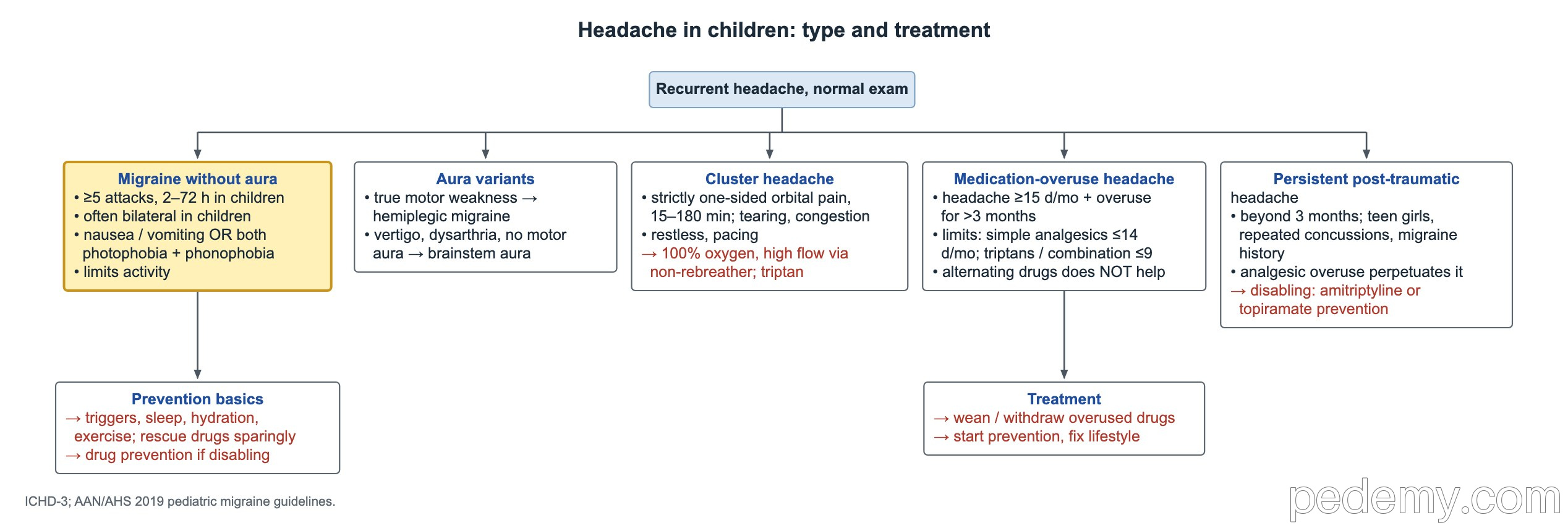
- At least 5 qualifying attacks.
- Attacks last 2–72 hours in children (4–72 hours in adults).
- Pain is often bilateral in children; bilateral pain does not exclude migraine.
- At least one of: nausea and/or vomiting, or BOTH photophobia and phonophobia.
- Moderate or severe pain that limits activity, pulsating, or worse with activity.
| Variant | Key feature |
|---|---|
| Migraine with brainstem aura | Reversible vertigo, dysarthria, ataxia or diplopia; no motor or retinal aura |
| Hemiplegic migraine | Aura with true motor weakness; may be familial |
Tension-type and cluster headache
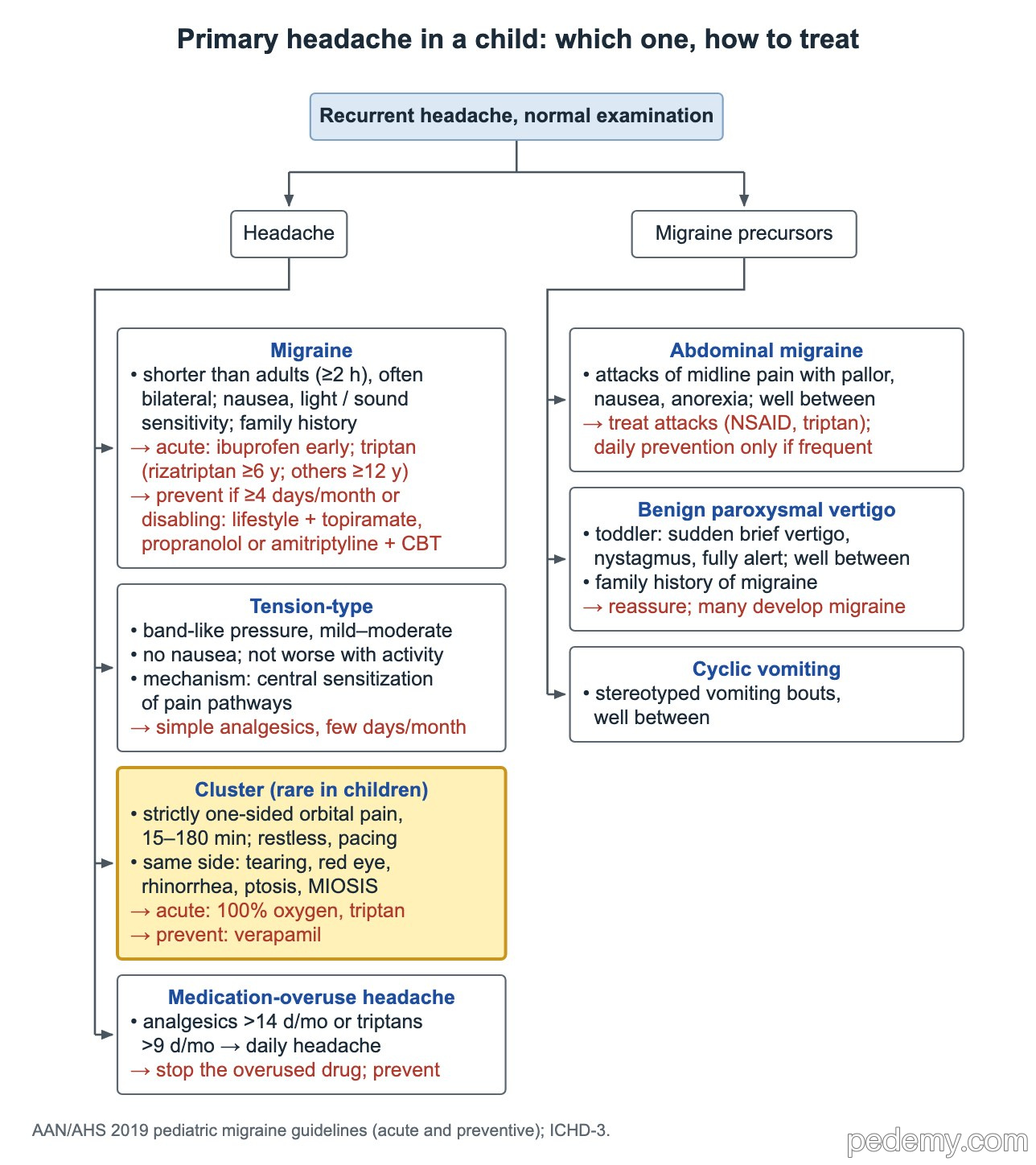
| Tension-type | Cluster (rare in children) | |
|---|---|---|
| Pain | Band-like pressing, mild to moderate, both sides | Severe, strictly one-sided, orbital or temporal |
| Duration | 30 minutes to days | 15–180 minutes, up to 8 a day |
| Other features | No nausea; not worse with activity | Same-side tearing, red eye, rhinorrhea or congestion, ptosis and miosis (partial Horner); restless, pacing |
| Mechanism | Central sensitization of pain pathways (frequent forms) | Trigeminal-autonomic activation |
| Treatment | Simple analgesics on few days a month | Acute: 100% oxygen at high flow by non-rebreather mask, or a triptan; prevention: verapamil |
Medication-overuse headache
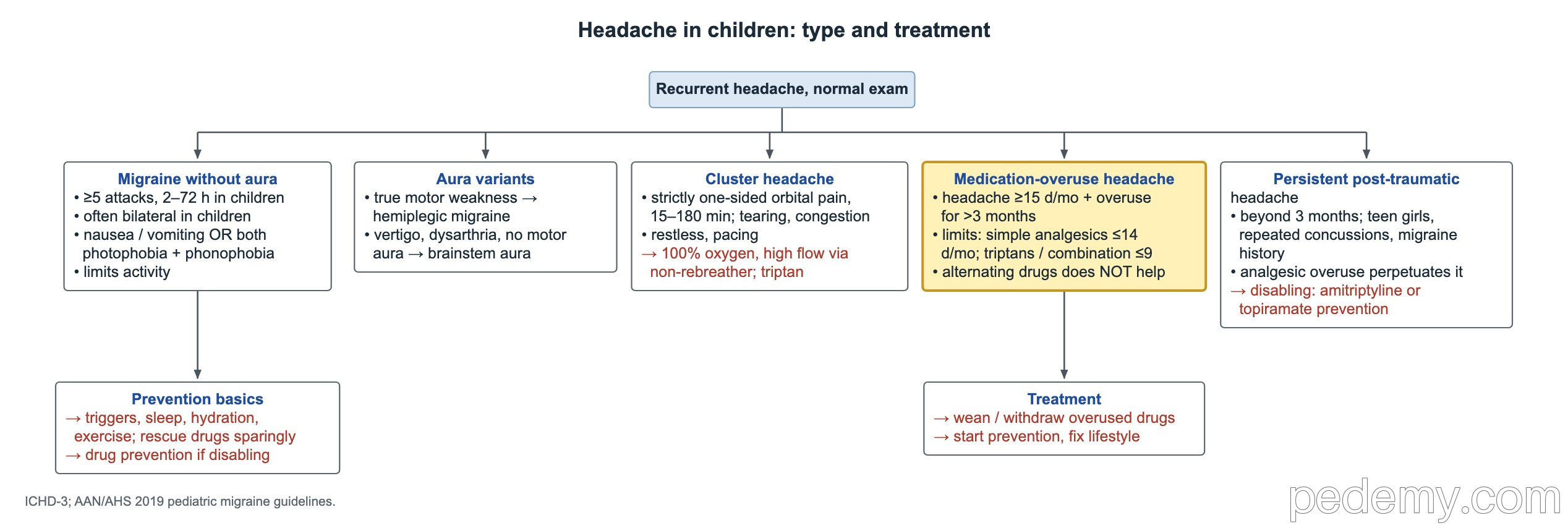
- ICHD-3: headache on 15 or more days a month in a child with a pre-existing headache disorder, with regular overuse for more than 3 months.
- Overuse means simple analgesics on 15 or more days a month, or triptans or combination analgesics on 10 or more days a month.
- To prevent it: simple analgesics on no more than 14 days a month; triptans or combination analgesics on no more than 9 days a month.
- Rotating between several acute drugs does not avoid overuse; total days count.
- Treatment: first withdraw or wean the overused medicines, then start preventive therapy and fix lifestyle factors (sleep, meals, hydration, screen time, stress).
Post-traumatic headache
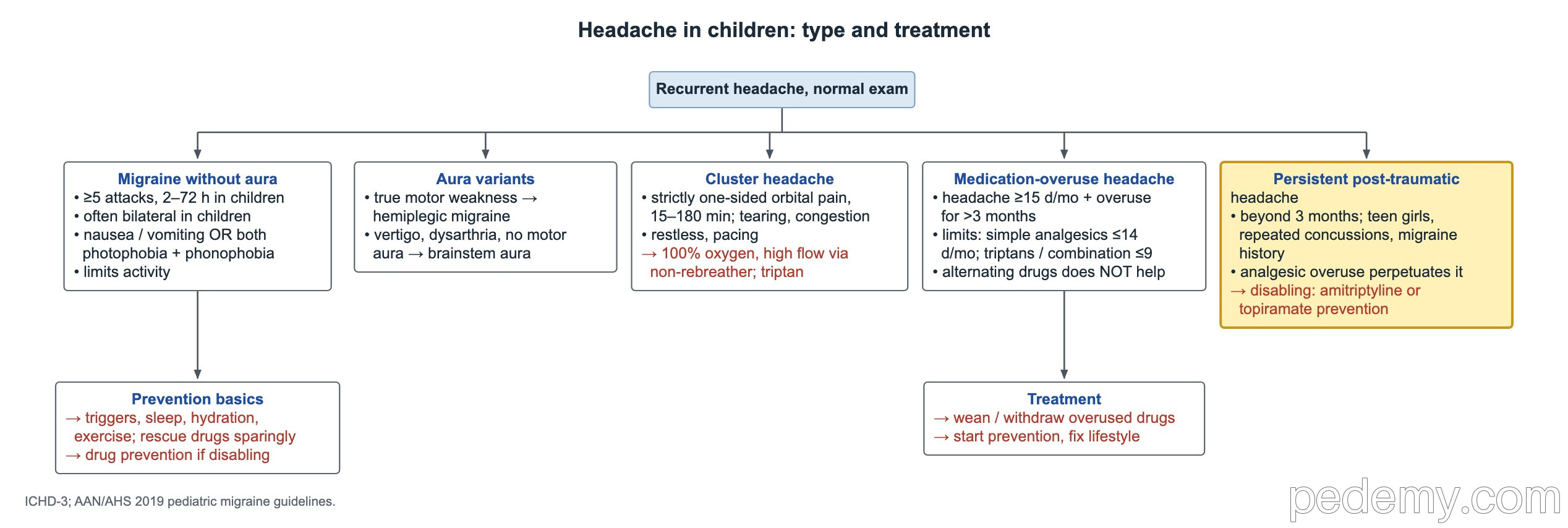
- Persistent post-traumatic headache lasts more than 3 months after the injury.
- Higher risk: adolescent girls, repeated concussions, and a personal or family history of migraine.
- Frequent analgesic use often keeps it going: limit rescue medicines.
- Frequent headaches that impair daily function: add a daily preventive, such as amitriptyline or topiramate, with a gradual return to school and activity.
Red flags, raised pressure and IIH
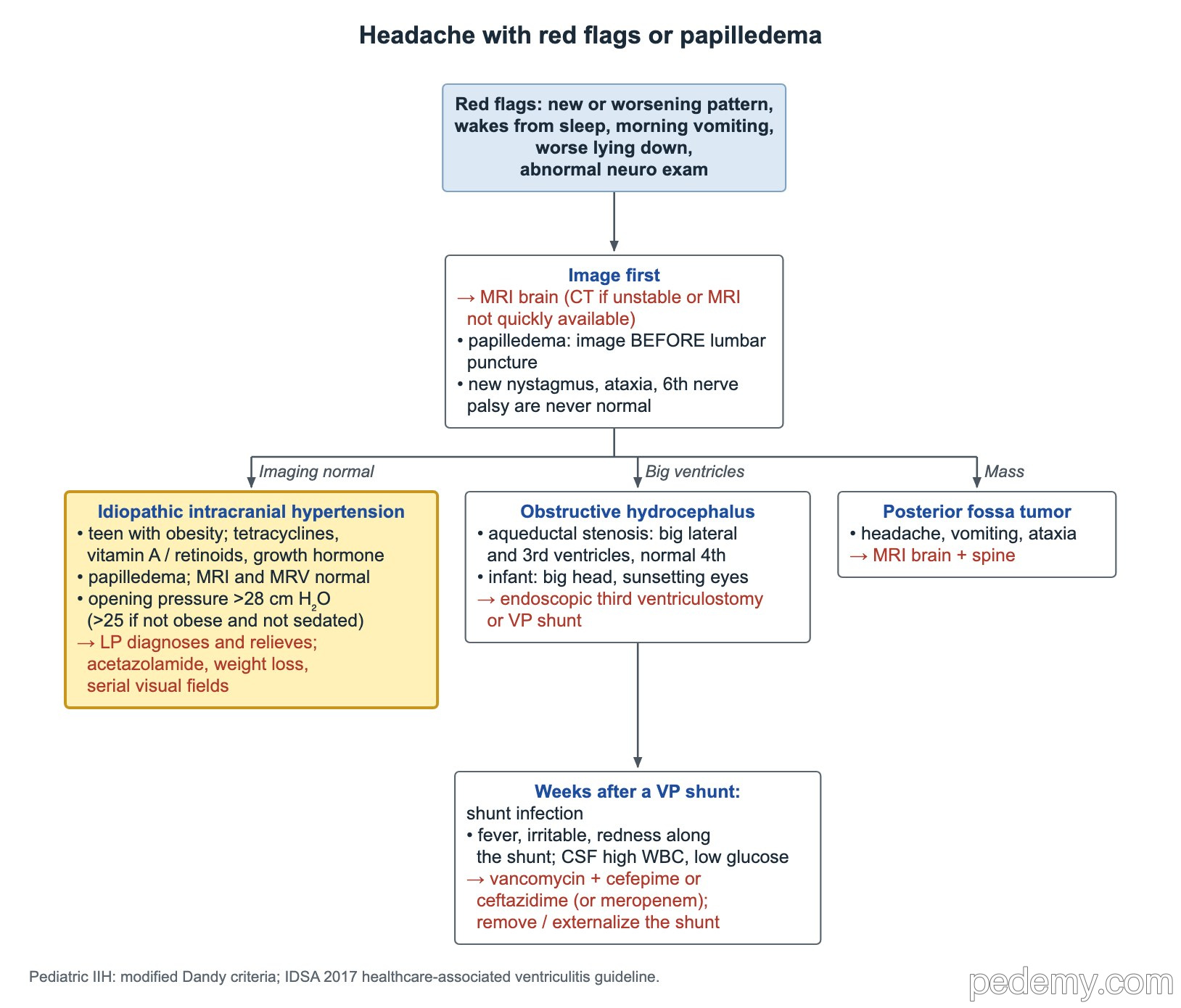
Idiopathic intracranial hypertension (IIH): headache and papilledema with normal MRI and MR venography. Strongest risk factor in adolescents is obesity (BMI at or above the 95th percentile); others are tetracyclines, vitamin A and retinoids, and growth hormone.
Lumbar puncture both diagnoses and relieves it: opening pressure above 28 cm H2O (above 25 cm H2O if not obese and not sedated) with normal CSF. Treat with acetazolamide and weight loss, and follow visual fields closely, because vision loss is the main risk.
- Red flags: new or worsening pattern, waking from sleep, morning vomiting, worse lying down, abnormal neurologic exam.
- New nystagmus, ataxia or 6th nerve palsy are never normal: MRI of the brain.
- Papilledema (even in a fussy infant): urgent neuroimaging BEFORE any lumbar puncture; head CT if MRI is not quickly available.
- Posterior fossa tumor: headache, vomiting and ataxia → MRI of brain and spine.
Migraine precursors in young children
| Syndrome | Clues | Management |
|---|---|---|
| Benign paroxysmal vertigo | Toddler; sudden brief spells of vertigo and nystagmus, fully alert, well between; family history of migraine | Reassure; many later develop migraine |
| Abdominal migraine | Attacks of midline abdominal pain with pallor, nausea, anorexia; well between | Treat attacks (NSAID, triptan, antiemetic); daily prevention only if frequent |
| Cyclic vomiting syndrome | Stereotyped bouts of vomiting, well between | Treat attacks; prevention if frequent |
Common questions
Which triptan can be used in a young child with migraine?
Rizatriptan is FDA-approved for ages 6–17 years. Most other triptans are approved from 12 years.
When should a child with migraine start daily prevention?
When headaches occur on 4 or more days a month or are disabling despite good acute treatment and lifestyle changes.
How often can a child take ibuprofen for headaches?
To avoid medication-overuse headache, simple analgesics should be used on no more than 14 days a month, and triptans on no more than 9.
When does a child's headache need a brain scan?
When there are red flags: a new or worsening pattern, waking from sleep, morning vomiting, worse lying down, papilledema or any abnormal neurologic sign.
Study this topic
Sources
- Oskoui M et al. AAN/AHS practice guideline: acute treatment of migraine in children and adolescents (Neurology 2019)
- Oskoui M et al. AAN/AHS practice guideline: pharmacologic treatment for pediatric migraine prevention (Neurology 2019)
- International Classification of Headache Disorders, 3rd edition (ICHD-3)
- Lumba-Brown A et al. CDC guideline on mild traumatic brain injury among children (JAMA Pediatr 2018)
- Friedman DI et al. Revised diagnostic criteria for the pseudotumor cerebri syndrome in adults and children (Neurology 2013)
Written for Pedemy in our own words from the sources above; checked November 2026. For education only, not medical advice; check doses and local protocols before treating a patient. Pedemy is independent and not affiliated with or endorsed by the organizations cited.