

Main decision tree
Head injury: bleeds, fractures, herniation
Key points
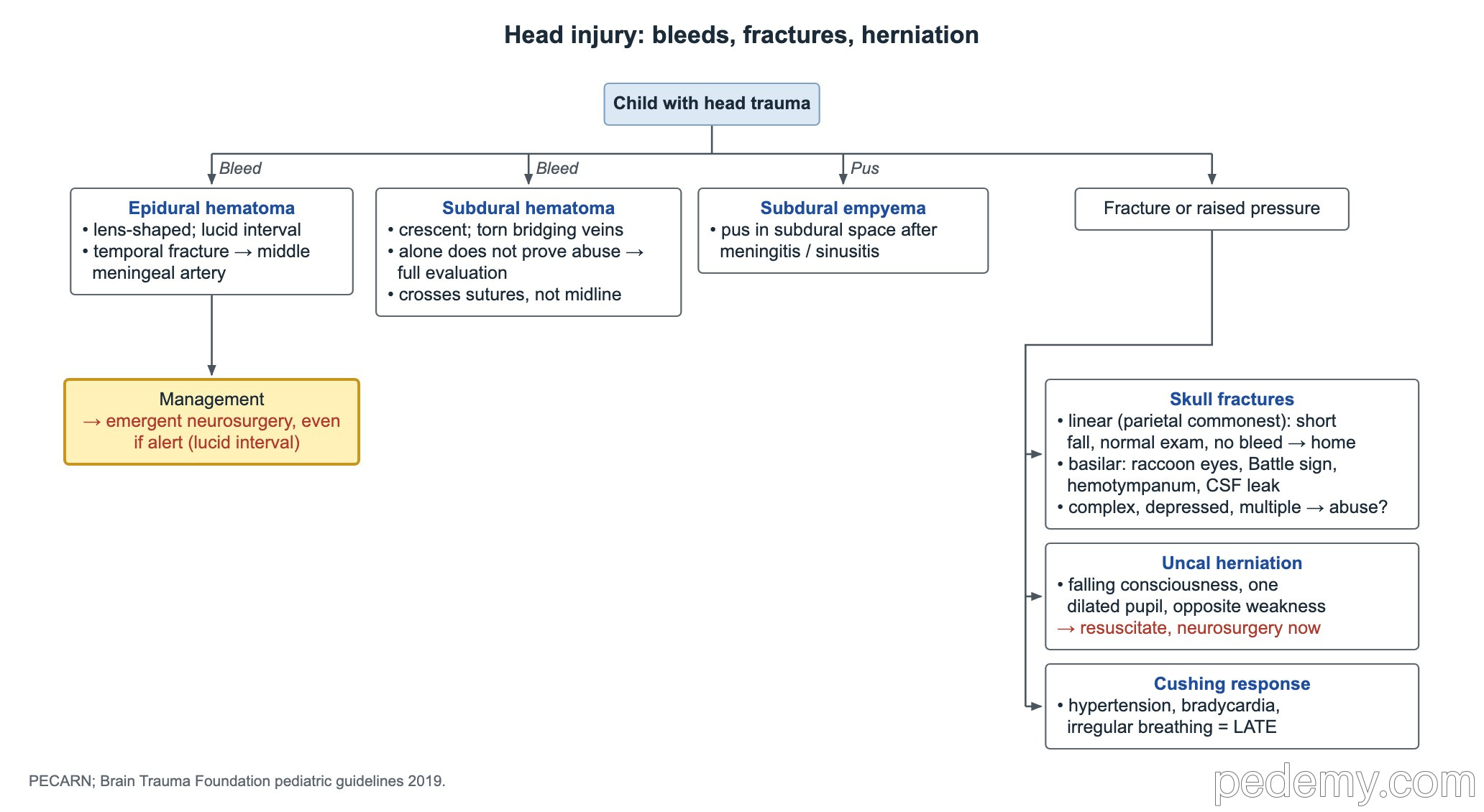
- Epidural hematoma: lens-shaped, often a temporal fracture tearing the middle meningeal artery; lucid interval → emergent neurosurgery even if alert.
- Subdural hematoma: crescent-shaped from torn bridging veins; crosses sutures but not the midline.
- Uncal herniation: falling consciousness, one dilated pupil, weakness on the opposite side → resuscitate and call neurosurgery now.
- Cushing response (hypertension, bradycardia, irregular breathing) is a late sign of raised intracranial pressure.
- Cannot abduct one eye with headache and vomiting = CN VI palsy, a false-localizing sign of raised pressure → brain MRI.
- Erb palsy (C5–C6): waiter's tip, grasp kept; Klumpke palsy (C8–T1): weak hand ± Horner syndrome.
- Gluteal injection → sciatic injury with foot drop; give infant IM injections in the thigh.
Epidural hematoma and skull fractures
Classic story: head trauma, a brief recovery (the lucid interval), then deterioration. CT shows a lens-shaped (biconvex) extra-axial bleed. A temporal bone fracture tearing the middle meningeal artery is the classic source.
The lucid interval is falsely reassuring: call neurosurgery emergently even while the child is alert.
- Linear skull fracture: the parietal bone is the commonest site; after a short fall with a normal exam and no bleed the child can usually go home.
- Basilar skull fracture: raccoon eyes, Battle sign, hemotympanum, CSF leak from the nose or ear.
- Complex, depressed or multiple fractures, especially with a minor story, raise concern for abuse.
Subdural hematoma, abuse and empyema
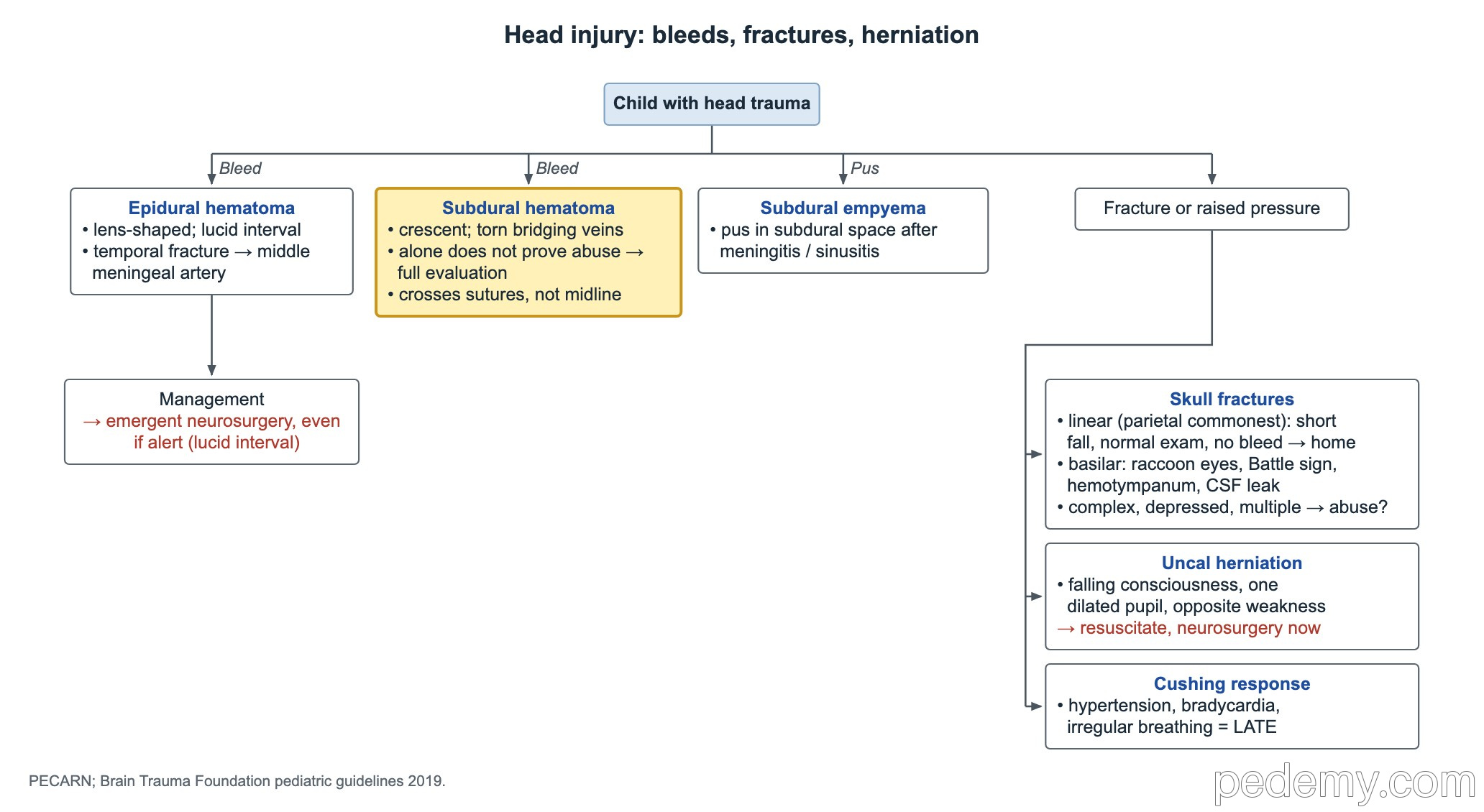
- Subdural hematoma: crescent-shaped collection from torn bridging veins; it crosses suture lines but not the midline (falx).
- In an infant, subdural blood raises concern for abusive head trauma, but it does not prove abuse on its own: take a full history, look for other injuries (eyes, skeleton, skin) and consider other causes (AAP 2020).
- Subdural empyema: pus in the subdural space after bacterial meningitis or sinusitis; needs imaging, antibiotics and often drainage.
Raised intracranial pressure and herniation
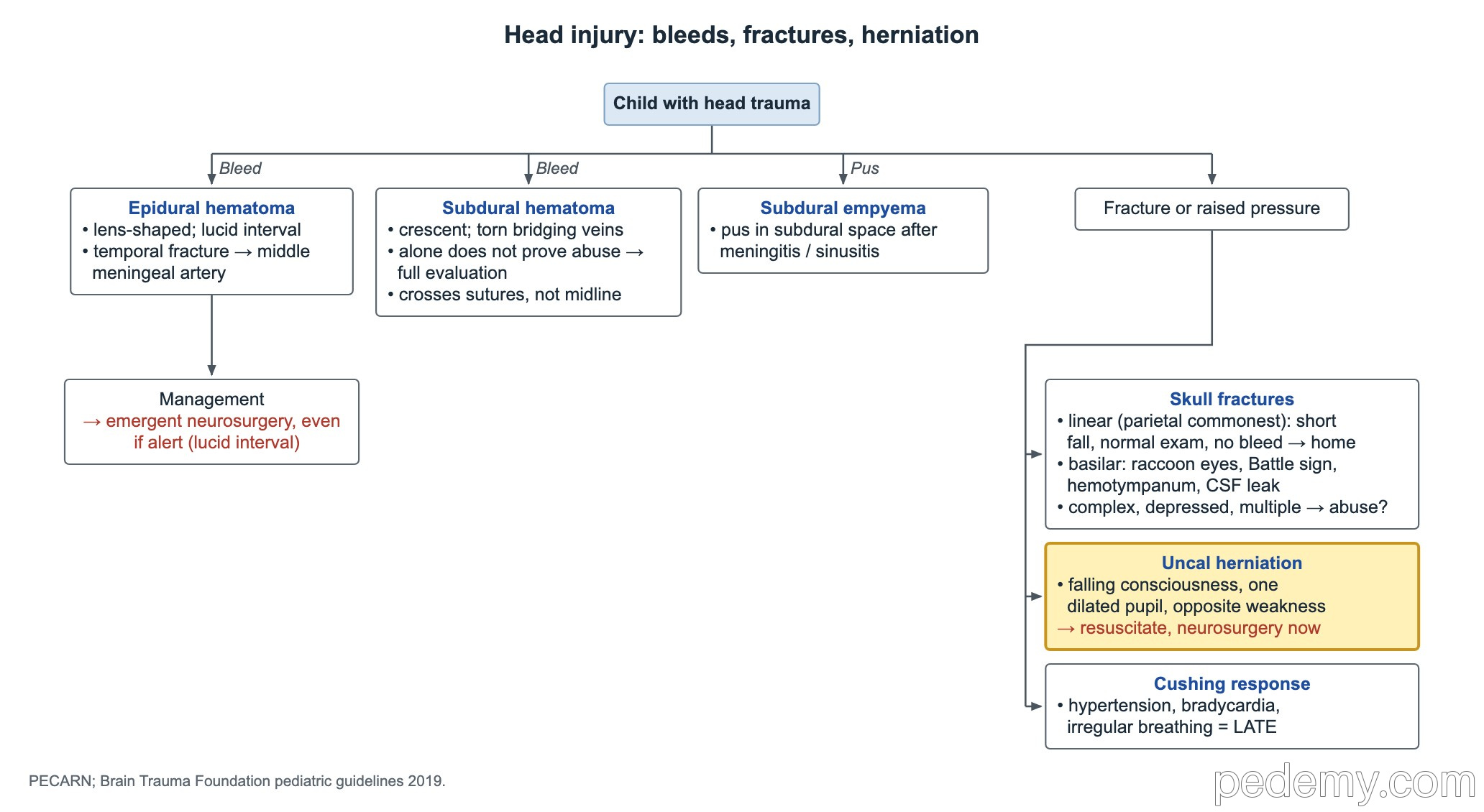
- Uncal herniation: declining consciousness, one fixed dilated pupil (CN III compression) and weakness on the opposite side.
- Act at once: secure the airway, support breathing and circulation, give hyperosmolar therapy as directed, and get urgent neurosurgical evaluation.
- Cushing response: hypertension, bradycardia and irregular respirations; it is a late warning sign, so do not wait for it.
Cranial nerve palsies: CN VI and Bell palsy
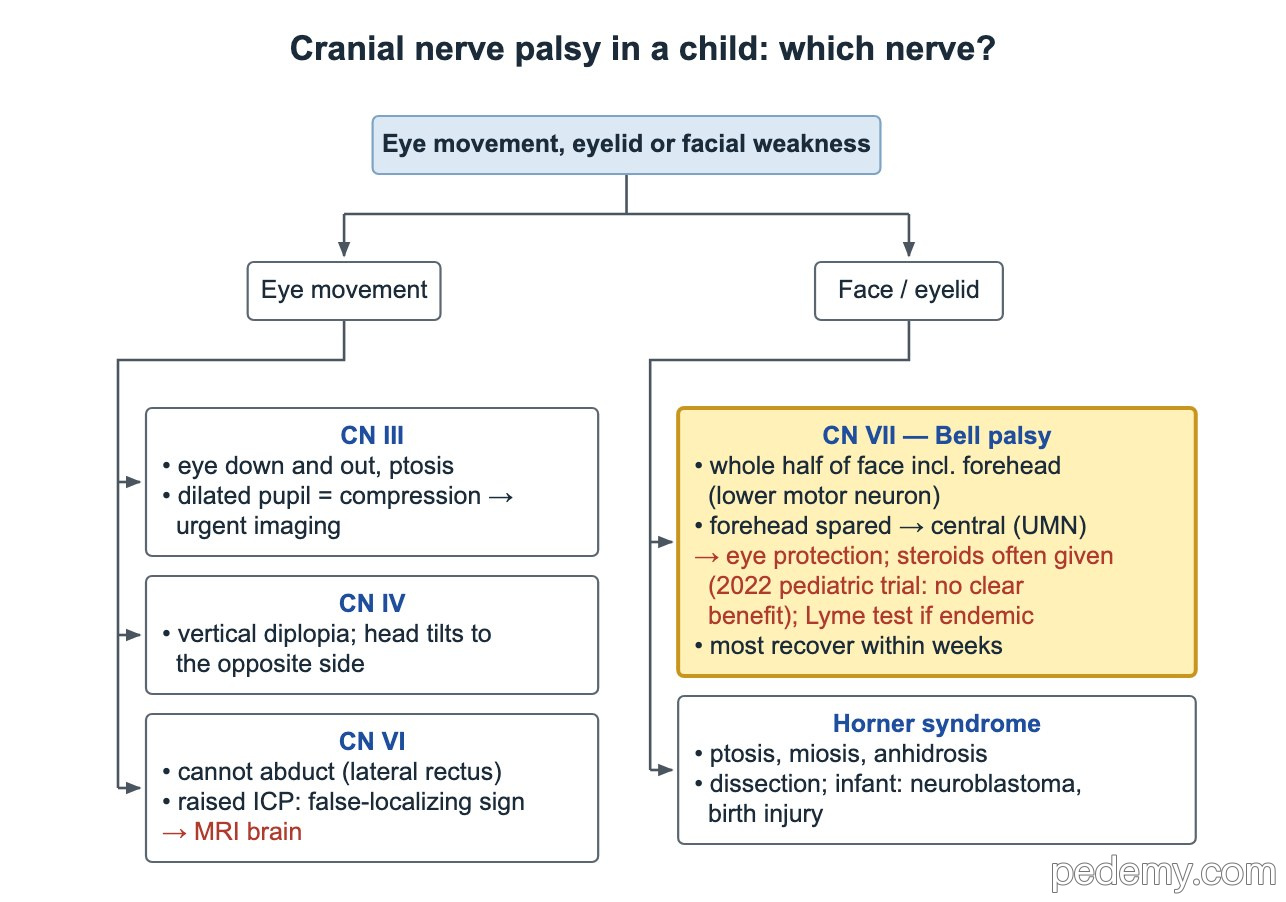
- CN VI: the child cannot abduct one eye (lateral rectus) and has horizontal double vision. With headache and vomiting it is a false-localizing sign of raised intracranial pressure: get a brain MRI.
- CN III: eye down and out with ptosis; a dilated pupil means compression and needs urgent imaging.
- CN IV: vertical double vision; the head tilts to the opposite side.
- Bell palsy (lower motor neuron CN VII): the whole half of the face is weak, including the forehead; the child cannot close the eye or wrinkle the forehead and the nasolabial fold is flat.
- Forehead spared: think of a central (upper motor neuron) lesion instead.
- Bell palsy care: protect the eye (lubricant, taping at night). Steroids are often given, but a 2022 pediatric trial showed no clear benefit. Test for Lyme disease in endemic areas. Most children recover within weeks.
- Horner syndrome (ptosis, miosis, anhidrosis): think of carotid dissection; in an infant, birth injury or neuroblastoma.
Brachial plexus birth injuries
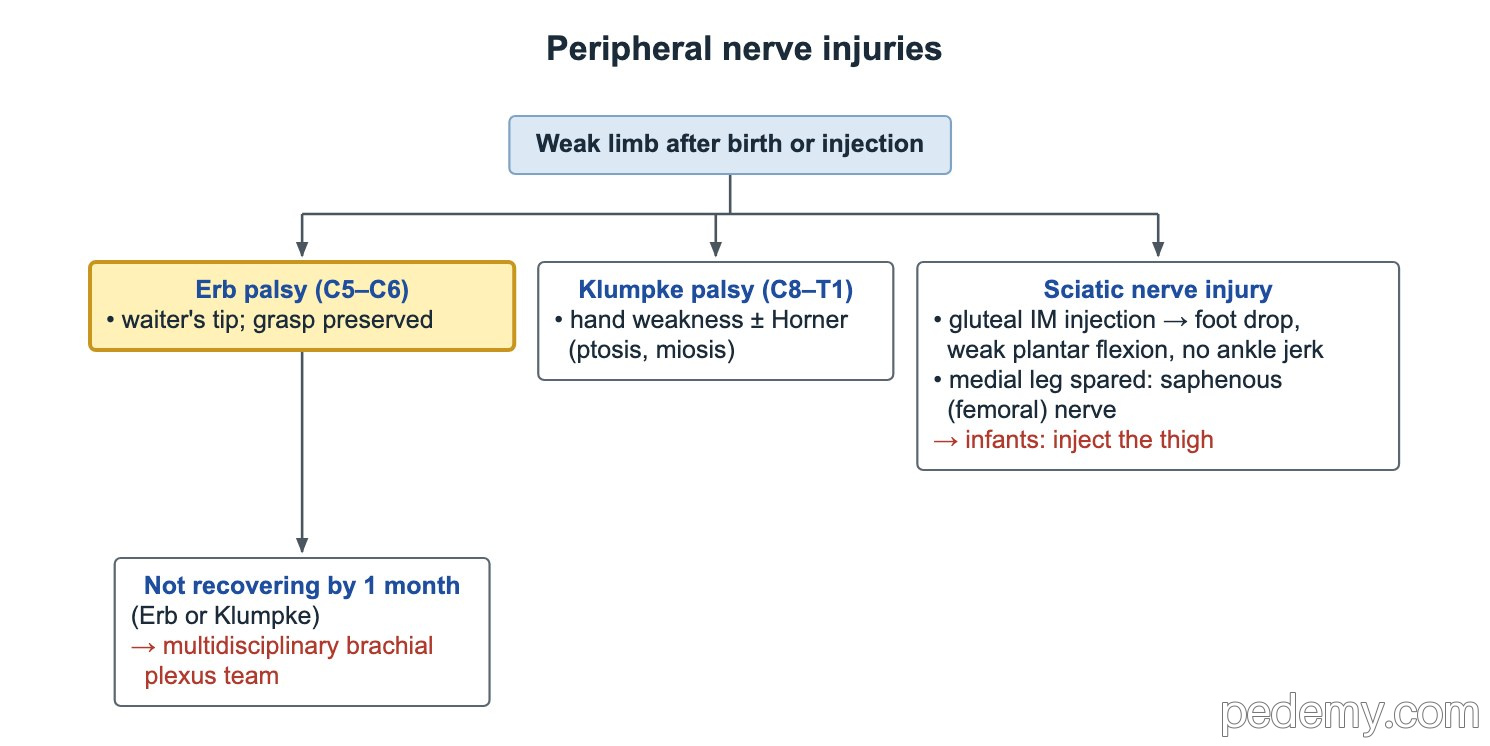
An infant with Erb or Klumpke palsy who is not recovering by 1 month should be referred to a multidisciplinary brachial plexus team.
| Injury | Roots | Findings |
|---|---|---|
| Erb palsy | C5–C6 | Arm adducted and internally rotated, wrist flexed ('waiter's tip'); grasp preserved |
| Klumpke palsy | C8–T1 | Weak hand and wrist, often with Horner syndrome (ptosis, miosis) |
Sciatic nerve injury after injection
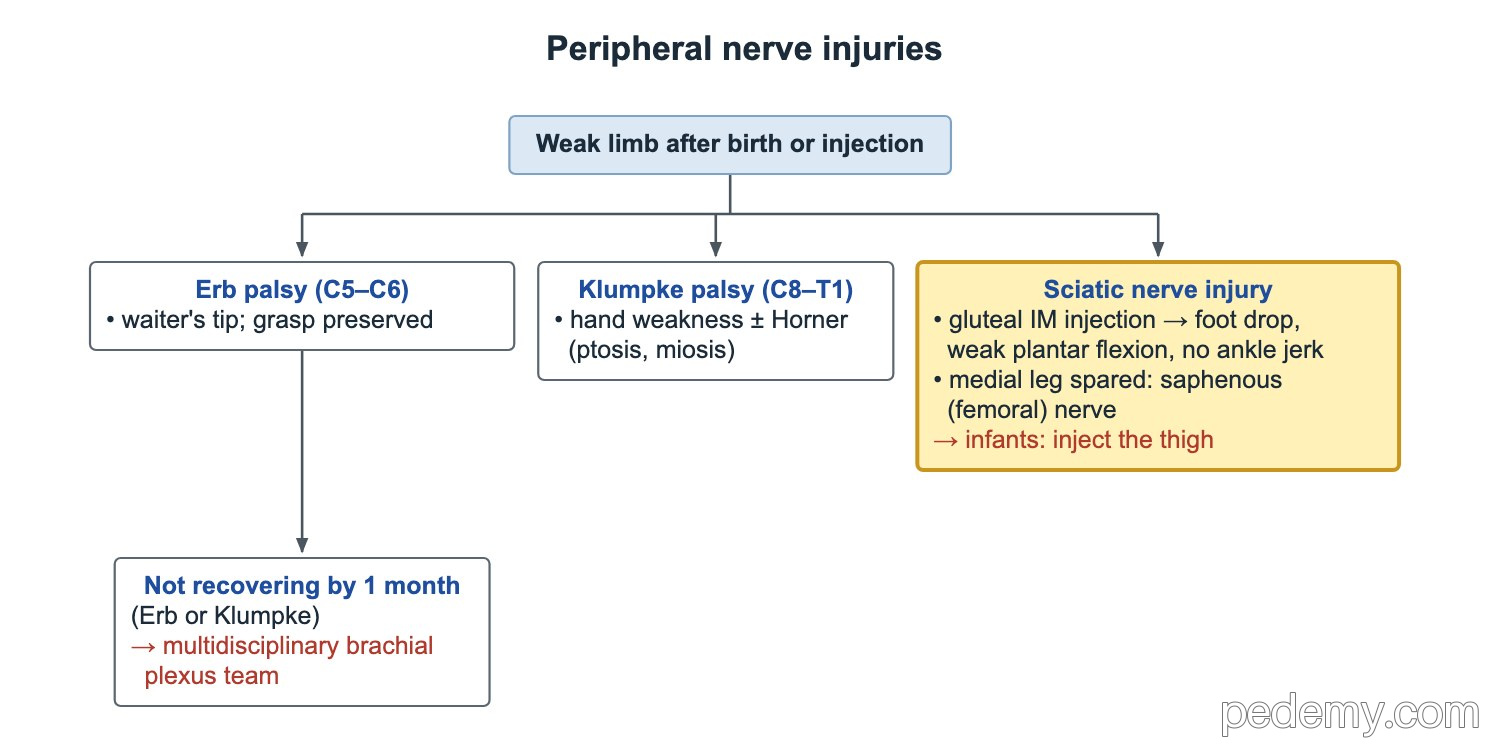
- A gluteal intramuscular injection can injure the sciatic nerve: foot drop, weak plantar flexion and a lost ankle jerk.
- Sensation over the medial lower leg is spared because the saphenous branch of the femoral nerve supplies it.
- Prevention: give routine IM injections to infants in the anterolateral thigh (vastus lateralis), not the buttock.
Common questions
How do you tell an epidural from a subdural hematoma on CT?
An epidural hematoma is lens-shaped and does not cross suture lines; a subdural hematoma is crescent-shaped and crosses sutures but not the midline.
Do children with Bell palsy need steroids?
Steroids are often given, but a 2022 randomized trial in children found no clear benefit of prednisolone. Eye protection matters most, and most children recover fully.
Study this topic
Sources
- AAP 2020: Abusive head trauma in infants and children (Pediatrics)
- Brain Trauma Foundation 2019: Pediatric severe traumatic brain injury guidelines, 3rd edition (Pediatr Crit Care Med)
- 2022: Efficacy of prednisolone for Bell palsy in children, randomized trial (Neurology)
Written for Pedemy in our own words from the sources above; checked November 2026. For education only, not medical advice; check doses and local protocols before treating a patient. Pedemy is independent and not affiliated with or endorsed by the organizations cited.