

Main decision tree
Vision development and screening
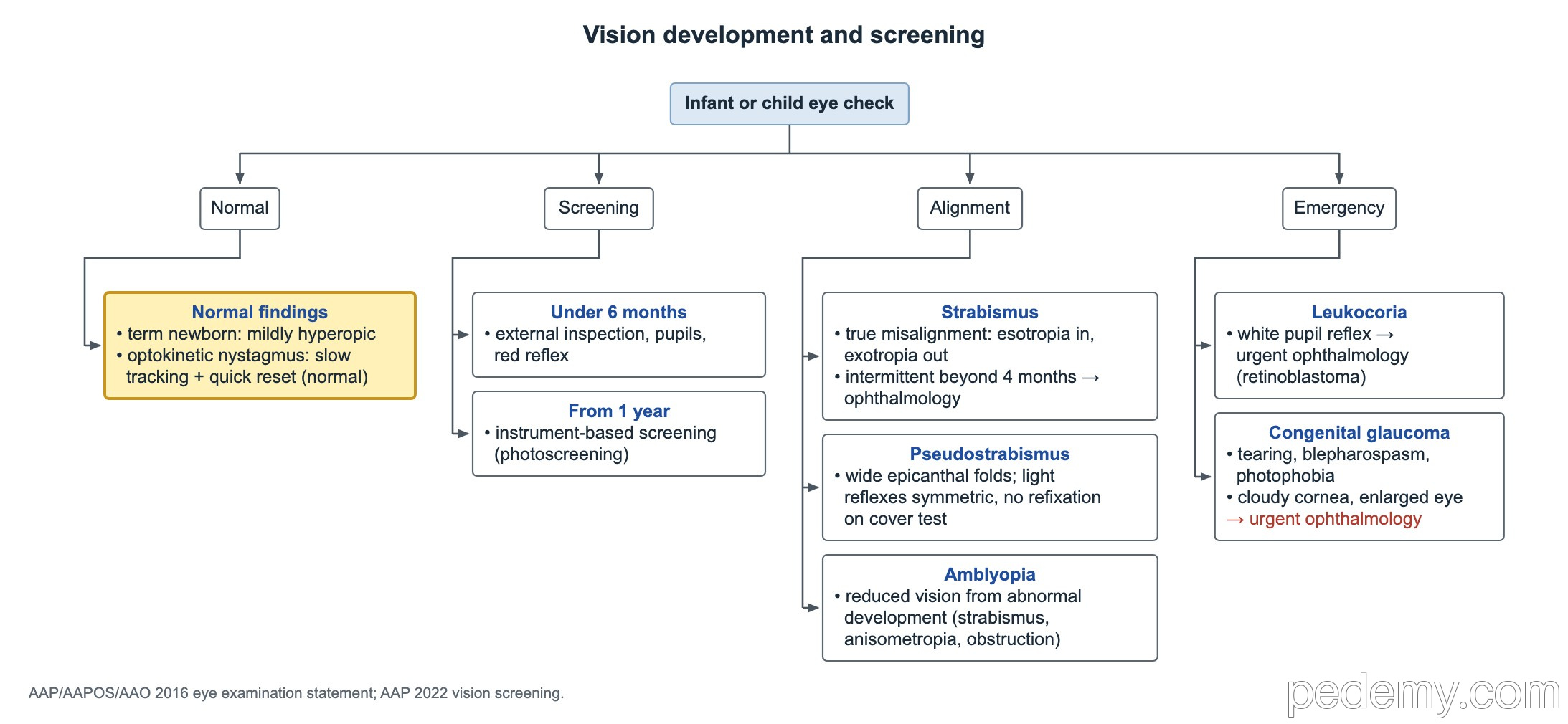
Key points
- Most term newborns are mildly hyperopic (farsighted); optokinetic nystagmus is a normal tracking response.
- Birth to 6 months: external inspection, pupil exam and red reflex.
- Instrument-based screening (photoscreener or autorefractor) can start at 12 months.
- Strabismus that is still intermittent beyond 4 months, or constant at any age, needs pediatric ophthalmology.
- Pseudostrabismus: symmetric corneal light reflexes and no refixation on cover testing.
- ROP screening: born at 30 weeks or less, or 1,500 g or less; high oxygen exposure is the key modifiable risk.
- Leukocoria means retinoblastoma until proven otherwise: urgent ophthalmology.
Normal vision in infancy
- Most full-term newborns are mildly hyperopic (farsighted). This usually lessens over the first years.
- Optokinetic nystagmus is normal: an infant watching a moving striped pattern shows slow tracking movements with quick resetting jerks.
- Vision keeps maturing through early childhood, which is why blur or misalignment in this period can cause lasting loss.
Vision screening by age
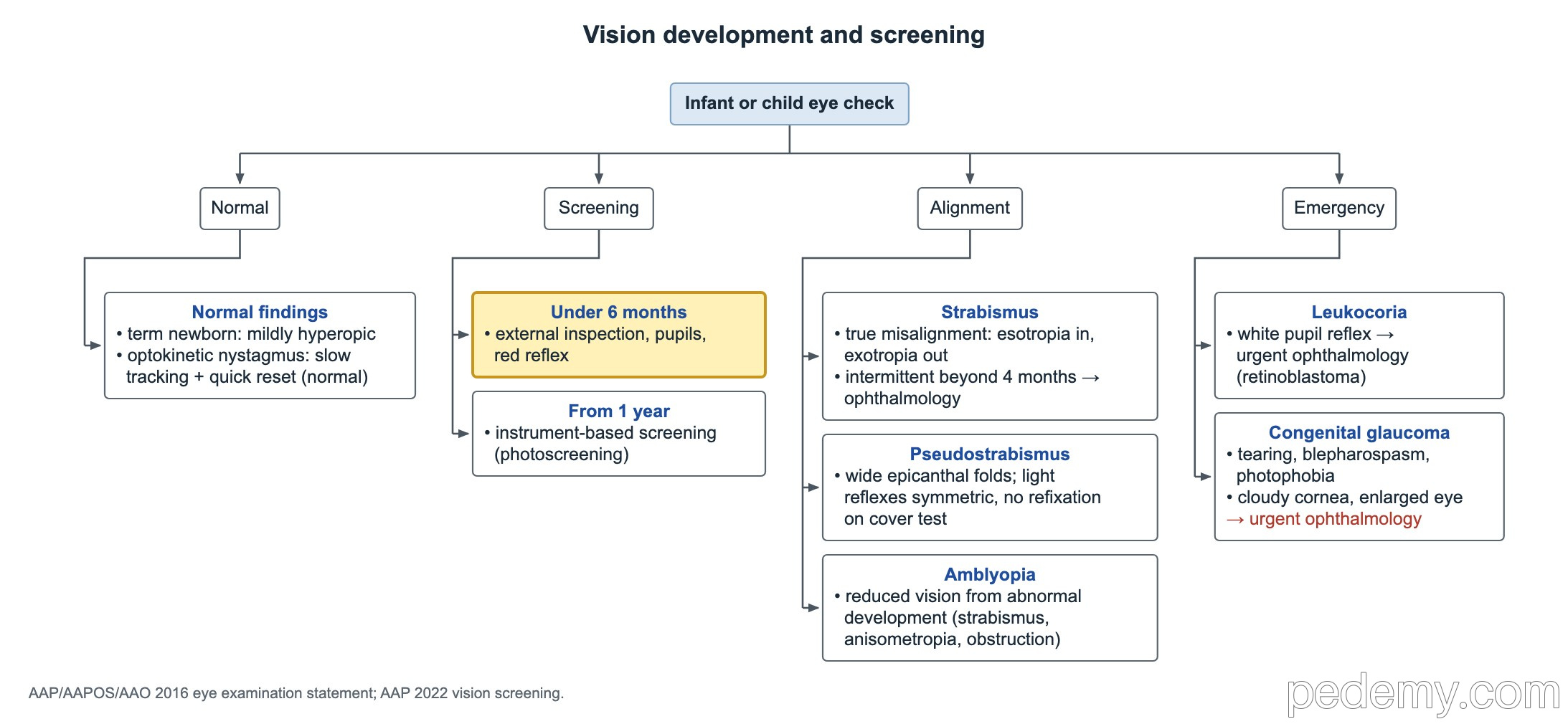
Refer any child with an abnormal red reflex, an eye abnormality or a failed screen to a pediatric eye specialist.
| Age | What to do |
|---|---|
| Newborn to 6 months | External inspection, pupil exam and red reflex test |
| 6 to 12 months | Add fixing and following, corneal light reflex and cover test |
| 12 months to 3 years | Instrument-based screening (photoscreener or autorefractor) if available, at well visits |
| About 4 years and older | Visual acuity with age-appropriate optotypes |
Eye alignment: strabismus and pseudostrabismus
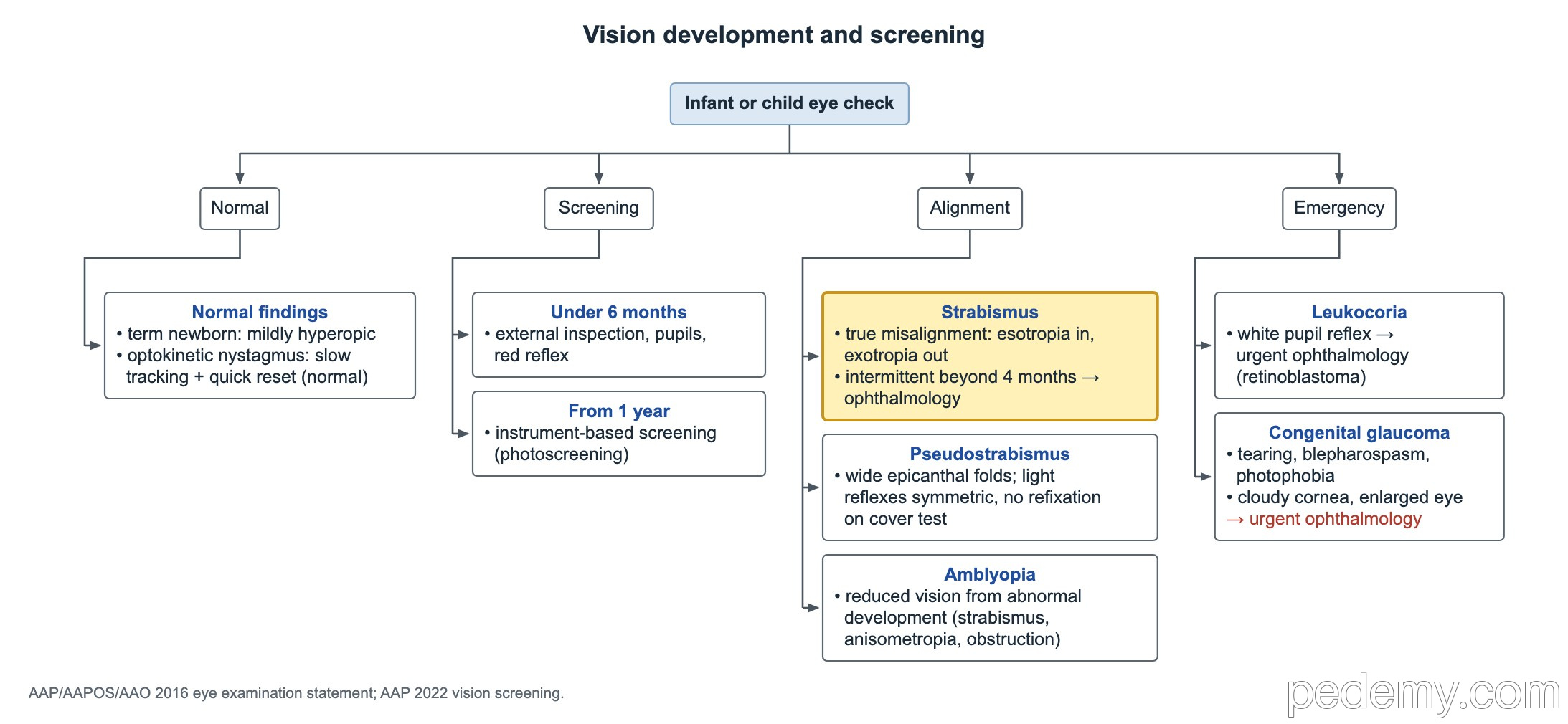
Strabismus is true misalignment of the eyes. Esotropia turns inward; exotropia turns outward. Brief intermittent misalignment is common in young infants, but if it continues beyond 4 months, refer to pediatric ophthalmology.
- Infantile esotropia: a constant inward turn starting before 6 months with an asymmetric corneal light reflex. The main complication is amblyopia; treatment is usually surgery.
- Pseudostrabismus: wide epicanthal folds or a broad nasal bridge make the eyes look crossed. The light reflexes are symmetric and the cover test shows no refixation movement.
Amblyopia and the drooping lid
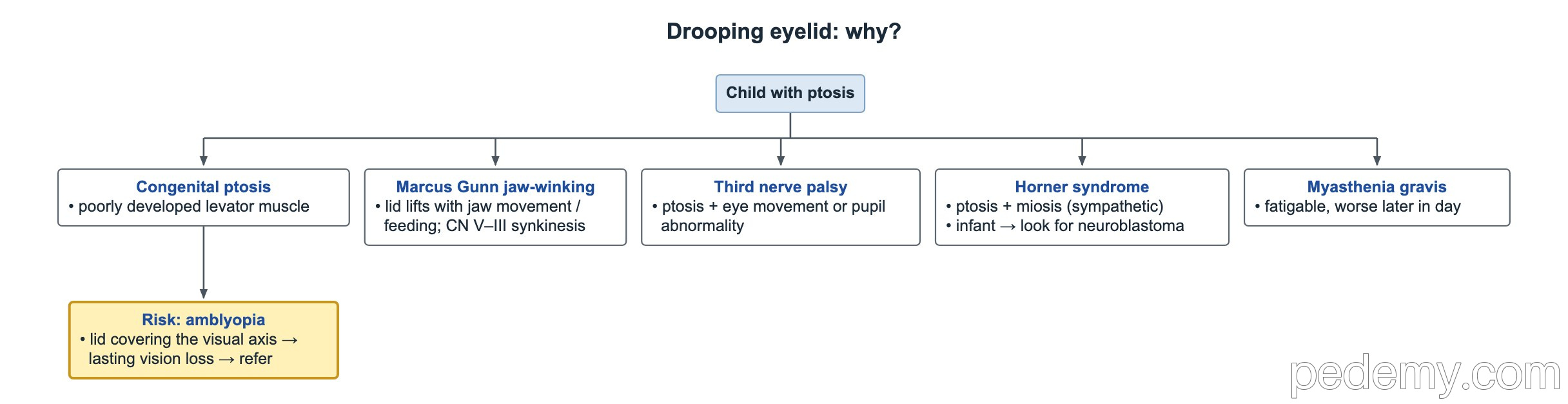
Amblyopia is reduced vision caused by abnormal visual development, not by eye disease. The brain learns to ignore one eye's blurred or blocked image.
- Strabismic amblyopia: from a misaligned eye.
- Refractive amblyopia: from a large difference in focus between the eyes (anisometropia) or high refractive error in both.
- Deprivation amblyopia: something blocks the image, such as a lid that covers the pupil for months or a cataract. Refer early.
- A new ptosis with a small pupil in an infant, with no birth trauma, is Horner syndrome; look for neuroblastoma.
Retinopathy of prematurity
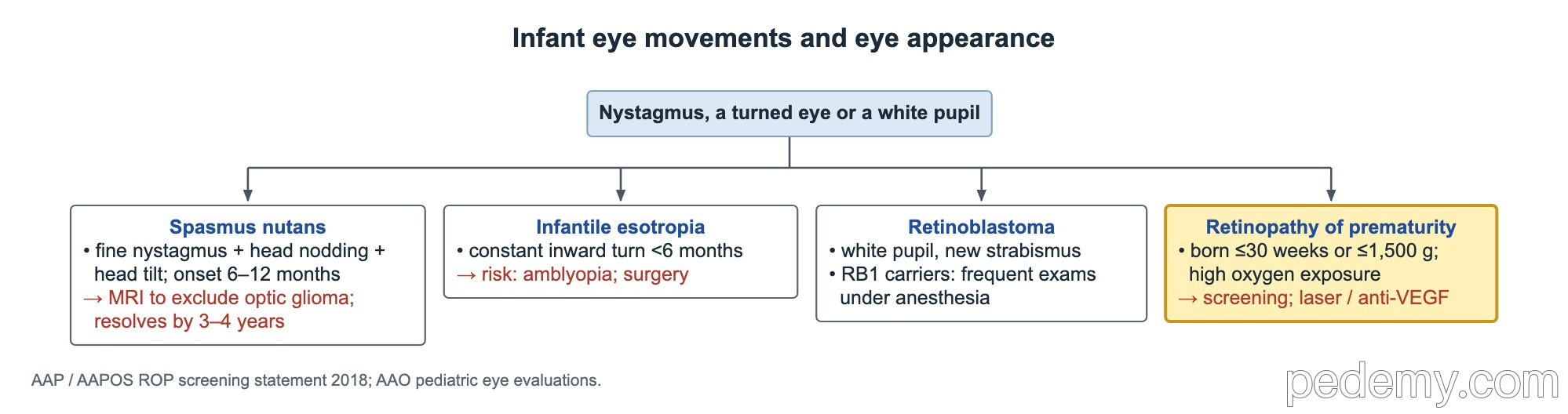
ROP is abnormal growth of immature retinal vessels in preterm infants. Screening exams find a ridge or abnormal vessels before the retina detaches.
- Screen infants born at 30 weeks or less, or weighing 1,500 g or less, plus selected larger infants with an unstable course.
- High oxygen exposure (hyperoxia) is the most important modifiable risk factor.
- Treatment-requiring ROP is treated with laser or anti-VEGF injection.
White pupil: retinoblastoma
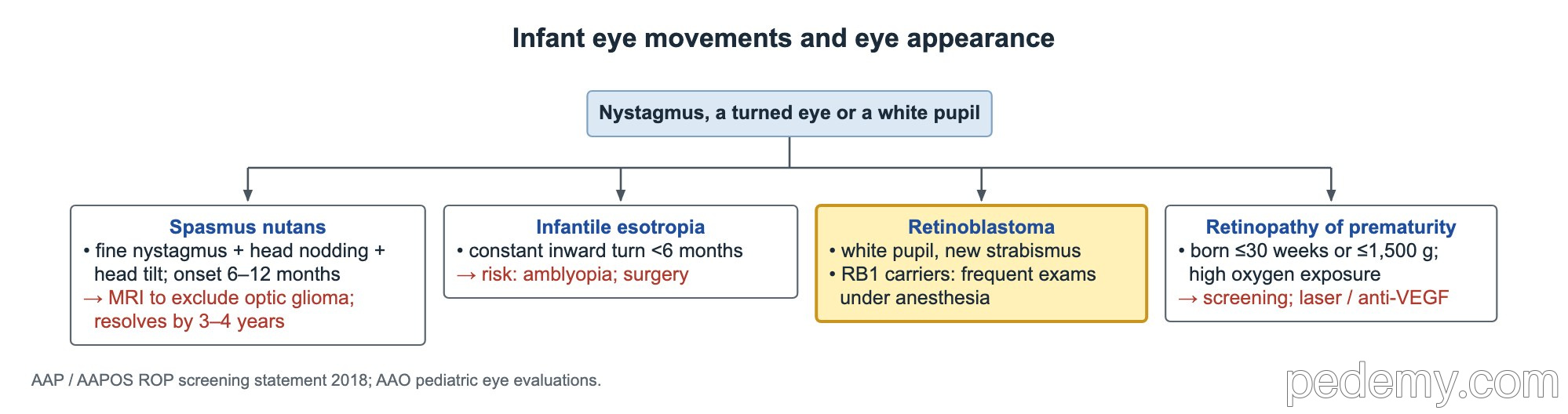
Leukocoria (a white pupillary reflex) is the most common sign of retinoblastoma, and a new strabismus is the next most common. A child with an RB1 variant who develops a turned eye most likely also has leukocoria.
Any white reflex needs urgent ophthalmology. RB1 carriers need frequent retinal exams under anesthesia.
Nystagmus with head nodding: spasmus nutans
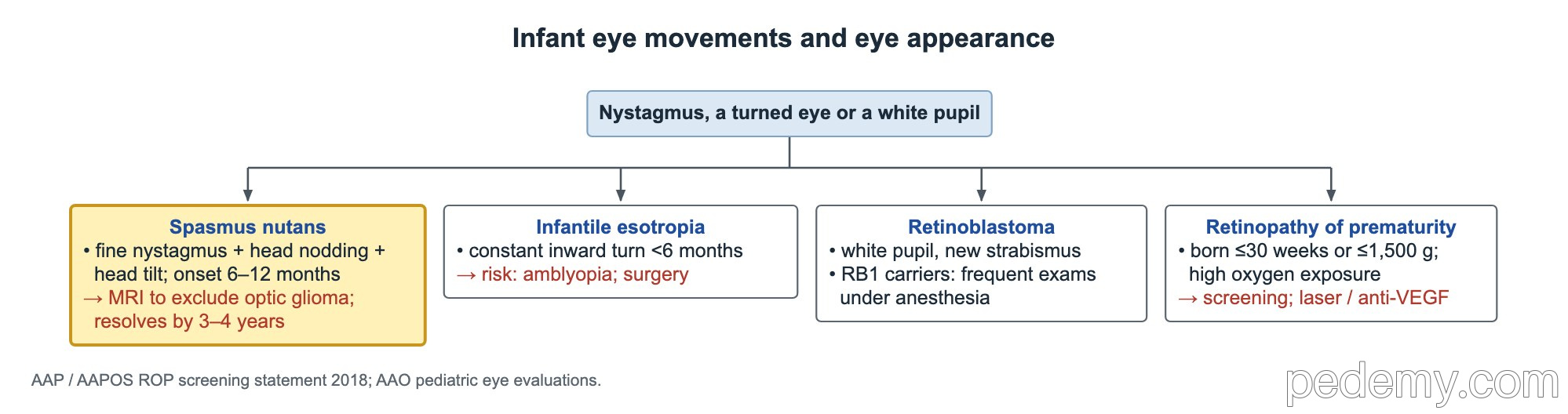
Spasmus nutans is fine nystagmus, head nodding and head tilt in an otherwise normally developing infant, starting at 6–12 months. Get an MRI to exclude an optic pathway glioma, which can look the same. True spasmus nutans resolves by 3–4 years.
Common questions
At what age can a photoscreener be used?
Instrument-based vision screening can start at 12 months and is used at well visits until the child can read an eye chart, usually by about 4 years.
Is it normal for a baby's eyes to cross?
Brief intermittent crossing is common in young infants. Refer if misalignment is still present after 4 months or is constant at any age.
How do you tell pseudostrabismus from true strabismus?
In pseudostrabismus the corneal light reflexes are symmetric and the eyes do not move on cover testing.
Study this topic
Sources
- AAP 2016: Visual system assessment in infants, children and young adults by pediatricians (Pediatrics)
- AAP 2016: Procedures for the evaluation of the visual system by pediatricians (Pediatrics)
- AAP/AAO/AAPOS 2018: Screening examination of premature infants for ROP (Pediatrics)
- AAO 2022: Amblyopia Preferred Practice Pattern (Ophthalmology)
- AAO 2022: Esotropia and Exotropia Preferred Practice Pattern (Ophthalmology)
Written for Pedemy in our own words from the sources above; checked November 2026. For education only, not medical advice; check doses and local protocols before treating a patient. Pedemy is independent and not affiliated with or endorsed by the organizations cited.