

Main decision tree
Ankle and heel injuries
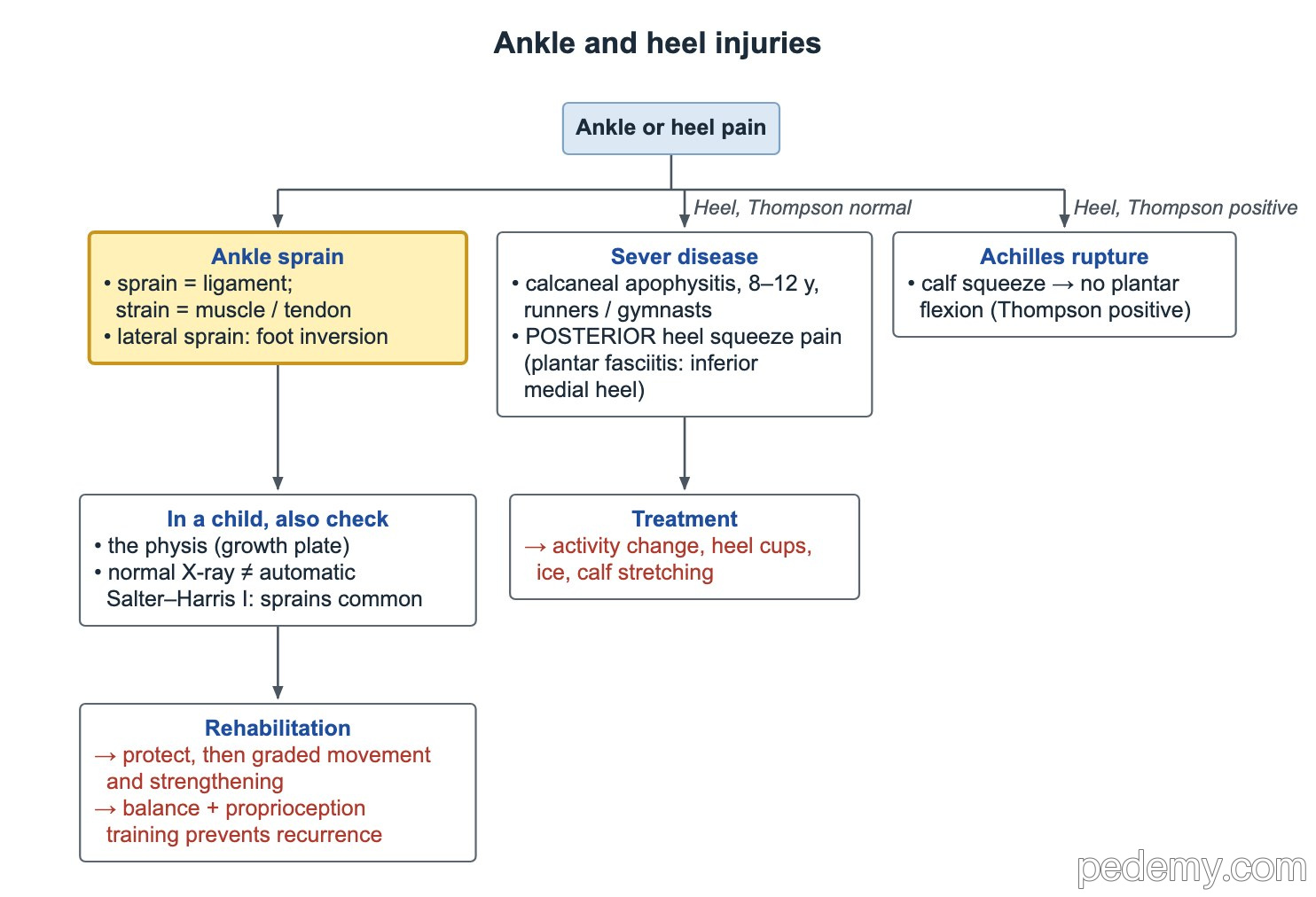
Key points
- Sprain = ligament injury; strain = muscle or tendon injury.
- Most lateral ankle sprains follow inversion of the foot, injuring the anterior talofibular ligament first.
- In a child, examine the physis (growth plate) as well as the ligaments.
- A normal X-ray does not mean an automatic Salter-Harris I fracture: sprains are common in children.
- Mild sprain pain: ice and elevation first; add acetaminophen 15 mg/kg or ibuprofen 10 mg/kg if needed.
- After brief protection, graded movement and strengthening restore function.
- Balance and proprioception training lowers the risk of another sprain.
Sprain, strain and the inversion injury
A sprain is a stretch or tear of a ligament. A strain is the same injury in a muscle or its tendon. The words are often mixed up, and boards test the difference.
The typical ankle sprain happens when the foot rolls inward (inversion), often while landing or cutting. The lateral ligaments take the load: the anterior talofibular ligament is injured first, then the calcaneofibular ligament in more severe sprains.
- Grade 1: stretch, little swelling, stable joint.
- Grade 2: partial tear, more swelling and bruising, some laxity.
- Grade 3: complete tear, marked swelling, unstable joint, often cannot bear weight.
- High ankle (syndesmotic) sprain: pain above the ankle with external rotation; slower recovery.
In a child, check the growth plate
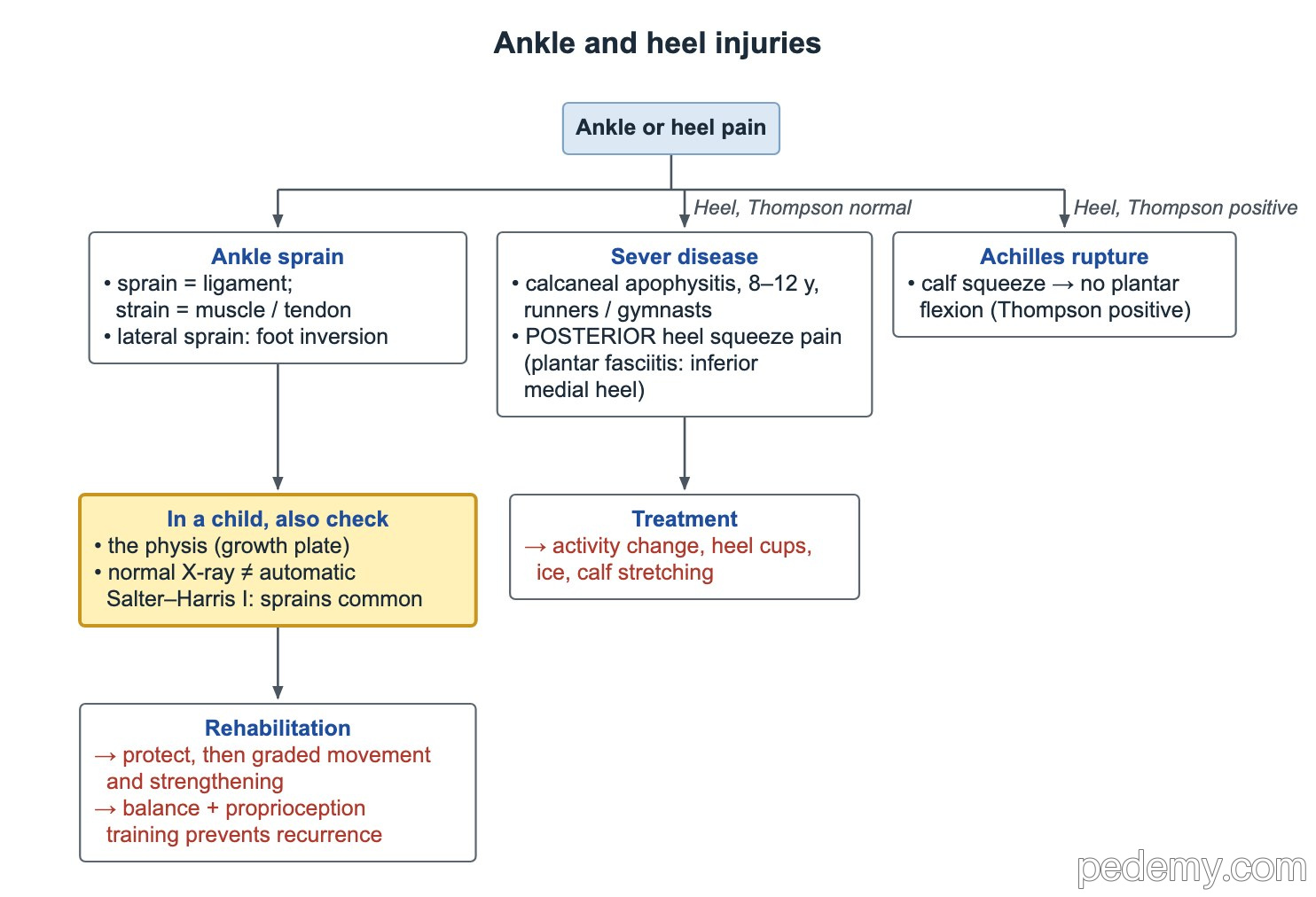
Before skeletal maturity, the physis can be weaker than the ligaments around it. Palpate the distal fibular and tibial physes, the malleoli, the base of the fifth metatarsal and the navicular.
Older teaching called every child with tenderness over the distal fibula and a normal X-ray a Salter-Harris I fracture. Imaging studies show most of these children have a sprain or a bone bruise, so the diagnosis is not automatic.
- The Ottawa ankle rules help decide on X-rays in school-age children: bone tenderness at the posterior edge or tip of either malleolus, at the base of the fifth metatarsal or at the navicular, or inability to take 4 steps.
- Get X-rays for marked swelling, deformity, bone tenderness or inability to bear weight.
- Tenderness exactly over the physis with a normal X-ray: treat symptomatically with protection and recheck; it does not need casting by default.
- Recurrent sprains with a stiff, flat foot suggest tarsal coalition.
First-line pain care
For a mild sprain, start with non-drug measures: ice for 15–20 minutes at a time, elevation, compression and short rest from painful activity.
If pain needs medicine, use acetaminophen 15 mg/kg per dose or ibuprofen 10 mg/kg per dose (6 months and older). Opioids are not needed for an uncomplicated sprain.
Rehabilitation and preventing recurrence
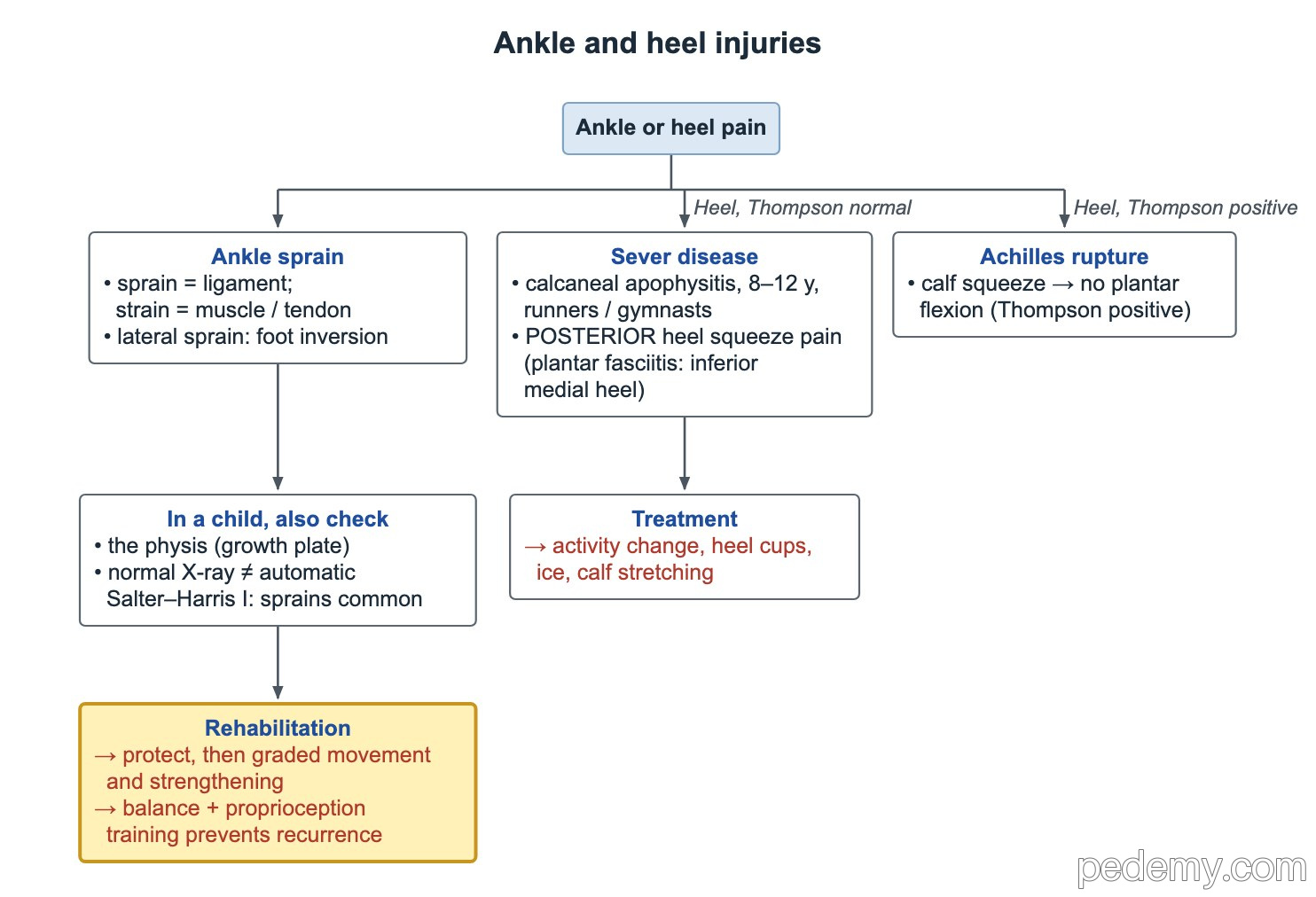
Protection is short. As pain allows, the child moves on to graded range of motion, weight bearing and strengthening. Long immobilization slows recovery for most sprains.
A previous sprain is the strongest risk factor for the next one. Balance and proprioception work (single-leg stance, wobble board, hopping drills) reduces re-injury.
- Phase 1: protect, ice, elevate; a lace-up brace or air stirrup for support.
- Phase 2: restore motion and strength (calf, peroneal and hip muscles).
- Phase 3: balance, agility and sport-specific drills before full return.
- Return to sport when the child can hop, cut and run without pain or limp.
Common questions
What is the difference between a sprain and a strain?
A sprain injures a ligament, which joins bone to bone. A strain injures a muscle or its tendon.
Does a child with ankle pain and a normal X-ray have a growth plate fracture?
Not automatically. Most children with tenderness over the distal fibula and a normal X-ray have a sprain. Treat the symptoms, protect the ankle and recheck.
How do you prevent another ankle sprain?
Finish rehab with strength, balance and proprioception training. A brace during sport can also help in the months after a sprain.
Study this topic
Sources
Written for Pedemy in our own words from the sources above; checked November 2026. For education only, not medical advice; check doses and local protocols before treating a patient. Pedemy is independent and not affiliated with or endorsed by the organizations cited.