

Main decision tree
Leg shape and rotation in young children: normal sequence
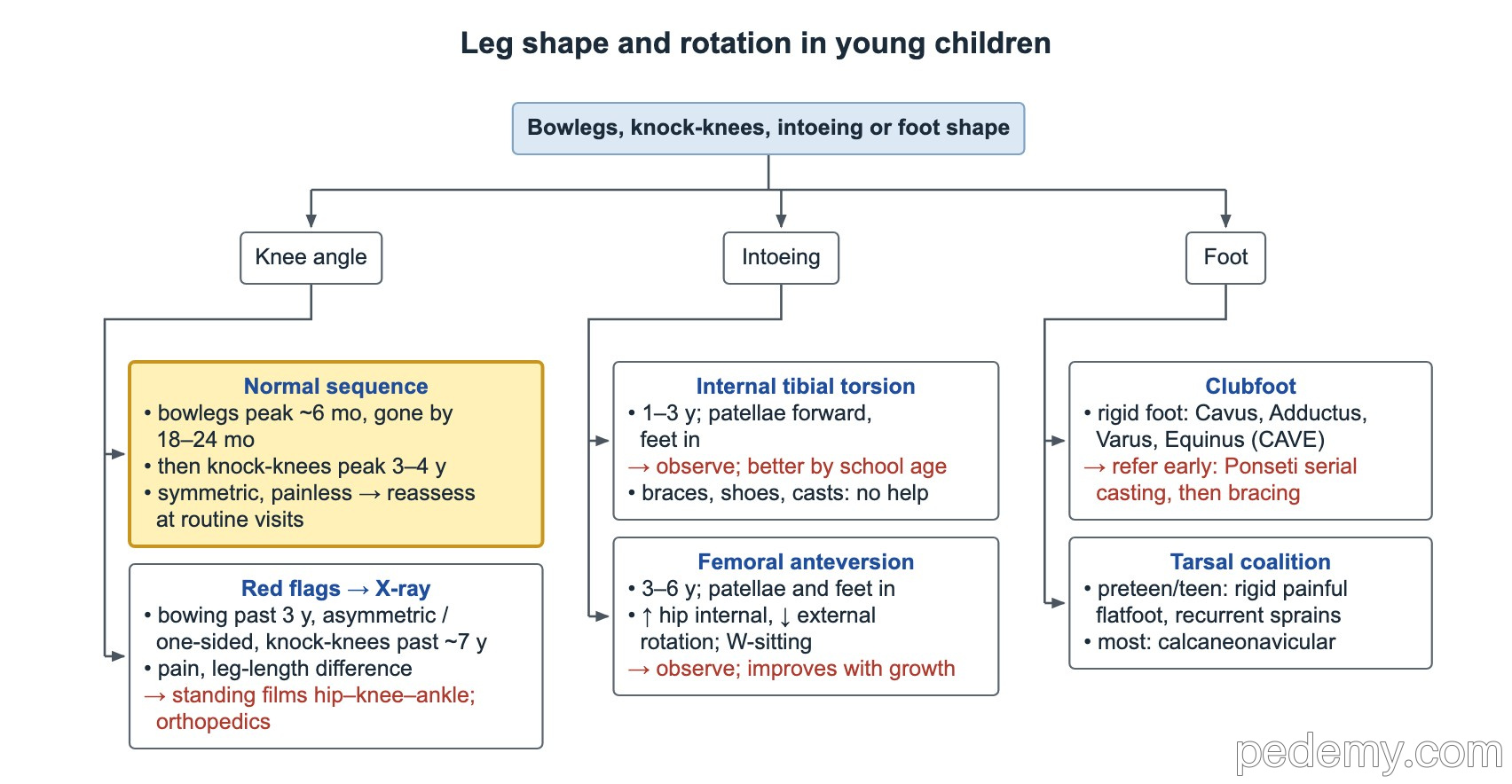
Key points
- Intoeing by age: metatarsus adductus in infants, internal tibial torsion at 1–3 years, femoral anteversion at 3–6 years.
- Flexible metatarsus adductus (corrects past midline) is observed; most resolve by about 1 year. Rigid → orthopedics for serial casting.
- Clubfoot (CAVE: cavus, adductus, varus, equinus) is rigid; refer early for Ponseti serial casting, then bracing.
- Normal alignment: bowlegs peak around 6 months and resolve by 18–24 months; knock-knees peak at 3–4 years.
- Red flags → standing hip-to-ankle X-rays: bowing past 2–3 years, one-sided or asymmetric, knock-knees past about 7 years, pain, leg-length difference.
- Blount disease: early walker with obesity, medial metaphyseal beaking, metaphyseal–diaphyseal angle >16°; brace under 3 years.
- Sever disease: heel pain at 8–12 years with a positive calcaneal squeeze; treat with activity change, heel cups, ice and calf stretching.
Normal knee alignment: bowlegs, then knock-knees
Babies are born bowlegged. Genu varum peaks around 6 months and straightens by 18–24 months. The legs then swing into knock-knees (genu valgum), which peak at 3–4 years and settle toward the adult alignment by about 7 years.
A healthy child with symmetric, painless bowing or knock-knees that fits this timeline needs only reassurance and a recheck at routine visits. X-rays, braces and special shoes are not needed.
When bowing or knock-knees is not physiologic
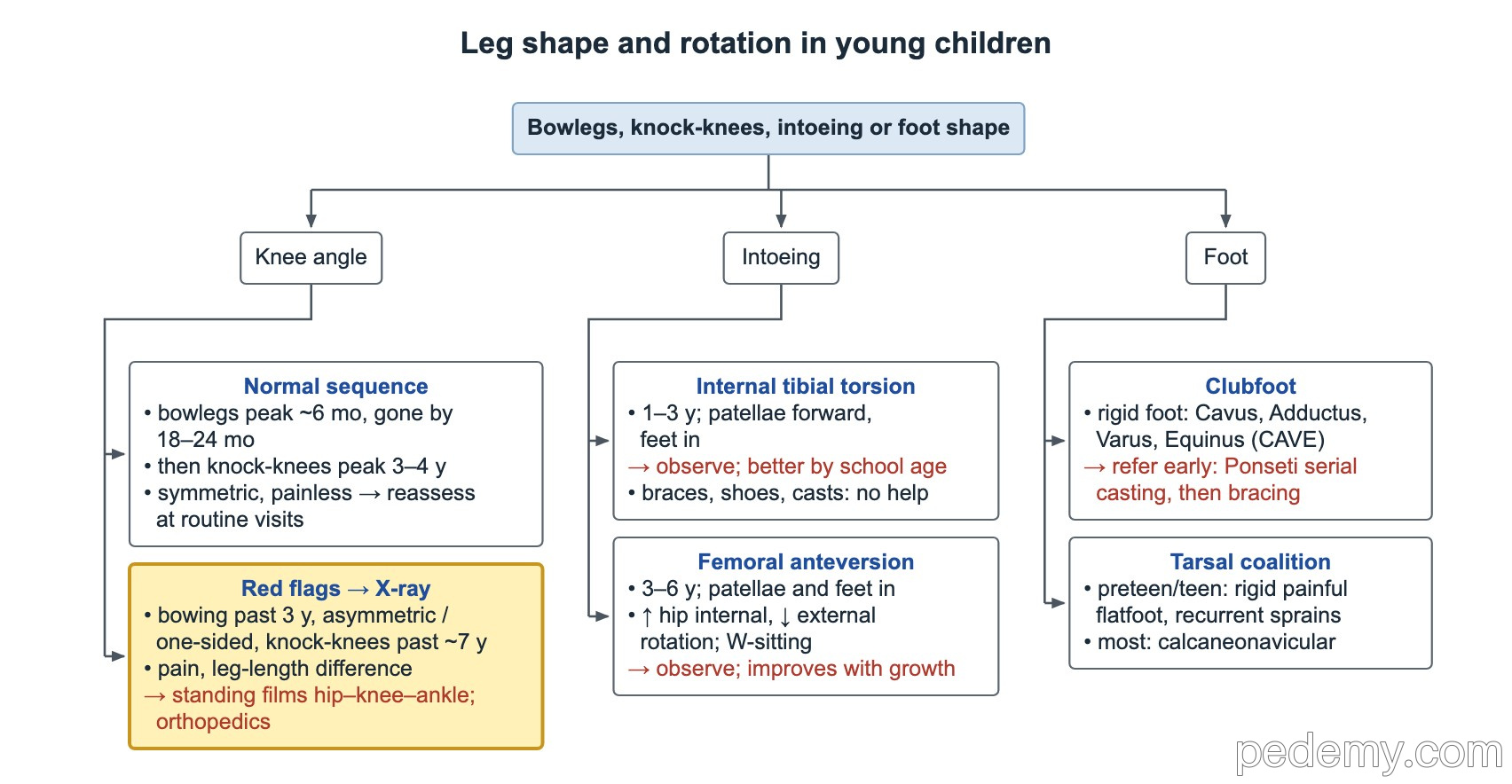
Pathologic causes include Blount disease, rickets (check calcium, phosphorus, alkaline phosphatase and vitamin D), skeletal dysplasia and old physeal injury.
- Bowing that persists past 2–3 years or gets worse.
- One-sided or clearly asymmetric deformity.
- Knock-knees beyond about 7 years, or severe at any age.
- Pain, limp, short stature or a leg-length difference.
- Imaging: standing full-length (hip-to-ankle) radiographs, then orthopedic referral.
Blount disease (tibia vara)
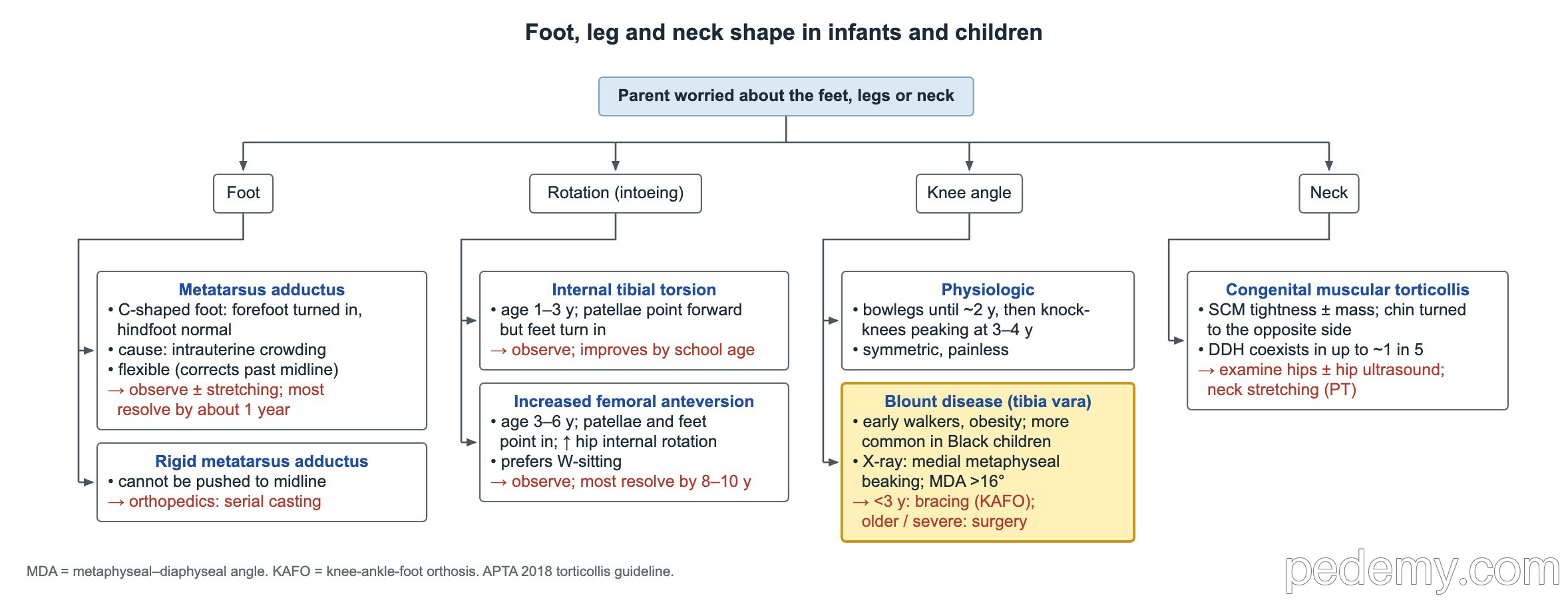
Blount disease is a growth disturbance of the medial proximal tibial physis. Infantile Blount affects toddlers who walked early and have obesity, and it is more common in Black children. Bowing is progressive and often asymmetric.
X-rays show medial metaphyseal beaking. A metaphyseal–diaphyseal angle above 16° supports the diagnosis.
- Younger than 3 years: knee-ankle-foot orthosis (bracing).
- Older, severe or failed bracing: surgery (guided growth or tibial osteotomy).
Intoeing: tibial torsion and femoral anteversion
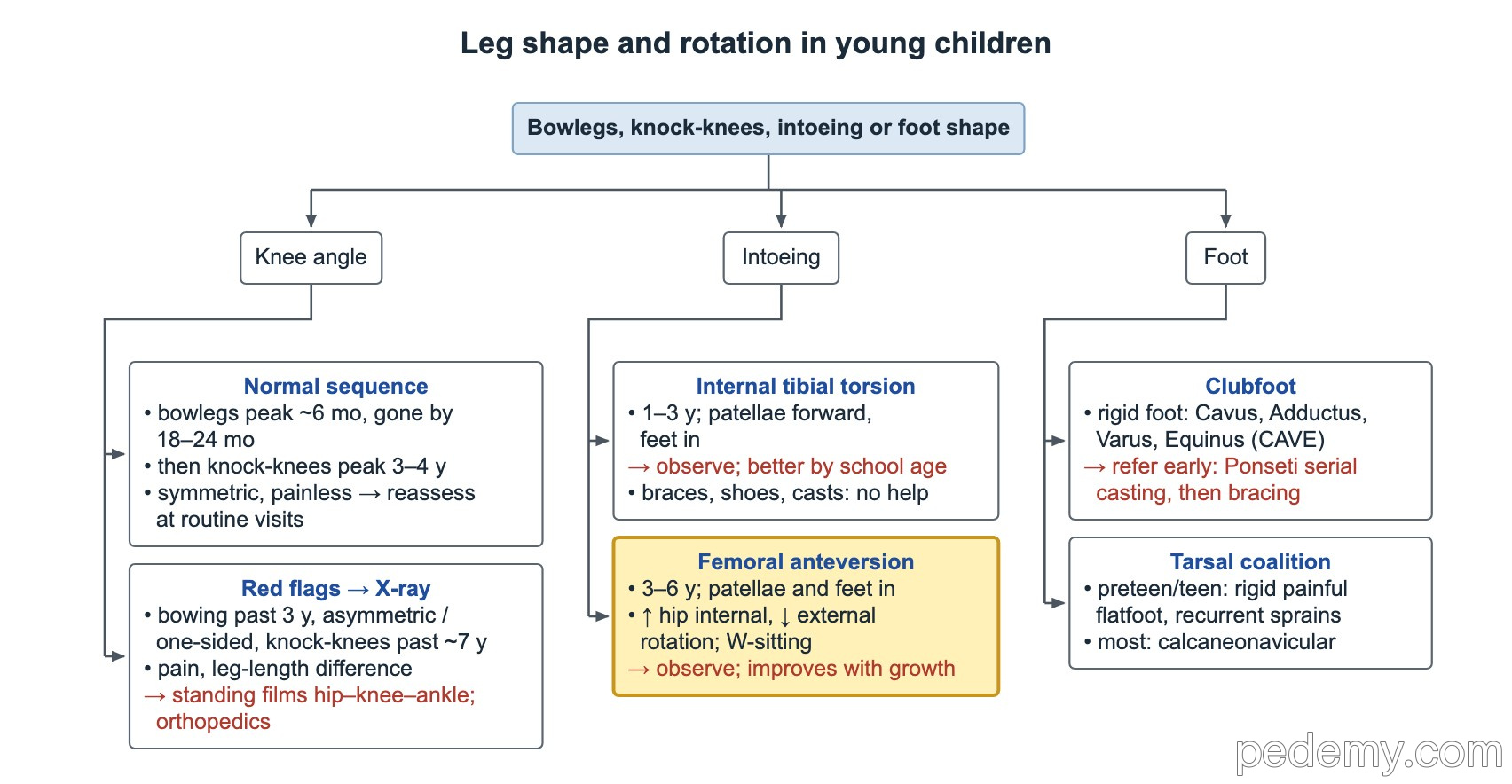
Internal tibial torsion is the commonest cause of intoeing in toddlers. Night splints, braces, special shoes and casts do not help.
Increased femoral anteversion makes hip internal rotation increase and external rotation decrease, so children like to W-sit. It improves with growth; surgery (derotation osteotomy) is rare and only for severe, functional problems in older children.
| Cause | Age | Clues | Plan |
|---|---|---|---|
| Metatarsus adductus | Infant | C-shaped foot; forefoot turned in, hindfoot normal | Flexible: observe; rigid: serial casting |
| Internal tibial torsion | 1–3 years | Patellae face forward, feet point in | Observe; better by school age |
| Femoral anteversion | 3–6 years | Patellae and feet point in; W-sitting; hip internal rotation up, external rotation down | Observe; most resolve by 8–10 years |
Metatarsus adductus and clubfoot
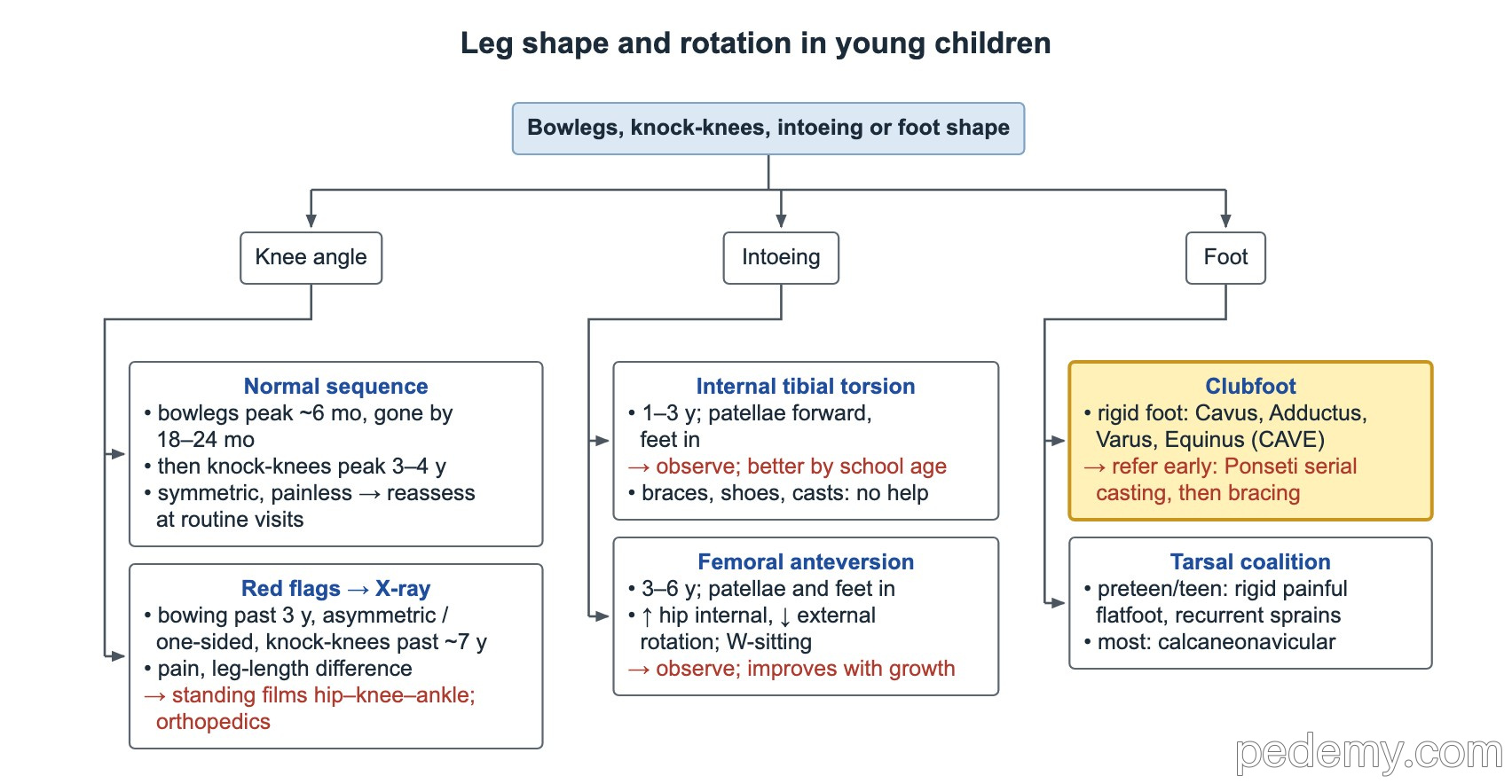
Metatarsus adductus is a C-shaped foot from intrauterine crowding: the forefoot turns in, the hindfoot is normal. If gentle pressure corrects it past midline, observe with or without stretching; most resolve by about 1 year. If it cannot be pushed to midline, refer for serial casting.
Clubfoot (talipes equinovarus) is a rigid foot pointing inward and downward. Most cases are idiopathic; some occur with neuromuscular disease or syndromes. Remember CAVE: cavus, adductus, varus, equinus.
- Refer early, in the first weeks of life; do not wait until walking.
- Ponseti method: weekly serial casts, usually a percutaneous Achilles tenotomy, then a foot-abduction brace.
- The brace is worn full-time at first, then at night for several years, to prevent relapse.
Heel pain and the rigid flatfoot
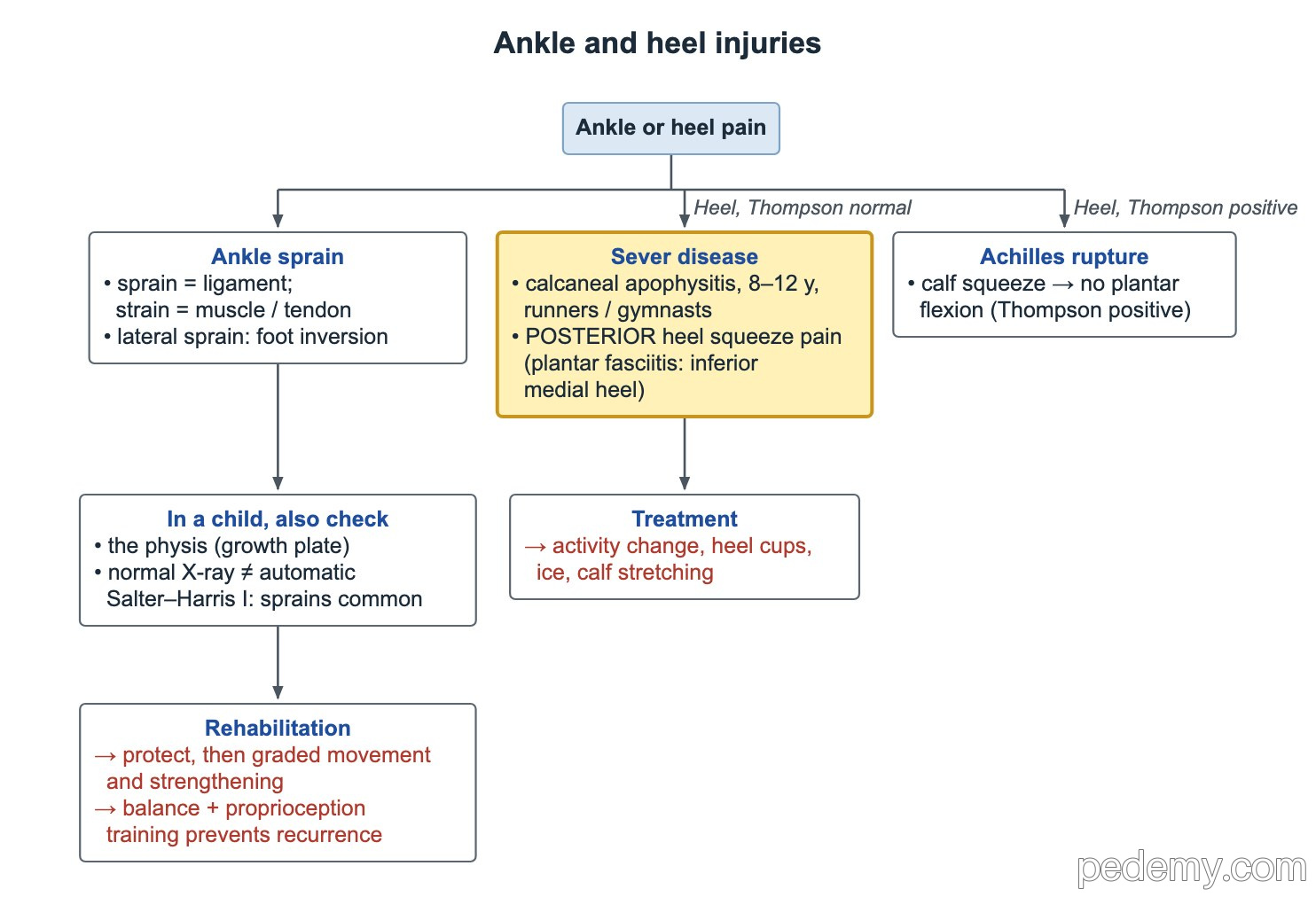
A flexible flatfoot that forms an arch on tiptoe is normal and needs no treatment. A rigid flatfoot needs X-rays, and CT if coalition is suspected.
| Condition | Clues | Management |
|---|---|---|
| Sever disease (calcaneal apophysitis) | Active child 8–12 years; posterior heel pain on side-to-side calcaneal squeeze; Achilles intact | Relative rest, heel cups, ice, calf stretching |
| Plantar fasciitis | Tenderness on the underside of the heel, medially | Stretching, supportive shoes |
| Achilles rupture | Thompson test: calf squeeze gives no plantar flexion | Urgent orthopedics |
| Tarsal coalition | Preteen or teen; rigid painful flatfoot (arch stays flat on tiptoe); recurrent ankle sprains | Orthopedics; most common is calcaneonavicular |
Common questions
When does intoeing in a toddler need treatment?
Rarely. Internal tibial torsion improves by school age and femoral anteversion by 8–10 years. Braces and special shoes do not help. Refer for pain, limp, asymmetry or severe functional problems.
At what age should bowlegs go away?
Physiologic bowlegs usually resolve by 18–24 months. Bowing past 2–3 years, one-sided bowing or worsening bowing needs standing X-rays.
How is clubfoot treated?
With the Ponseti method: weekly casts starting in early infancy, usually an Achilles tenotomy, then a foot-abduction brace for several years.
Study this topic
Sources
- Rerucha CM et al. Lower extremity abnormalities in children (American Family Physician, 2017)
- AAOS OrthoInfo: Clubfoot
- AAP: Overuse injuries, overtraining and burnout in young athletes (Pediatrics, 2024)
Written for Pedemy in our own words from the sources above; checked November 2026. For education only, not medical advice; check doses and local protocols before treating a patient. Pedemy is independent and not affiliated with or endorsed by the organizations cited.