

Main decision tree
Knee pain in a young athlete: ACL tear
Key points
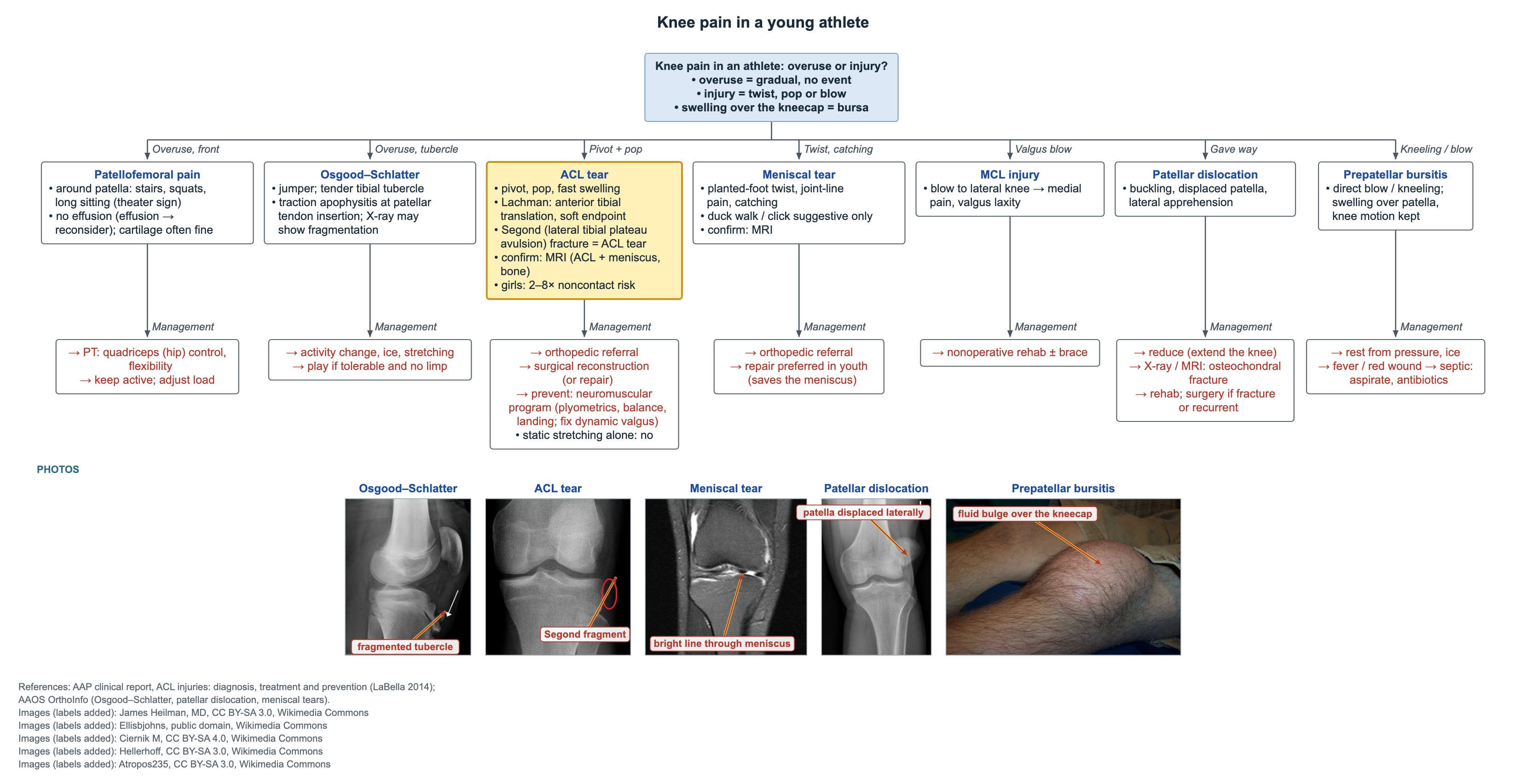
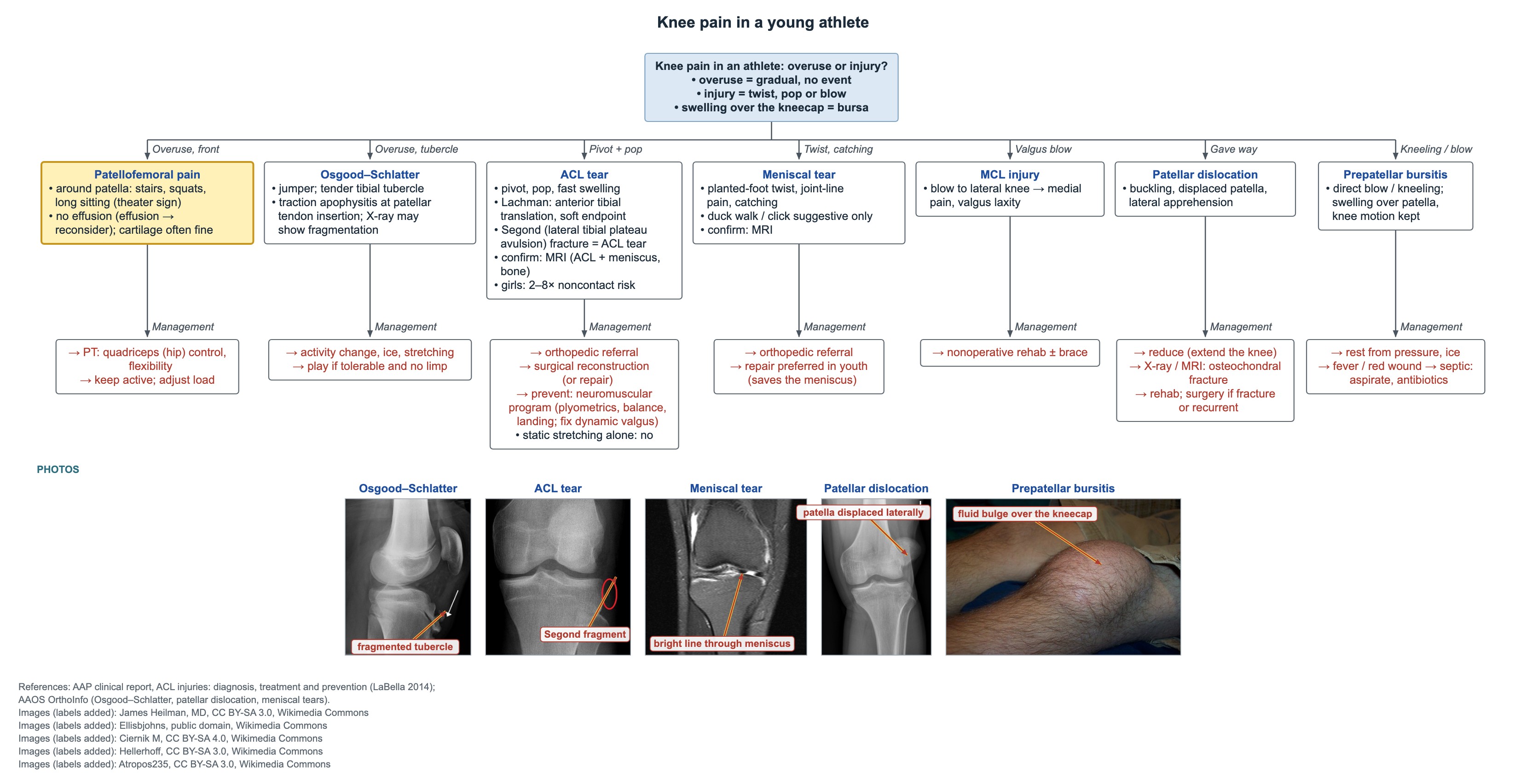
- ACL tear: pivot, pop, rapid swelling, soft Lachman endpoint; a Segond (lateral tibial plateau avulsion) fracture means an ACL tear.
- Neuromuscular training (plyometric, balance and dynamic exercises) lowers ACL injury risk; static stretching alone does not.
- Osgood-Schlatter: traction apophysitis at the tibial tubercle; clinical diagnosis; keep playing if pain is tolerable and there is no limp.
- Patellofemoral pain: diffuse peripatellar pain with stairs, squats and long sitting; no effusion; treat with exercise-based therapy.
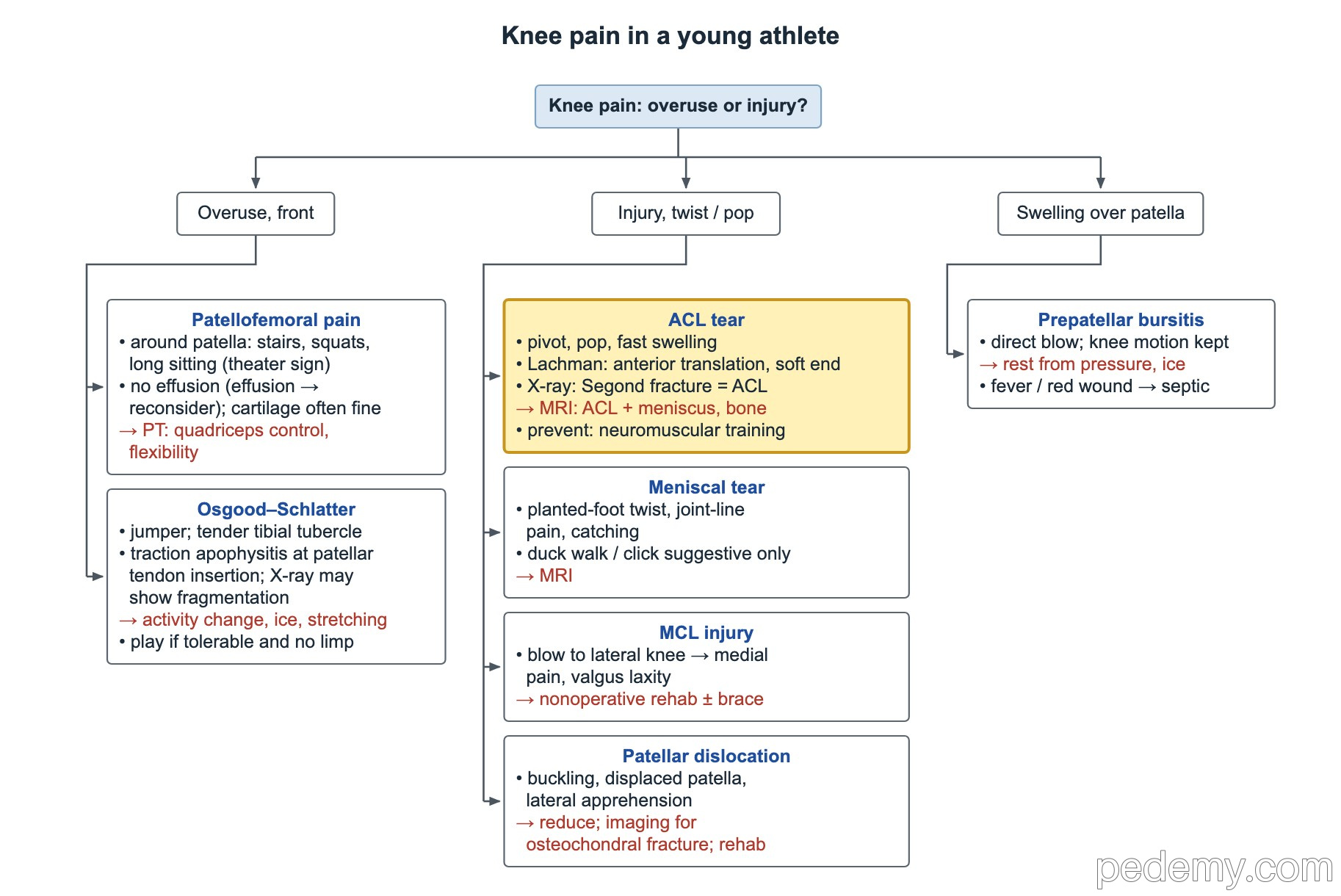
- Meniscal tear: planted-foot twist, joint-line pain, catching; confirm with MRI.
- Osteochondritis dissecans: lateral aspect of the medial femoral condyle; stable with open physes → stop impact sport 3–6 months.
- An effusion argues against patellofemoral pain and Osgood-Schlatter: look for another diagnosis.
ACL tear
The classic story is a non-contact pivot or landing, a pop, and a knee that swells within hours (hemarthrosis). The Lachman test, which assesses anterior translation of the tibia on the femur, shows laxity with a soft endpoint.
A Segond fracture, a small avulsion of the lateral tibial plateau, is a marker of ACL tear. MRI confirms the tear and shows associated meniscal, ligament and bone injuries.
- Adolescent girls have a noncontact ACL injury risk several times higher than boys in the same sports (about 2–8 times).
- Refer children and adolescents with ACL tears to orthopedics; surgical reconstruction is often advised to protect the menisci and cartilage, with techniques that respect open physes.
- Athletes with ACL injury have a much higher risk of later knee osteoarthritis.
Preventing ACL injury
Knees that collapse inward (dynamic valgus) on landing raise ACL risk. At the preparticipation exam, the double-leg squat, single-leg squat and box-drop landing show valgus collapse.
Neuromuscular training programs that combine plyometrics, balance, strength and dynamic movement control reduce ACL injuries, especially in adolescent girls. Static stretching alone is not enough.
Meniscus, MCL, patellar dislocation and bursitis
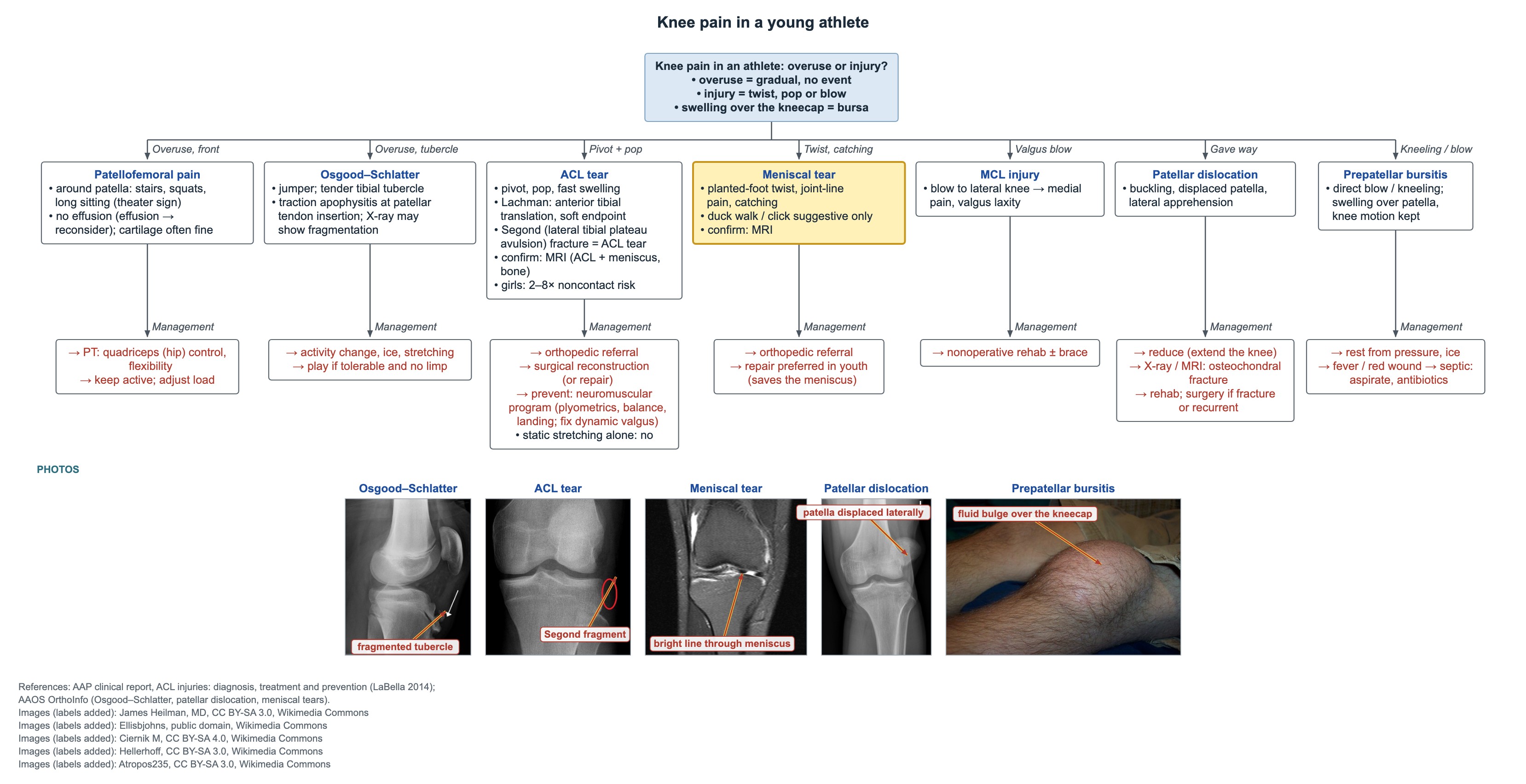
A painful duck walk or a joint-line click suggests a meniscal tear but does not prove it.
| Injury | Clues | Next step |
|---|---|---|
| Meniscal tear | Twist on a planted foot; joint-line tenderness; catching or locking. McMurray with the foot externally rotated tests the medial meniscus, internally rotated the lateral | MRI if X-rays are normal; repair if locked or unstable |
| MCL injury | Blow to the lateral knee; medial tenderness; laxity on valgus stress | Nonoperative rehab, often with a hinged brace |
| Patellar dislocation | Knee buckles; patella displaced laterally; positive apprehension | Reduce; X-ray for osteochondral fracture; rehab, and stabilization if recurrent |
| Prepatellar bursitis | Direct blow or kneeling; swelling over the patella; knee motion kept | Rest from pressure, ice, elevation, analgesia |
| Septic bursitis | Same swelling plus fever, redness or a skin wound | Aspirate and treat as infection |
Osgood-Schlatter disease
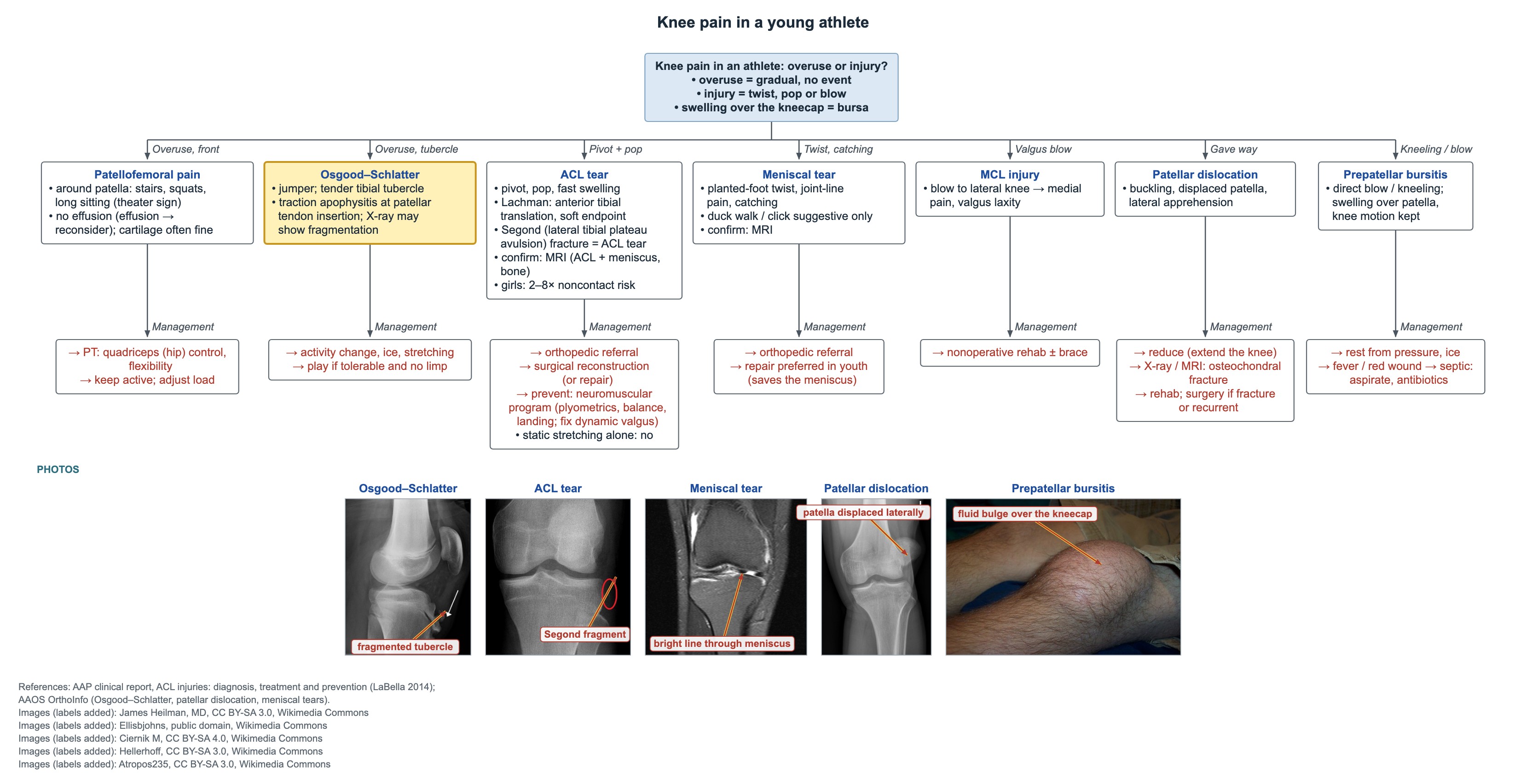
Osgood-Schlatter disease is traction apophysitis where the patellar tendon inserts on the tibial tubercle. It affects jumping and running athletes during the growth spurt, often both knees, with a tender, sometimes enlarged tubercle.
It is a clinical diagnosis. X-rays are only needed for atypical features such as night pain, marked swelling or one-sided pain with systemic signs; they may show tubercle fragmentation.
- Treatment: activity adjustment, ice, analgesia, quadriceps and hamstring stretching, strengthening.
- Continued sport is fine if the pain is tolerable and the child does not limp.
- Tibial tubercle tenderness = Osgood-Schlatter; diffuse pain around the patella = patellofemoral pain.
Patellofemoral pain
Patellofemoral pain is an ache around or behind the patella in runners and jumpers, worse with stairs, squatting and long sitting (the theater or moviegoer sign). There is no effusion; if the knee is swollen, look for another diagnosis.
The pain does not mean the patellar cartilage is damaged. First-line treatment is exercise-based physical therapy focused on quadriceps and hip strength and leg flexibility, plus adjusting training load.
Osteochondritis dissecans and iliotibial band syndrome
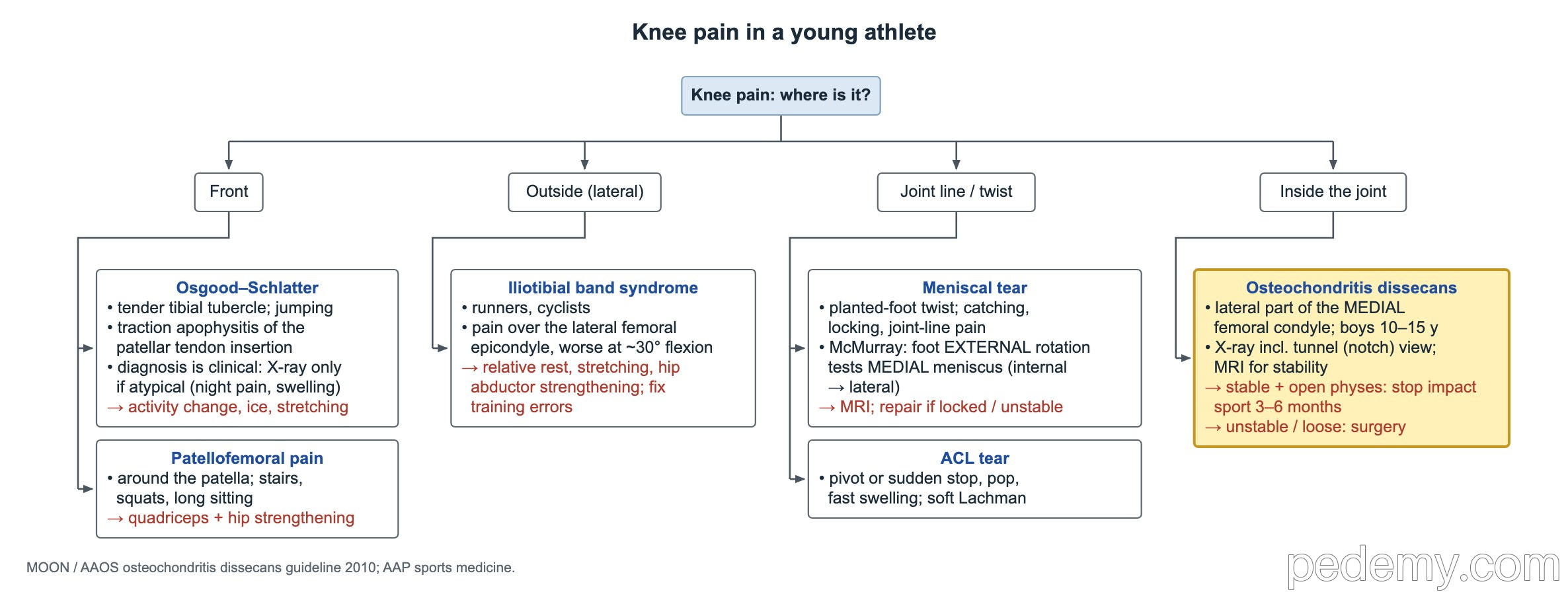
Osteochondritis dissecans (OCD) is a lesion of subchondral bone and its cartilage, most often on the lateral aspect of the medial femoral condyle in boys 10–15 years. It causes vague activity-related pain, sometimes swelling or catching. X-rays, including a tunnel (notch) view, show a well-demarcated subchondral fragment; MRI judges stability.
Iliotibial band syndrome causes lateral knee pain over the lateral femoral epicondyle in distance runners and cyclists, worse at about 30° of flexion, with no effusion.
- Stable OCD with open physes: stop impact sports for 3–6 months, with or without a brace or immobilization.
- Unstable, loose or non-healing OCD: surgery.
- IT band syndrome: relative rest, stretching, hip abductor strengthening and correction of training errors.
Common questions
Can a child with Osgood-Schlatter disease keep playing sports?
Yes, if the pain is tolerable and the child does not limp. Ice, stretching and adjusting training load help.
Do ACL prevention programs work?
Yes. Neuromuscular training with plyometric, balance and dynamic exercises reduces ACL injuries, especially in adolescent girls. Static stretching alone does not.
Does Osgood-Schlatter need an X-ray?
No, it is a clinical diagnosis. X-ray only for atypical features such as night pain, marked swelling or one-sided pain with systemic signs.
Study this topic
Sources
- AAP: Anterior cruciate ligament injuries: diagnosis, treatment and prevention (Pediatrics, 2014)
- AAP: Overuse injuries, overtraining and burnout in young athletes (Pediatrics, 2024)
- Willy RW et al. Patellofemoral pain clinical practice guideline (JOSPT, 2019)
Written for Pedemy in our own words from the sources above; checked November 2026. For education only, not medical advice; check doses and local protocols before treating a patient. Pedemy is independent and not affiliated with or endorsed by the organizations cited.