

Main decision tree
Back pain and spine shape: inflammatory back pain
Key points
- Idiopathic scoliosis by Cobb angle: under 25° observe (sports OK); 25–45° while growing → brace; over 45–50° → surgery evaluation.
- Spondylolysis: pars stress fracture, usually L5, with low back pain on extension; first imaging AP and lateral lumbar X-rays, then MRI.
- Spondylolisthesis: L5 slips forward on S1; palpable step-off and tight hamstrings.
- Scheuermann kyphosis: ≥5° wedging of 3 adjacent vertebrae; rigid curve that does not correct on hyperextension.
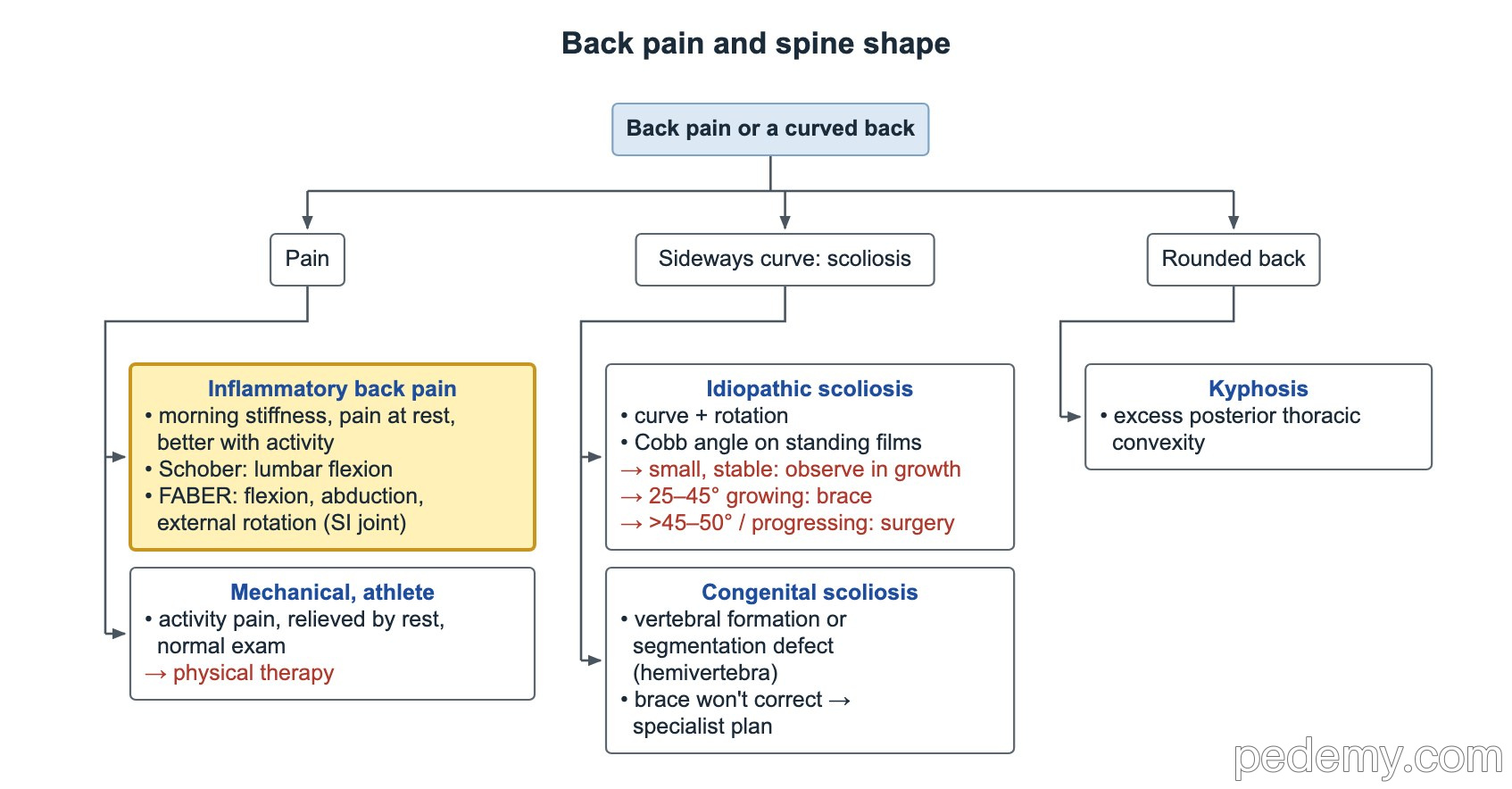
- Inflammatory back pain: morning stiffness, pain at rest, better with exercise; check the SI joints (FABER) and lumbar flexion (Schober).
- Klippel-Feil: fusion of ≥2 cervical vertebrae; short neck, low hairline, limited motion; check hearing (and kidneys); look for Sprengel deformity.
- Torticollis with fever and dysphagia → think retropharyngeal or deep neck infection.
Back pain in a young athlete: mechanical vs inflammatory
Mechanical back pain comes with activity and eases with rest, and the exam is normal. Physical therapy with core and hip strengthening is the treatment.
Inflammatory back pain is the opposite: morning stiffness, pain at rest and improvement with exercise. It suggests spondyloarthritis (enthesitis-related arthritis), often HLA-B27 positive.
- FABER test (flexion, abduction, external rotation of the hip) stresses the sacroiliac joint.
- Modified Schober test measures lumbar spine flexion; limited flexion supports spondyloarthritis.
- Red flags: night pain, fever, weight loss, neurologic signs, pain in a young child → image and look for infection, tumor or a structural cause.
Spondylolysis and spondylolisthesis
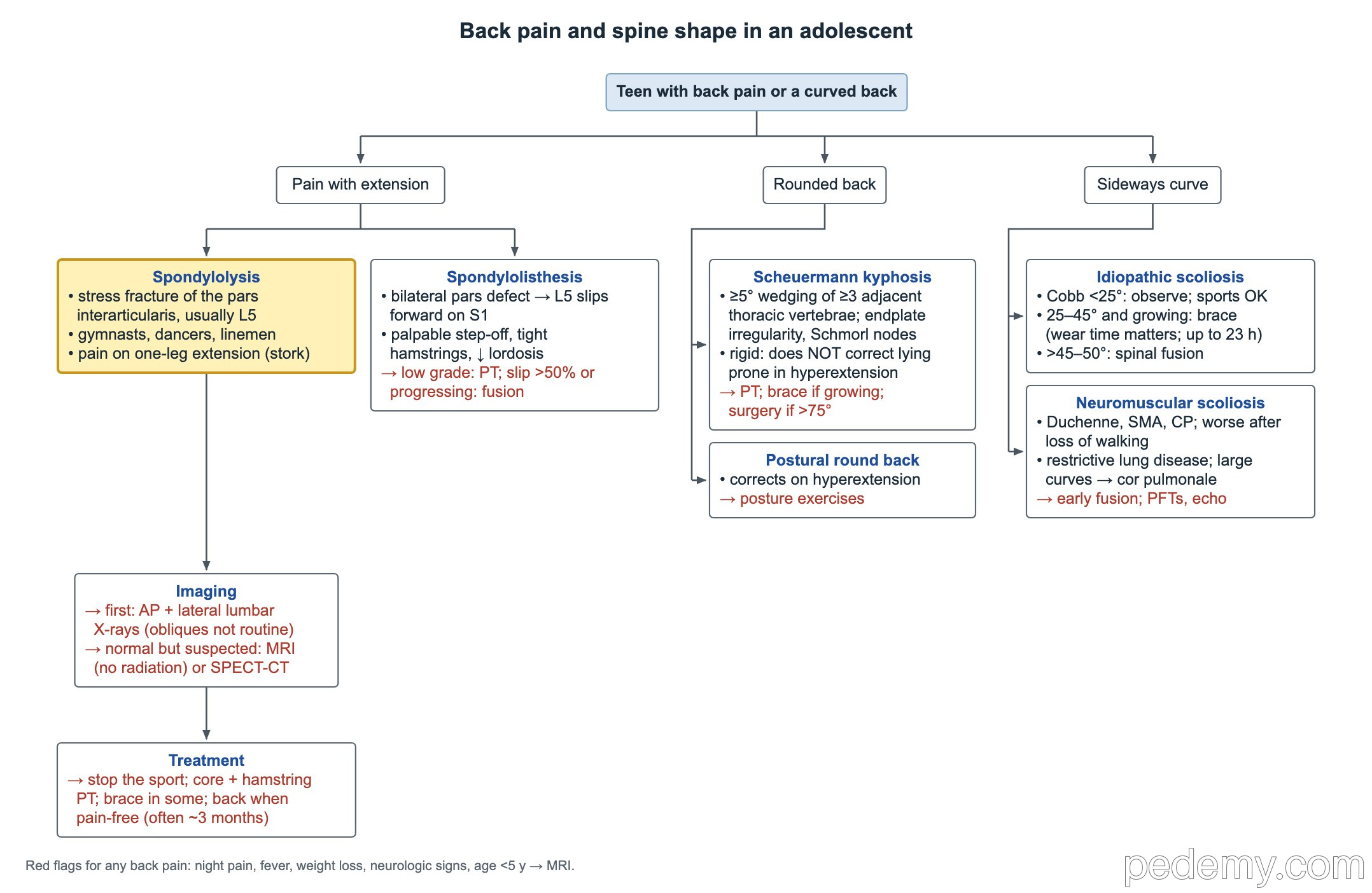
Spondylolysis is a stress fracture of the pars interarticularis, usually at L5, from repeated extension and rotation. It is common in gymnasts, dancers, divers and football linemen. Pain is worse with back extension and with one-leg standing extension (the stork test).
When the pars defect is bilateral, L5 can slip forward on S1: spondylolisthesis. Clues are a palpable lumbar step-off, tight hamstrings and reduced lordosis.
- First imaging: AP and lateral lumbar X-rays; oblique views are not routine.
- X-rays normal but suspicion high: MRI (no radiation) or SPECT-CT.
- Spondylolysis treatment: rest from the provoking sport and physical therapy; bracing is used by some.
- Low-grade spondylolisthesis: physical therapy; slip over 50% or progressing: spinal fusion.
Scoliosis
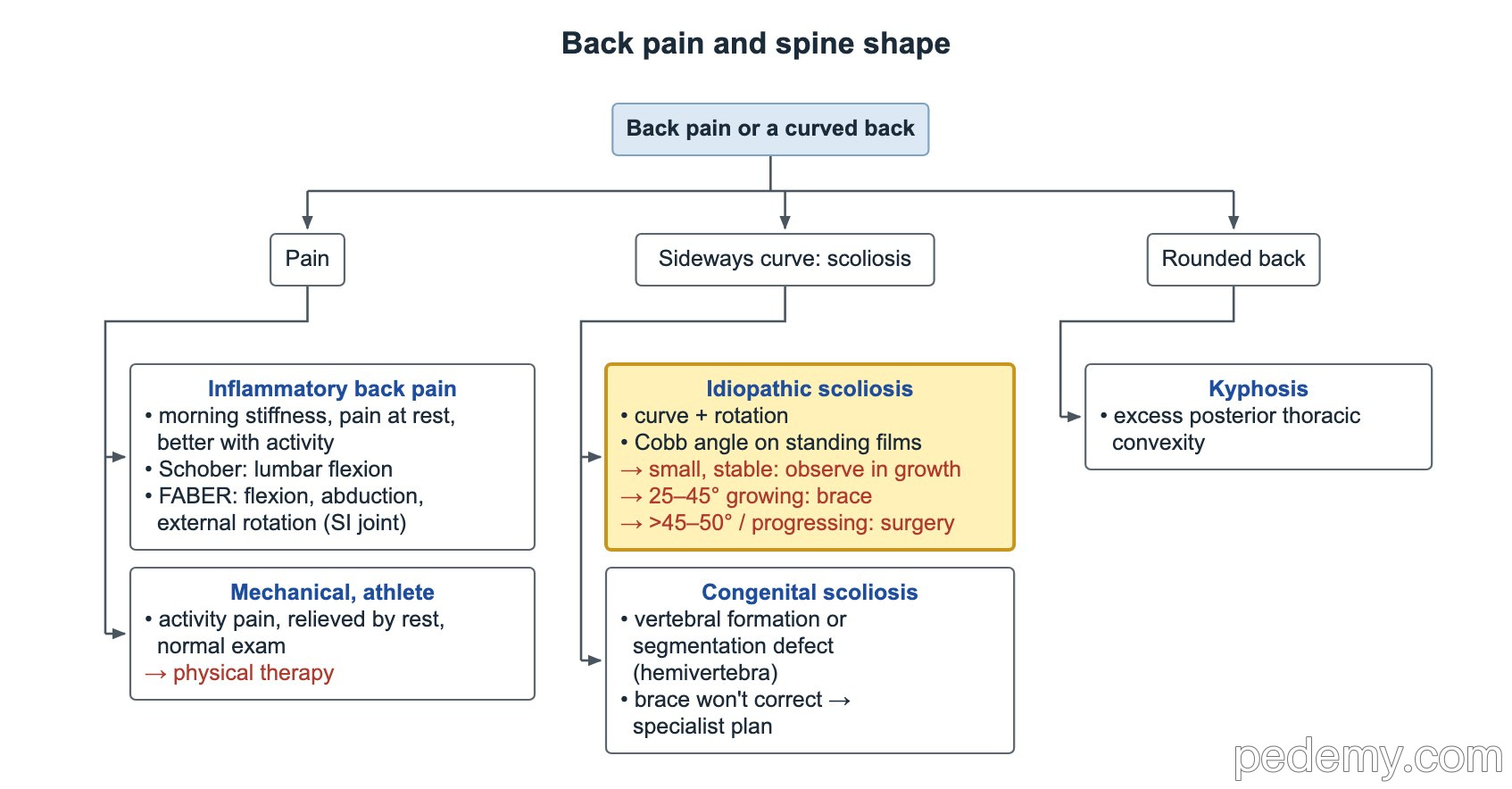
Scoliosis is a sideways curve of the spine with rotation, graded by the Cobb angle on standing spinal X-rays; a curve of at least 10° counts. Adolescent idiopathic scoliosis is the common form, and curves progress mostly during growth.
The USPSTF (2018) found insufficient evidence to recommend for or against screening asymptomatic adolescents. Pediatric orthopedic societies still support screening, and the forward-bend test with a scoliometer is the usual exam.
- Painful scoliosis, a left thoracic curve, rapid progression or neurologic signs → MRI for an underlying cause.
- Congenital scoliosis comes from a vertebral formation or segmentation defect such as a hemivertebra. A brace does not correct it; it needs specialist planning.
- Neuromuscular scoliosis (Duchenne, SMA, cerebral palsy) worsens after loss of walking; large curves cause restrictive lung disease and cor pulmonale.
| Curve | Plan |
|---|---|
| Small and stable (under about 25°) | Observe with X-rays during growth; full sports participation |
| About 25–45° in a growing child | Brace to limit progression; more hours of wear work better |
| Over about 45–50° or progressing | Spine surgery evaluation (fusion) |
Kyphosis and Scheuermann disease
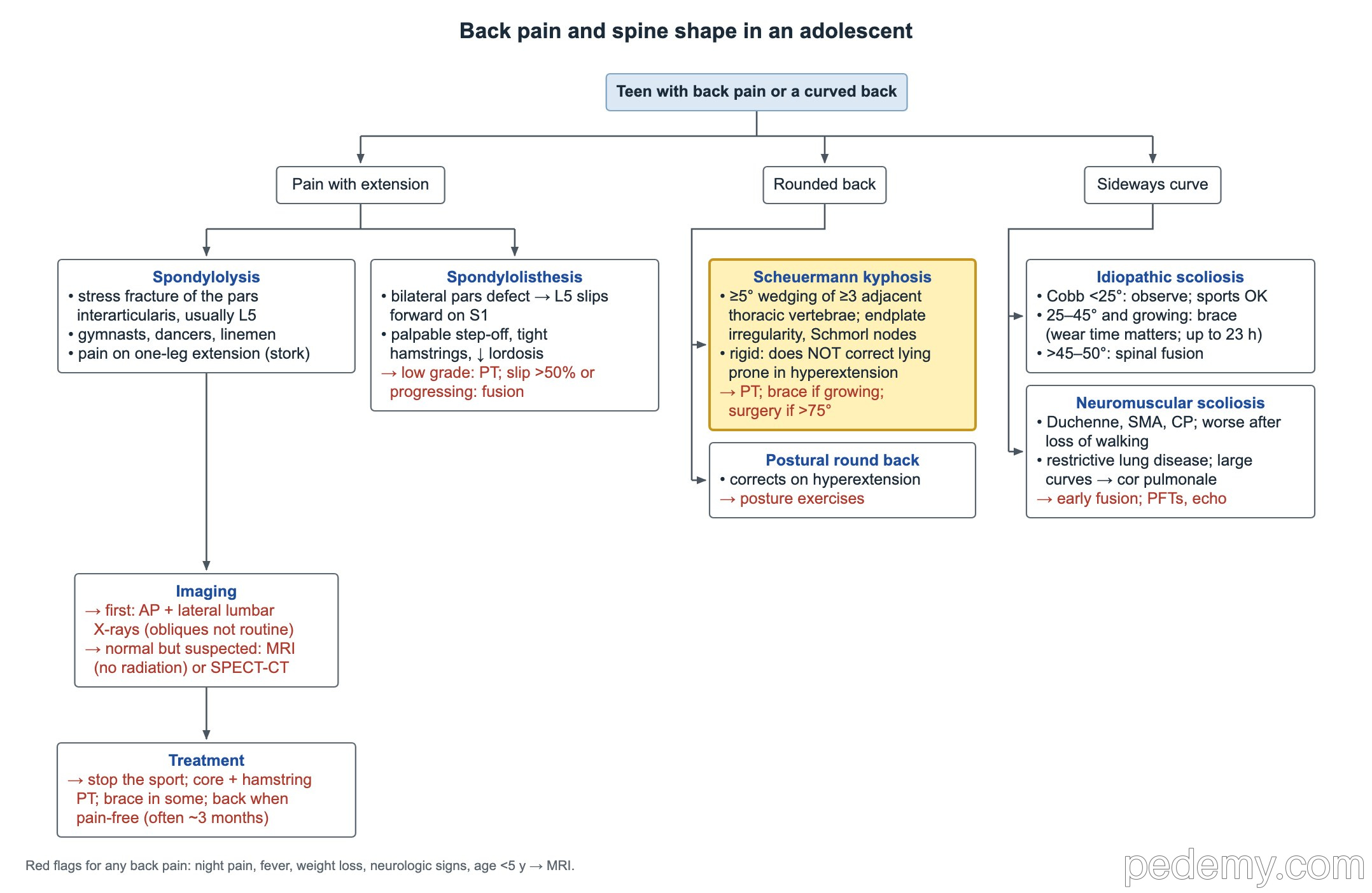
Kyphosis is an increased posterior convexity of the thoracic spine, the rounded upper back. Postural kyphosis is flexible and corrects when the teen lies prone and extends the back.
Scheuermann kyphosis is rigid and does not correct on hyperextension. X-rays show at least 5° of anterior wedging in 3 adjacent thoracic vertebrae, with endplate irregularity and Schmorl nodes.
- Physical therapy for mild cases.
- Brace while still growing.
- Surgery for severe curves (over about 75°) or neurologic signs.
Klippel-Feil syndrome and Sprengel deformity
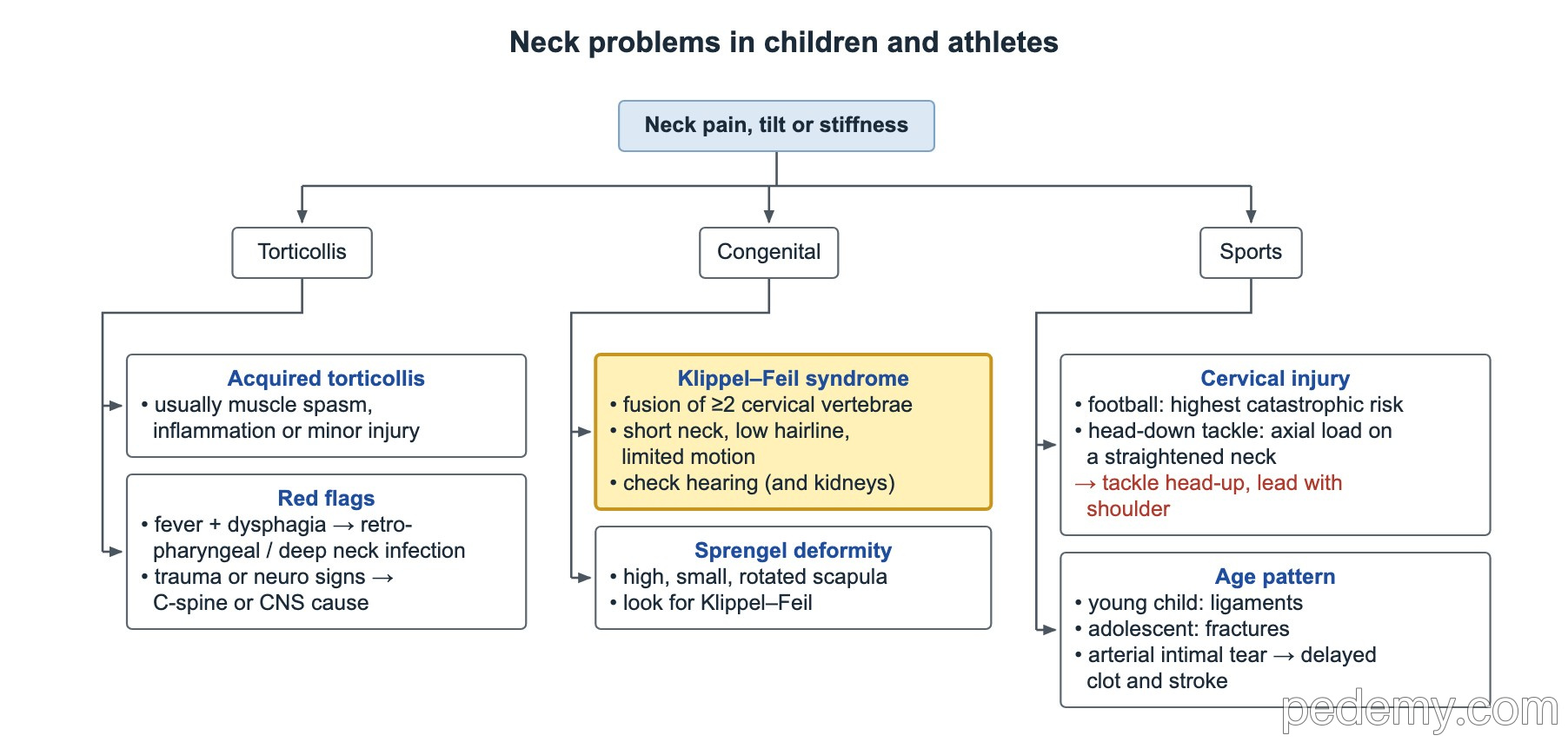
Klippel-Feil syndrome is congenital fusion of 2 or more cervical vertebrae. The classic triad is a short neck, low posterior hairline and limited neck motion, though many children have only part of it.
Associated problems include hearing loss (test hearing), kidney anomalies, scoliosis and Sprengel deformity: a high, small, rotated scapula with limited shoulder motion. A child with Sprengel deformity should be checked for Klippel-Feil.
Acquired torticollis and its red flags
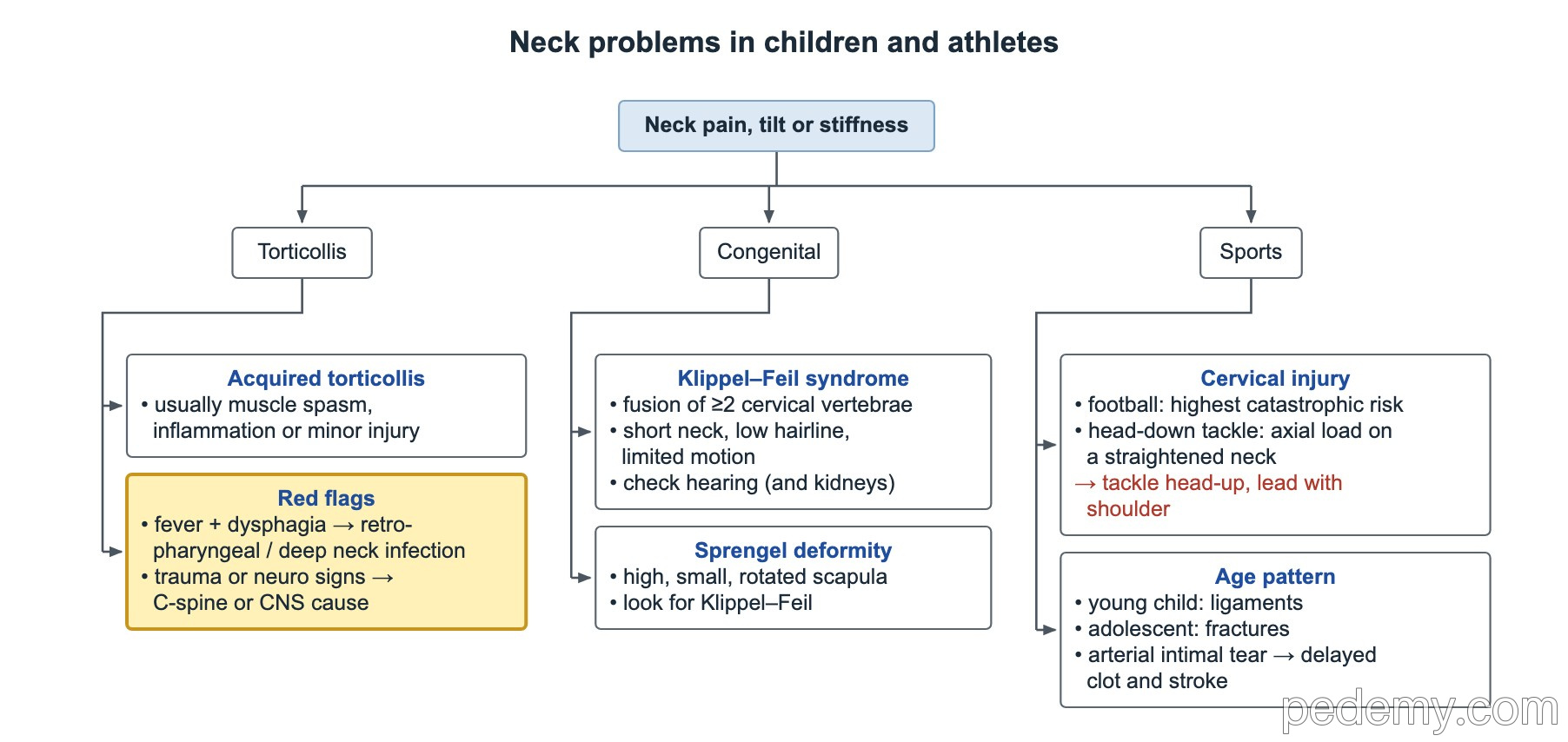
Most acquired torticollis comes from neck muscle spasm, inflammation or minor injury and settles with analgesia and gentle movement.
- Fever, dysphagia, drooling or neck stiffness → retropharyngeal or deep neck infection.
- Trauma or neurologic signs → cervical spine injury or CNS cause (such as a posterior fossa tumor).
- Infant with a firm sternocleidomastoid mass → congenital muscular torticollis; examine the hips for DDH.
Neck injuries in sport
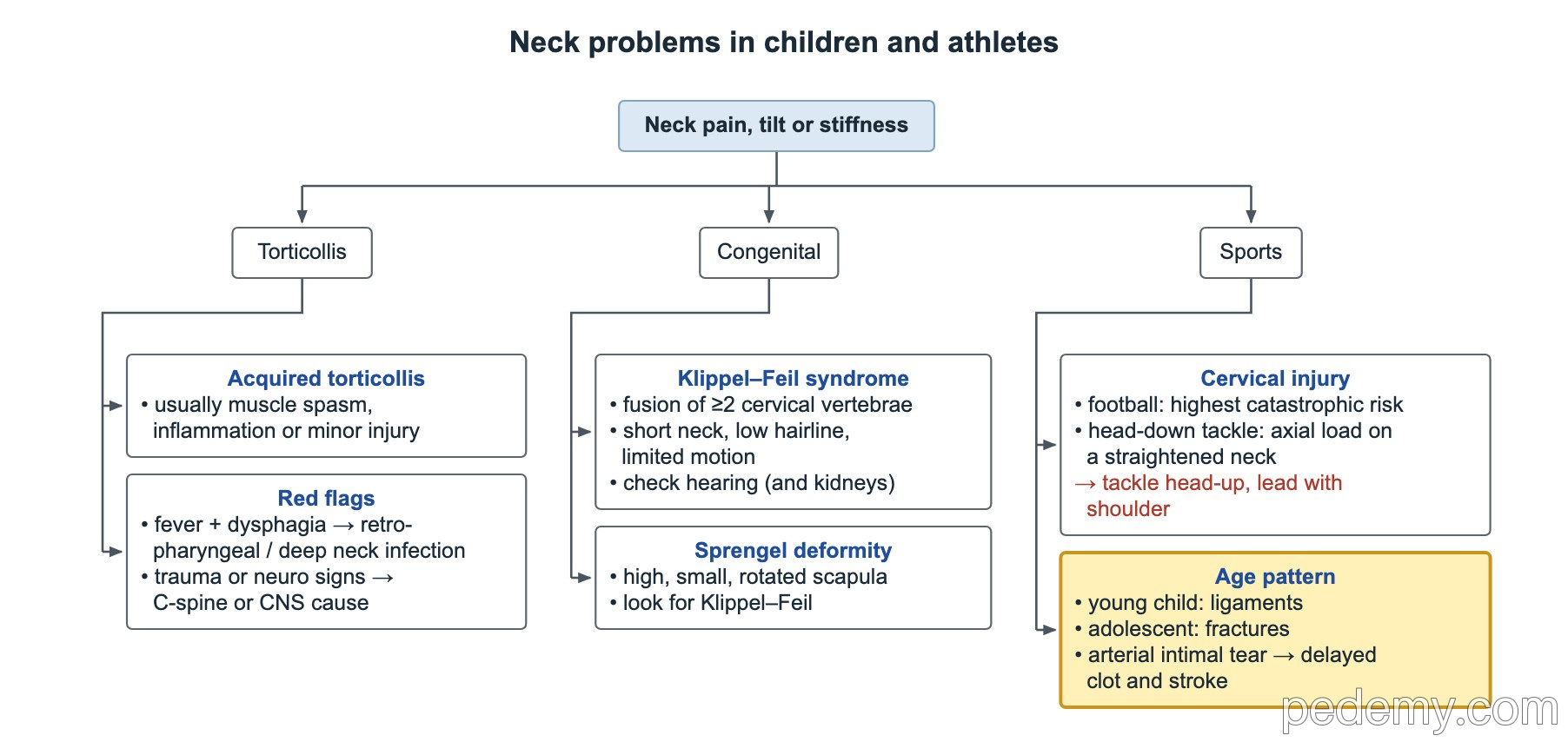
Football causes the most catastrophic cervical spine injuries among high school sports. Spear tackling with the head down puts an axial load on a flexed, straightened neck, which can fracture or dislocate the cervical spine. Teach tackling with the head up and contact with the shoulder.
The injury pattern changes with age. Young children, with a large head and lax ligaments, get ligamentous injuries of the upper cervical spine. Adolescents get fractures, more often lower in the neck, as in adults.
- A carotid or vertebral artery intimal tear after neck trauma can form a clot and cause a delayed embolic stroke.
- Neck pain, neurologic symptoms or a mechanism of concern → immobilize and image before any return to play.
Common questions
Can a teen with mild scoliosis play sports?
Yes. Small idiopathic curves need no activity restriction, only follow-up X-rays during growth.
What is the first imaging test for suspected spondylolysis?
AP and lateral lumbar X-rays. If they are normal and suspicion stays high, MRI (no radiation) or SPECT-CT.
When is scoliosis braced?
Usually for curves of about 25–45° in a child who is still growing. Curves over about 45–50° are evaluated for surgery.
Study this topic
Sources
- USPSTF: Screening for adolescent idiopathic scoliosis (JAMA, 2018)
- AAP: Overuse injuries, overtraining and burnout in young athletes (Pediatrics, 2024)
- AAP: Tackling in youth football (Pediatrics, 2015)
- Demharter NS et al. Torticollis (Pediatrics in Review, 2026)
Written for Pedemy in our own words from the sources above; checked November 2026. For education only, not medical advice; check doses and local protocols before treating a patient. Pedemy is independent and not affiliated with or endorsed by the organizations cited.