

Main decision tree
Shoulder and elbow in young athletes
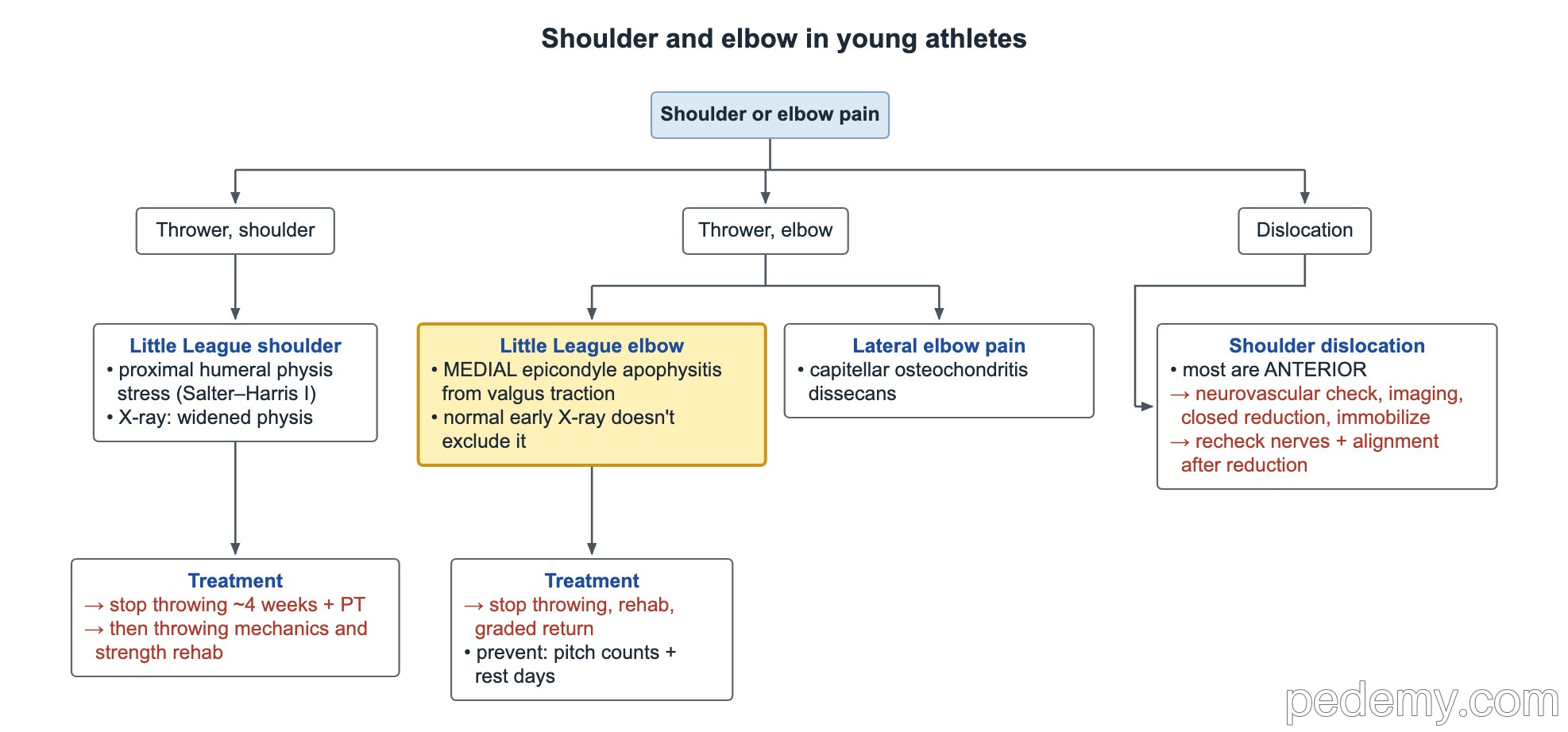
Key points
- Little League elbow: medial epicondyle apophysitis from repeated valgus traction in young pitchers.
- A normal early X-ray does not exclude Little League elbow.
- Lateral elbow pain in a young thrower: think capitellar osteochondritis dissecans.
- Little League shoulder: Salter–Harris type I stress injury of the proximal humeral physis; X-ray shows a widened physis.
- Treatment of both Little League injuries: stop throwing until pain-free, then rehab and a graded throwing program.
- Best prevention: pitch-count limits with required rest days.
- Most traumatic shoulder dislocations are anterior; check the neurovascular status before and after reduction.
Little League elbow
A child pitcher with medial elbow pain that worsens with throwing has Little League elbow until proven otherwise. Repeated valgus stress during the throwing motion pulls on the medial epicondyle growth center (apophysis) through the flexor-pronator muscles and the ulnar collateral ligament.
Expect tenderness over the medial epicondyle and pain with valgus stress. X-rays may show widening or fragmentation of the apophysis, but they are often normal early, so a normal X-ray does not exclude the diagnosis.
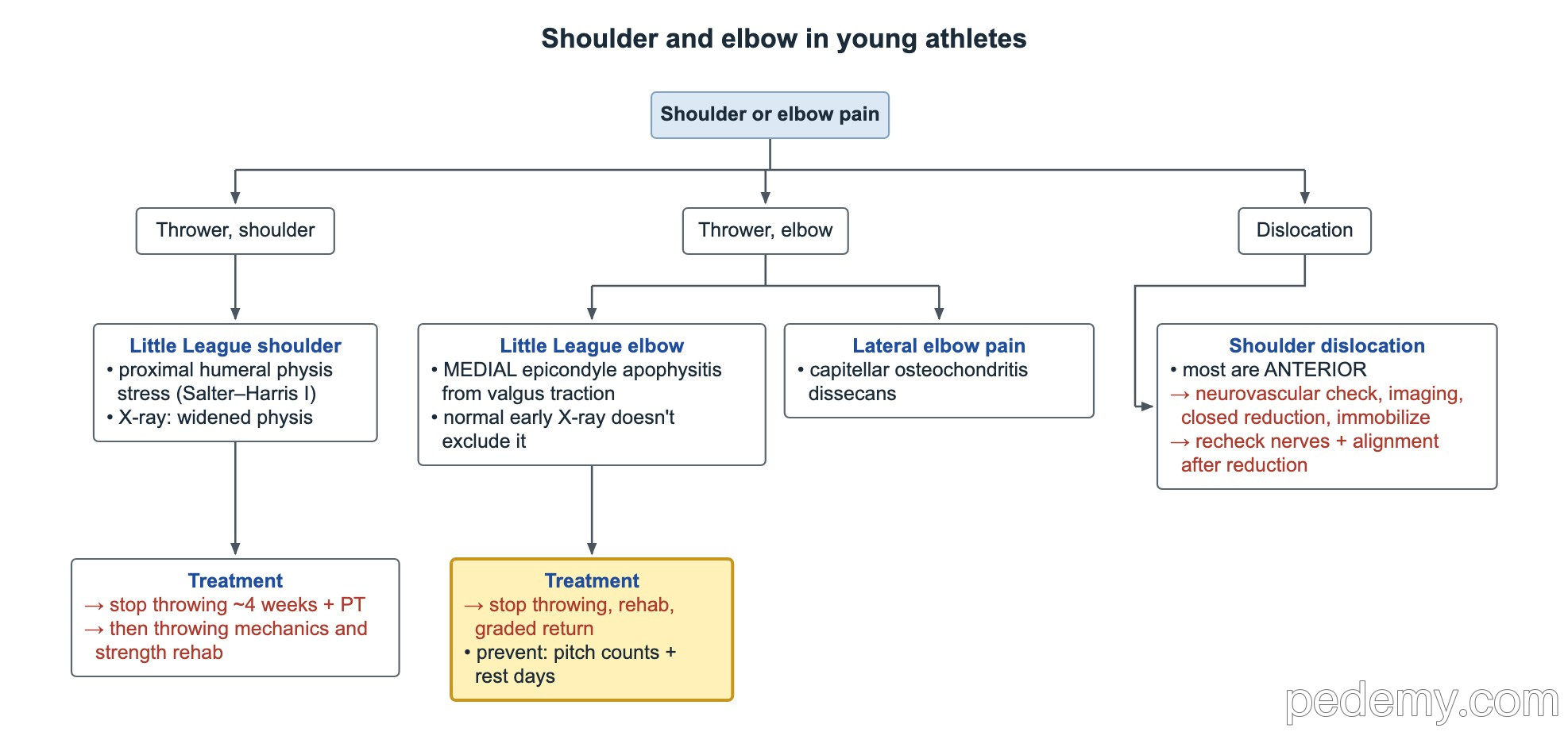
Treatment and prevention of Little League elbow
Pitch Smart also advises no pitching on consecutive days, no pitching while fatigued, and at least 4 months a year off from overhead throwing.
- Stop throwing and manage pain.
- Rehabilitation: flexibility, forearm, shoulder and core strength.
- Return through a graded throwing program once pain-free.
- Prevent with pitch-count limits and rest days, and correct throwing mechanics.
| Age (years) | Maximum pitches per day (Pitch Smart) |
|---|---|
| 7–8 | 50 |
| 9–10 | 75 |
| 11–12 | 85 |
| 13–16 | 95 |
| 17–18 | 105 |
Lateral elbow pain: capitellar osteochondritis dissecans
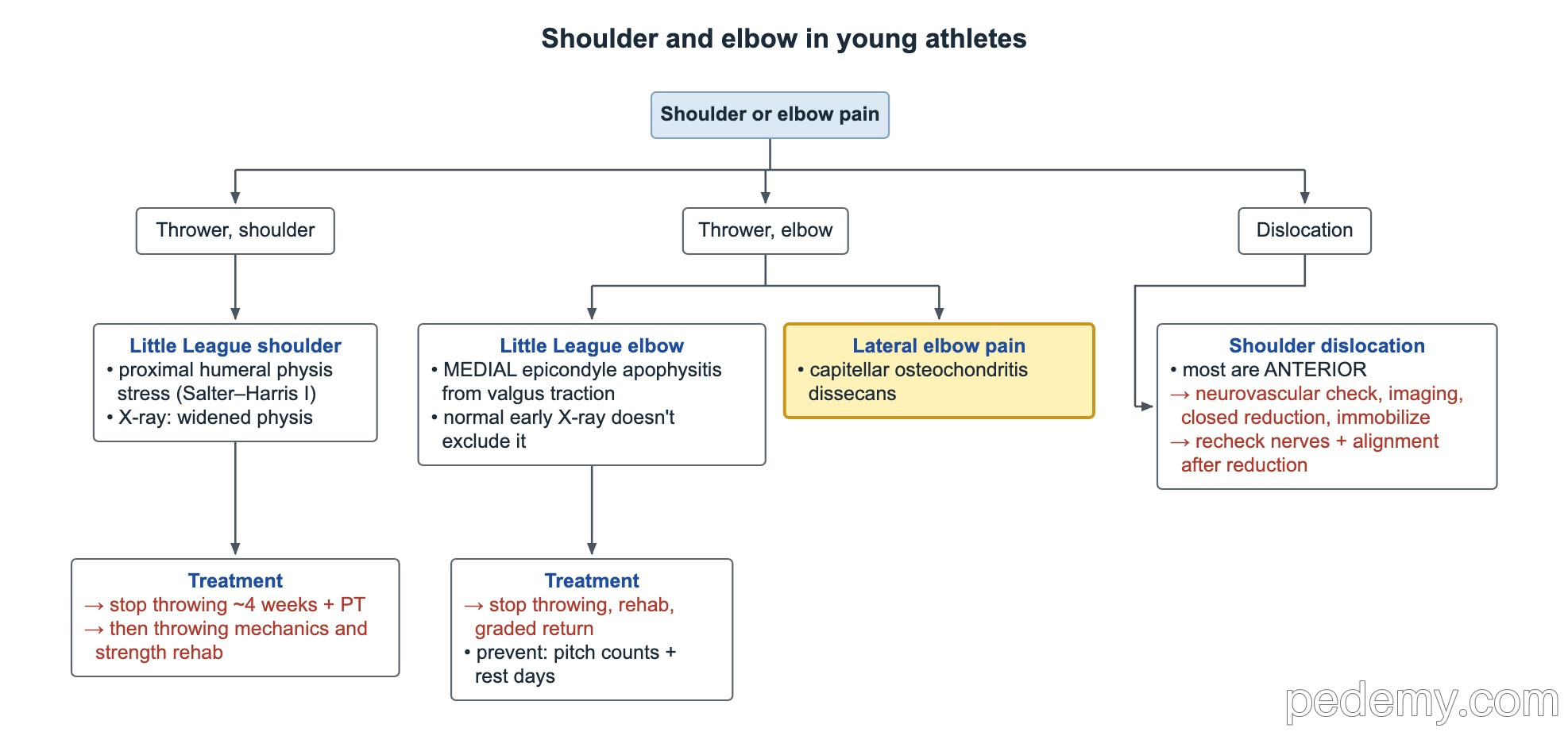
In a young thrower or gymnast, lateral rather than medial elbow pain suggests capitellar osteochondritis dissecans (OCD). The same valgus load that pulls the medial side compresses the radius against the capitellum.
Clues are lateral pain, loss of full extension, and catching or locking if a loose fragment forms. X-rays may show a lucent or flattened capitellum; MRI shows whether the lesion is stable. Stable lesions are treated with rest from throwing; unstable lesions or loose bodies need orthopedic surgery.
Lateral epicondylitis (tennis elbow)
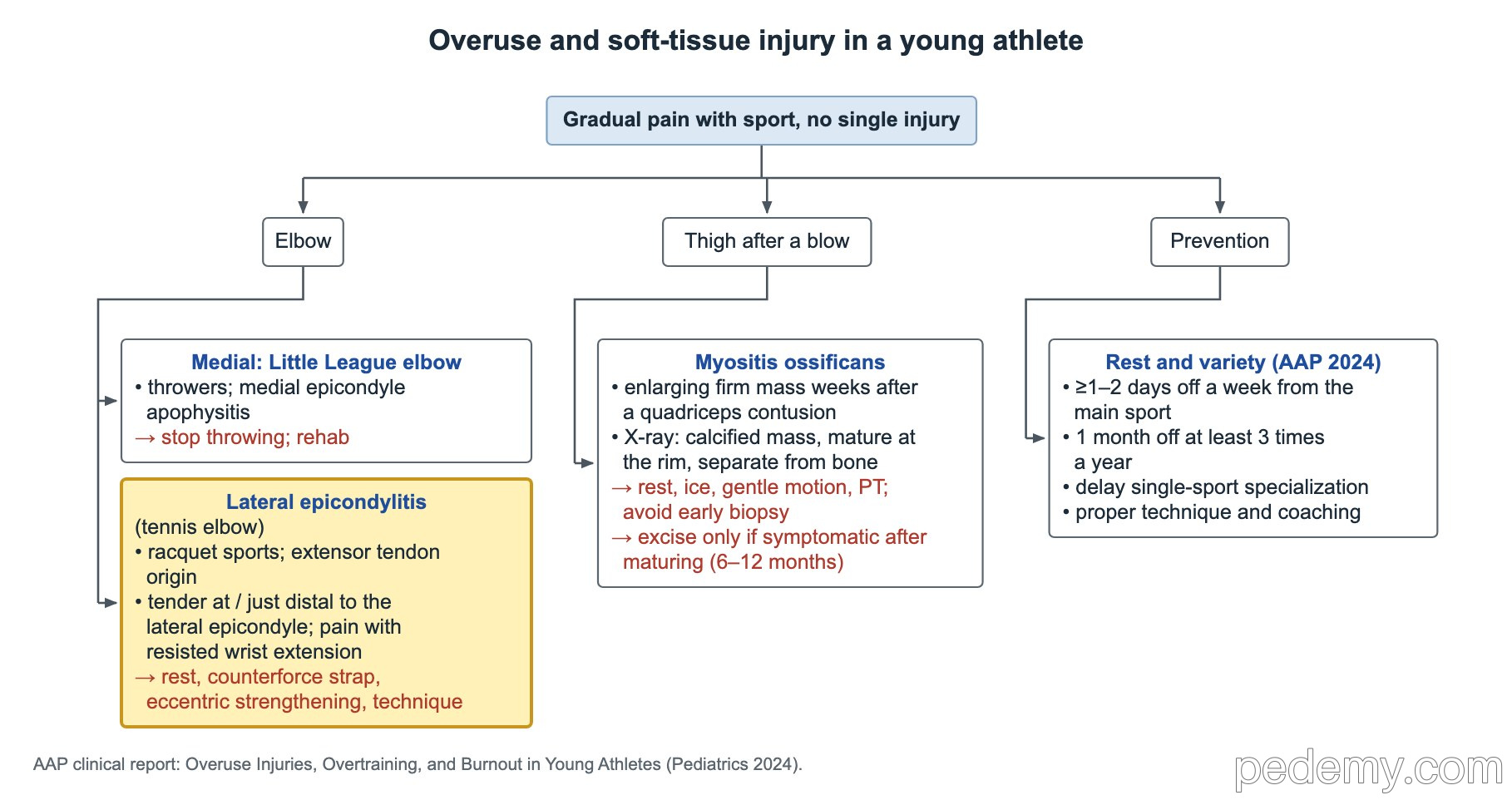
A teen racquet-sport player with pain at or just distal to the lateral epicondyle, worse with resisted wrist extension, has lateral epicondylitis. It is an overuse injury of the wrist-extensor tendon origin.
- Relative rest from the painful activity.
- Counterforce strap on the forearm.
- Eccentric wrist-extensor strengthening.
- Correct stroke technique and equipment, such as grip size.
Little League shoulder
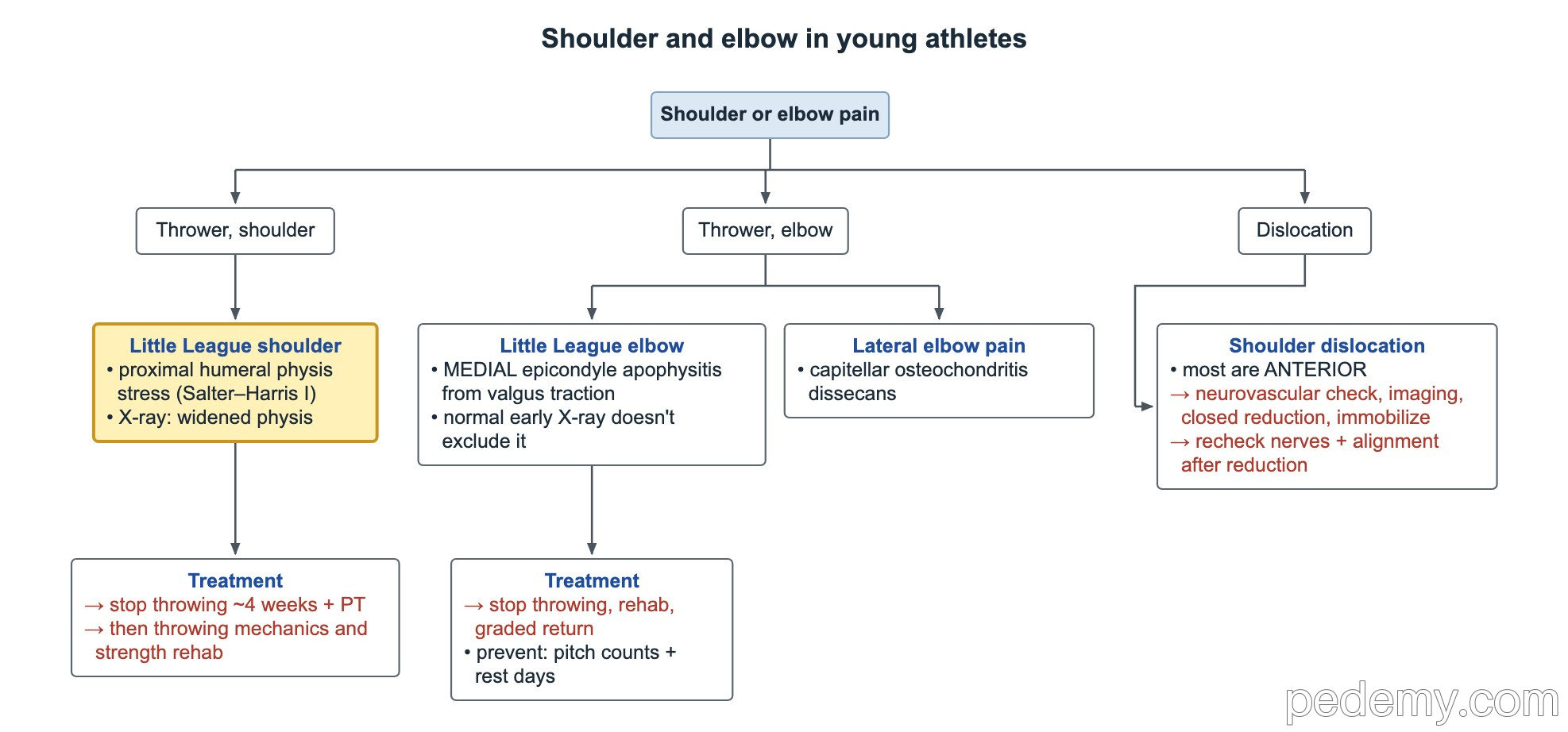
A youth pitcher, usually around 11–16 years old, with lateral upper-arm or shoulder pain during throwing may have Little League shoulder. It is a stress injury of the proximal humeral growth plate, classed as a Salter–Harris type I injury.
The imaging sign is widening of the proximal humeral physis, best seen by comparing X-rays of both shoulders.
Treatment of Little League shoulder
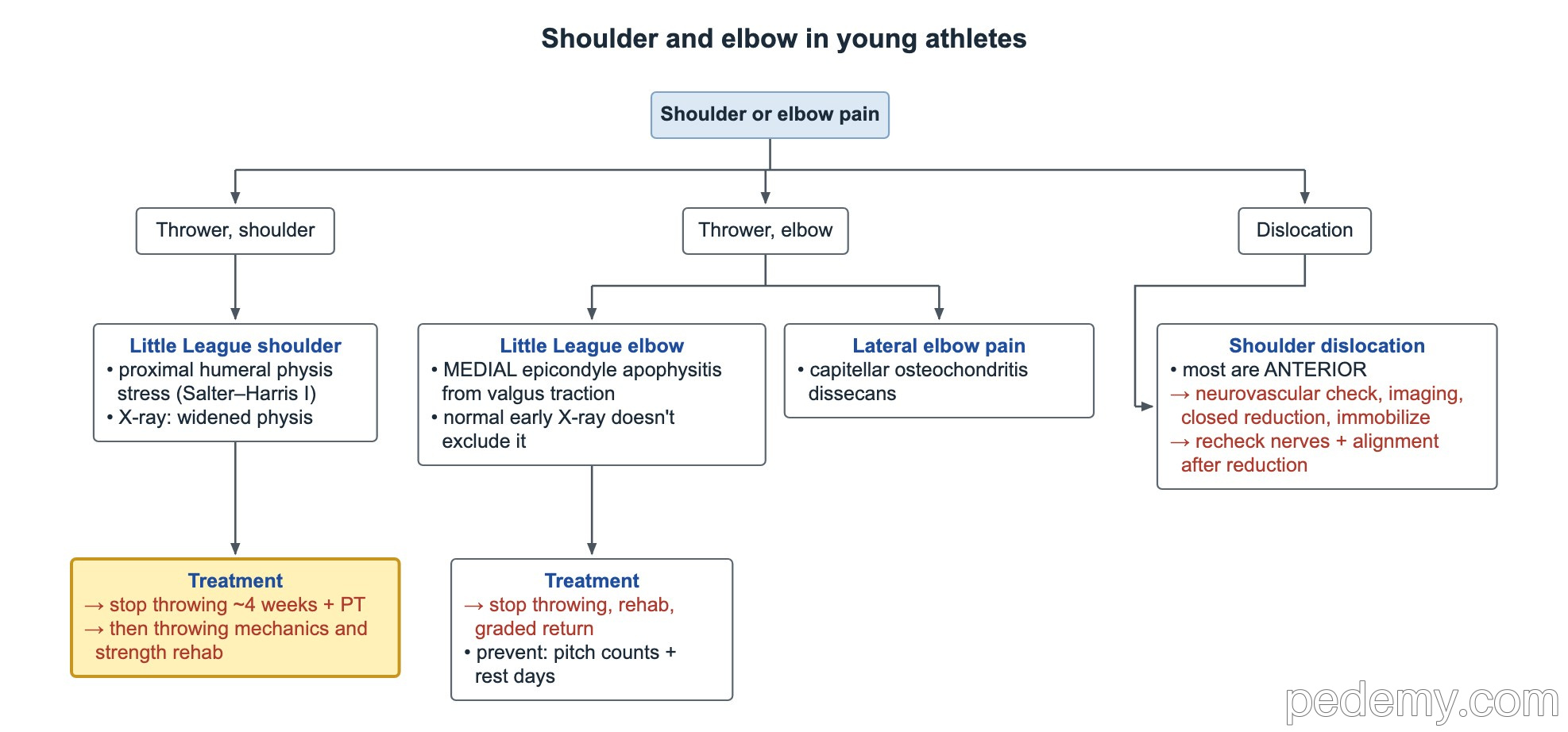
- Stop all throwing until pain-free, usually at least about 4 weeks.
- Physical therapy, then a graded throwing program before return to pitching.
- Reduce recurrence by correcting throwing mechanics and strengthening the shoulder and core.
- Follow pitch-count and rest-day limits after return.
Traumatic shoulder dislocation
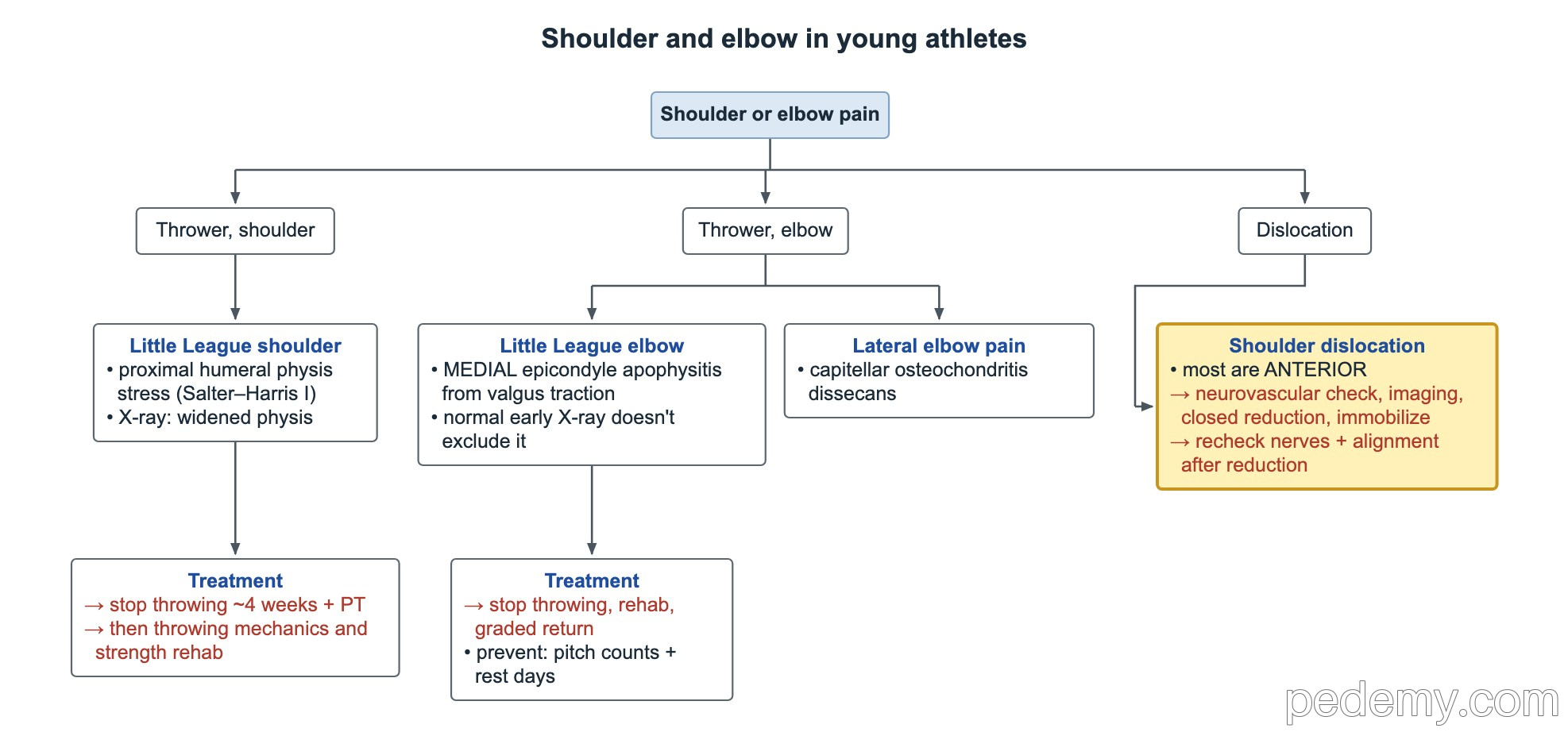
Most traumatic shoulder dislocations are anterior: the arm is held slightly abducted and externally rotated, and the shoulder looks squared off. Posterior dislocation is rare and suggests a seizure or electric shock.
- Before reduction: check pulses and nerves, especially the axillary nerve (sensation over the lateral deltoid).
- Get X-rays to confirm the direction and look for a fracture, including a proximal humeral physeal fracture in a child with open growth plates.
- Closed reduction, then immobilization in a sling for comfort.
- After reduction: recheck neurovascular status and confirm alignment and any associated fracture on X-ray.
- Recurrence is common in teen athletes, so arrange orthopedic follow-up and rehabilitation.
Common questions
What is Little League elbow?
An overuse injury of the medial epicondyle growth center in young pitchers, caused by repeated valgus stress. It is treated by stopping throwing, rehab and a graded return.
How many pitches can a 12-year-old throw?
Pitch Smart sets a maximum of 85 pitches a day for ages 11–12, with required rest days after higher counts.
How is Little League shoulder diagnosed?
By shoulder pain with throwing in a skeletally immature pitcher and widening of the proximal humeral physis on X-ray, compared with the other side.
Study this topic
Sources
- AAP clinical report: Overuse injuries, overtraining, and burnout in young athletes (Pediatrics 2024)
- MLB and USA Baseball: Pitch Smart pitching guidelines
- Diagnosis and management of Little League shoulder: a systematic review (Orthop J Sports Med 2021)
- AAOS OrthoInfo: Dislocated shoulder
Written for Pedemy in our own words from the sources above; checked November 2026. For education only, not medical advice; check doses and local protocols before treating a patient. Pedemy is independent and not affiliated with or endorsed by the organizations cited.