

Main decision tree
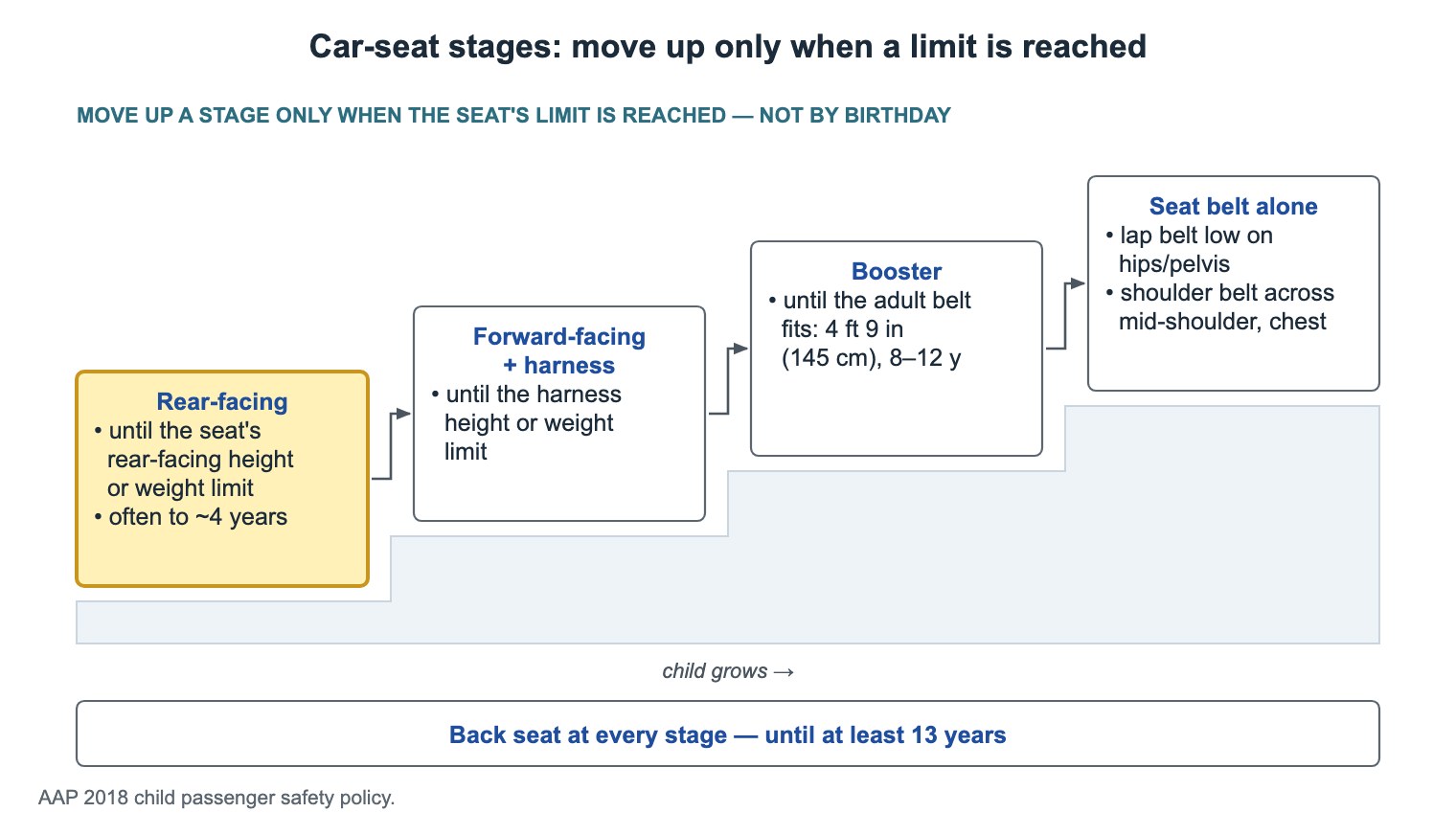
Car-seat stages: move up only when a limit is reached
Key points
- Rear-facing until the seat's rear-facing height or weight limit, not by birthday; many children stay rear-facing to about 4 years.
- Booster until the adult belt fits, about 4 ft 9 in (145 cm), usually at 8–12 years; back seat until at least 13 years.
- An installed car seat should move less than 1 inch side to side or front to back at the belt path.
- Pools: 4-sided fence with a self-closing, self-latching gate; swim lessons from age 1; lessons never replace supervision.
- Safest firearm storage: unloaded and locked, ammunition locked separately; the safest home has no gun.
- Water heater at 120°F (49°C) or lower; no baby walkers.
- DEET 10–30% is safe from 2 months; no oil of lemon eucalyptus under 3 years; sunscreen first, then repellent.
Car-seat stages
Each move to the next stage gives up some protection, so a child moves up only when the current seat's limit for height or weight is reached. Turning 2 is not a reason to turn the seat around.
Children ride in the back seat at every stage, until at least 13 years.
- Rear-facing: until the seat's rear-facing height or weight limit, often to about 4 years with convertible seats.
- Forward-facing with a 5-point harness: until the harness height or weight limit for that seat.
- Belt-positioning booster: until the adult belt fits, about 4 ft 9 in (145 cm), usually at 8–12 years.
- Seat belt alone: lap belt low across the upper thighs and hips, shoulder belt across the middle of the chest and shoulder, not the neck.
- The child must sit with the back against the seat and knees bent at the seat edge for the whole trip.
Car-seat checks: discharge, installation, use
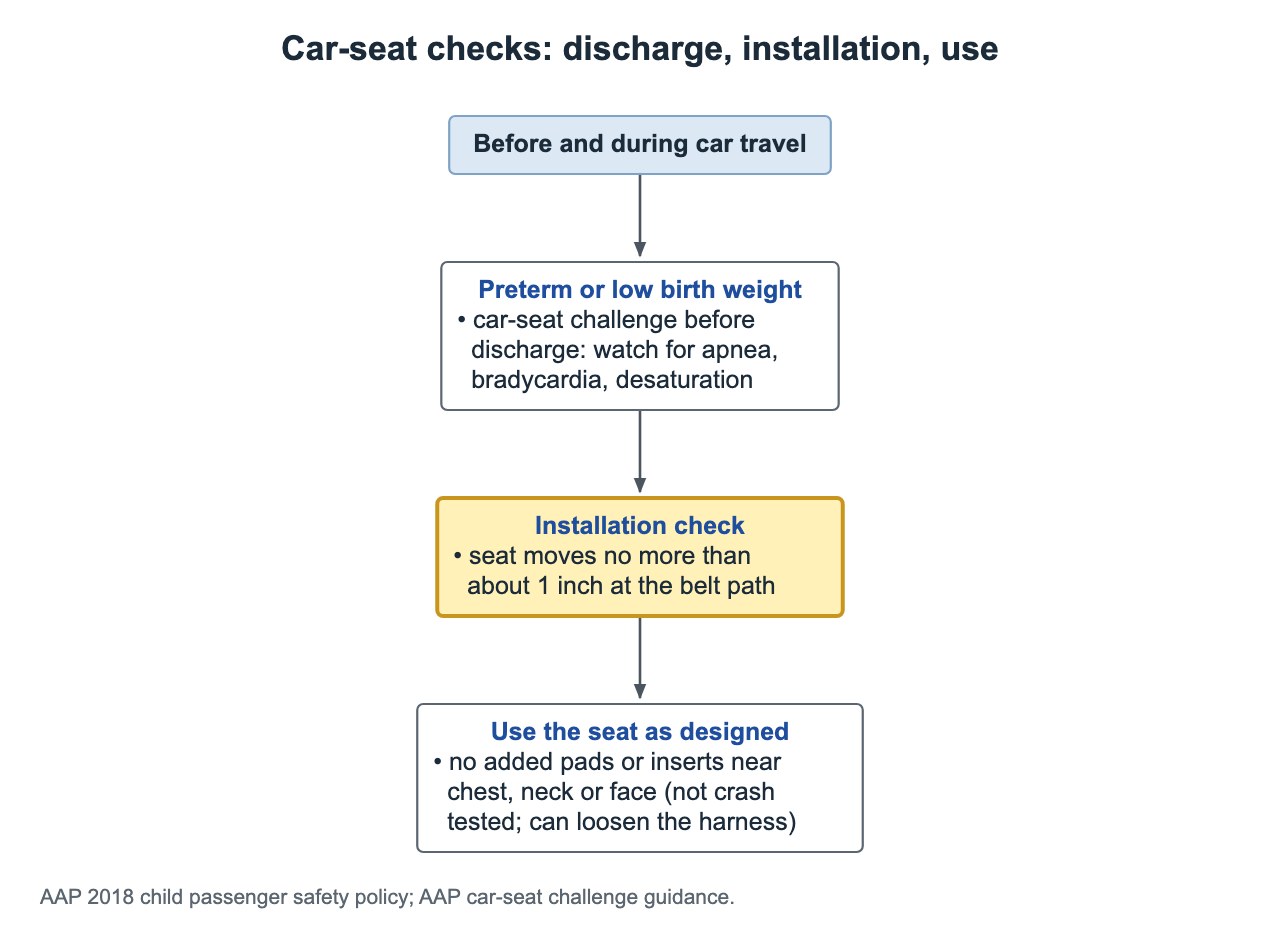
- Infants born before 37 weeks or with low birth weight: a car-seat challenge before discharge watches for apnea, bradycardia and oxygen desaturation in the seat.
- Installation check: the seat moves no more than about 1 inch at the belt path.
- No aftermarket pads, inserts or head positioners that did not come with the seat: they are not crash tested and can loosen the harness or tip the head forward.
- Harness straps snug, chest clip at armpit level; no bulky coats under the harness.
Injuries in and around parked cars
Many car-related deaths happen when the car is not moving. The single key message is: never leave a child alone in or around a car.
Even on a mild day of about 65°F (18°C), the inside of a parked car can reach about 110°F (43°C) within a short time. Children's temperature rises faster than adults'.
| Danger | What to know |
|---|---|
| Heatstroke | Greatest risk for a child left in a car or hiding in a trunk; keep cars locked and keys out of reach |
| Trunk entrapment | When a young child is missing at home, check the car and the trunk |
| Backovers | Toddlers and preschoolers are hit most; walk around the car before reversing |
| Power windows, seat belts | Strangulation is the most dangerous outcome |
| Car doors | Crush injuries and fractures of fingers, hands or feet |
Water, home and bicycle safety
Drowning is fast and silent. For young children and weak swimmers, an adult should stay within arm's reach (touch supervision), without phones or alcohol.
- Home pools: 4-sided fencing that separates the pool from the house, with a self-closing, self-latching gate.
- Swim lessons are recommended from age 1 year, but they never replace supervision or fencing.
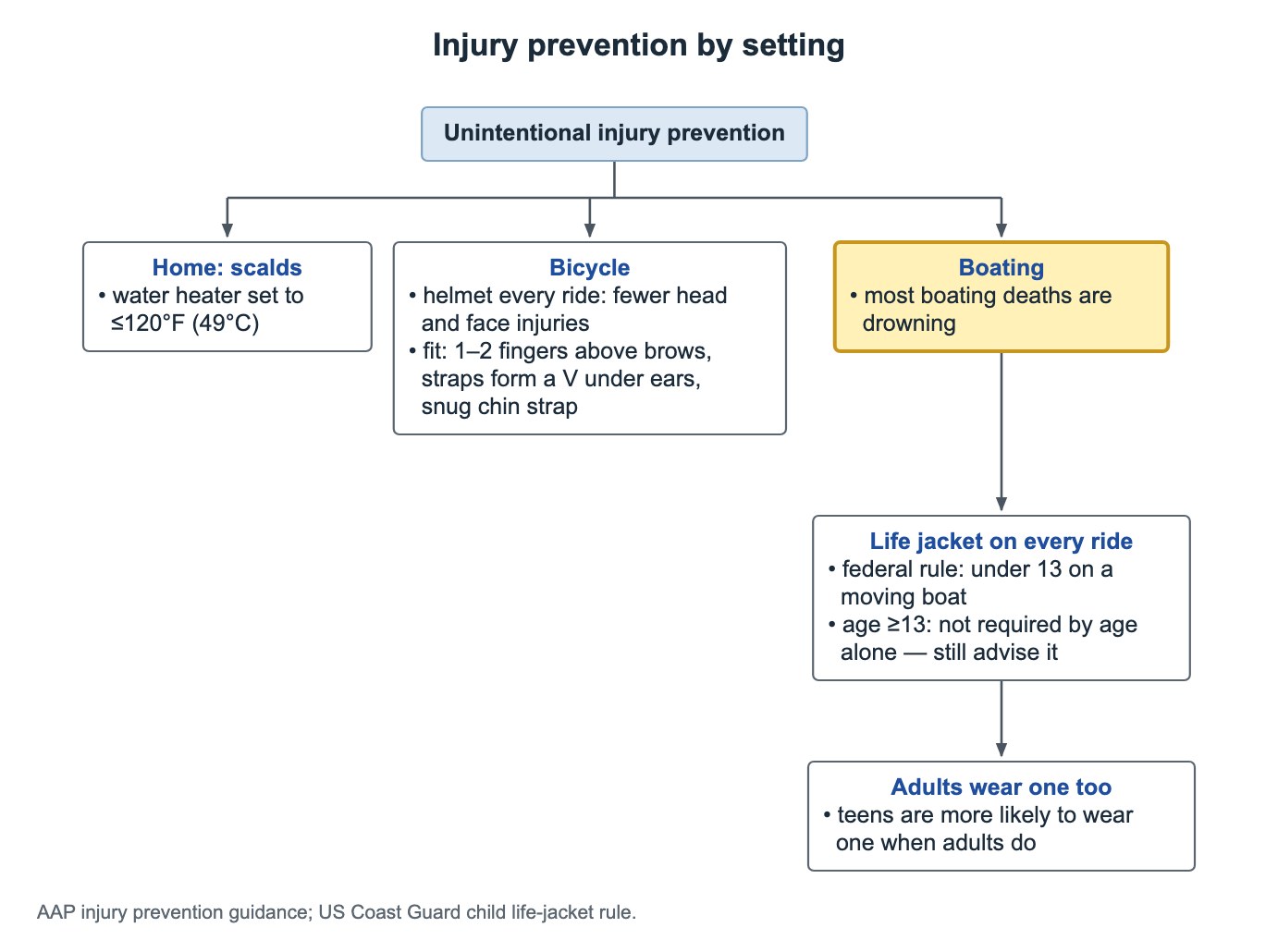
- Boating: drowning causes most boating deaths. The federal rule requires a life jacket for children under 13 on a moving recreational boat; a 14-year-old is not covered by that rule, but should still wear one.
- Teens are more likely to wear a life jacket when the adults on the boat wear one too.
- Scalds: set the water heater to 120°F (49°C) or lower.
- Bicycles: a properly fitted helmet on every ride is the best way to reduce head and face injuries; fit is 1–2 fingers above the eyebrows, straps in a V under the ears, snug chin strap. Tuck in pant cuffs so they cannot catch in the chain.
- Baby walkers: do not use them. They cause stair falls and burns and do not help a baby walk; they may delay walking.
- Windows: use window guards or stops that let windows open no more than 4 inches; move furniture away from windows.
- Poisons: keep medicines and chemicals locked, up and out of sight, in original containers; save Poison Help, 1-800-222-1222.
Firearms and safe sleep
Unintentional injury (motor-vehicle crashes, drowning, suffocation, poisoning) is the leading cause-of-death category from 1 year through adolescence. As a single cause, firearm injuries are now the leading cause of death in US children and teens aged 1–19 years.
Ask every family about guns in the home and in homes the child visits.
- Safest home: no gun.
- If there is a gun: store it unloaded and locked, with ammunition locked separately.
- Safe sleep: on the back, alone, on a firm, flat surface with no soft bedding, bumpers or pillows; room-share without bed-sharing, ideally for at least the first 6 months.
- Modifiable SIDS risks include prone sleep, soft sleep surfaces or bedding, and tobacco smoke; blunted arousal is the proposed mechanism.
- A pacifier at nap and bedtime lowers SIDS risk; in breastfed infants, offer it once breastfeeding is well established.
- Tobacco smoke exposure in pregnancy or infancy raises SIDS risk.
Sunscreen, insect repellent and ticks
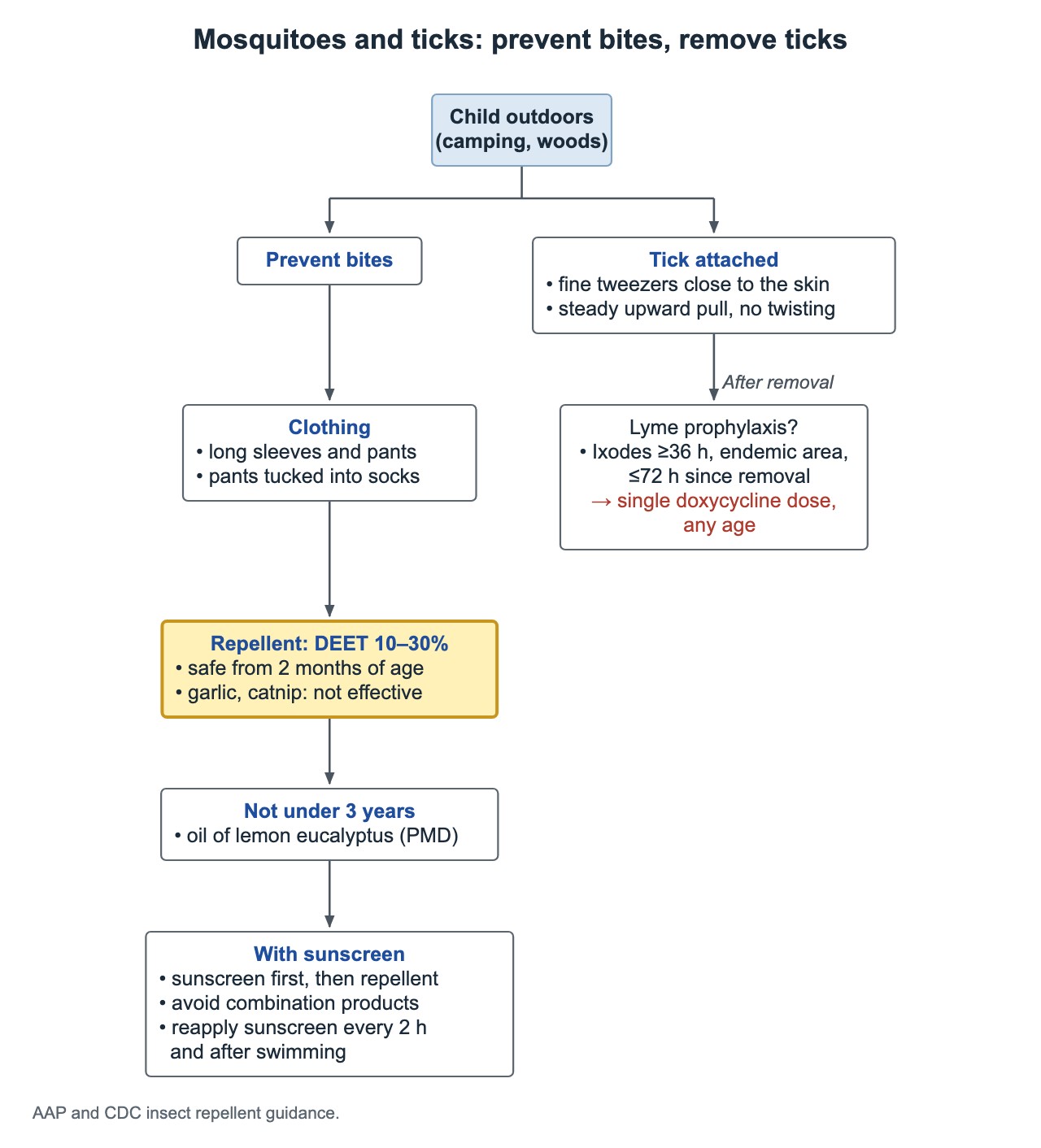
- DEET 10–30% is safe from 2 months of age and is the best choice for siblings of different ages; garlic and catnip do not work.
- Do not use oil of lemon eucalyptus (PMD) under 3 years.
- Clothing for tick areas: long sleeves, long pants, pants tucked into socks.
- With sun and bugs: apply sunscreen first, then repellent; avoid combined sunscreen-repellent products, because sunscreen needs reapplying and repellent does not.
- Sunscreen: broad-spectrum SPF 30 or higher (at least 15); little added benefit above 50. Apply 15–30 minutes before sun; reapply every 2 hours and after swimming or sweating.
- Tick removal: fine-tipped tweezers close to the skin, steady upward pull, no twisting.
- After an Ixodes tick bite attached 36 hours or more in a Lyme-endemic area, within 72 hours of removal: a single dose of doxycycline is an option at any age.
Tobacco smoke, pesticides and food-contact chemicals
Frozen fruits and vegetables are as good as fresh.
| Exposure | Key fact | Advice |
|---|---|---|
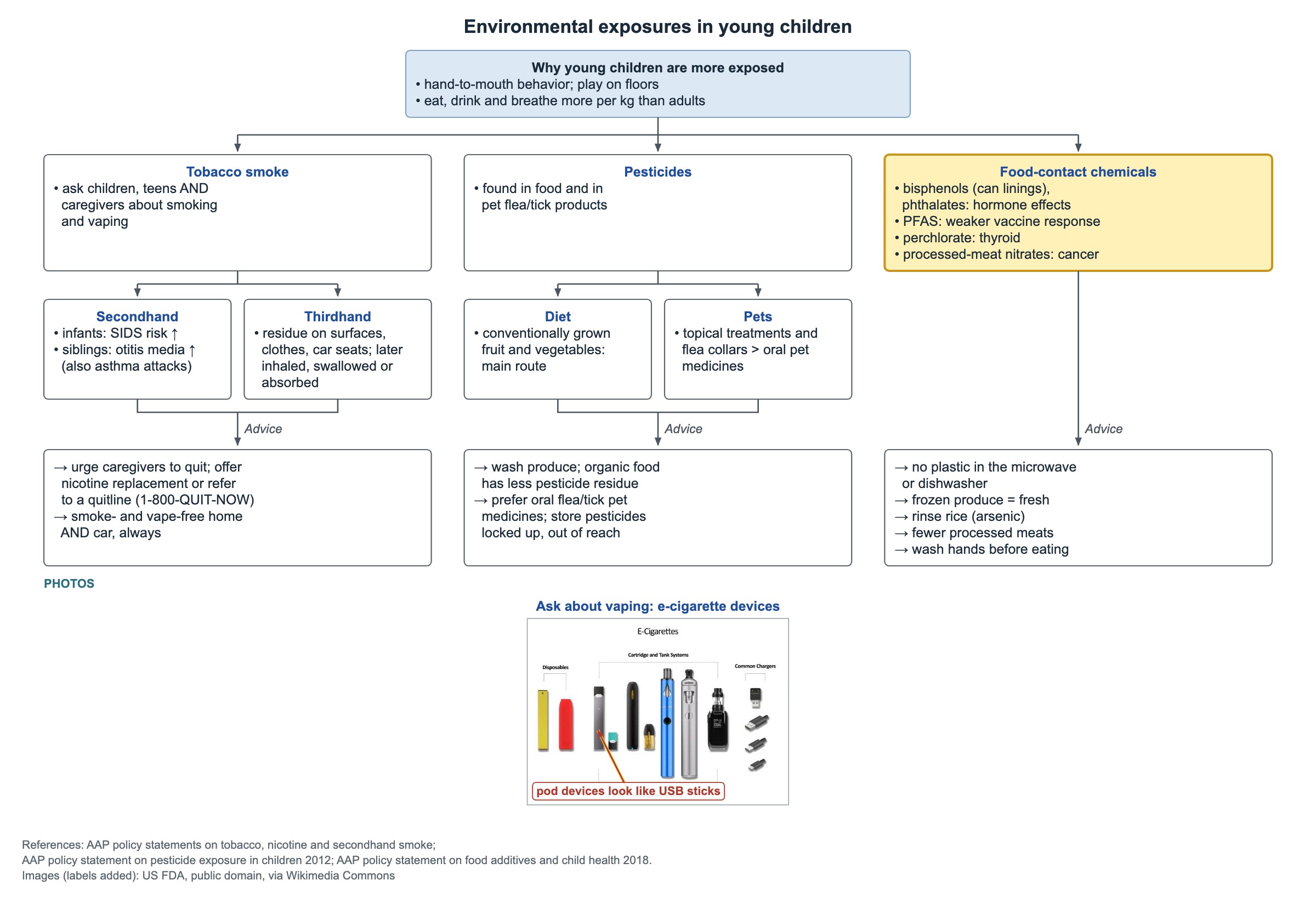
| Secondhand smoke | Raises SIDS risk in infants; more otitis media and asthma attacks in siblings | Ask children, teens and caregivers about smoking and vaping; smoke- and vape-free home and car |
| Thirdhand smoke | Residue in dust, fabrics and surfaces that the child touches, swallows or breathes | Quitting, not just smoking outside, removes it |
| Pesticides: diet | Conventionally grown produce is the main source for a typical toddler | Wash produce; organic food has less residue |
| Pesticides: pets | Spot-on topicals and flea collars expose children more than oral pills | Prefer oral flea and tick medicines |
| Bisphenols (BPA), phthalates | Endocrine disruption: fertility, puberty timing; phthalates also male genital development, obesity, insulin resistance; can linings are a BPA source | No plastic in the microwave or dishwasher; use glass or stainless steel |
| PFAS | Immunosuppression, weaker vaccine responses | Limit greasy food packaging |
| Perchlorate | Thyroid: blocks iodide uptake | |
| Nitrates, nitrites in processed meat | Cancer risk | Fewer processed meats |
| Inorganic arsenic in rice | Rinsing rice before cooking lowers exposure | Vary grains |
Common questions
When can my child face forward in the car?
Only when the child reaches the rear-facing height or weight limit of the car seat. This is often around 4 years; turning 2 is not the trigger.
When can a child stop using a booster seat?
When the adult belt fits correctly, usually at about 4 ft 9 in (145 cm) tall, between 8 and 12 years. Children stay in the back seat until at least 13.
What age can you use DEET on a baby?
From 2 months of age, using 10–30% DEET. Oil of lemon eucalyptus should not be used under 3 years.
How should a gun be stored in a home with children?
Unloaded and locked, with the ammunition locked in a separate place. The safest home for a child has no gun.
Study this topic
Sources
- AAP 2018: Child passenger safety (Pediatrics)
- AAP 2019: Prevention of drowning (Pediatrics)
- AAP 2022: Firearm-related injuries and deaths in children and youth (Pediatrics)
- AAP 2022: Sleep-related infant deaths, updated recommendations (Pediatrics)
- CDC: Preventing mosquito bites
Written for Pedemy in our own words from the sources above; checked November 2026. For education only, not medical advice; check doses and local protocols before treating a patient. Pedemy is independent and not affiliated with or endorsed by the organizations cited.