

Main decision tree
Stridor since infancy: floppy or narrowed airway
Key points
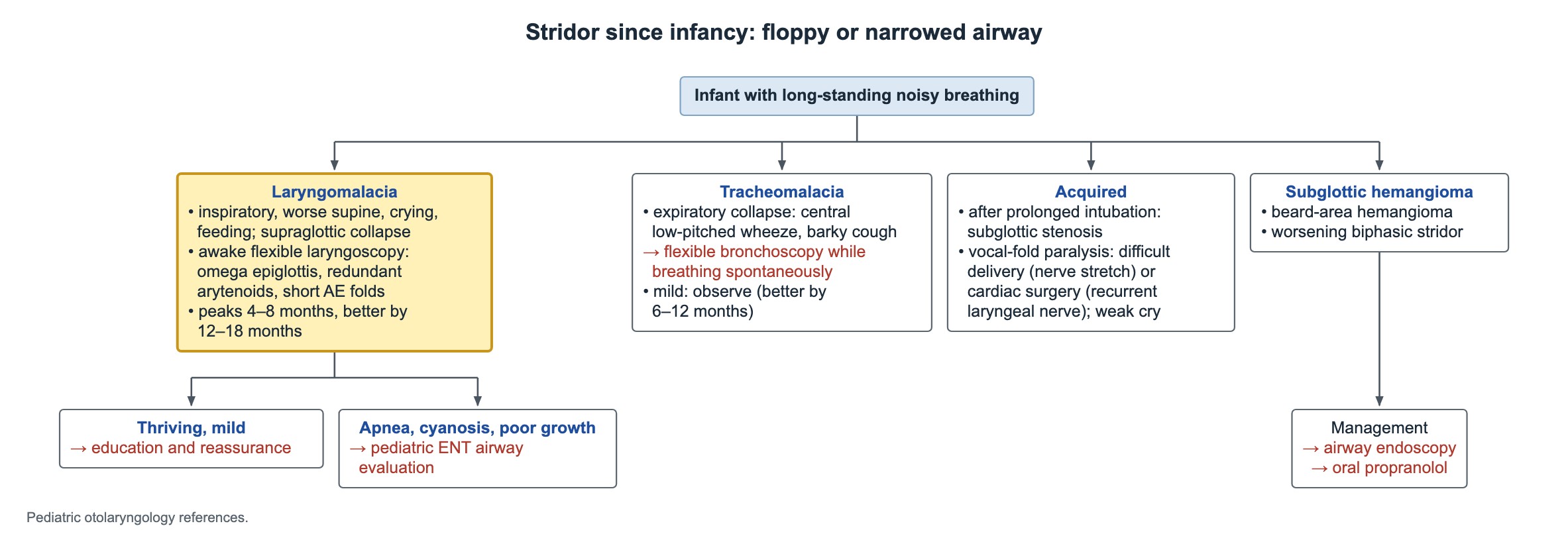
- Inspiratory stridor = extrathoracic; expiratory = intrathoracic trachea or large airways; biphasic = fixed (often glottic or subglottic) obstruction.
- Laryngomalacia is the commonest cause of infant stridor: worse with crying, feeding and lying supine; worst at 4–8 months, gone by 12–18 months.
- Laryngomalacia with apnea, cyanosis or poor weight gain → pediatric otolaryngology airway evaluation.
- Croup is the commonest cause of acute stridor; every child with croup, even mild, gets one dose of oral dexamethasone.
- After nebulized epinephrine, observe 2–4 hours because the effect wears off.
- Drooling, dysphagia, tripod posture and no barky cough → suspected epiglottitis: secure the airway before any imaging.
- A normal chest x-ray does not rule out an inhaled foreign body; rigid bronchoscopy removes it.
Laryngomalacia
In laryngomalacia the supraglottic tissues collapse inward during inspiration. The stridor is inspiratory and louder with crying, feeding, agitation and lying on the back.
Awake flexible laryngoscopy confirms it: an omega-shaped epiglottis, short aryepiglottic folds and arytenoid tissue that prolapses on inspiration.
- Course: noise often starts in the first weeks, peaks at 4–8 months and resolves by 12–18 months.
- Mild stridor in a baby who feeds and gains weight well: reassure and teach the family the expected course.
- Apnea, cyanosis, feeding difficulty or poor weight gain: refer to pediatric otolaryngology for airway evaluation; some infants need supraglottoplasty.
Tracheomalacia
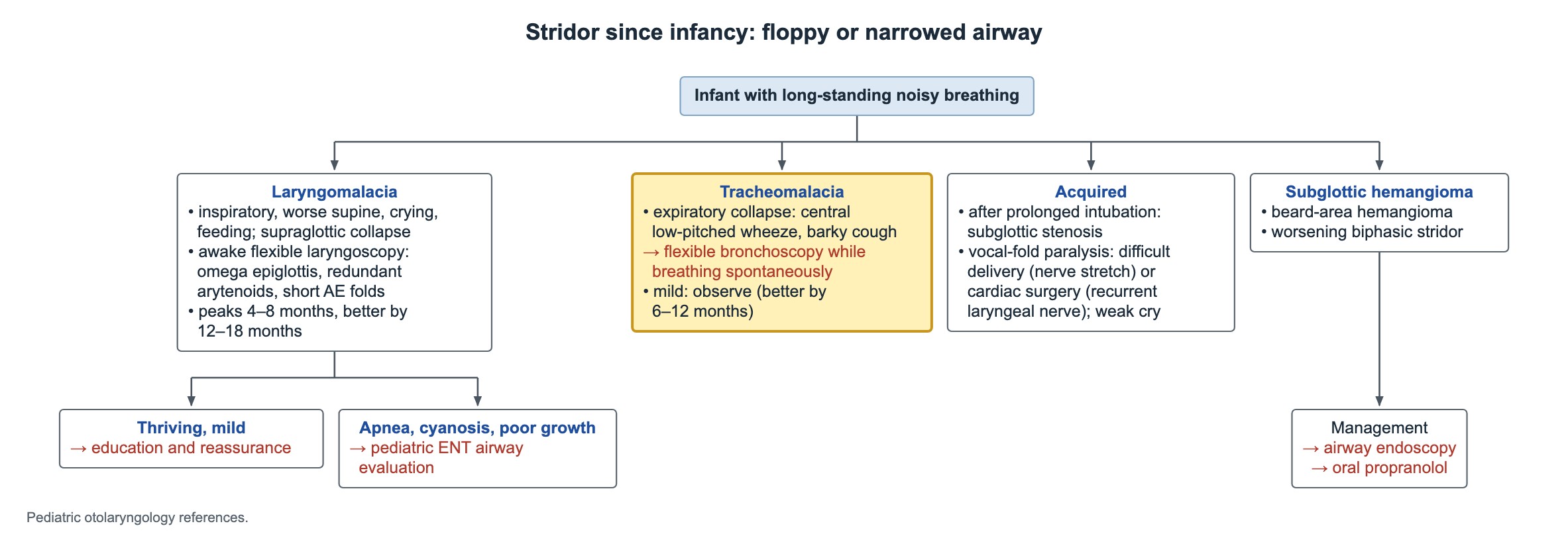
A soft trachea collapses during exhalation, when pressure in the chest rises. The result is a low-pitched central wheeze and a harsh, barky or brassy cough, often worse with colds and crying.
- Gold-standard test: flexible bronchoscopy while the child breathes spontaneously, so the dynamic collapse can be seen.
- Mild, isolated tracheomalacia in a thriving infant: observe; it usually improves as the airway matures.
Acquired and fixed causes
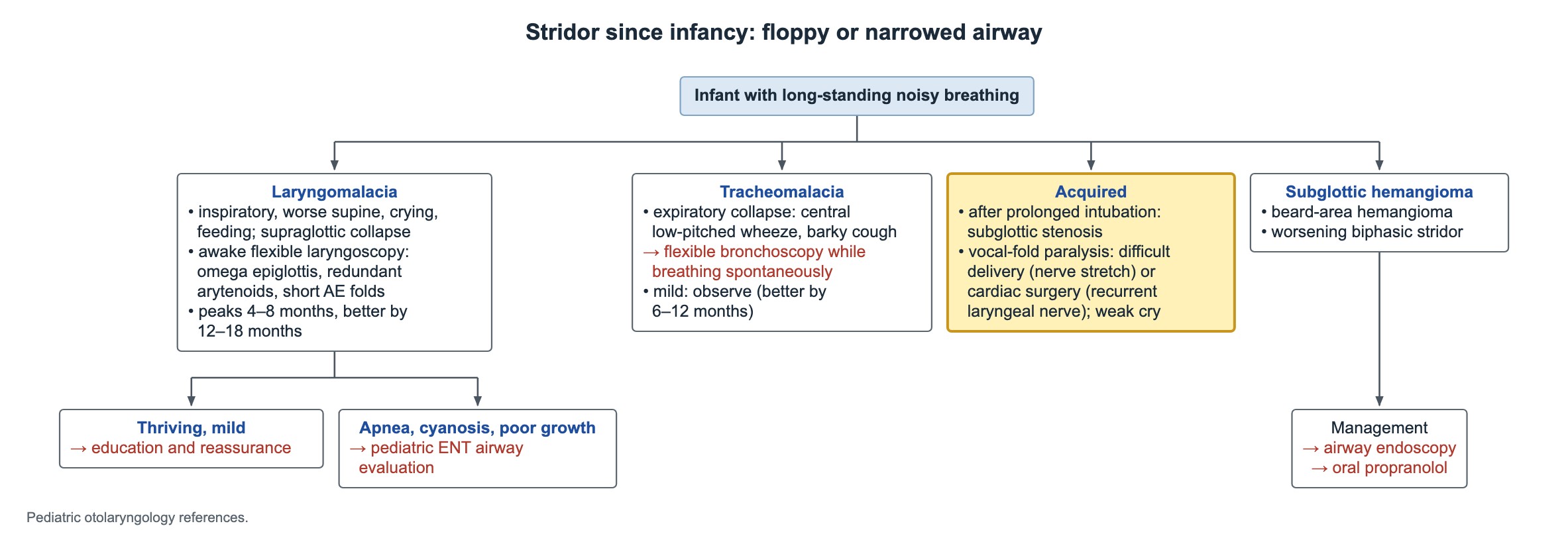
| Clue | Cause | Next step |
|---|---|---|
| Former preterm infant with a long ventilator course and persistent stridor | Subglottic stenosis | Airway endoscopy |
| Weak cry and stridor after PDA ligation or other cardiac surgery | Recurrent laryngeal nerve injury: vocal fold paralysis | Laryngoscopy |
| Weak cry and stridor after a difficult vaginal delivery | Vocal fold paralysis from nerve stretch | Laryngoscopy |
| Bilateral vocal fold paralysis without birth trauma | CNS cause: Chiari II malformation, hydrocephalus | Brain imaging |
| Beard-area hemangioma with worsening biphasic stridor | Subglottic hemangioma | Airway endoscopy; oral propranolol first line |
| Toddler with slowly worsening hoarseness; warty vocal cord mass | Recurrent respiratory papillomatosis (HPV 6 and 11) | Endoscopic removal |
Acute stridor and croup
First decide whether the airway needs emergency help; stabilize before any imaging. Then use the pattern to find the cause.
Croup (viral laryngotracheitis) is the commonest cause of acute stridor: a coryzal prodrome, then barky cough, hoarseness and inspiratory stridor, worse at night. Spasmodic croup is recurrent night-time barky cough with little fever in a child who is well by day. An x-ray is rarely needed; if done, the AP film shows subglottic narrowing (steeple sign).
- Dexamethasone 0.6 mg/kg by mouth once for every child with croup, even mild croup with stridor only when crying.
- Moderate to severe croup (stridor at rest): add nebulized epinephrine, either racemic epinephrine 2.25% 0.5 mL or L-epinephrine 1 mg/mL 5 mL.
- Observe 2–4 hours after epinephrine, because its effect wanes and symptoms can return.
Epiglottitis, bacterial tracheitis and foreign body
- Nebulized epinephrine fails in bacterial tracheitis because the obstruction is pus and membranes, not mucosal swelling.
- Lateral neck film in tracheitis: a shaggy, irregular tracheal wall, intraluminal membranes and subglottic narrowing.
- Foreign body: the classic film shows unilateral hyperinflation from air trapping, but a normal chest x-ray does not exclude it.
- A choking child who is coughing forcefully and crying: do not give back blows or thrusts; let the child cough and watch closely.
| Condition | Clues | Management |
|---|---|---|
| Epiglottitis | Abrupt onset without a viral prodrome; fever, drooling, dysphagia, muffled voice, tripod posture, little barky cough | Airway first: secure it with a skilled team (often in the operating room); no neck x-ray first. Then IV ceftriaxone or cefotaxime, adding vancomycin if MRSA is a concern or illness is severe |
| Bacterial tracheitis | Usually follows viral croup; toxic, febrile child with stridor and cough who responds poorly to croup treatment; most often Staphylococcus aureus | Secure the airway if failing; direct laryngoscopy or bronchoscopy confirms; IV vancomycin plus ceftriaxone |
| Inhaled foreign body | Choking episode, then cough or unilateral wheeze | Rigid bronchoscopy, which removes the object in about 95% |
Exercise-induced laryngeal obstruction
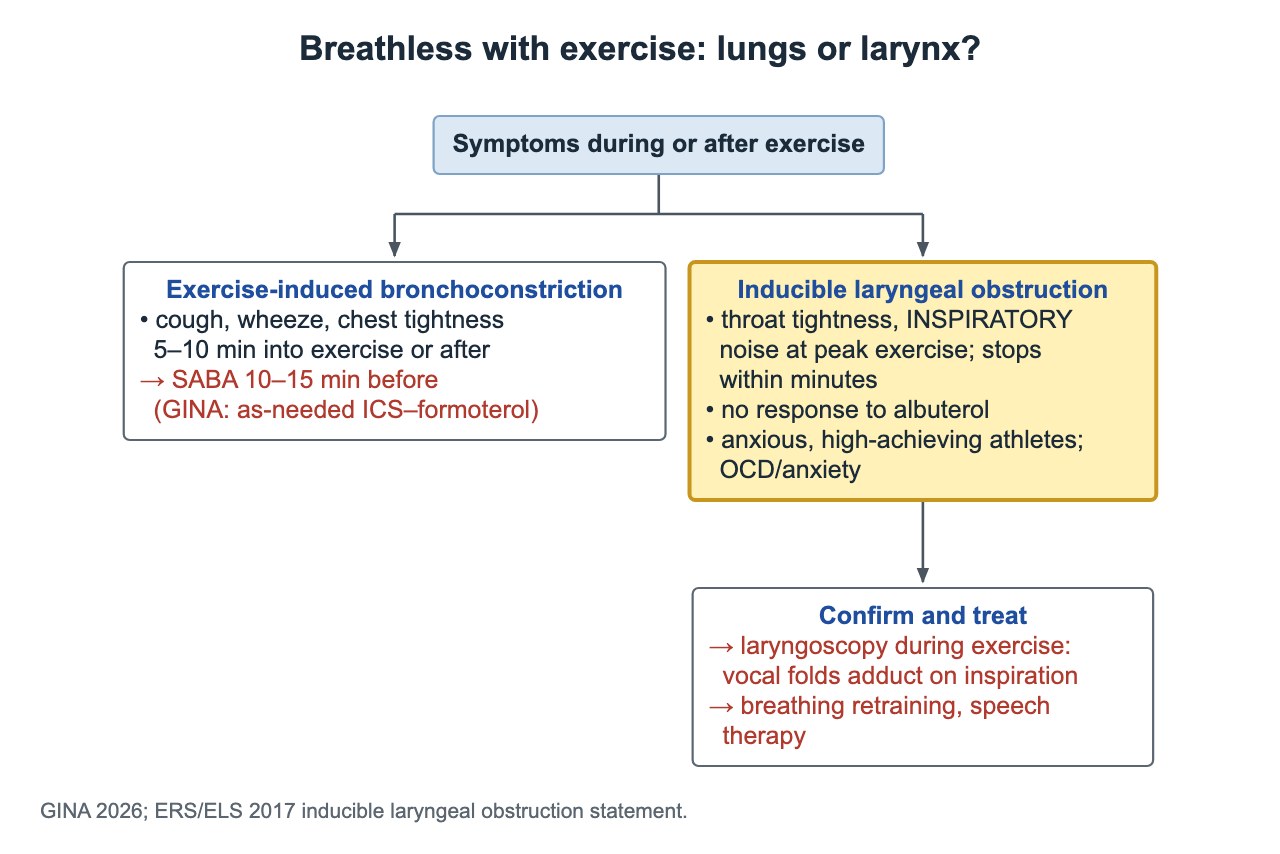
In inducible laryngeal obstruction the vocal folds close during inspiration at peak exercise. The teen feels throat tightness and makes an inspiratory noise that settles within minutes of stopping. Albuterol does not help.
It is common in driven, high-achieving athletes, often girls, and is linked to anxiety and perfectionism. Exercise-induced bronchoconstriction, in contrast, causes cough, wheeze and chest tightness and responds to a pre-exercise bronchodilator.
- Confirm: laryngoscopy during exercise shows the vocal folds adducting on inspiration.
- Treat: breathing retraining with speech therapy.
Periodic breathing in young infants
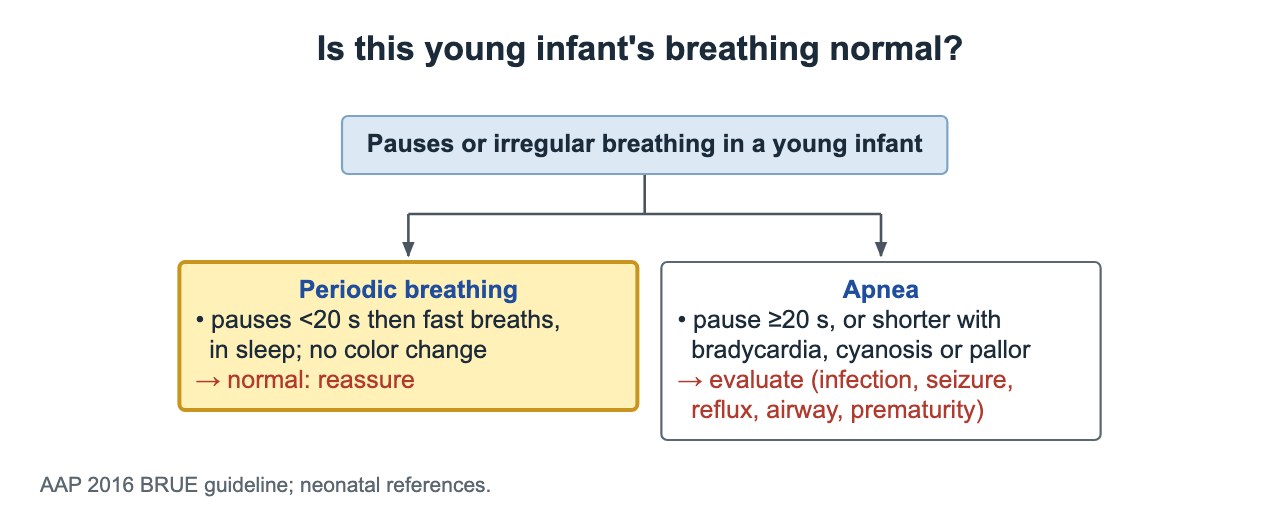
A healthy young infant who has pauses of 5–10 seconds followed by quick breaths during sleep, with no color change, has periodic breathing. It is normal: reassure the parents.
- Apnea is a pause of 20 seconds or more, or a shorter pause with bradycardia, cyanosis or pallor.
- Apnea needs evaluation for infection, seizures, reflux, airway problems and prematurity.
Common questions
When does laryngomalacia go away?
Stridor usually peaks at 4–8 months and resolves by 12–18 months. Poor weight gain, apnea or cyanosis need an airway evaluation.
What dose of dexamethasone is used for croup?
A single oral dose of 0.6 mg/kg is the common board answer. Even mild croup benefits from one dose.
How do you tell epiglottitis from croup?
Epiglottitis starts abruptly with high fever, drooling, dysphagia and a tripod posture but little barky cough. Croup follows a cold and has a barky cough and hoarseness.
Study this topic
Sources
- AHA 2020: Pediatric basic and advanced life support (Circulation)
- AAP 2019: Clinical practice guideline for the management of infantile hemangiomas (Pediatrics)
- ERS statement on tracheomalacia and bronchomalacia in children (Eur Respir J, 2019)
Written for Pedemy in our own words from the sources above; checked November 2026. For education only, not medical advice; check doses and local protocols before treating a patient. Pedemy is independent and not affiliated with or endorsed by the organizations cited.