

Main decision tree
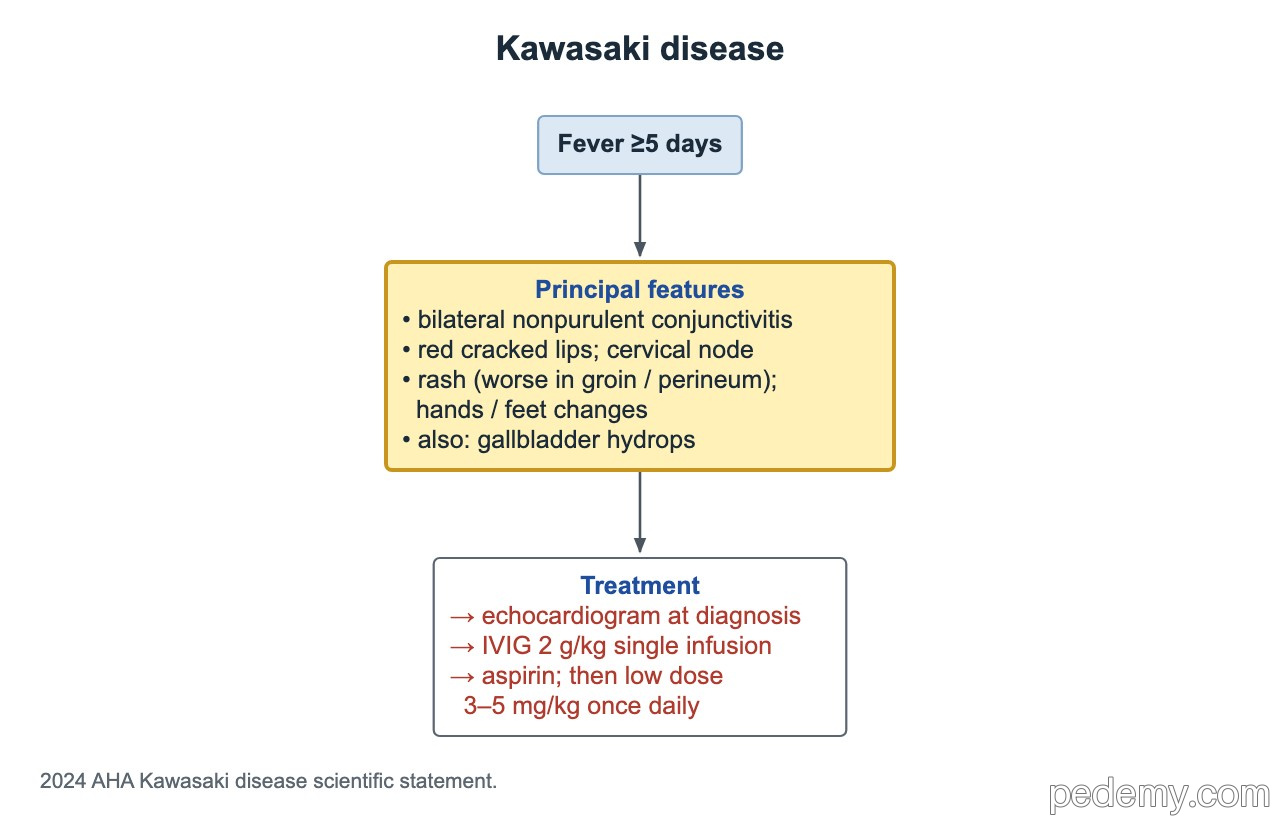
Kawasaki disease: fever, principal features, treatment
Key points
- Classic KD: fever for 5 days or more plus at least 4 of the 5 principal features.
- Incomplete KD: fever ≥5 days with 2–3 features (or an infant with ≥7 days of unexplained fever) → check CRP and ESR.
- CRP ≥3 mg/dL or ESR ≥40 mm/h, then 3 or more supplemental lab findings or a positive echo → treat.
- Treatment: IVIG 2 g/kg as one infusion, ideally within 10 days of fever onset, plus aspirin.
- After the fever settles, low-dose aspirin 3–5 mg/kg once daily until the 4–6 week echo is normal.
- Echo at diagnosis, at 1–2 weeks and at 4–6 weeks after treatment.
- Delay measles and varicella vaccines 11 months after 2 g/kg IVIG; give the yearly inactivated flu vaccine while on aspirin.
Recognize classic Kawasaki disease
Think of KD in any young child with fever for 5 days or more. The 5 principal features often come and go, so ask about features that have already settled.
- Eyes: bilateral bulbar conjunctival injection without pus, often sparing the limbus.
- Mouth: red, cracked lips, strawberry tongue, red throat without exudate.
- Rash: polymorphous, often worse in the groin and perineum; not vesicular or bullous.
- Hands and feet: red, swollen palms and soles early; peeling around the nails at 2–3 weeks.
- Neck: one cervical node of 1.5 cm or more, usually on one side.
| Other clues | Why it matters |
|---|---|
| Gallbladder hydrops | Right upper quadrant pain or mass on ultrasound |
| Sterile pyuria | Urine WBCs with a negative culture |
| Redness at the BCG scar | A specific clue in BCG-vaccinated infants |
| Marked irritability | Common, especially in infants |
Incomplete Kawasaki disease
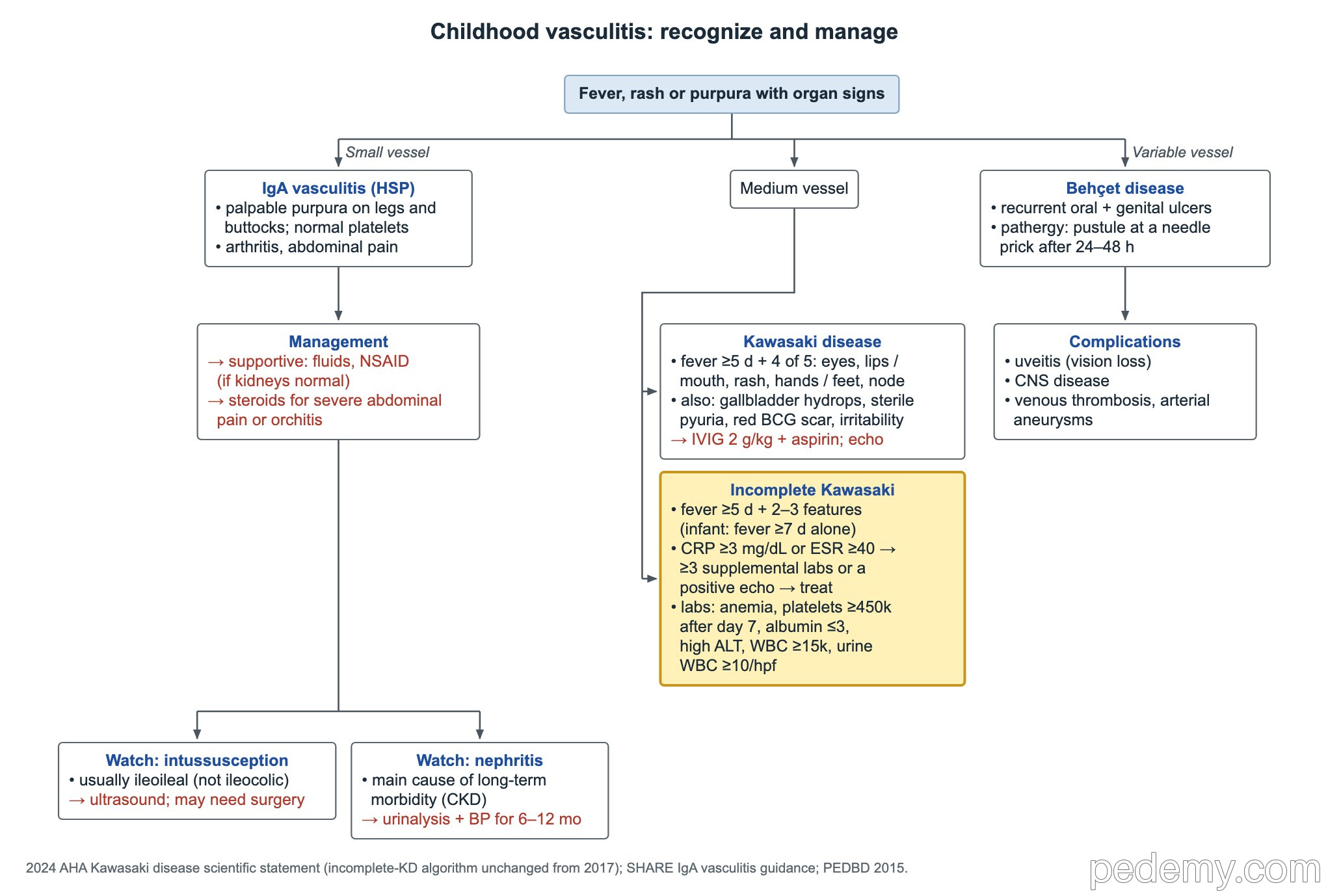
Incomplete KD is not milder disease: infants under 6 months often present this way and have the highest aneurysm risk.
Use the lab pathway when fever has lasted 5 days or more with 2 or 3 features, or 7 days or more in an infant with no other cause.
- CRP ≥3.0 mg/dL or ESR ≥40 mm/h: look for supplemental findings.
- Supplemental findings: anemia for age, platelets ≥450,000 after day 7, albumin ≤3.0 g/dL, raised ALT, WBC ≥15,000, urine ≥10 WBC/hpf.
- 3 or more supplemental findings, or a positive echo → treat as KD.
- CRP and ESR below those cut-offs: re-examine daily; get an echo if peeling appears.
- Positive echo: LAD or RCA z score ≥2.5, an aneurysm, or several other suggestive findings.
Treatment: IVIG and aspirin
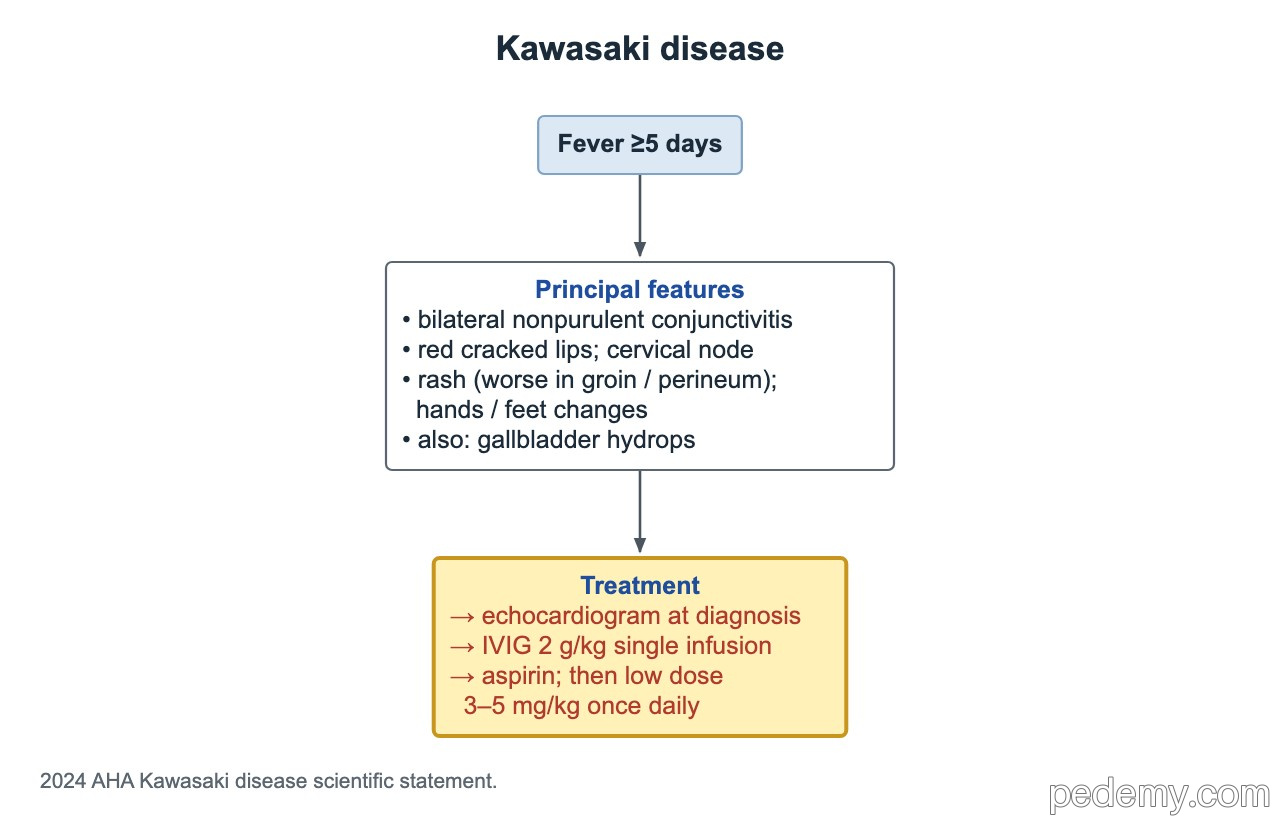
Children at high risk of IVIG resistance or with aneurysms at diagnosis may also get corticosteroids or another added therapy; this is a cardiology decision.
- IVIG 2 g/kg as a single infusion, best within the first 10 days of fever.
- Still give IVIG after day 10 if fever or raised inflammatory markers persist, or if there are coronary changes.
- Aspirin: moderate or high dose while febrile, then low dose 3–5 mg/kg once daily.
- Stop low-dose aspirin at 4–6 weeks if the echo shows no coronary changes.
- Avoid ibuprofen in children taking aspirin for coronary aneurysms: it blocks aspirin's antiplatelet effect.
If fever persists after IVIG
About 10–20% of children still have fever 36 hours or more after the IVIG infusion ends. This is IVIG resistance and raises the aneurysm risk.
Options are a second dose of IVIG 2 g/kg, corticosteroids or infliximab, chosen with the cardiology and rheumatology teams.
Echo follow-up and vaccines
- Echo at diagnosis, again 1–2 weeks after treatment, and 4–6 weeks after treatment.
- Children with aneurysms need closer imaging, antithrombotic therapy and lifelong cardiology care.
- Measles- and varicella-containing vaccines: wait 11 months after 2 g/kg IVIG, because the antibodies in IVIG block the vaccine response.
- Long-term aspirin carries a Reye syndrome risk with influenza or varicella: give the inactivated flu vaccine, not the live nasal one.
Look-alikes
| Condition | What points away from KD |
|---|---|
| MIS-C | Recent SARS-CoV-2 infection or exposure; older children; prominent GI symptoms, shock and myocardial dysfunction |
| Scarlet fever | Positive group A strep test; sandpaper rash; improves quickly on antibiotics |
| Measles | Cough, coryza, Koplik spots; rash starts on the face |
| Adenovirus | Exudative pharyngitis or purulent conjunctivitis |
| Drug reaction, SJS | New medicine; mucosal erosions, target or blistering lesions |
| IgA vasculitis | Palpable purpura on the legs and buttocks with normal platelets |
Common questions
Can Kawasaki disease be diagnosed before day 5 of fever?
Yes. With 4 or more principal features, an experienced clinician can diagnose and treat on day 4.
What is the IVIG dose for Kawasaki disease?
2 g/kg given as one infusion, ideally within 10 days of fever onset.
How long do children with Kawasaki disease take aspirin?
Low-dose aspirin, 3–5 mg/kg once daily, usually continues until the echo 4–6 weeks after onset is normal. Children with aneurysms continue longer.
Study this topic
Sources
- AHA 2024: Update on diagnosis and management of Kawasaki disease (Circulation)
- AHA 2017: Diagnosis, treatment and long-term management of Kawasaki disease (Circulation)
- CDC: Clinical overview of Kawasaki disease
Written for Pedemy in our own words from the sources above; checked November 2026. For education only, not medical advice; check doses and local protocols before treating a patient. Pedemy is independent and not affiliated with or endorsed by the organizations cited.