

Main decision tree
Wetting and bleeding: enuresis and urethral causes
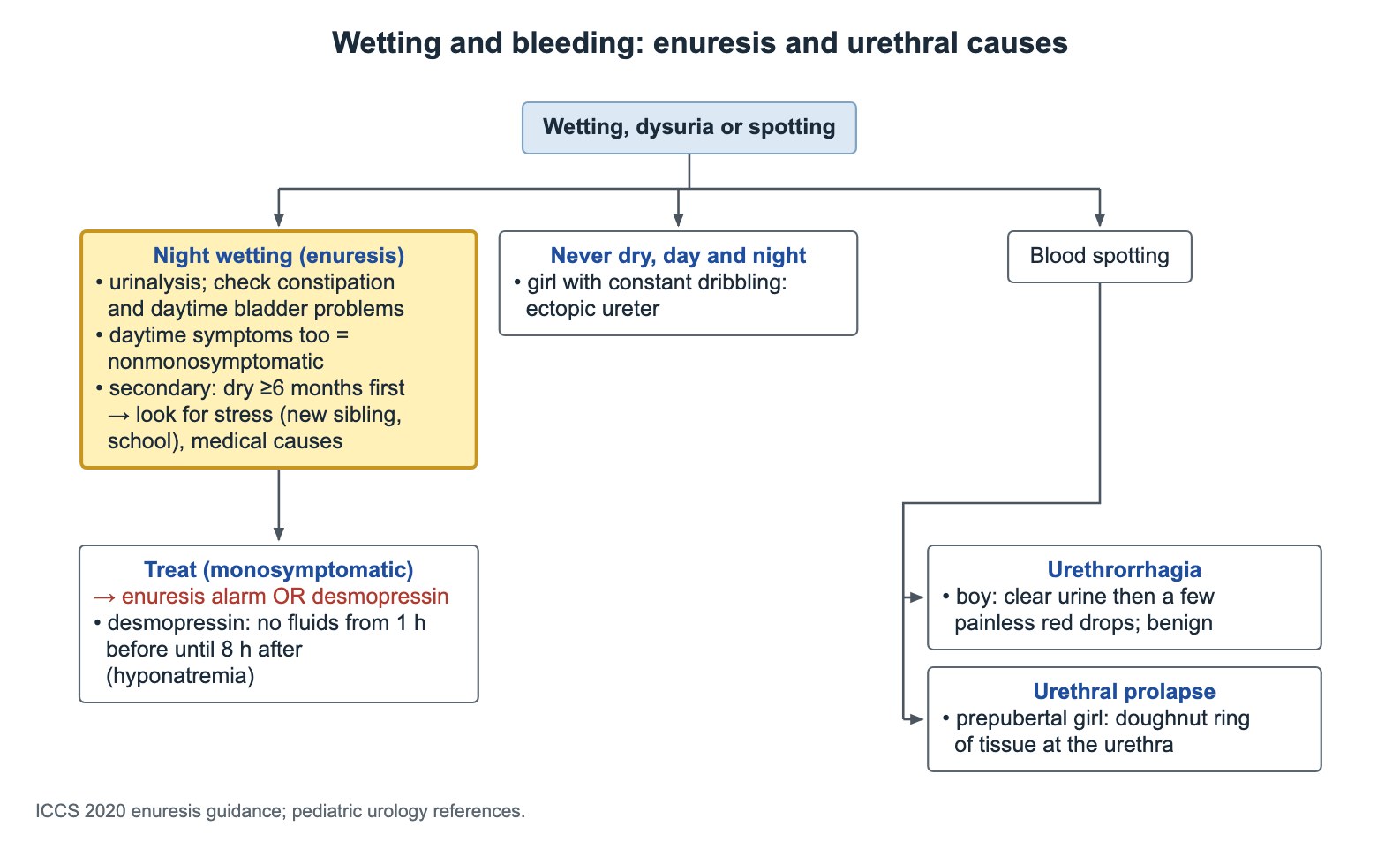
Key points
- Enuresis = wetting during sleep at age 5 years or older; active treatment is usually offered from about 6 years.
- The one routine test for bedwetting is a urinalysis; check for constipation and daytime bladder problems first.
- Secondary enuresis = wetting after at least 6 months of dryness: look for stress, UTI, diabetes, constipation and sleep apnea.
- First-line treatment for monosymptomatic enuresis: an enuresis alarm or oral desmopressin.
- With desmopressin, no fluids from 1 hour before the dose until 8 hours after, to prevent hyponatremia.
- A girl who voids normally but is never dry, with constant dribbling: ectopic ureter.
- Circumcised boy with a thin stream that sprays upward: meatal stenosis; treat with meatotomy, not dilation.
Bedwetting: classify and evaluate
Enuresis is intermittent wetting during sleep in a child aged 5 years or older. Classify it two ways, because each changes the plan.
- History and a bladder and bowel diary are the core of the evaluation.
- Urinalysis is the single routine test: glucose for diabetes mellitus, low specific gravity for diabetes insipidus or kidney disease, and signs of infection.
- No blood tests, imaging or urodynamics are needed without warning signs such as a poor stream, excessive thirst or weight loss.
- Treat constipation and daytime bladder dysfunction first; enuresis often improves when they are fixed.
- Also ask about snoring or sleep apnea, ADHD and other behavioral conditions.
- Secondary enuresis: look for emotional stress (new sibling, school move, family conflict), UTI, diabetes, constipation and, rarely, abuse.
| Term | Meaning |
|---|---|
| Monosymptomatic | Night wetting only, no daytime bladder symptoms |
| Nonmonosymptomatic | Night wetting plus daytime urgency, frequency, holding or leaks |
| Primary | Never dry for 6 months in a row |
| Secondary | Wetting returns after at least 6 months of dryness |
Bedwetting: treatment
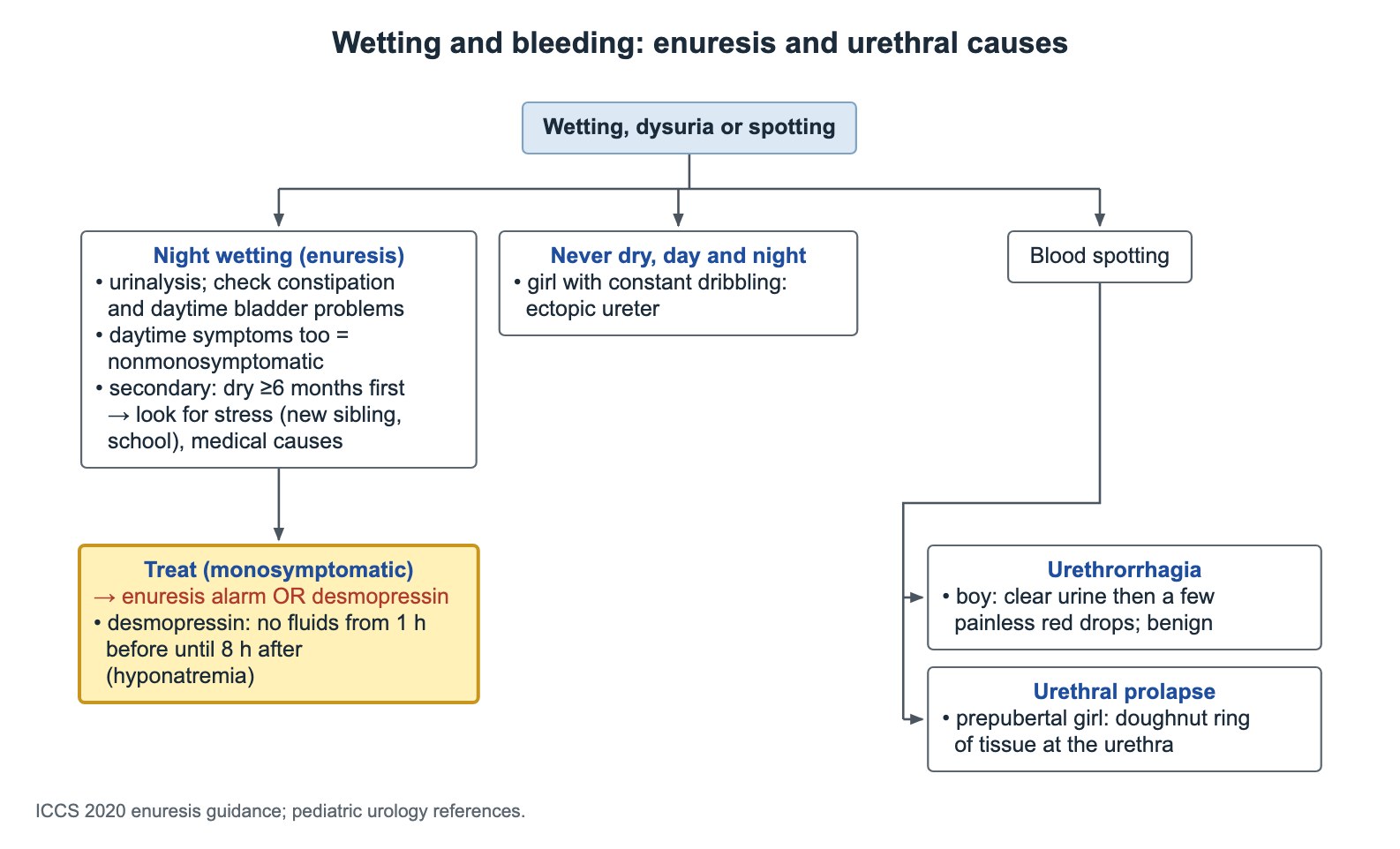
Bedwetting is not the child's fault. Before age 6 years, reassurance and good habits are often enough: regular daytime drinking and voiding, voiding before bed and less fluid in the evening.
- Enuresis alarm: best for a motivated child and family; it works slowly over weeks and has a lower relapse rate after stopping.
- Oral desmopressin: works within days and suits children with large nighttime urine volumes or short-term needs such as sleepovers and camp.
- Desmopressin safety: no fluids from 1 hour before the dose until at least 8 hours after; stop it during vomiting or diarrhea. Water intoxication can cause hyponatremia and seizures.
- Intranasal desmopressin is not used for enuresis because of the higher hyponatremia risk.
- If both fail: add an anticholinergic (for bladder overactivity) under specialist care; imipramine is a last-line drug because overdose is cardiotoxic.
- Treat snoring from enlarged tonsils and adenoids; some children become dry afterward.
Never dry: ectopic ureter
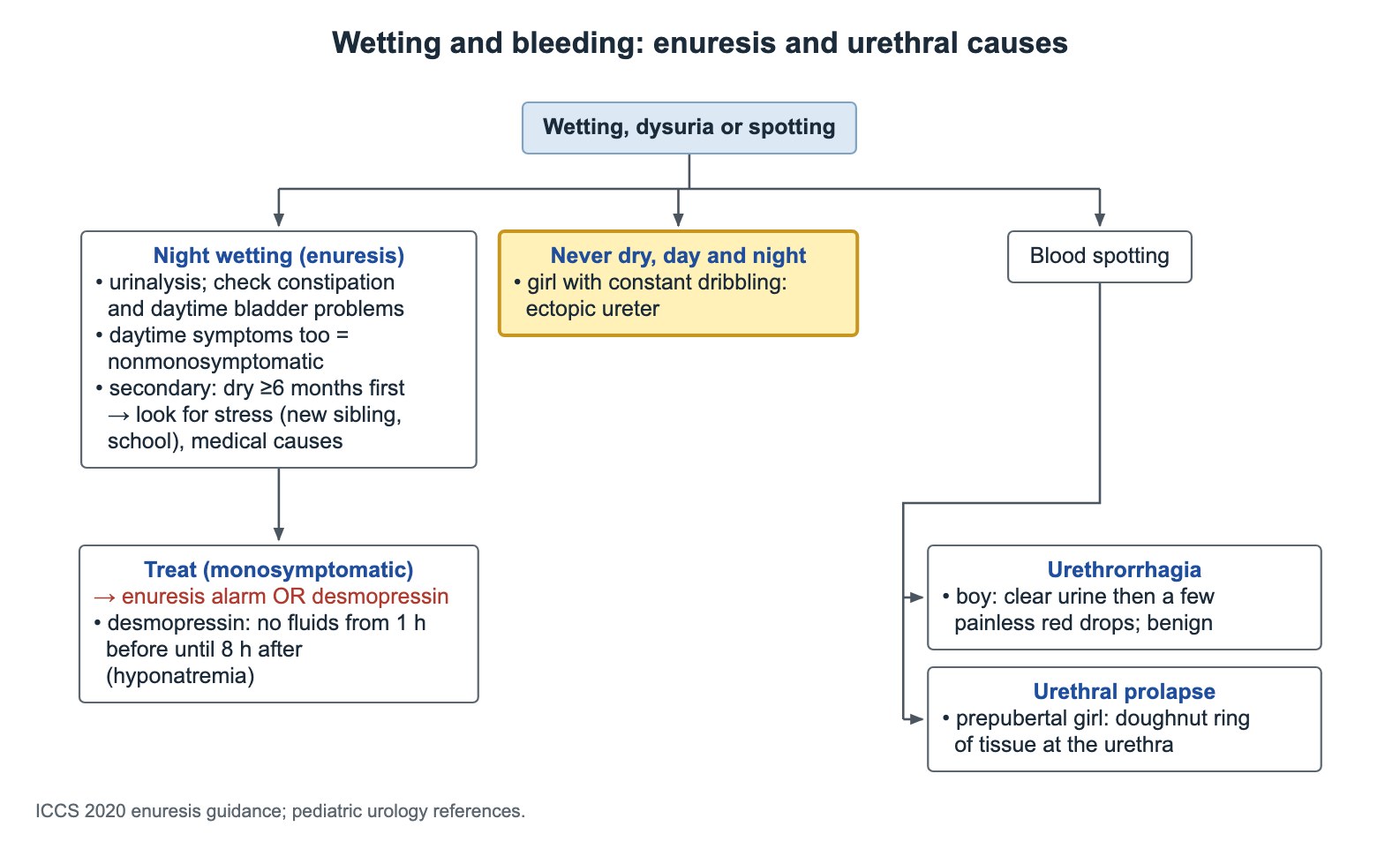
An ectopic ureter drains outside the normal spot in the bladder, usually from the upper pole of a duplex kidney.
In girls it can open below the urinary sphincter, into the urethra or vagina, so urine leaks all the time. The classic story is a girl who voids normally but has constant dribbling and has never been dry, day or night.
In boys the ectopic ureter always opens above the sphincter, so boys do not have this continuous leak; they present with UTI or epididymitis instead. Ultrasound shows the duplex kidney; MR urography defines the anatomy; treatment is surgical.
Blood spotting: urethrorrhagia and urethral prolapse
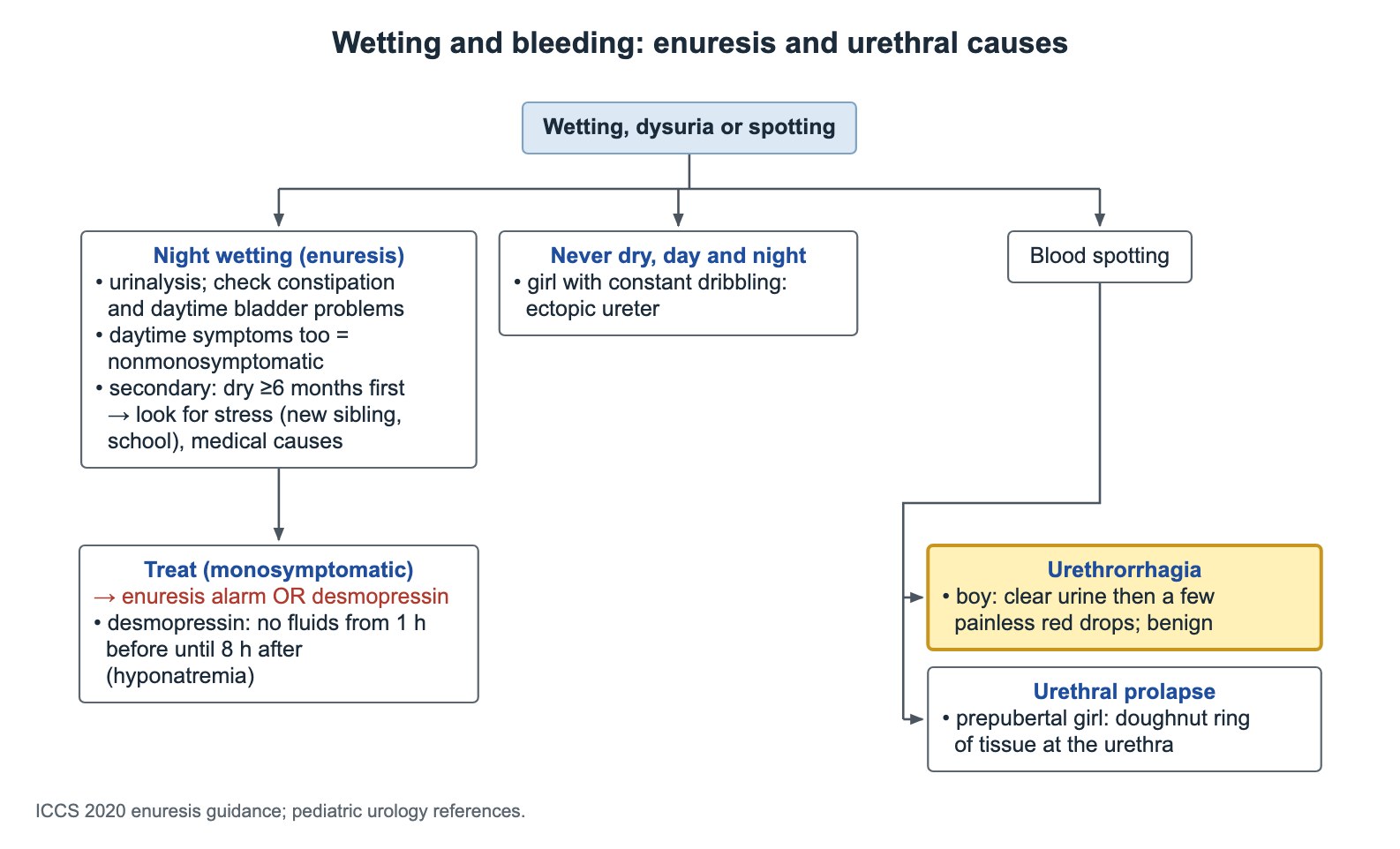
Urethral prolapse can be mistaken for sexual abuse or a tumor. A central meatus within the ring of tissue makes the diagnosis.
| Urethrorrhagia | Urethral prolapse | |
|---|---|---|
| Who | Prepubertal boy | Prepubertal girl, most often Black girls aged about 4–10 years |
| Clue | Clear urine, then a few painless bright-red drops at the end of voiding; spots in the underwear | Spotting with a red or purple doughnut-shaped ring of tissue around the urethral opening |
| Cause | Benign inflammation of the bulbar urethra | Urethral mucosa everts through the meatus, often after straining or coughing |
| Workup | Urinalysis and culture; ultrasound if needed; no early cystoscopy | Clinical diagnosis by examination |
| Course and treatment | Self-limited; usually resolves over months | Sitz baths and topical estrogen; surgical excision if necrotic or persistent |
Meatal stenosis
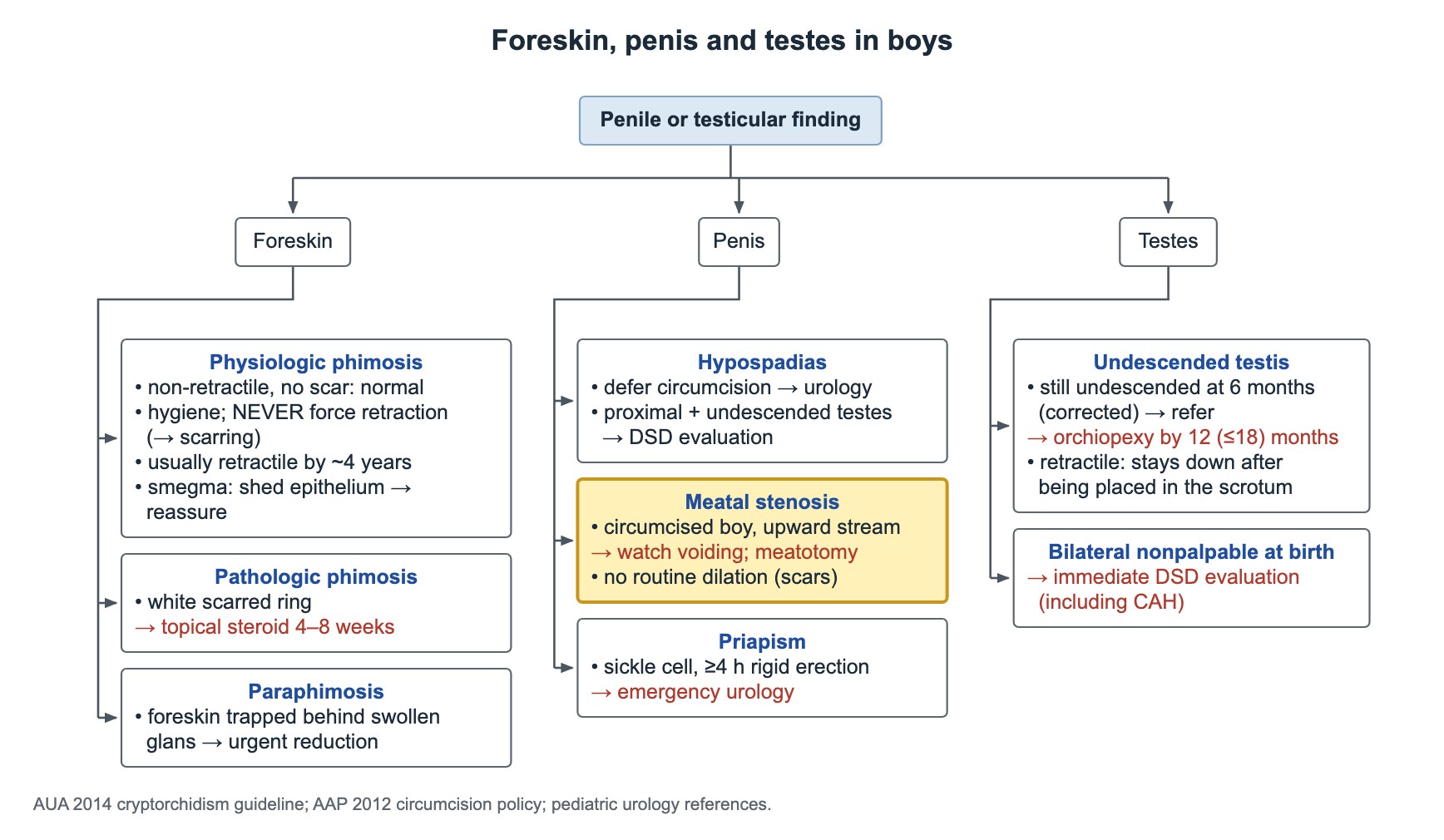
Meatal stenosis is a narrowing of the urethral opening, seen almost only in circumcised boys. Irritation of the exposed meatus by diapers and ammonia causes scarring.
- Symptoms: a thin stream that sprays or points upward, pain or burning at the start of voiding, frequency, or a drop of blood at the tip.
- Diagnosis: look at the meatus and watch the child void; imaging is not routine.
- Treatment for symptoms: meatotomy (meatoplasty), often a short office or day-surgery procedure.
- Do not use repeated dilation: stretching tears the tissue and causes more scarring.
Urethral stricture
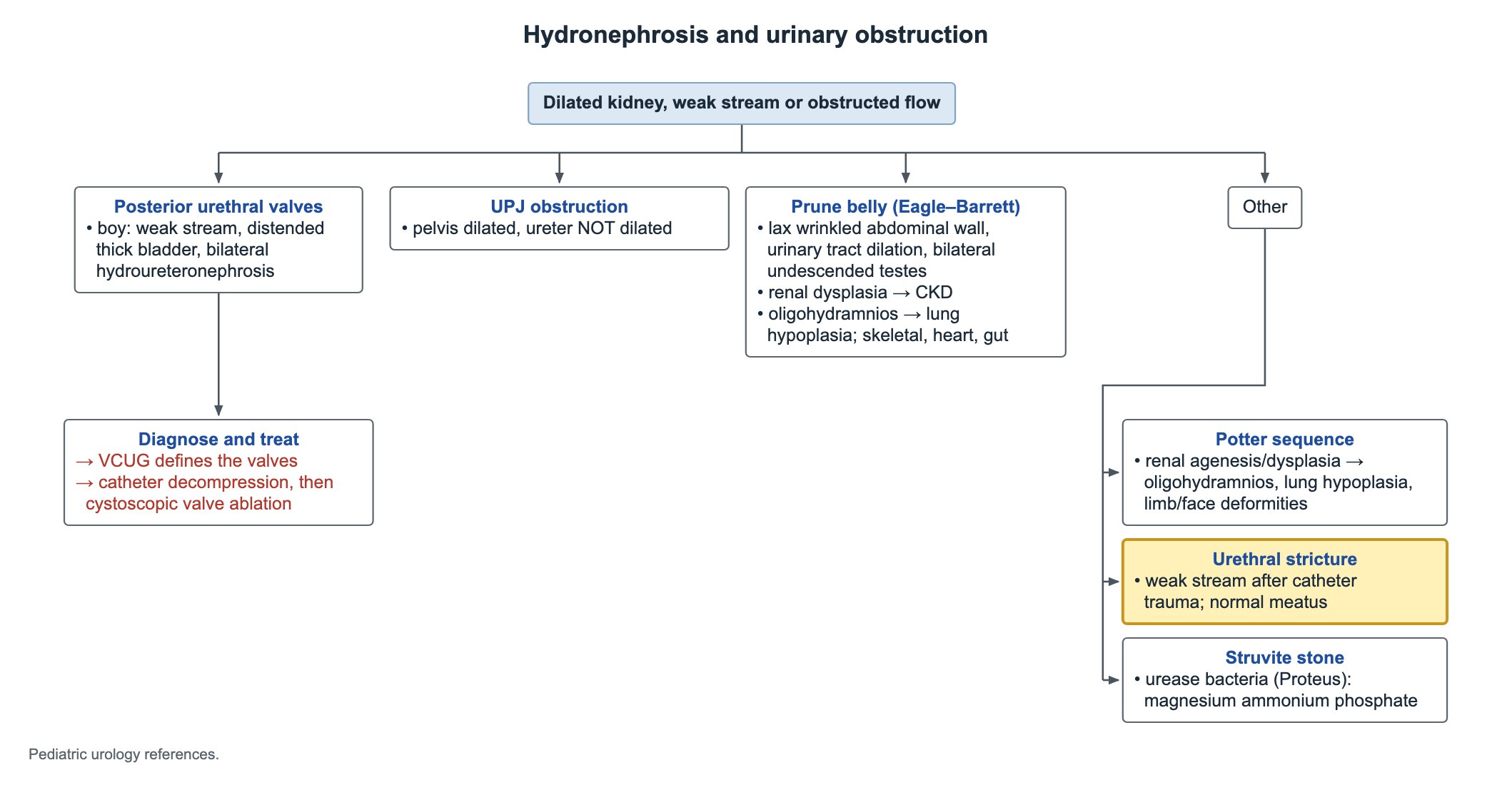
A urethral stricture is scarring inside the urethra. In children it usually follows trauma: a difficult or traumatic catheterization, a straddle injury or a pelvic fracture, or earlier urethral surgery.
The clue is a weak stream, straining or incomplete emptying in a boy whose meatus looks normal. A retrograde urethrogram or VCUG shows the narrowing; treatment is endoscopic incision or urethroplasty.
Common questions
At what age is bedwetting a problem?
Wetting during sleep is called enuresis from age 5 years. Active treatment, such as an alarm or desmopressin, is usually offered from about 6 years if the child or family is bothered.
What tests are needed for bedwetting?
A history, an examination and a urinalysis. Blood tests and imaging are only needed with warning signs such as a poor stream, excessive thirst or daytime symptoms that do not respond to treatment.
Why must fluids be limited with desmopressin?
Desmopressin makes the kidneys hold water. Drinking a lot after the dose can lower blood sodium and cause seizures, so no fluids from 1 hour before until 8 hours after.
Study this topic
Sources
- ICCS 2020: Management and treatment of nocturnal enuresis (J Pediatr Urol)
- ICCS 2016: Terminology of lower urinary tract function in children (Neurourol Urodyn)
- NIDDK: Bladder control problems and bedwetting in children
Written for Pedemy in our own words from the sources above; checked November 2026. For education only, not medical advice; check doses and local protocols before treating a patient. Pedemy is independent and not affiliated with or endorsed by the organizations cited.