

Main decision tree
Hives or swelling: histamine or bradykinin?
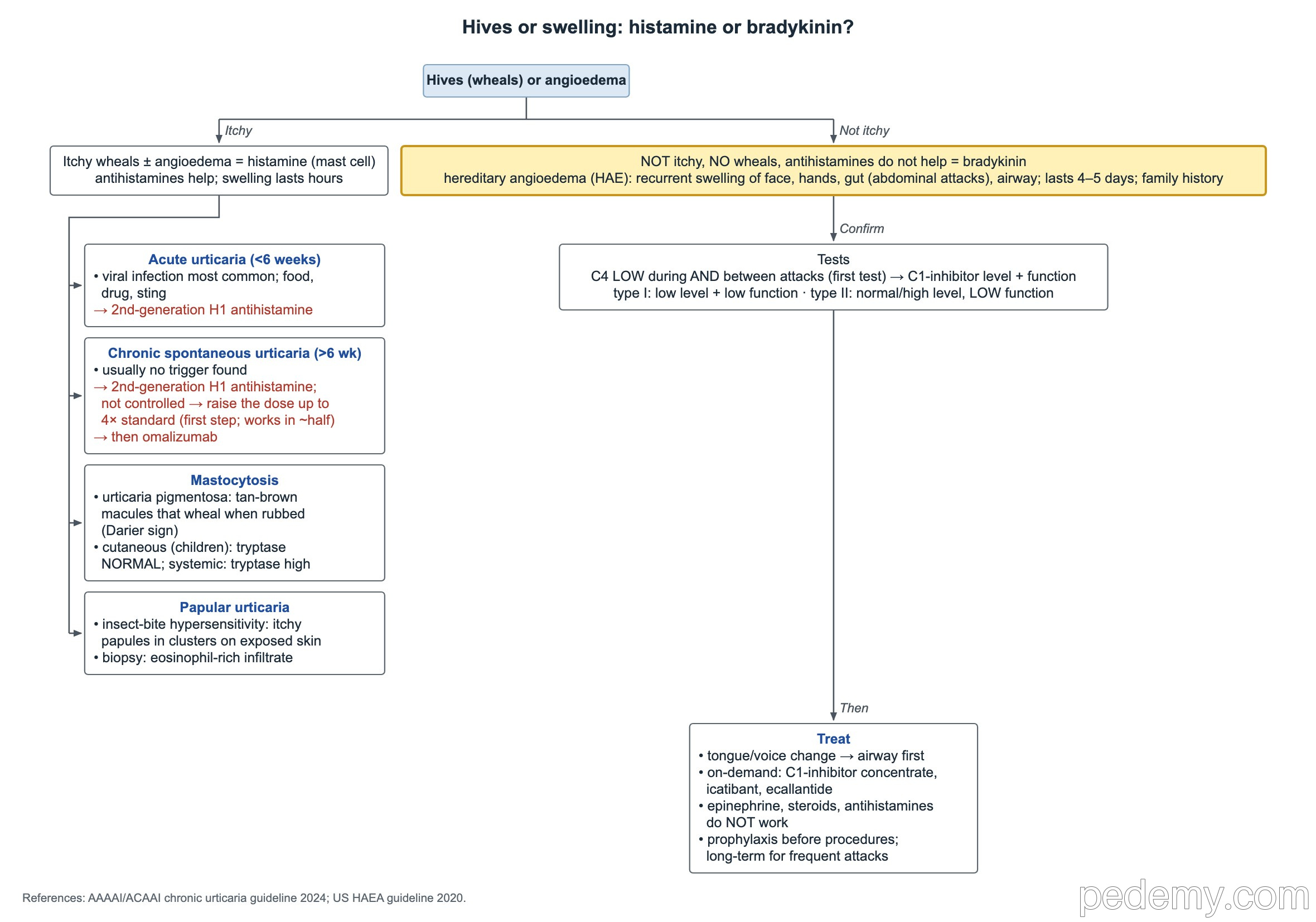
Key points
- Itchy wheals ± angioedema = histamine (mast cell); swelling lasts hours and antihistamines help.
- No itch, no wheals, swelling for 4–5 days, abdominal attacks, family history = bradykinin (HAE).
- HAE first test: C4 (low during and between attacks); then C1-inhibitor level and function.
- Type I HAE: low C1-INH level and function; type II: normal or high level, low function.
- HAE attacks do not respond to epinephrine, steroids or antihistamines; give HAE-specific on-demand therapy.
- Chronic urticaria (over 6 weeks): 2nd-generation H1 antihistamine → up to 4× dose → omalizumab.
- Urticaria pigmentosa: Darier sign; tryptase normal in childhood cutaneous mastocytosis.
Histamine or bradykinin?
Start with two questions: does it itch, and are there wheals? Mast-cell swelling comes with itchy hives, lasts hours and settles with antihistamines.
Bradykinin swelling has no itch and no hives. It builds over a day, lasts 4–5 days and does not respond to antihistamines, steroids or epinephrine. Recurrent attacks of the face, hands, gut or airway with a similar family history suggest hereditary angioedema (HAE).
| Feature | Histamine (mast cell) | Bradykinin (HAE) |
|---|---|---|
| Itch and wheals | Yes | No |
| Duration of swelling | Hours (under 24–48 h) | Usually 2–5 days |
| Abdominal pain attacks | Uncommon | Common, can mimic a surgical abdomen |
| Response to antihistamine or epinephrine | Yes | No |
Testing for hereditary angioedema
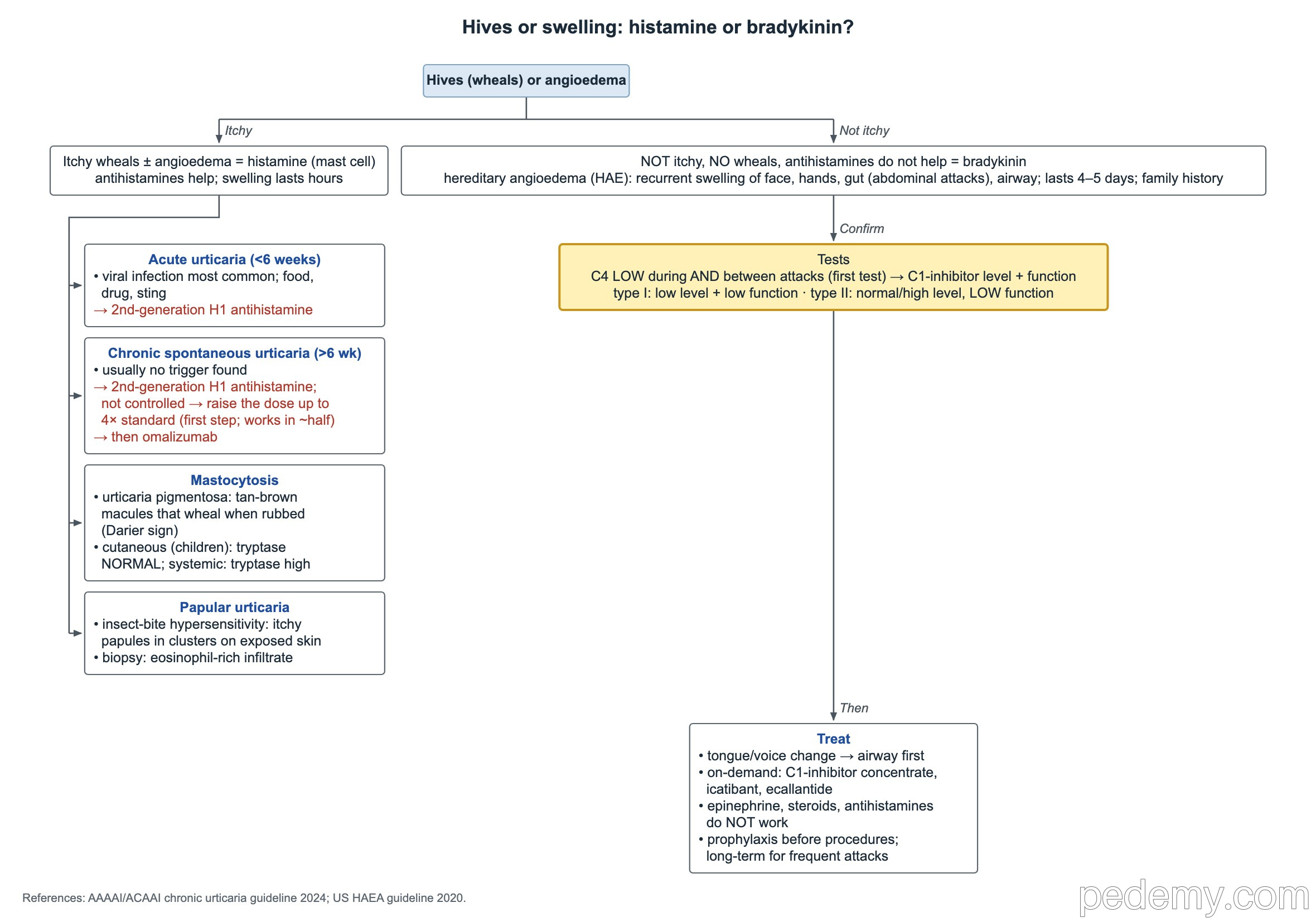
- Order 3 tests together: C4, C1-inhibitor antigen level and C1-inhibitor function.
- C4 is low in almost all C1-inhibitor HAE, both during and between attacks; a normal C4 during an attack makes C1-INH HAE very unlikely.
- Type I (about 85%): low C1-INH level and low function.
- Type II: normal or high C1-INH level but low function.
- Abnormal results are repeated to confirm; levels in infants under 1 year can be low and need retesting.
- HAE with normal C1-inhibitor exists but is rare in children and needs specialist genetic testing.
Treating an HAE attack
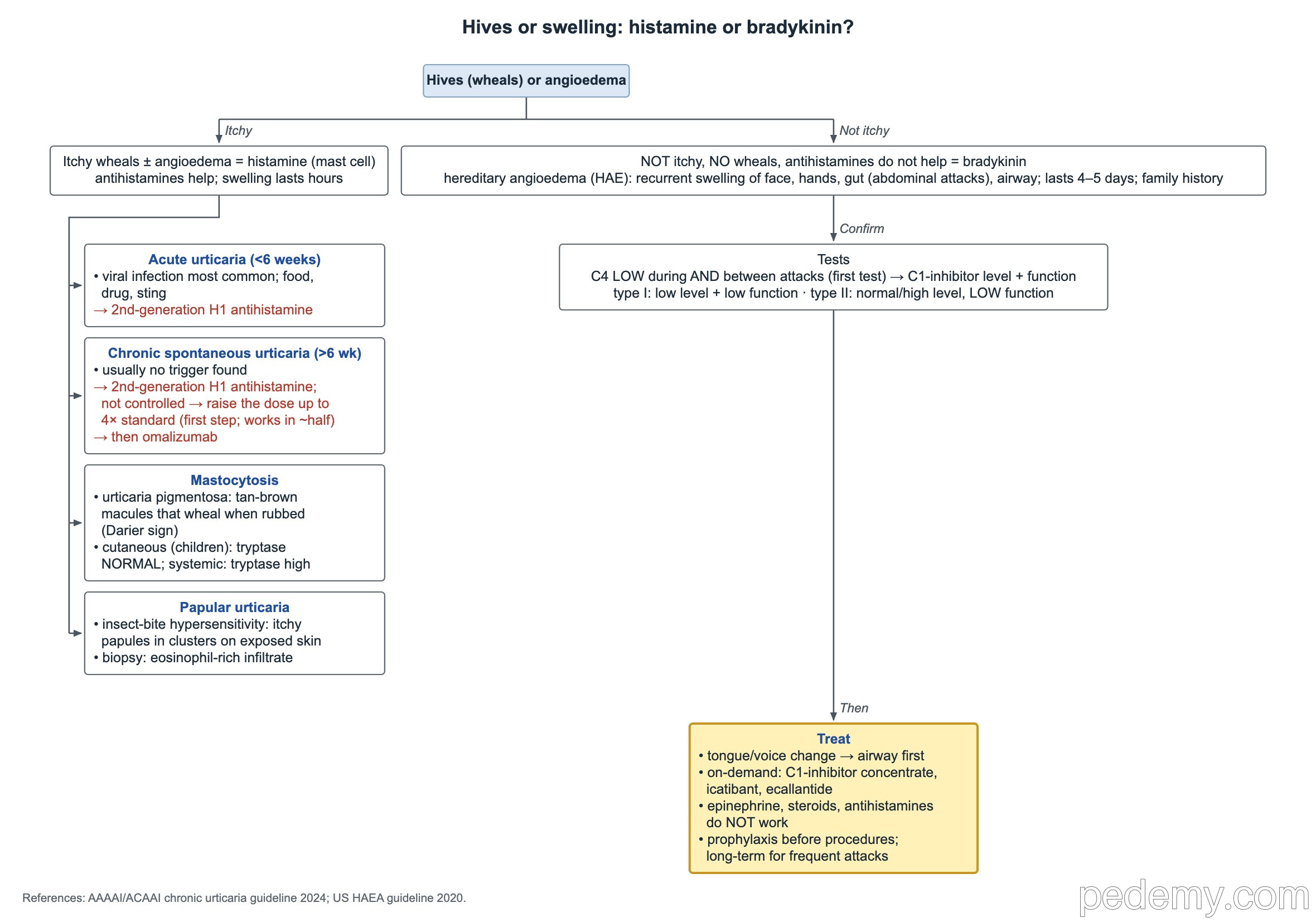
- Tongue swelling, throat tightness or a voice change: airway first, with early help from anesthesia or ENT.
- Give HAE-specific on-demand therapy early: C1-inhibitor concentrate, icatibant or ecallantide (age limits differ by drug and country).
- Epinephrine, steroids and antihistamines do not work in bradykinin angioedema.
- Short-term prophylaxis before dental work, surgery or endoscopy; long-term prophylaxis for frequent attacks.
- Every patient should carry on-demand therapy for at least 2 attacks and a written plan.
Acute and chronic urticaria
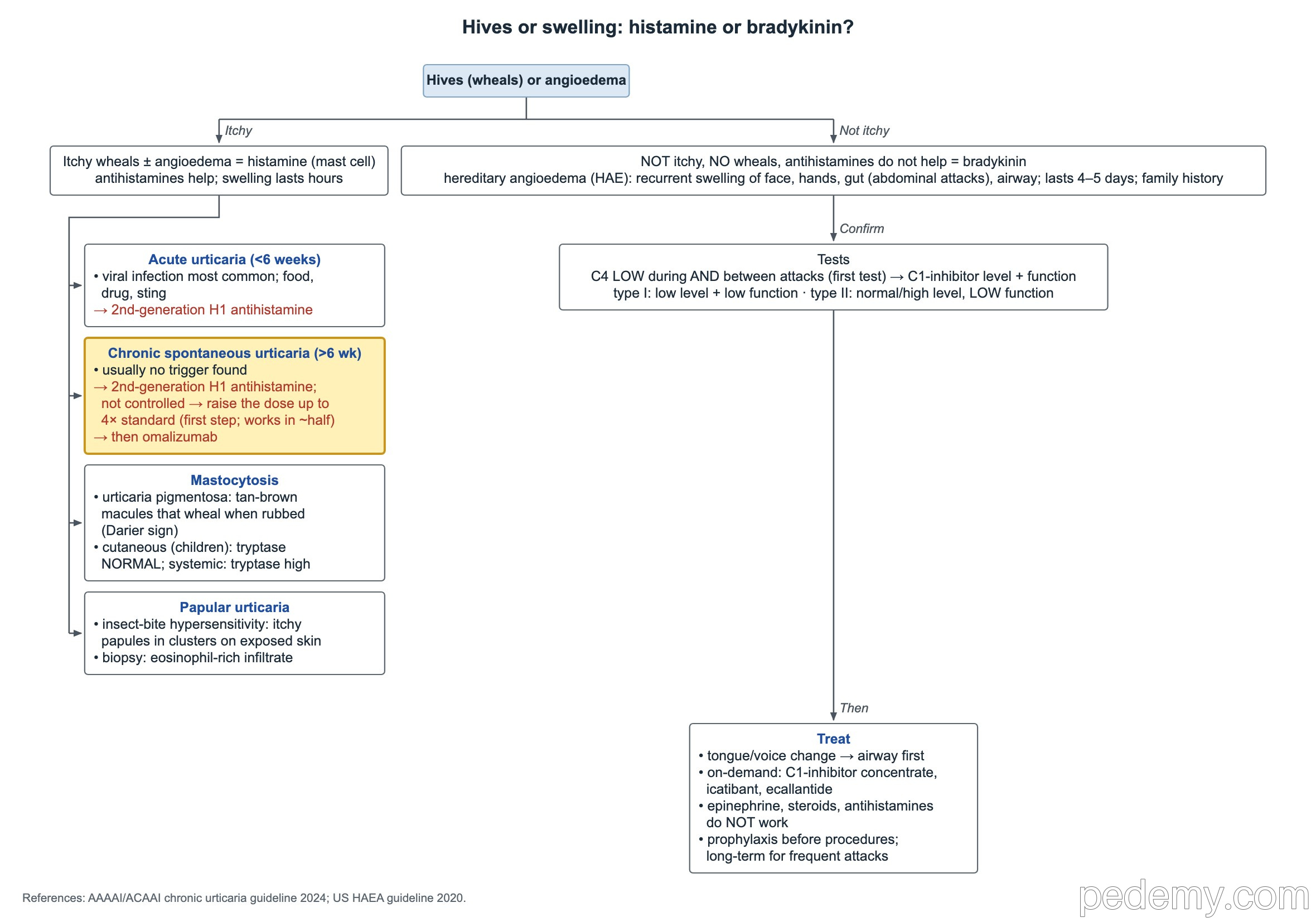
Acute urticaria lasts under 6 weeks. In children it is most often triggered by a viral infection; foods, drugs and stings are other causes. Treat with a 2nd-generation H1 antihistamine.
Chronic spontaneous urticaria lasts over 6 weeks, usually with no external trigger found. Routine allergy panels are not needed.
- Step 1: standard-dose 2nd-generation H1 antihistamine (cetirizine, levocetirizine, fexofenadine, loratadine).
- Step 2: if not controlled, increase the same drug up to 4 times the standard dose.
- Step 3: still uncontrolled → add omalizumab.
- Avoid long courses of oral steroids.
Urticaria pigmentosa (cutaneous mastocytosis)
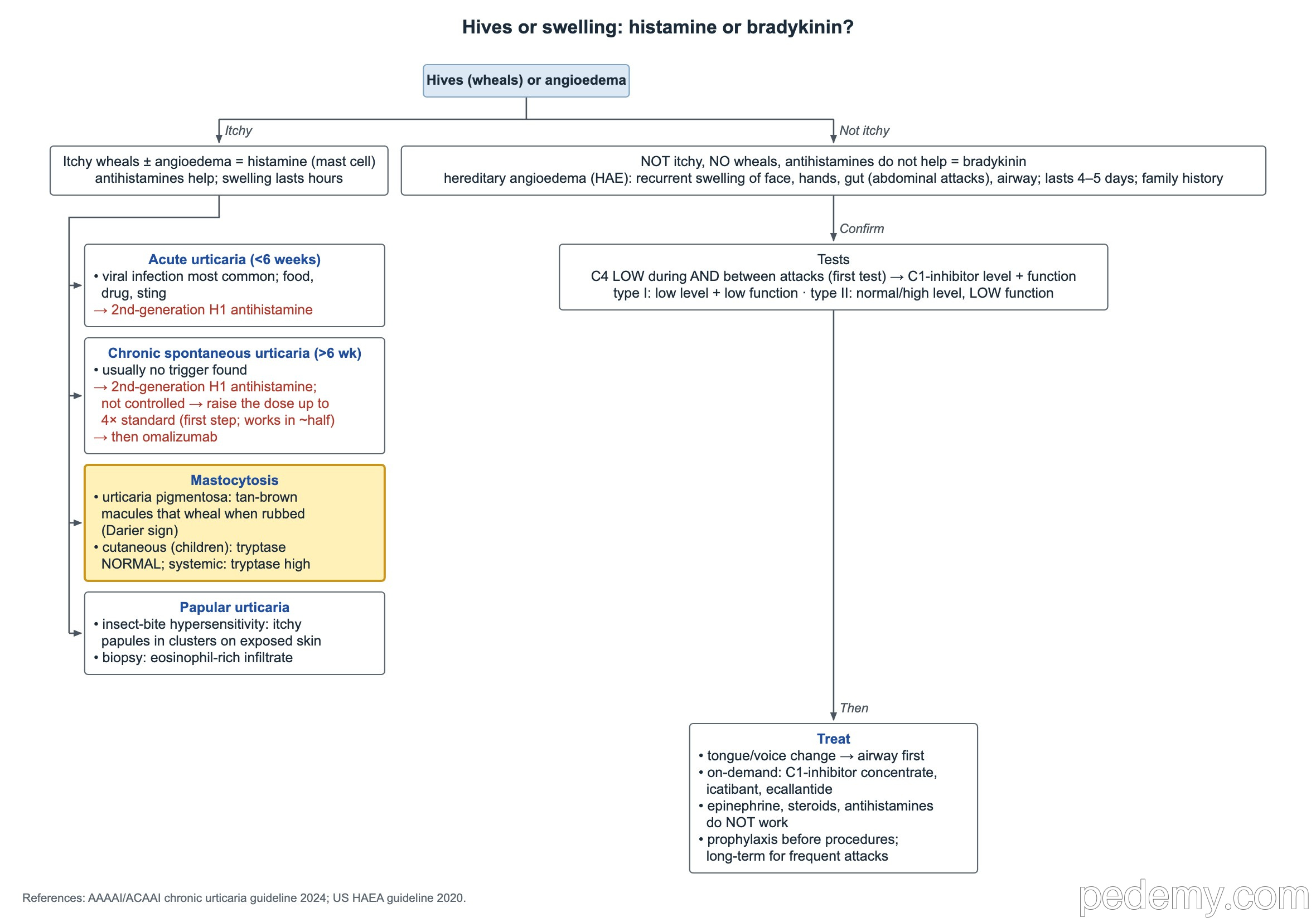
Tan-brown macules or papules in an infant or toddler that swell, redden and itch when rubbed (positive Darier sign) are urticaria pigmentosa.
Childhood disease is usually limited to the skin, and serum tryptase is normal. A raised tryptase suggests systemic mastocytosis. Many children improve by adolescence. Avoid triggers such as friction, heat and some drugs, and give antihistamines for symptoms.
Papular urticaria
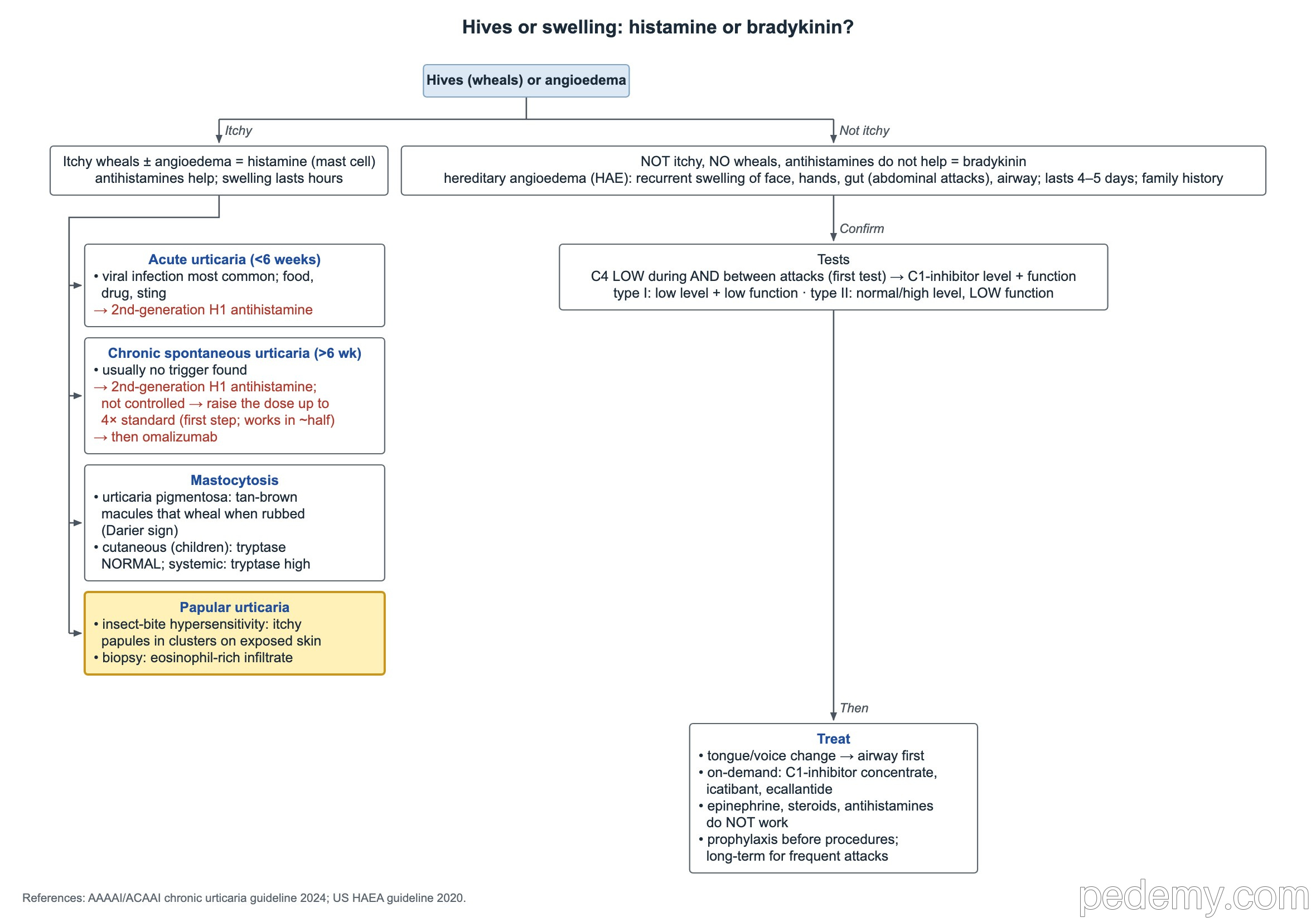
Clusters of itchy papules on exposed skin after outdoor play, often recurring each summer, are papular urticaria: a hypersensitivity to bites from fleas, mosquitoes or bed bugs. Siblings may have no reaction to the same bites.
Treat with bite prevention (repellent, pet flea control), topical steroids and oral antihistamines for itch. A biopsy, rarely needed, shows an eosinophil-rich infiltrate.
Common questions
How do you tell hereditary angioedema from allergic swelling?
HAE swelling is not itchy, has no hives, lasts 2–5 days and does not respond to antihistamines or epinephrine. Check C4, then C1-inhibitor level and function.
Can you give 4 times the dose of cetirizine for chronic hives?
Yes. Guidelines allow increasing a 2nd-generation antihistamine up to 4 times the standard dose when the standard dose does not control chronic urticaria.
What is the Darier sign?
Rubbing a lesion of urticaria pigmentosa makes it swell and redden like a wheal, because the mast cells in it release histamine.
Study this topic
Sources
- US HAEA Medical Advisory Board 2020 guidelines for the management of hereditary angioedema (J Allergy Clin Immunol Pract)
- WAO/EAACI guideline for the management of hereditary angioedema, 2021 revision (Allergy)
- EAACI/GA²LEN/EuroGuiDerm/APAAACI guideline on urticaria (Allergy 2022)
Written for Pedemy in our own words from the sources above; checked November 2026. For education only, not medical advice; check doses and local protocols before treating a patient. Pedemy is independent and not affiliated with or endorsed by the organizations cited.