

Main decision tree
Endemic fungi in the United States: histoplasmosis
Key points
- All three are breathed in from soil and are not spread person to person.
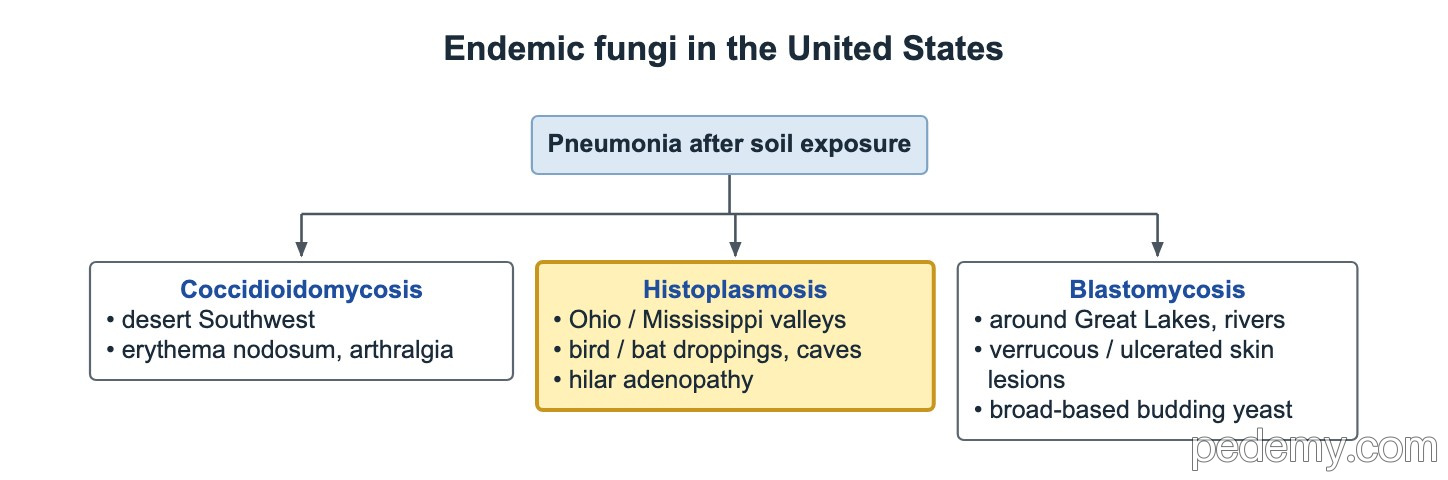
- Histoplasma: Ohio and Mississippi River valleys, bird or bat droppings, caves; hilar adenopathy.
- Blastomyces: Great Lakes and river valleys; pneumonia plus verrucous or ulcerated skin lesions.
- Blastomyces microscopy: broad-based budding yeast.
- Coccidioides (Valley fever): desert Southwest; pneumonia with erythema nodosum and joint pain.
- Coccidioides in tissue: spherules filled with endospores.
- Most mild histoplasmosis and Valley fever resolve without antifungals; blastomycosis is usually treated.
Histoplasmosis
Histoplasma lives in soil enriched by bird or bat droppings: chicken coops, old barns, caves, or demolition work. It is most common in the Ohio and Mississippi River valleys.
Most infections cause no symptoms or a flu-like illness. A large exposure causes pneumonia with hilar or mediastinal lymph node enlargement. Healed infection often leaves calcified granulomas in the lungs or spleen.
- Diagnosis: urine and serum antigen, serology, culture or tissue showing small intracellular yeast.
- Mild acute pulmonary disease usually needs no treatment; give itraconazole if symptoms last more than about 1 month.
- Severe or disseminated disease (infants and immunocompromised children): amphotericin B, then itraconazole.
Blastomycosis
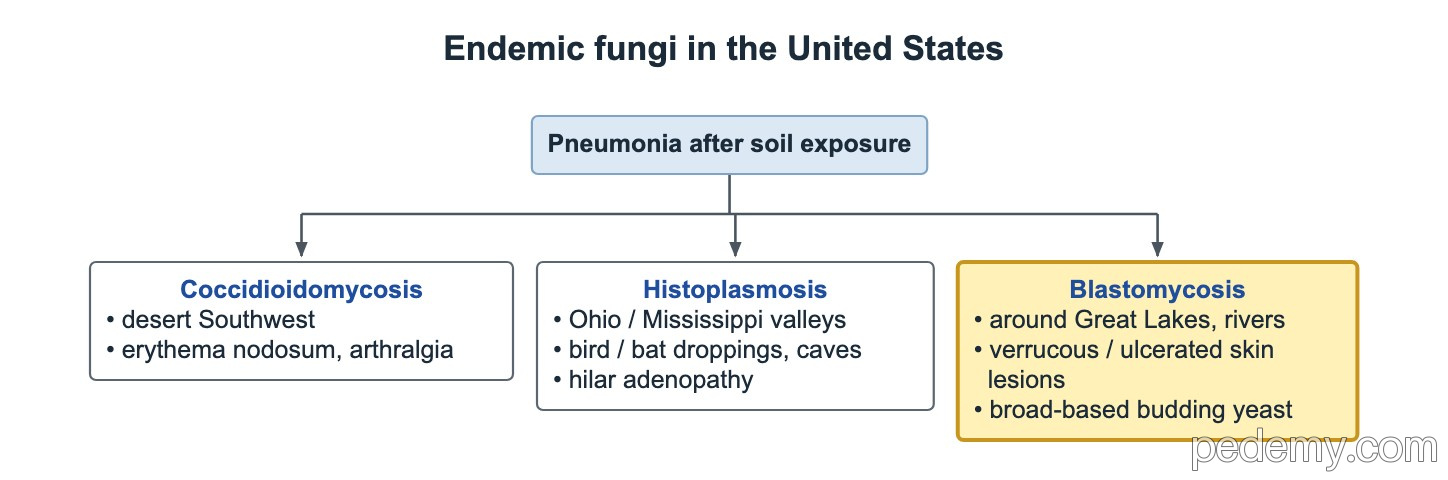
Blastomyces is found in moist soil and decaying wood near the Great Lakes and the Mississippi and Ohio River valleys.
It causes pneumonia that can look like bacterial pneumonia, TB or cancer. Spread to the skin gives verrucous (wart-like) or ulcerated lesions; bone and genitourinary spread also occur.
- Microscopy: large yeast with a single broad-based bud.
- Treatment: itraconazole for mild to moderate disease; amphotericin B first for severe or CNS disease.
Coccidioidomycosis (Valley fever)
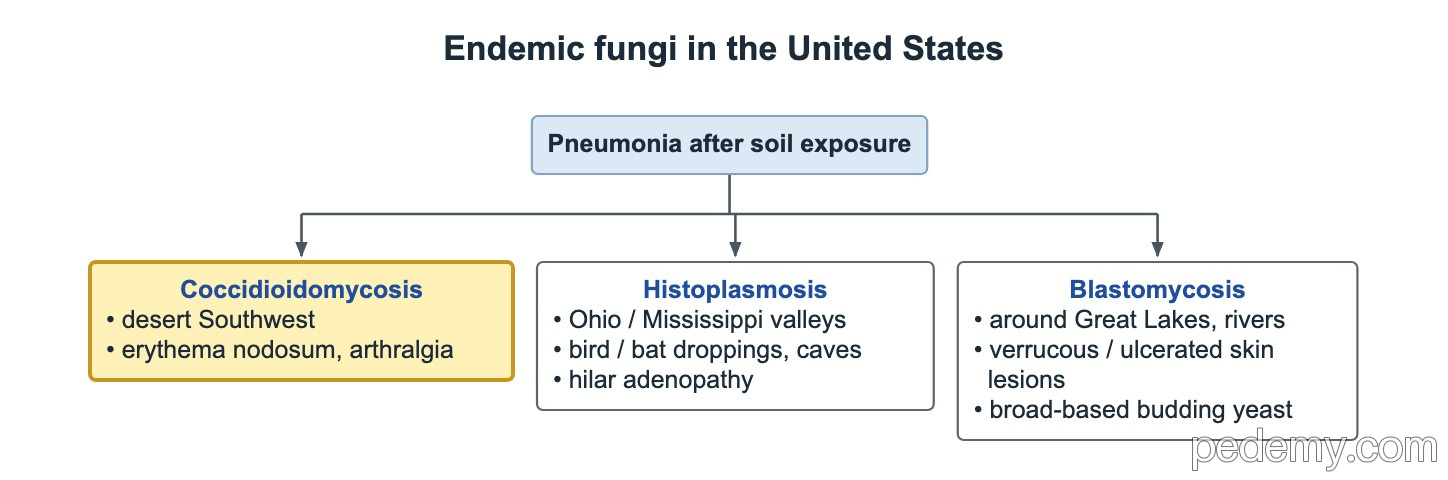
Coccidioides grows in the dry soil of the desert Southwest (Arizona, central and southern California) and nearby regions. Dust storms and digging raise the risk.
Primary infection is a pneumonia-like illness with fever, cough, chest pain and fatigue. Erythema nodosum and joint pain ("desert rheumatism") are classic and signal a strong immune response.
- Diagnosis: serology (EIA, immunodiffusion, complement fixation); spherules with endospores in tissue.
- Higher risk of spread to skin, bone or meninges: immunocompromise, pregnancy, infants, and people of Filipino or African ancestry.
- Uncomplicated pneumonia often resolves without antifungals; fluconazole for significant or spreading disease.
- Coccidioidal meningitis needs fluconazole for life.
Side-by-side comparison
| Histoplasma | Blastomyces | Coccidioides | |
|---|---|---|---|
| Region | Ohio and Mississippi valleys | Great Lakes, river valleys | Desert Southwest |
| Exposure | Bird or bat droppings, caves | Moist soil, rotting wood | Dust, digging |
| Classic clue | Hilar adenopathy, calcified granulomas | Verrucous or ulcerated skin lesions | Erythema nodosum, arthralgia |
| Form in tissue | Small intracellular yeast | Broad-based budding yeast | Spherules with endospores |
Common questions
Which fungus causes broad-based budding yeast?
Blastomyces. It often causes pneumonia plus wart-like or ulcerated skin lesions.
Which fungus is linked to bird and bat droppings?
Histoplasma, common in the Ohio and Mississippi River valleys.
Is Valley fever contagious?
No. Coccidioides is inhaled from soil and does not spread from person to person.
Study this topic
Sources
- IDSA 2007: Management of patients with histoplasmosis
- IDSA 2008: Management of blastomycosis
- IDSA 2016: Treatment of coccidioidomycosis
- AAP Red Book Online
Written for Pedemy in our own words from the sources above; checked November 2026. For education only, not medical advice; check doses and local protocols before treating a patient. Pedemy is independent and not affiliated with or endorsed by the organizations cited.