

Main decision tree
Infant feeding by age: solid foods
Key points
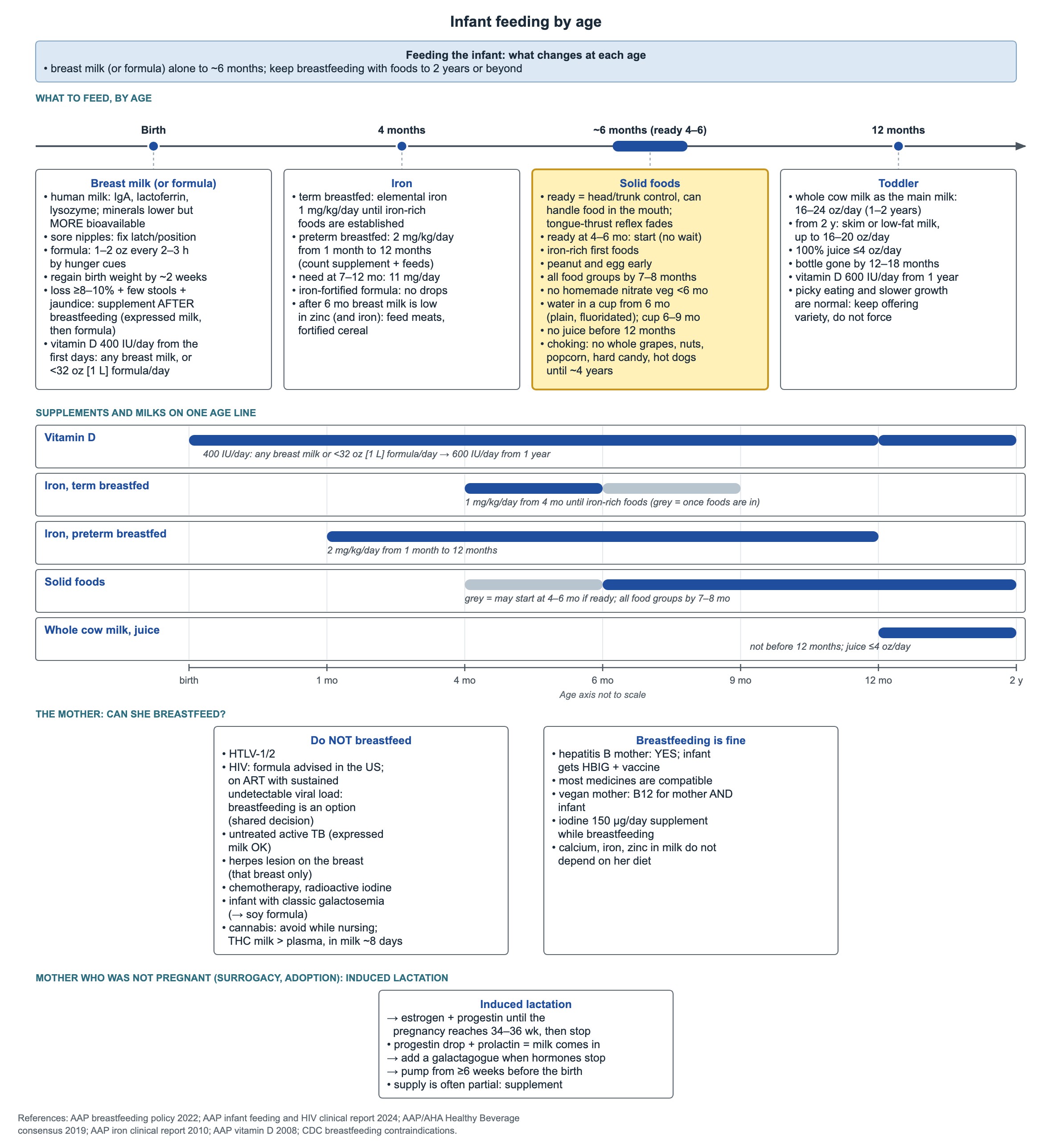
- Start solids at 4–6 months when developmentally ready (about 6 months for most); a ready 5-month-old can start now.
- Readiness: good head and trunk control and a fading tongue-thrust reflex.
- First foods should be iron-rich (meats, iron-fortified cereal); all food groups by 7–8 months.
- Peanut and egg early: delaying allergenic foods past 4–6 months does not prevent allergy.
- No juice before 12 months; at 1–3 years no more than 4 oz of 100% juice a day.
- Whole cow's milk from 12 months, 16–24 oz a day to age 2; then skim or low-fat milk, about 16–20 oz.
- Plant beverages never replace breast milk or formula before 1 year.
Starting solid foods
Breast milk or formula alone covers needs to about 6 months. After that, iron and zinc from breast milk alone are no longer enough, so the first foods should supply them.
- Timing: 4–6 months, once ready. If a 5-month-old is ready, start now rather than waiting for 6 months.
- Readiness: head and trunk control, can move food to the back of the mouth, tongue-thrust reflex fading.
- First foods: iron- and zinc-rich foods such as meats and iron-fortified infant cereal.
- Include all food groups by 7–8 months.
- Avoid home-prepared carrots, beets, spinach and squash before 6 months: their nitrates can cause methemoglobinemia. Young infants are prone because their NADH cytochrome b5 reductase activity is low.
- No honey before 12 months (infant botulism).
Peanut, egg and other allergenic foods
The AAP 2019 report found no benefit from delaying peanut, egg or fish beyond 4–6 months, and early peanut can prevent peanut allergy. Hydrolyzed formulas do not prevent allergic disease.
- Give peanut as thinned peanut butter or peanut puffs, never whole nuts.
- Once tolerated, keep it in the diet regularly.
| Infant | Peanut introduction |
|---|---|
| Severe eczema, egg allergy or both | Peanut-containing food around 4–6 months; testing first is not required (2021 consensus), but some families choose an allergist visit |
| Mild to moderate eczema | Around 6 months, at home |
| No eczema or food allergy | With other solids, in an age-appropriate form |
Iron, formula amounts and the first days
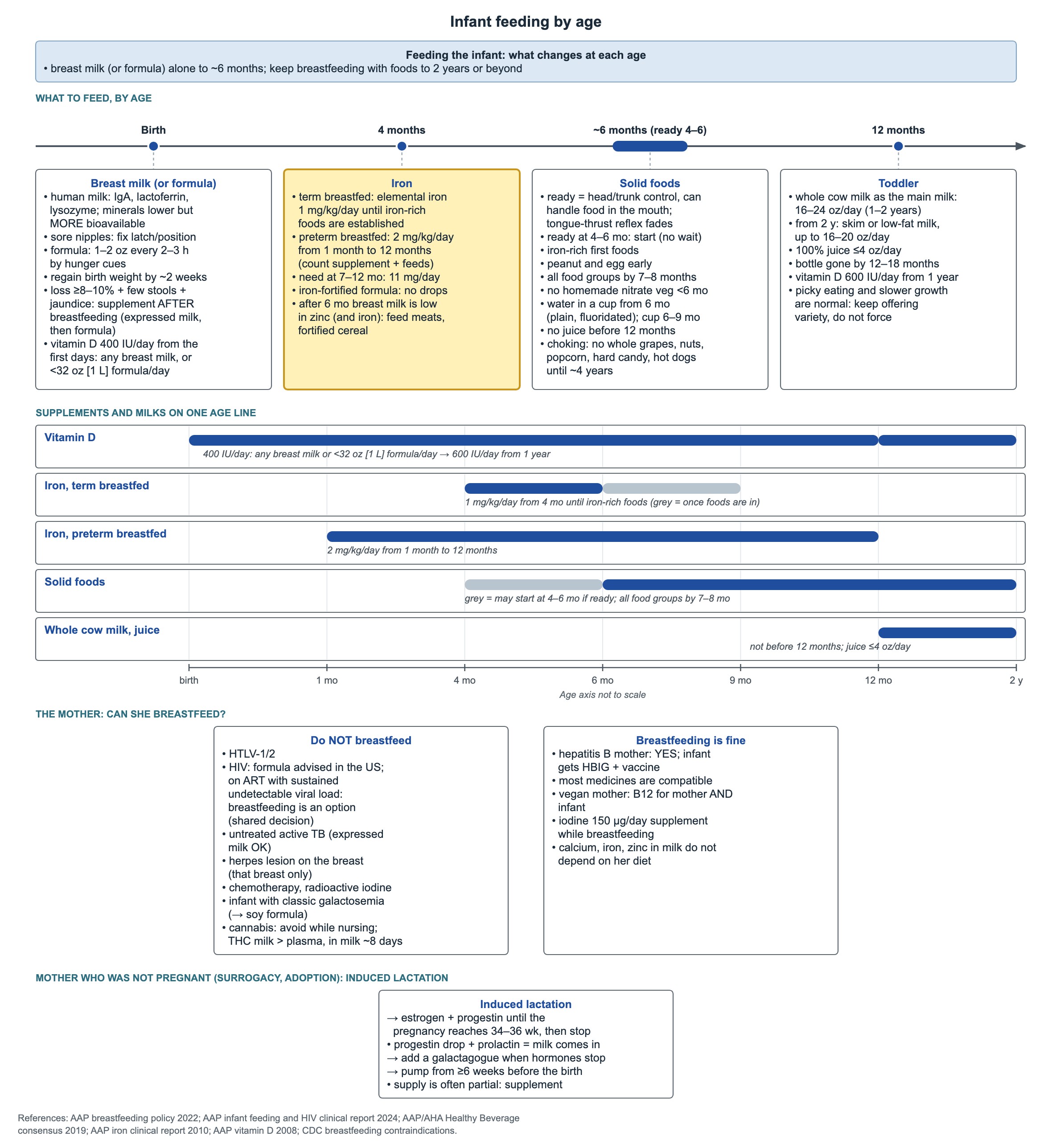
- Formula-fed newborn, first days: about 1–2 oz every 2–3 hours, guided by hunger cues.
- Term infant on iron-fortified formula: no iron drops needed.
- Iron need at 7–12 months: about 11 mg/day of elemental iron.
- After about 6 months breast milk alone is low in zinc and iron: feed meats and fortified cereal.
Water, juice, cups and choking
- Water: offer small amounts of plain fluoridated water from a cup at 6 months, about 4–8 oz a day at 6–12 months.
- Introduce a cup at 6–9 months; finish weaning from the bottle by 12–18 months.
- No fruit juice before 12 months. At 1–3 years, no more than 4 oz of 100% juice a day.
- Choking hazards until about 4 years: whole grapes, nuts, popcorn, hard candy and hot dogs.
- Make foods safer: quarter grapes, cut hot dogs into thin short strips; soft crackers are a safe snack.
Toddlers: cow's milk and picky eating
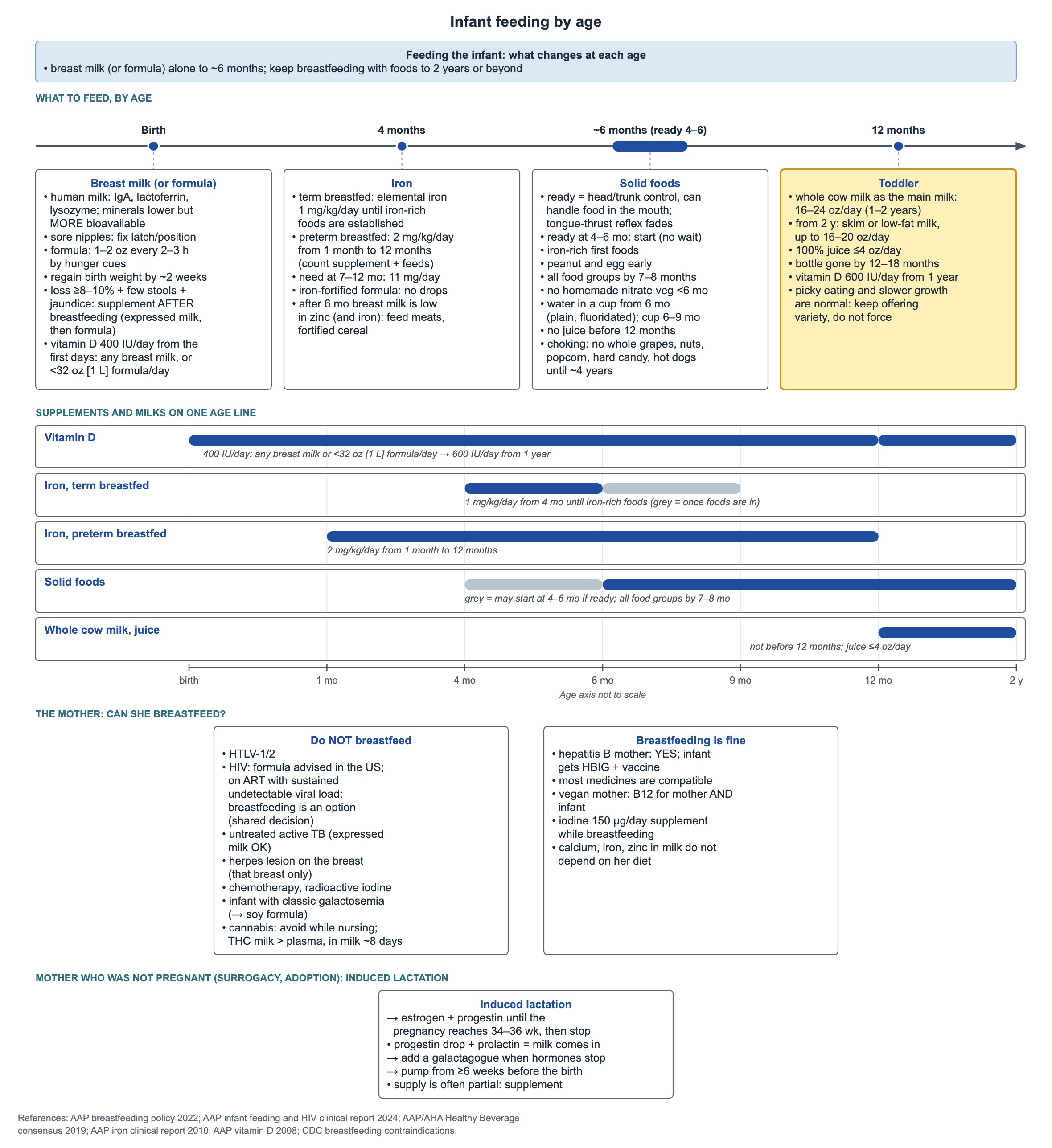
- Cow's milk can become the main drink at 12 months; use whole milk at 12–24 months, about 16–24 oz a day.
- From 2 years: plain skim or low-fat milk, up to about 16 oz a day at 2–3 years and 20 oz at 4–5 years.
- Cow's milk is a poor iron source: little iron, poorly absorbed. Too much milk crowds out iron-rich food.
- Vitamin D need is 600 IU a day from 1 year.
- Eating less and refusing old favorites in the second year is normal as growth slows. Keep offering a variety without forcing.
Plant-based milks
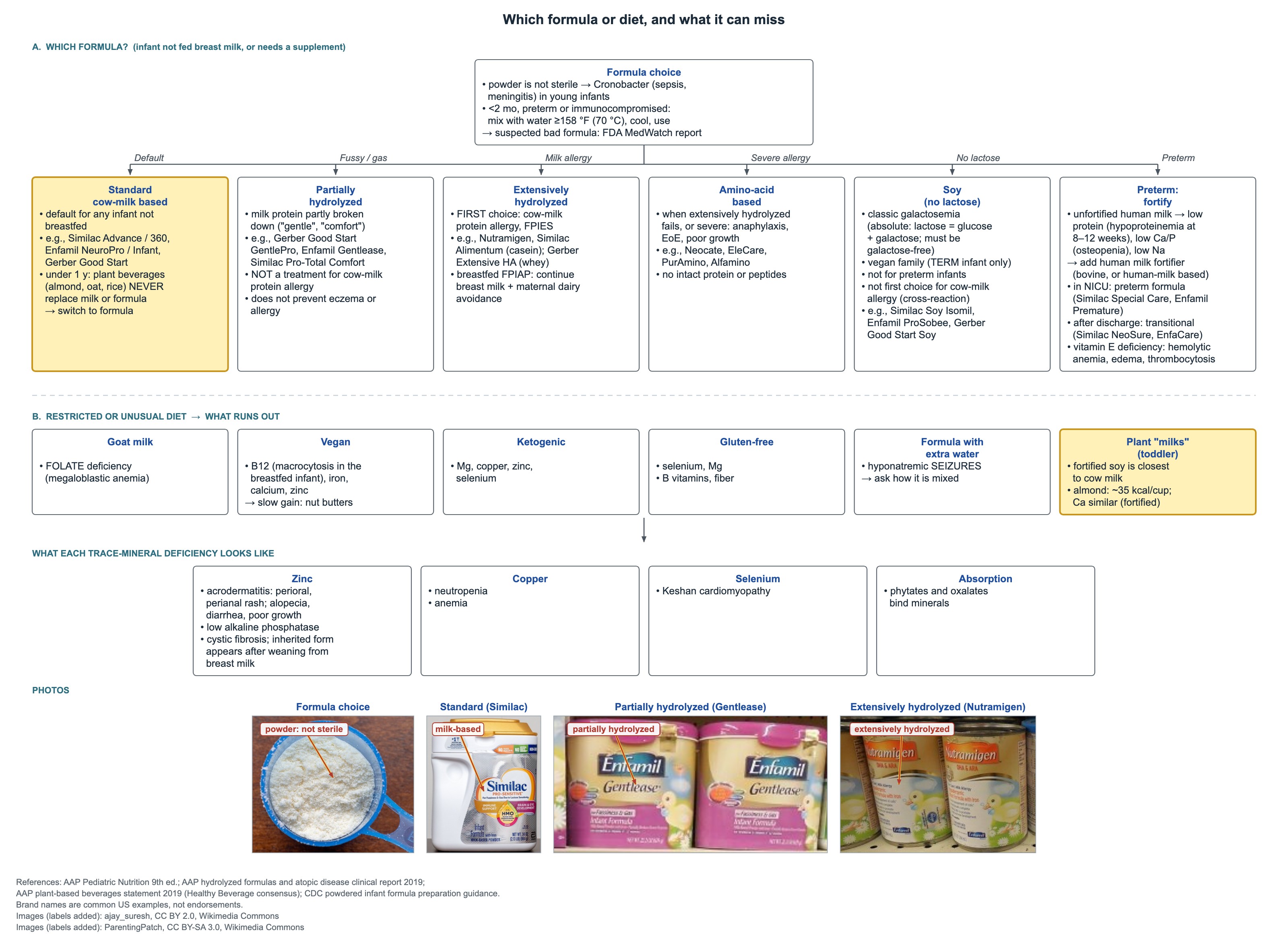
Before 1 year, almond, oat, rice or homemade plant milks are never the main milk. An infant with deficiencies on a homemade plant milk should switch to a standard cow's milk-based infant formula.
- Toddler drinking mostly plant milk: check protein, calcium, iron, vitamin B12 and vitamin D intake.
- Lactose is a disaccharide of glucose and galactose.
| Drink (8 oz) | What to know |
|---|---|
| Whole cow's milk | About 150 kcal; the reference toddler milk |
| Fortified soy milk | Closest to cow's milk in protein; the best choice for a toddler who can't drink cow's milk |
| Unsweetened almond milk | About 30–40 kcal and little protein; calcium similar or higher when fortified |
Common questions
When can babies start solid food?
Between 4 and 6 months, once the baby has good head control and the tongue-thrust reflex is fading. Most babies are ready at about 6 months.
When should peanut be introduced?
Early: around 6 months and not before 4 months, together with egg and other allergens. Babies with severe eczema or egg allergy benefit most; testing before the first taste is not required.
When can a baby have cow's milk and juice?
Both wait until 12 months. Then whole milk to age 2, and no more than 4 oz of 100% juice a day.
Is almond or oat milk OK for a baby?
Not before 1 year as the main milk. For a toddler who can't drink cow's milk, fortified soy milk is the closest match.
Study this topic
Sources
- AAP 2019: Early nutritional interventions and atopic disease, including timing of allergenic foods (Pediatrics)
- AAAAI/ACAAI/CSACI 2021: Consensus on primary prevention of food allergy through nutrition
- NIAID 2017: Addendum guidelines for the prevention of peanut allergy (J Allergy Clin Immunol)
- AAP 2017: Fruit juice in infants, children and adolescents (Pediatrics)
- AAP: Diagnosis and prevention of iron deficiency in infants and young children (Pediatrics 2010)
- AAP: Prevention of choking among children (Pediatrics 2010)
Written for Pedemy in our own words from the sources above; checked November 2026. For education only, not medical advice; check doses and local protocols before treating a patient. Pedemy is independent and not affiliated with or endorsed by the organizations cited.