

Main decision tree
Recurrent wheeze: is it asthma, and will it last?
Key points
- Atopic dermatitis, allergic sensitization and parental (especially maternal) asthma raise the chance that preschool wheeze becomes asthma.
- Well-controlled asthma at 5–11 years: night waking no more than once a month.
- Two or more exacerbations a year needing oral steroids means persistent asthma, even if the child is well in between.
- Persistent asthma needs an inhaled corticosteroid (ICS)-containing controller; montelukast alone is not preferred.
- Not controlled on low-dose ICS: first check adherence, technique and triggers, then step up to ICS–formoterol (SMART) or medium-dose ICS.
- An MDI with a valved spacer works as well as a nebulizer in mild to moderate attacks.
- Previous intubation or ICU admission for asthma is the strongest risk factor for fatal asthma.
Is it asthma, and will it last?
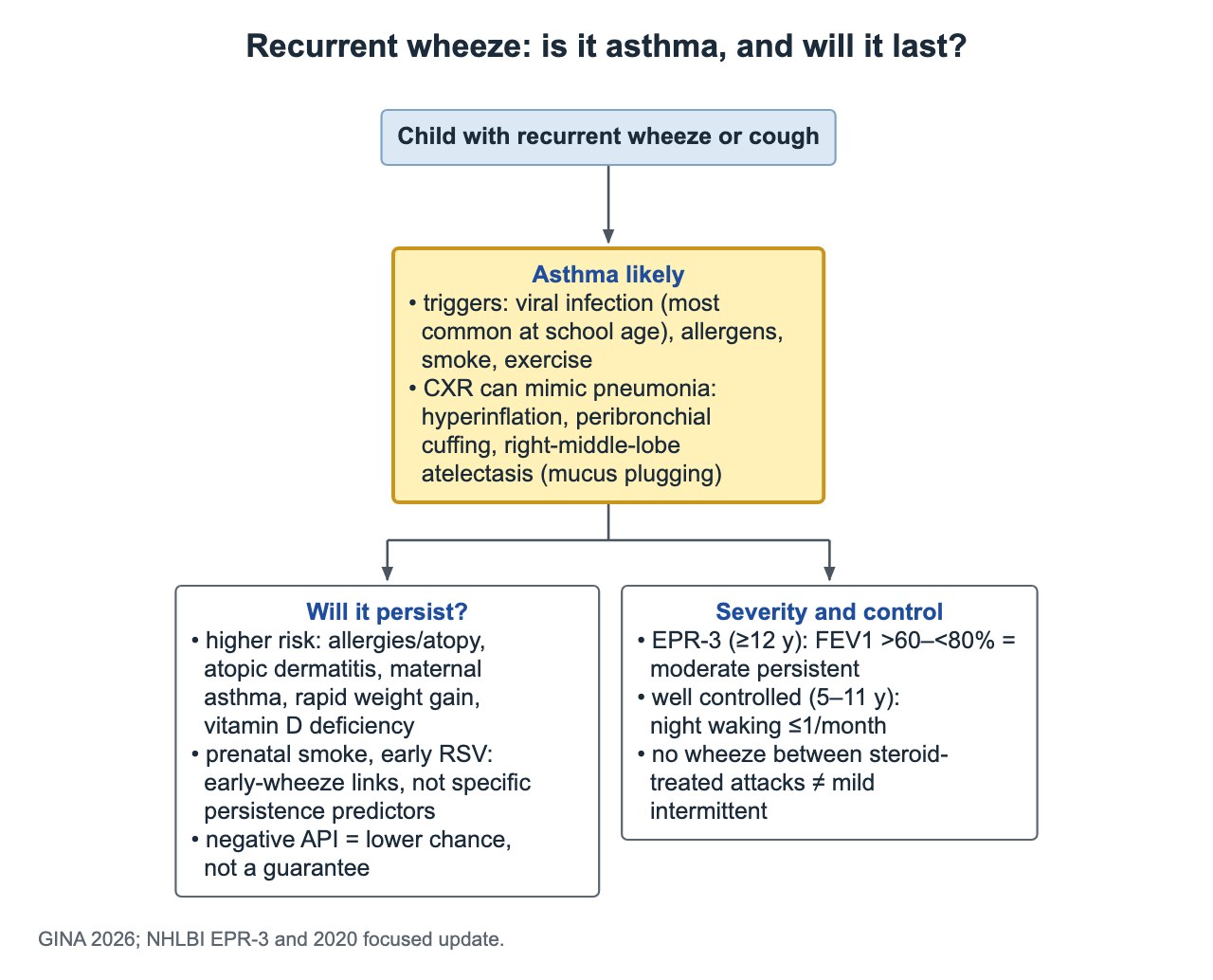
Recurrent wheeze or cough that comes with colds, allergens, smoke or exercise and improves with a bronchodilator points to asthma. In school-age children, a respiratory virus is the commonest trigger of a flare.
During a flare the chest film is often over-read as pneumonia. Hyperinflation, peribronchial cuffing and right middle lobe atelectasis from mucus plugging are typical of asthma. A child with many 'pneumonias' and wheeze often has asthma flares instead.
- Higher risk that wheeze persists: atopy or allergic sensitization, atopic dermatitis, parental (especially maternal) asthma.
- Rapid weight gain in childhood predicts persistence into the teens in children with obesity.
- Low vitamin D levels are linked to ongoing childhood asthma.
- Prenatal smoke exposure and infant RSV are linked to early wheeze, but they do not specifically predict wheeze into adolescence.
- A negative Asthma Predictive Index means a lower chance of persistent asthma, not a guarantee.
- Wheeze of unknown cause that does not respond to bronchodilators: get a chest x-ray first.
Severity, control and spirometry
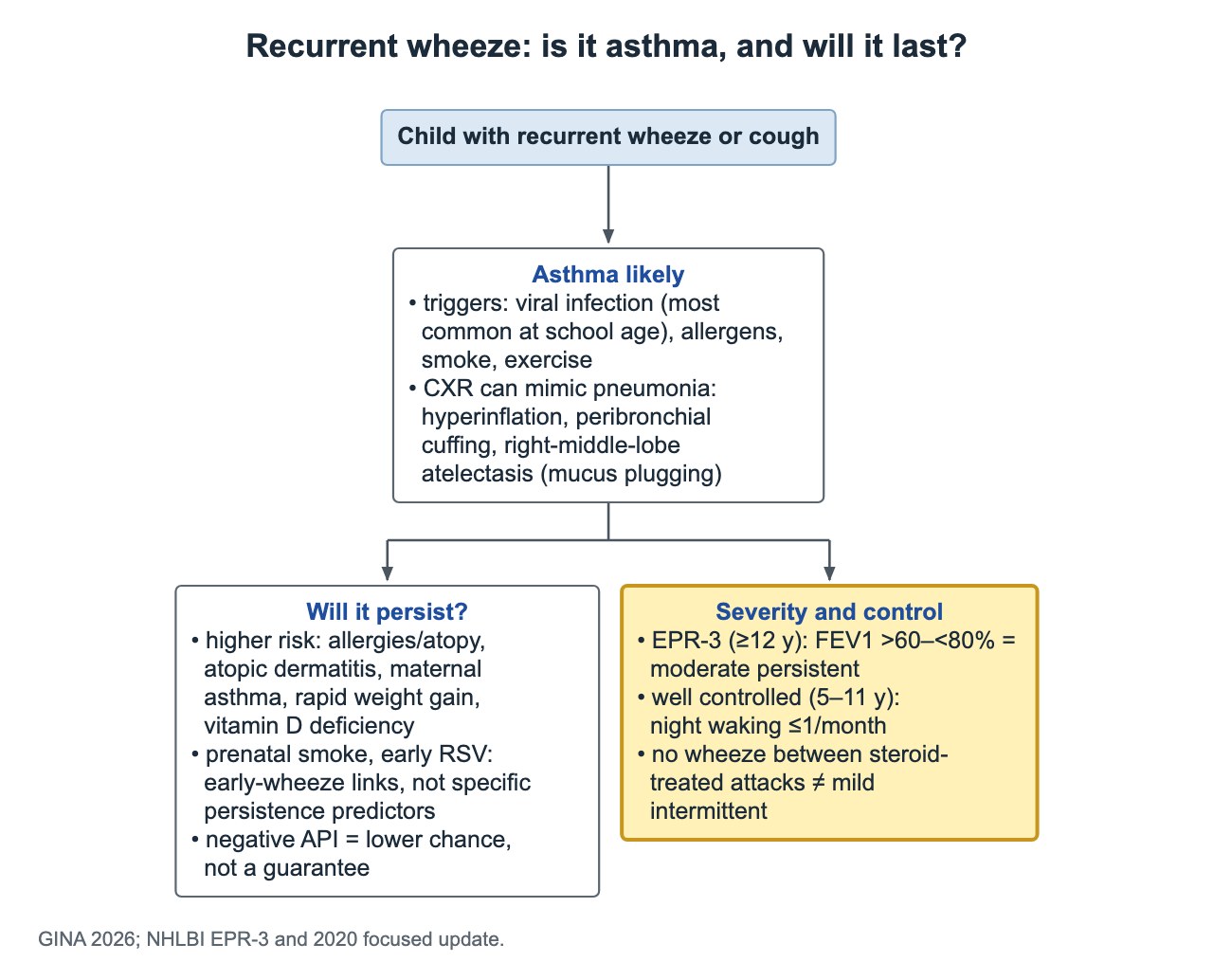
Severity is classified before a controller is started; control is judged at every visit after that. The tables below use the NAEPP (EPR-3) categories that remain in the 2020 focused update.
| Measure | What it means |
|---|---|
| FEV1 >80% predicted (age ≥12, untreated) | Intermittent or mild persistent |
| FEV1 >60% to <80% predicted | Moderate persistent |
| FEV1 <60% predicted | Severe persistent |
| Night waking ≤1 time a month (age 5–11) | Well controlled; 2 or more a month is not well controlled |
| ≥2 exacerbations a year needing oral steroids | Persistent asthma, even with no symptoms between attacks |
| FEV1/FVC below the lower limit of normal, normal FVC | Obstructive pattern |
| Low FVC with normal or high FEV1/FVC | Restrictive pattern (confirm with lung volumes) |
Controllers, devices and side effects
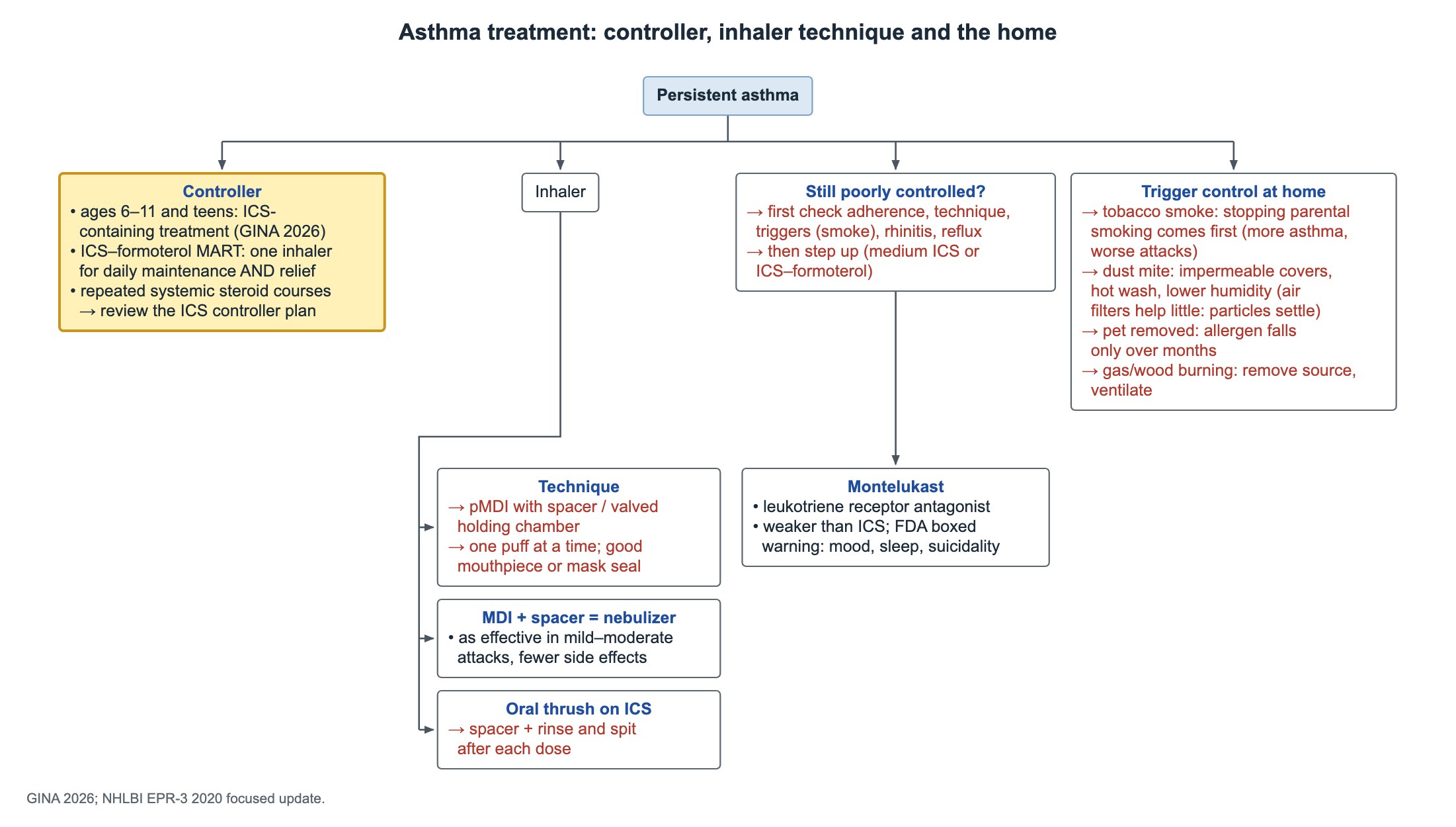
Every child with persistent asthma needs ICS-containing treatment. Repeated oral steroid bursts are a sign that the controller plan needs review.
With ICS–formoterol maintenance and reliever therapy (MART or SMART), one inhaler is taken every day and also used as needed for symptoms. NAEPP 2020 prefers it from age 4 at steps 3 and 4; GINA uses it for teens from step 1 and for children 6–11 from step 3.
- MDI technique: use a valved holding chamber (spacer), one puff at a time, with a good mouthpiece or mask seal.
- MDI with spacer is as effective as a nebulizer in mild to moderate attacks, with fewer side effects.
- Oral thrush on ICS: use a spacer and rinse the mouth and spit after each dose.
- Growth: ICS lower height by about 0.5–1 cm, mostly in the first year of use.
- High-dose ICS or frequent oral steroids: easy bruising, thin skin and Cushingoid features mean steroid excess.
- Montelukast is a leukotriene receptor antagonist. It is weaker than ICS and carries an FDA boxed warning (2020) for nightmares, sleep problems, agitation, poor focus, depression and suicidal thoughts.
- In allergic rhinitis, reserve montelukast for children who fail or cannot take other treatment.
Still poorly controlled: check first, then step up
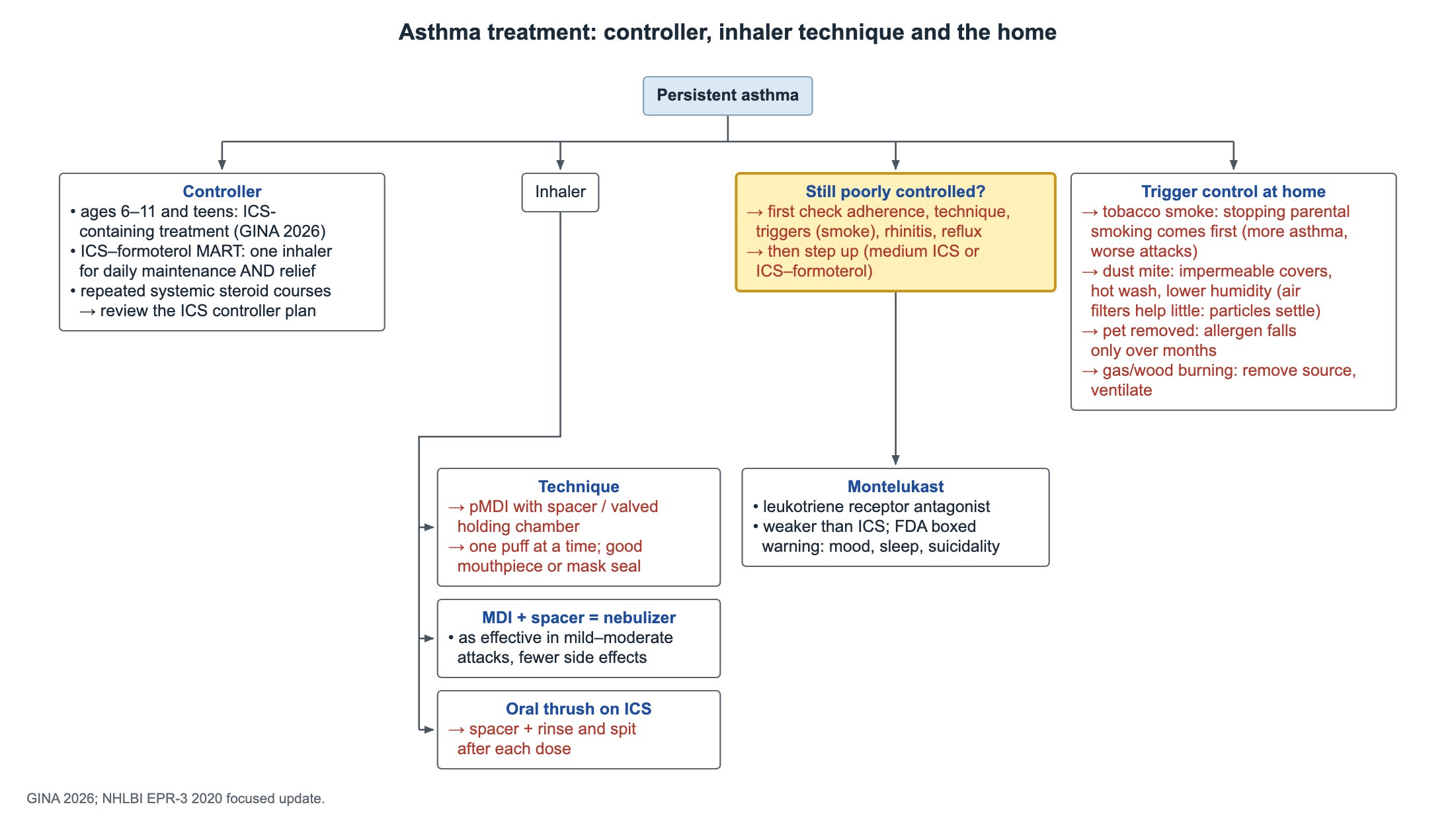
Before adding medicine, look for the common reasons a controller seems to fail. In a family with a language barrier, start by watching the child use the inhaler and spacer.
- Adherence: is the controller actually taken every day?
- Technique: spacer use, seal, one puff at a time.
- Triggers: tobacco smoke, allergens at home or school.
- Other conditions: rhinitis, obesity, reflux.
- Then step up (age ≥4): ICS–formoterol as maintenance and reliever is preferred; medium-dose ICS is the alternative.
- Exercise-induced bronchoconstriction: cough and wheeze 5–10 minutes into exercise. Give a short-acting β-agonist 10–15 minutes before exercise, or as-needed ICS–formoterol.
Trigger control at home
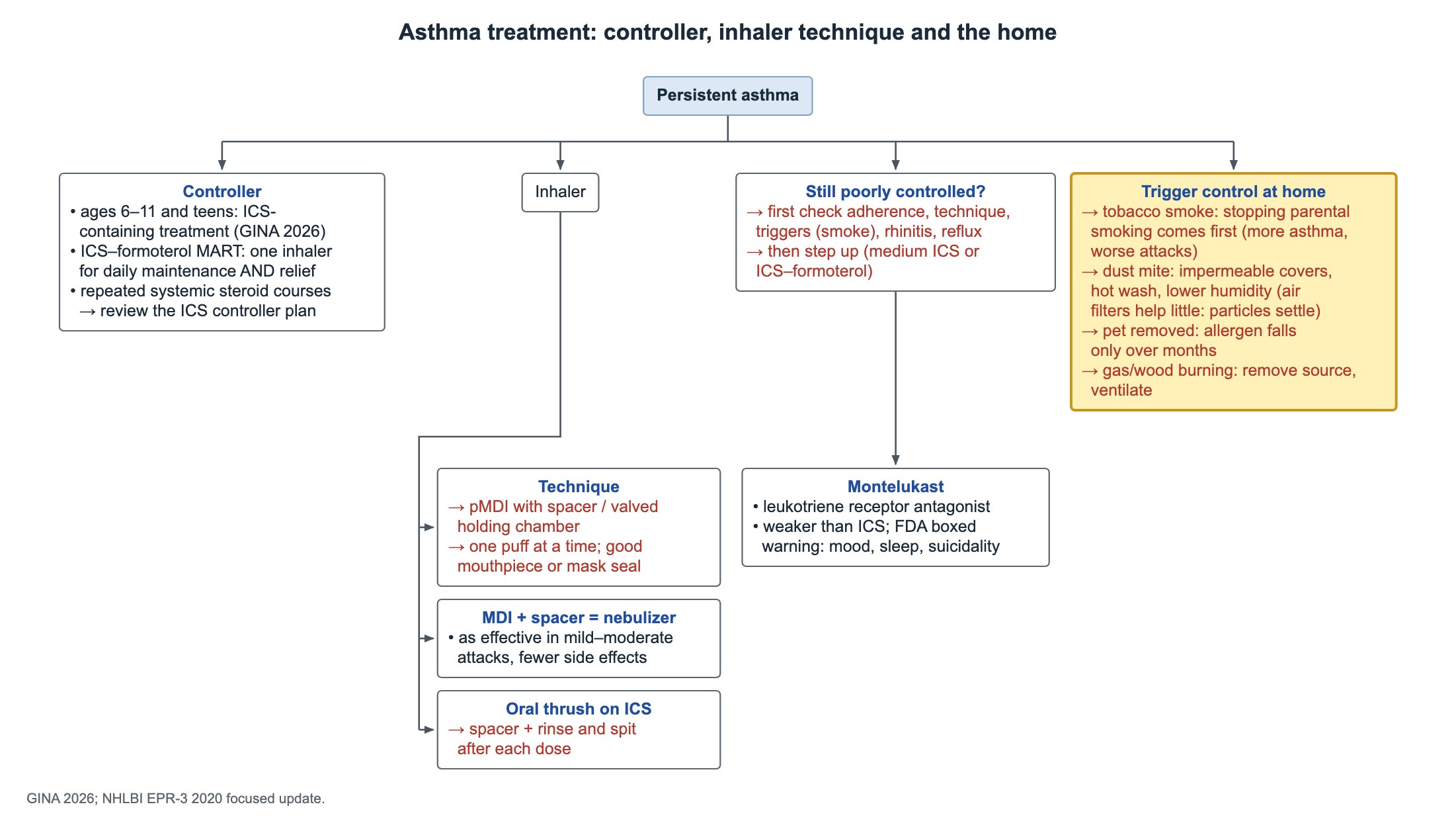
Persistent asthma is treated with a controller plus steps to find triggers and cut the exposures that can be changed. Secondhand smoke causes more new asthma, worse symptoms and more attacks, so a parent quitting smoking comes before any other home change.
| Exposure | Practical step |
|---|---|
| Tobacco smoke | Parent quits; no smoking in the home or car |
| Dust mites | Impermeable mattress and pillow covers, hot-water washing of bedding, lower humidity |
| Room air filters for mites | Help little, because mite allergen particles settle quickly |
| Cat or other pet | Removing the pet helps, but allergen falls slowly over months |
| Wood stove or unvented gas appliance | Remove the source if possible; vent outdoors |
Acute flares
Severe obstruction shows as accessory muscle use, a prolonged expiratory phase (I:E ratio about 1:3), wheeze in both phases, speaking in words only and low oxygen saturation. A tired child with little air movement and a quiet chest is near respiratory failure; quieter wheeze is not reassuring.
- Home action plan: still wheezy after 2 rounds of albuterol with peak flow 50–79% → keep using the reliever and call the clinician the same day.
- Peak flow below 50%, speaking in words only or SpO2 below 90% despite albuterol and an oral steroid → go to the emergency department now.
- Emergency care: repeated inhaled albuterol (MDI with spacer or nebulizer), ipratropium in moderate or severe attacks, and an early systemic corticosteroid.
- Oral dexamethasone (1–2 doses) works as well as a 5-day prednisone course and is easier to complete.
- Admit if SpO2 stays low (below about 92%) or work of breathing persists after initial treatment.
- Severe attacks: continuous nebulized albuterol (EPR-3: 0.5 mg/kg/h), IV magnesium sulfate, then in intensive care IV terbutaline, a trial of noninvasive ventilation before intubation, heliox (70:30 helium:oxygen) or ketamine as rescue.
- β-agonist toxicity: tachycardia, tremor, low diastolic blood pressure, high glucose, and low potassium, magnesium and phosphate. Check potassium during hours of continuous albuterol.
Chronic cough that is not asthma
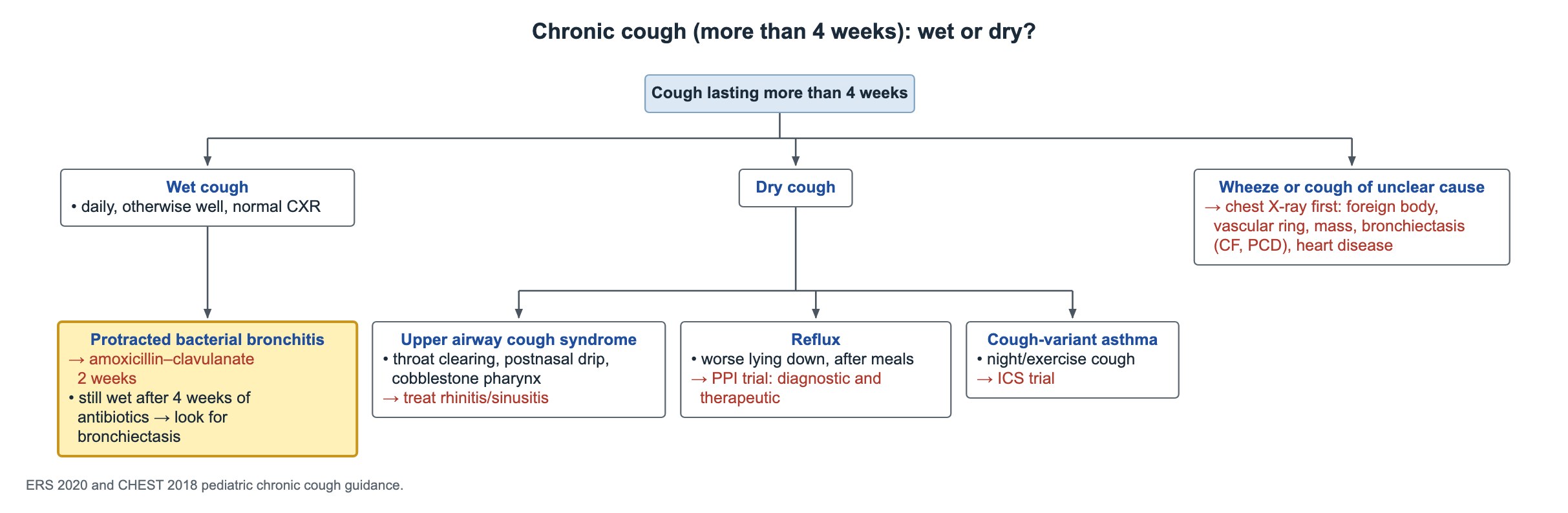
Chronic cough in a child means cough lasting more than 4 weeks. First ask whether it is wet or dry.
| Pattern | Likely cause | Next step |
|---|---|---|
| Daily wet cough, otherwise well, normal chest x-ray | Protracted bacterial bronchitis | Amoxicillin–clavulanate for 2 weeks; still wet after 4 weeks of antibiotics → look for bronchiectasis |
| Throat clearing, postnasal drip, cobblestoned posterior pharynx | Upper airway cough syndrome | Treat the rhinitis or sinusitis |
| Teen with heartburn; cough worse lying down or after meals | Gastroesophageal reflux | Time-limited (4–8 week) proton-pump inhibitor trial |
| Night or exercise cough | Cough-variant asthma | ICS trial |
| Wheeze or cough of unclear cause | Foreign body, vascular ring, mass, bronchiectasis, heart disease | Chest x-ray first |
Common questions
What is SMART therapy for asthma in children?
Single maintenance and reliever therapy uses one ICS–formoterol inhaler every day and also for symptom relief. NAEPP 2020 prefers it from age 4 when low-dose ICS is not enough.
Is a spacer as good as a nebulizer for an asthma attack?
Yes. In mild to moderate attacks an MDI with a valved spacer works as well as a nebulizer, with fewer side effects.
Do inhaled steroids stunt growth?
They reduce height by about 0.5–1 cm, mostly in the first year. The benefit of good control usually outweighs this.
Study this topic
Sources
- NAEPP 2020 Focused Updates to the Asthma Management Guidelines (J Allergy Clin Immunol)
- Global Initiative for Asthma (GINA): strategy reports
- FDA: Boxed warning about serious mental health side effects of montelukast
Written for Pedemy in our own words from the sources above; checked November 2026. For education only, not medical advice; check doses and local protocols before treating a patient. Pedemy is independent and not affiliated with or endorsed by the organizations cited.