

Main decision tree
Acute scrotal pain: torsion until proven otherwise
Key points
- Testis salvage is best when torsion is relieved within about 6 hours of pain onset.
- TWIST score: swelling 2, hard testis 2, absent cremasteric reflex 1, nausea or vomiting 1, high-riding testis 1; 5–7 → surgery without imaging, 3–4 → Doppler ultrasound.
- A low TWIST score or a present cremasteric reflex does not exclude torsion.
- Torsion surgery = detorsion plus fixation of both testes; manual detorsion is usually medial to lateral (open book).
- Suspected testicular cancer: scrotal ultrasound, AFP, β-hCG and LDH, then radical inguinal orchiectomy; never a scrotal biopsy.
- Undescended testis at 6 months (corrected age) → refer; orchiopexy by 12 months when possible and by 18 months at the latest.
- Ischemic priapism lasting 4 hours or more, for example in sickle cell disease, is a urologic emergency.
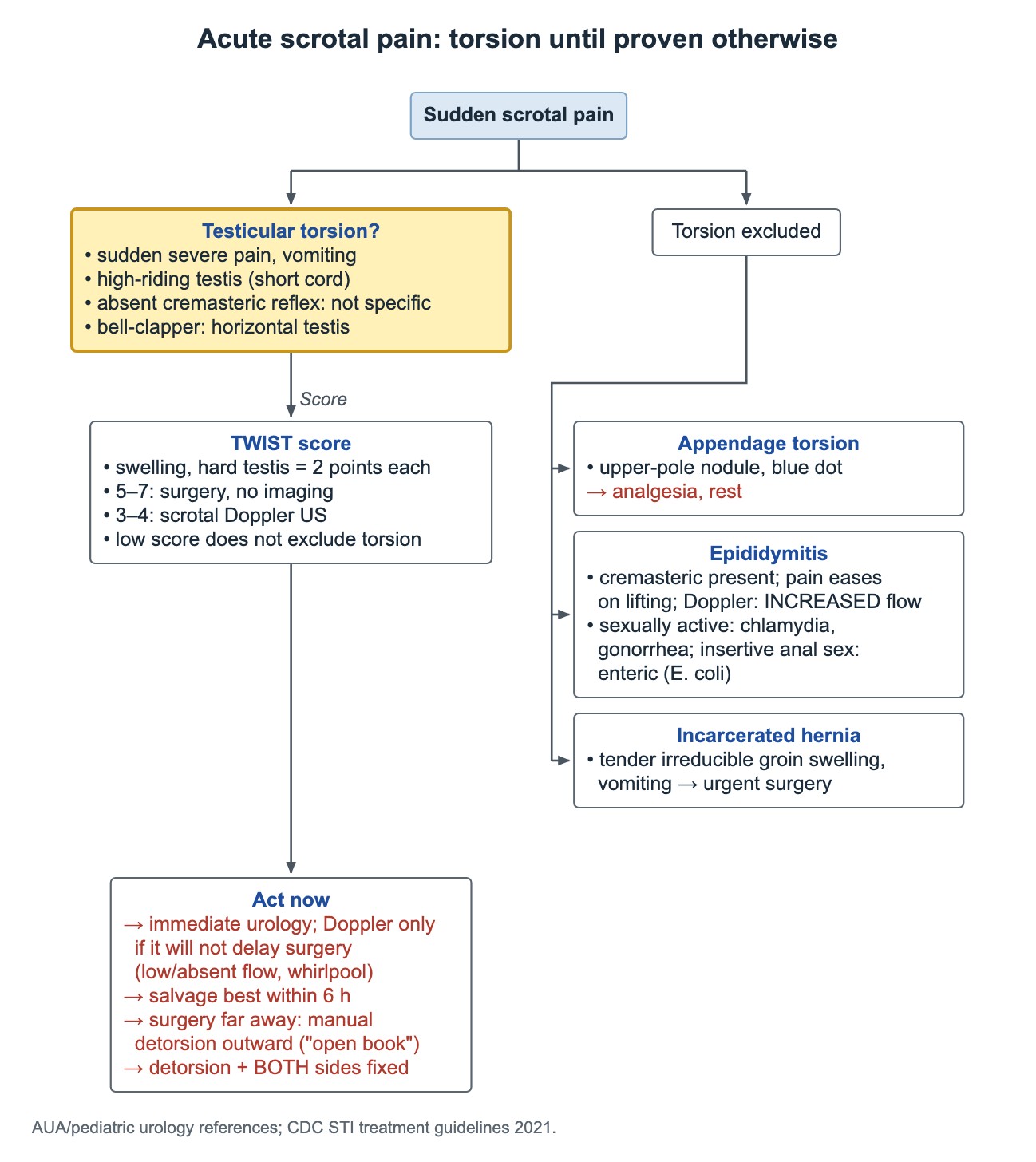
Testicular torsion: recognize it
Torsion is twisting of the spermatic cord. Venous outflow stops first, the testis swells, and then arterial inflow stops and the testis dies. Peaks are in newborns and in adolescents.
- Sudden, severe, one-sided testicular pain, often with nausea and vomiting; it may wake the boy from sleep.
- High-riding testis: the twisted cord is shorter and pulls the testis up.
- Horizontal lie: the bell-clapper anomaly, a high attachment of the tunica vaginalis, leaves the testis free to rotate. It is often present on both sides.
- Absent cremasteric reflex supports torsion but is not specific, and a present reflex does not rule torsion out.
- Lower abdominal pain alone can be the complaint in a teenager: always examine the scrotum.
TWIST score and emergency management
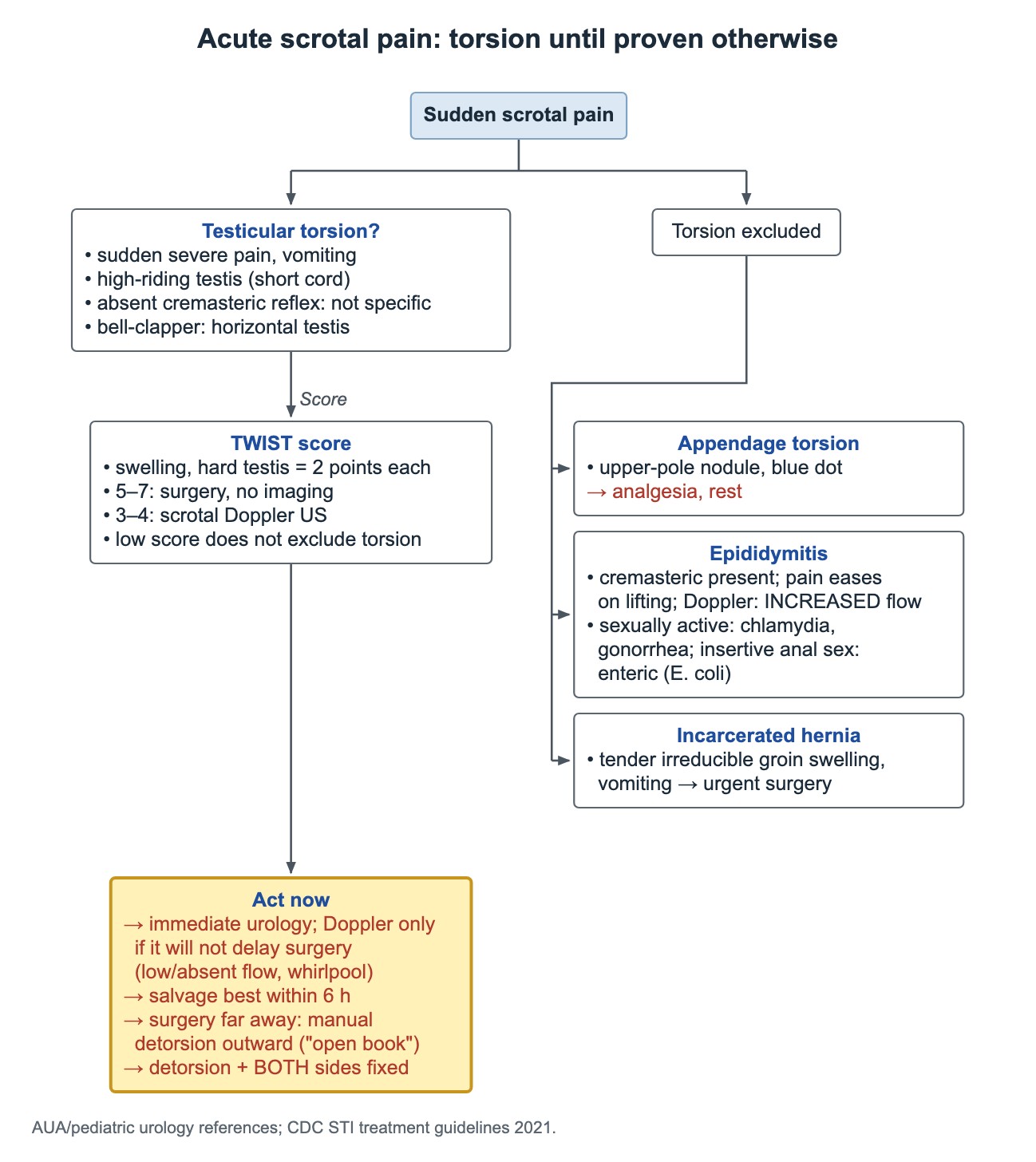
- Score 5–7 (high risk): go straight to surgery; do not wait for ultrasound.
- Score 3–4 (intermediate): scrotal Doppler ultrasound.
- Score 0–2 (low): torsion is less likely but not excluded; image or consult if concern remains.
- Strong suspicion of torsion at any score: call urology immediately. Doppler is used only if it will not delay surgery; it shows reduced or absent flow and a twisted, spiral (whirlpool) cord.
- Time matters: salvage is high within about 6 hours and falls steeply after that.
- If surgery is far away, try manual detorsion: most testes twist medially, so rotate outward like opening a book; some twist the other way. Relief of pain suggests success, but surgery is still needed.
- Surgery: untwist, check viability, and fix both testes (bilateral orchiopexy); remove a testis that is not viable.
| TWIST finding | Points |
|---|---|
| Testicular swelling | 2 |
| Hard testis | 2 |
| Absent cremasteric reflex | 1 |
| Nausea or vomiting | 1 |
| High-riding testis | 1 |
When torsion is excluded: appendage torsion, epididymitis, hernia
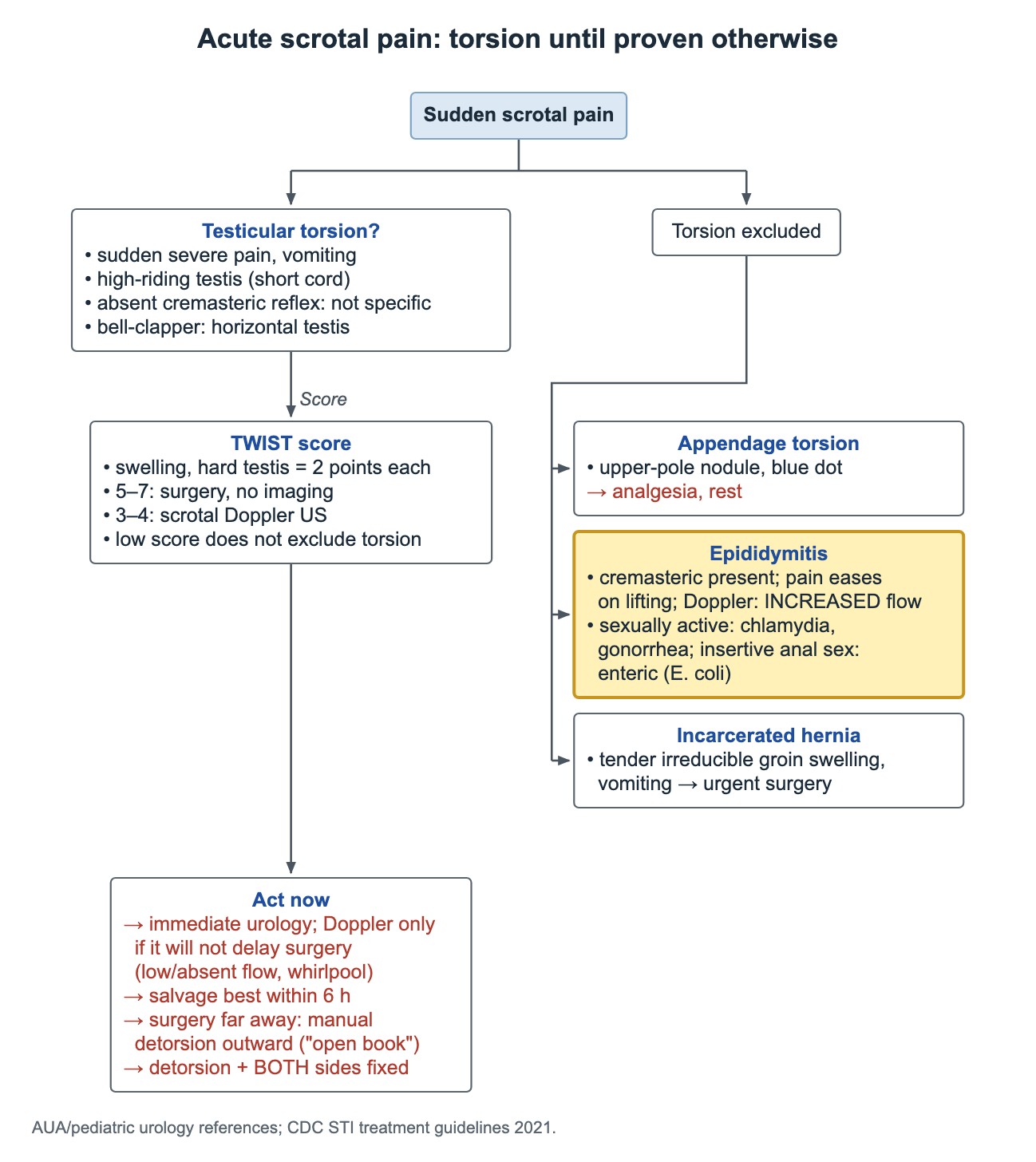
- Epididymitis in a sexually active adolescent: Chlamydia trachomatis and Neisseria gonorrhoeae. CDC 2021 treatment is ceftriaxone 500 mg IM once plus doxycycline 100 mg twice daily for 10 days.
- After insertive anal intercourse, enteric organisms such as E. coli are also possible: ceftriaxone 500 mg IM once plus levofloxacin 500 mg daily for 10 days.
- In prepubertal boys epididymitis is often inflammatory or linked to a urinary tract anomaly; get a urinalysis and culture.
| Condition | Clues | Management |
|---|---|---|
| Torsion of the testicular appendage | Prepubertal boy; tender nodule at the upper pole; blue-dot sign; normal testis | Analgesia (NSAIDs), rest, scrotal support; settles in about a week |
| Epididymitis | Gradual pain; cremasteric reflex present; pain eases when the testis is lifted; increased flow on Doppler; pyuria | Sexually active teen: test and treat for chlamydia and gonorrhea |
| Incarcerated inguinal hernia | Infant with a tender, irreducible groin or scrotal swelling and vomiting | Urgent surgery; strangulation threatens bowel and testis |
Painless scrotal swelling and testicular tumors
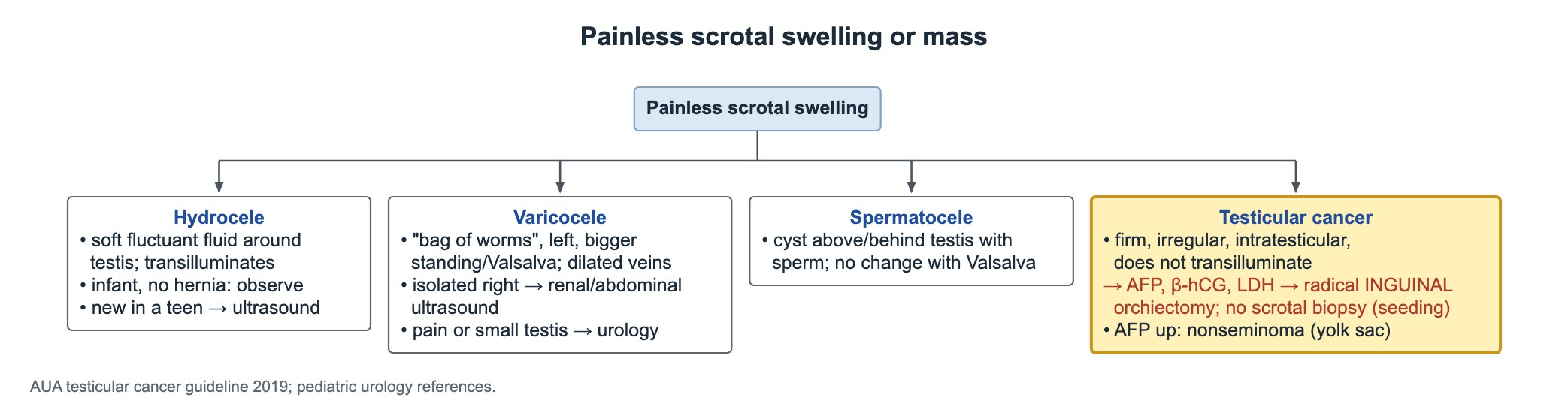
- Varicoceles are left-sided because the left testicular vein drains at a right angle into the left renal vein.
- Never biopsy or operate on a suspected testicular cancer through the scrotum: it can seed tumor into the scrotal lymph drainage. Use the inguinal approach.
- A raised AFP points to a nonseminomatous component such as yolk sac tumor, the main malignant testis tumor of young children. Pure seminoma does not raise AFP.
- AFP is normally high in young infants, so interpret it against age norms.
- A teen with weight loss, cough or back pain and a high AFP may have metastatic germ cell tumor: examine the testes and get a scrotal ultrasound.
| Mass | Exam | Next step |
|---|---|---|
| Hydrocele | Soft, fluctuant fluid around the testis; transilluminates | Infant without hernia: observe; most resolve in infancy. New hydrocele in a teen: ultrasound for a tumor or hernia |
| Varicocele | Bag of worms, usually left; bigger when standing or with Valsalva; dilated veins of the pampiniform plexus | Pain or a smaller testis on that side: urology. Isolated right-sided: renal and abdominal ultrasound for a mass or venous block |
| Spermatocele | Smooth cyst above or behind the testis, separate from it; does not change with Valsalva | Benign epididymal cyst containing sperm; reassure |
| Testicular tumor | Firm, irregular mass inside the testis; does not transilluminate | Scrotal ultrasound, AFP, β-hCG, LDH, then radical inguinal orchiectomy |
Foreskin: physiologic phimosis, pathologic phimosis and paraphimosis
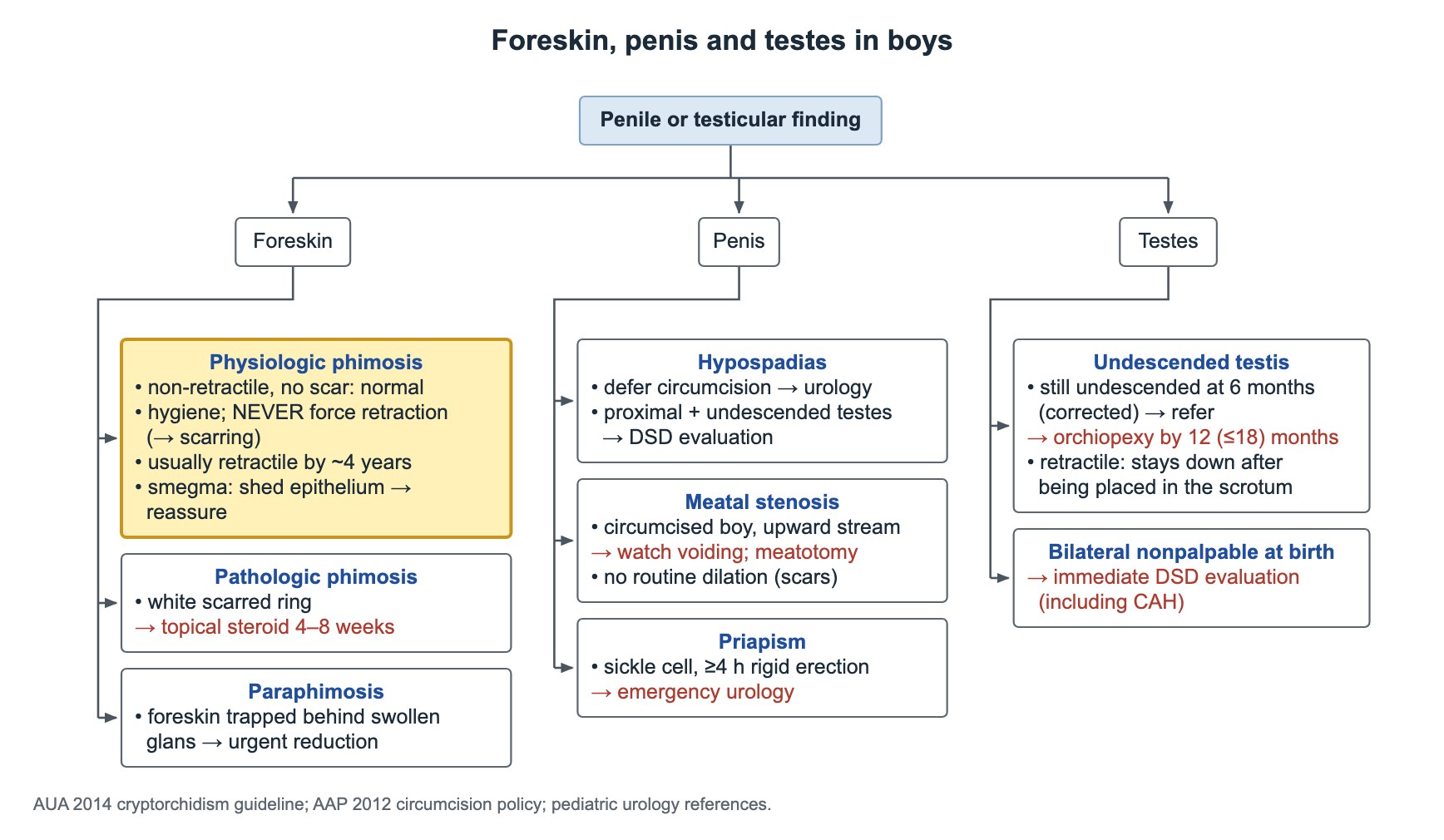
- Physiologic phimosis: a nonretractile foreskin without scarring is normal in young boys. Retraction becomes possible gradually through childhood and sometimes not until adolescence.
- Never force the foreskin back: repeated forced retraction causes tears and scarring, which can create pathologic phimosis.
- Clean only the outside; once the foreskin retracts on its own, the boy can gently pull it back to wash.
- Smegma is shed skin cells and secretions. White or cream smegma pearls under the foreskin need only reassurance; they are released as the foreskin separates.
- Pathologic phimosis: a firm, pale, scarred ring at the tip of the foreskin. First-line treatment is a topical steroid for 4–8 weeks; circumcision if it fails.
- Paraphimosis: a retracted foreskin is trapped behind a swollen glans. It is an emergency: give analgesia, compress the swelling and reduce the foreskin promptly; a dorsal slit is needed if reduction fails.
Hypospadias, undescended testes and priapism
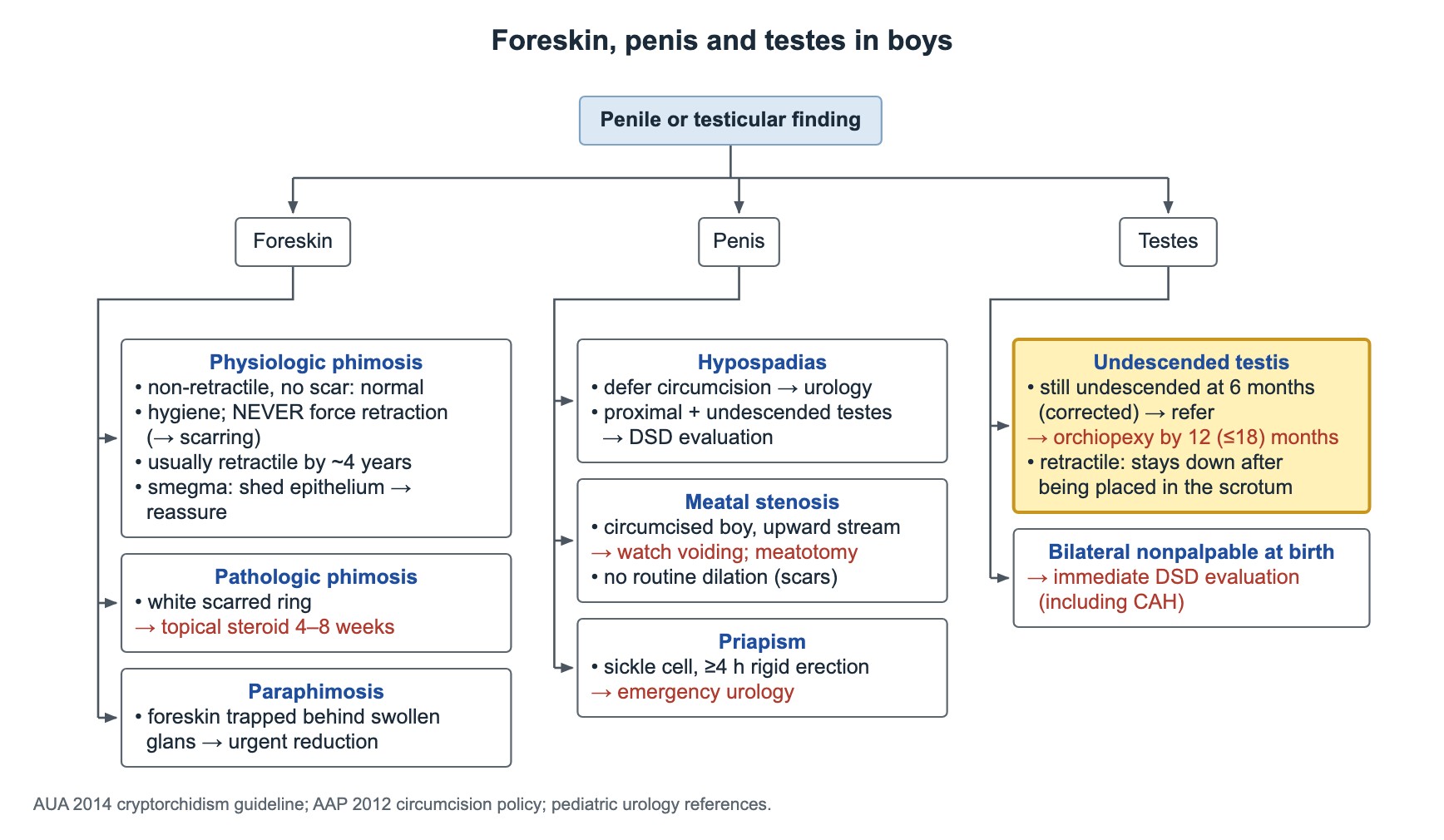
- Hypospadias: do not circumcise; the foreskin may be needed for the repair. Refer to pediatric urology.
- Proximal hypospadias with one or both testes undescended or nonpalpable: prompt evaluation for a difference of sex development (DSD).
- Undescended testis: if still not in the scrotum at 6 months (corrected for prematurity), refer. Orchiopexy should be done by 12 months when possible and by 18 months at the latest.
- Do not order ultrasound or other imaging before referral, and do not use hormone therapy.
- Orchiopexy lowers but does not remove the later risks of infertility and testicular cancer.
- Retractile testis: it can be brought down into the scrotum without tension and stays there at least briefly after release. Recheck yearly, because some ascend.
- Bilateral nonpalpable testes in a newborn: do not wait 6 months. Evaluate immediately for DSD, including congenital adrenal hyperplasia, which can cause a life-threatening salt-wasting crisis in a virilized genetic female.
- Priapism: a painful, rigid erection lasting 4 hours or more is ischemic priapism. In sickle cell disease, get emergency urology care to relieve the erection (aspiration and intracavernous phenylephrine); give usual sickle cell care such as fluids and pain control at the same time, without delaying urology.
Labial adhesions
Labial adhesions are a fusion of the labia minora, seen as a thin, pale central line, in prepubertal girls with low estrogen, most often toddlers. They are acquired, not congenital.
- No symptoms: observe; most separate without treatment, at the latest when estrogen rises at puberty.
- Symptoms such as dribbling, UTI or urinary retention: topical estrogen cream applied to the line of fusion, usually for 2–4 weeks.
- Alternative: betamethasone 0.05% cream.
- Estrogen side effects are reversible: breast budding, vulvar redness or irritation and hyperpigmentation.
- After separation, a bland emollient such as petroleum jelly for several weeks helps prevent recurrence; recurrence is common.
- Manual or surgical separation only for urinary retention or failure of medical treatment.
- Main complications: urinary retention and UTI.
Common questions
How long do you have to treat testicular torsion?
Testis salvage is best when the cord is untwisted within about 6 hours of pain onset, and it falls steeply after that. Do not delay surgery for imaging when torsion is likely.
What is the TWIST score?
A bedside score for torsion: testicular swelling 2, hard testis 2, absent cremasteric reflex 1, nausea or vomiting 1, high-riding testis 1. A score of 5–7 means surgery without imaging; 3–4 means Doppler ultrasound.
When should an undescended testis be fixed?
Refer if the testis is still undescended at 6 months corrected age. Orchiopexy is best done by 12 months and no later than 18 months.
Should a baby's foreskin be pulled back to clean it?
No. A tight foreskin is normal in young boys and separates on its own over years. Forcing it back causes tears and scarring.
Study this topic
Sources
- AUA 2014: Evaluation and treatment of cryptorchidism (J Urol)
- CDC: Sexually transmitted infections treatment guidelines, 2021 (MMWR)
- Barbosa et al.: Scoring system (TWIST) to diagnose testicular torsion in children (J Urol 2013)
- AUA/SMSNA 2022: Recurrent ischemic priapism, priapism in sickle cell disease and non-ischemic priapism (J Urol)
Written for Pedemy in our own words from the sources above; checked November 2026. For education only, not medical advice; check doses and local protocols before treating a patient. Pedemy is independent and not affiliated with or endorsed by the organizations cited.