

Main decision tree
Exposed to an infection: who needs prophylaxis, and with what?
Key points
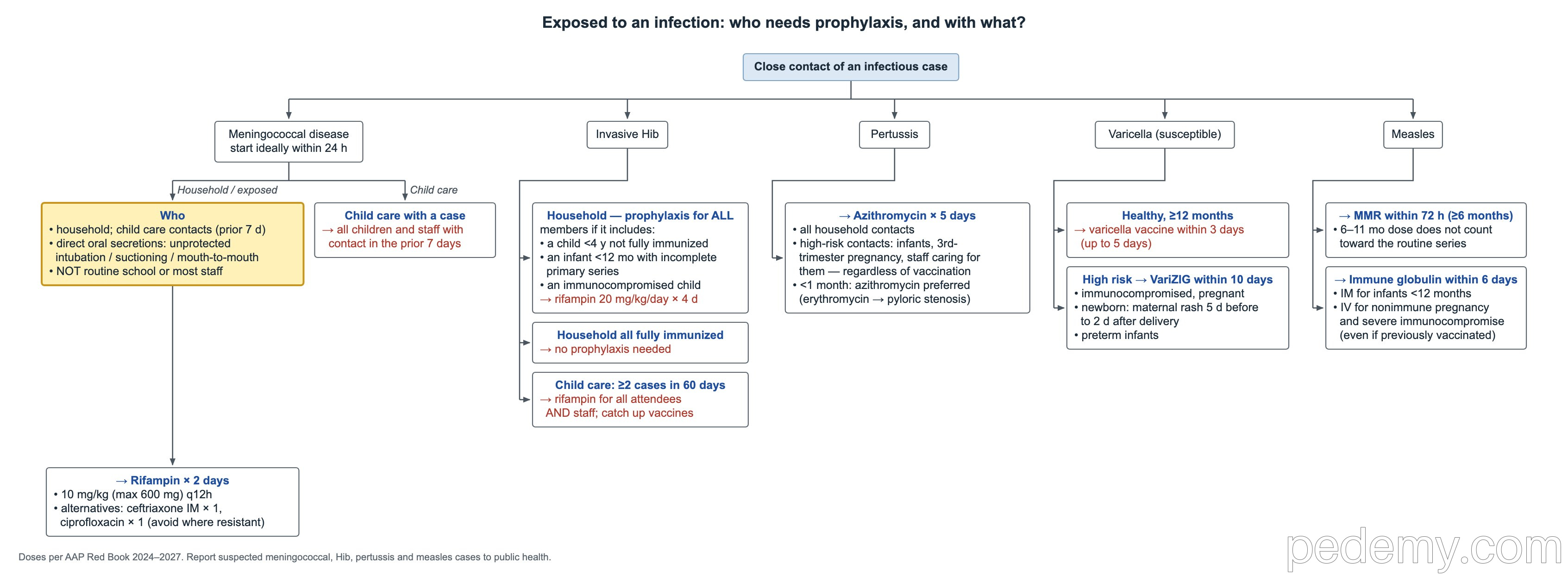
- Meningococcus: household and child-care contacts from the 7 days before illness; rifampin 10 mg/kg (max 600 mg) every 12 hours for 2 days.
- Meningococcus in pregnancy: single IM ceftriaxone. Hospital staff only after unprotected contact with oral secretions.
- Hib: rifampin 20 mg/kg (max 600 mg) once daily for 4 days for the whole household if any member is at risk; none if all are fully immunized.
- Pertussis: azithromycin for 5 days for all household and high-risk contacts, whatever their vaccine status; avoid erythromycin under 1 month (pyloric stenosis).
- Varicella: vaccine within 3 days (up to 5) for healthy contacts ≥12 months; VariZIG up to 10 days for high-risk contacts.
- Measles: MMR within 72 hours (from 6 months); immune globulin within 6 days.
- Tetanus gives no herd immunity: every person must be vaccinated.
Meningococcal disease: who needs prophylaxis
Close contacts have a much higher risk than the general population, so they get chemoprophylaxis whatever their vaccine status. Start it as soon as possible, ideally within 24 hours of identifying the case. Throat cultures do not help.
- Household members, especially those who slept in the same home in the 7 days before illness.
- Child-care and preschool contacts in the 7 days before illness: all children and staff in contact with the child.
- Anyone directly exposed to oral secretions: kissing, shared toothbrush or utensils, mouth-to-mouth resuscitation.
- Health-care workers only if they had unprotected contact with secretions, such as intubation or suctioning without a mask.
- Airline passengers seated directly next to the case on a flight of 8 hours or more.
- Not needed: routine school classmates and most hospital staff.
Meningococcal prophylaxis: drug choice
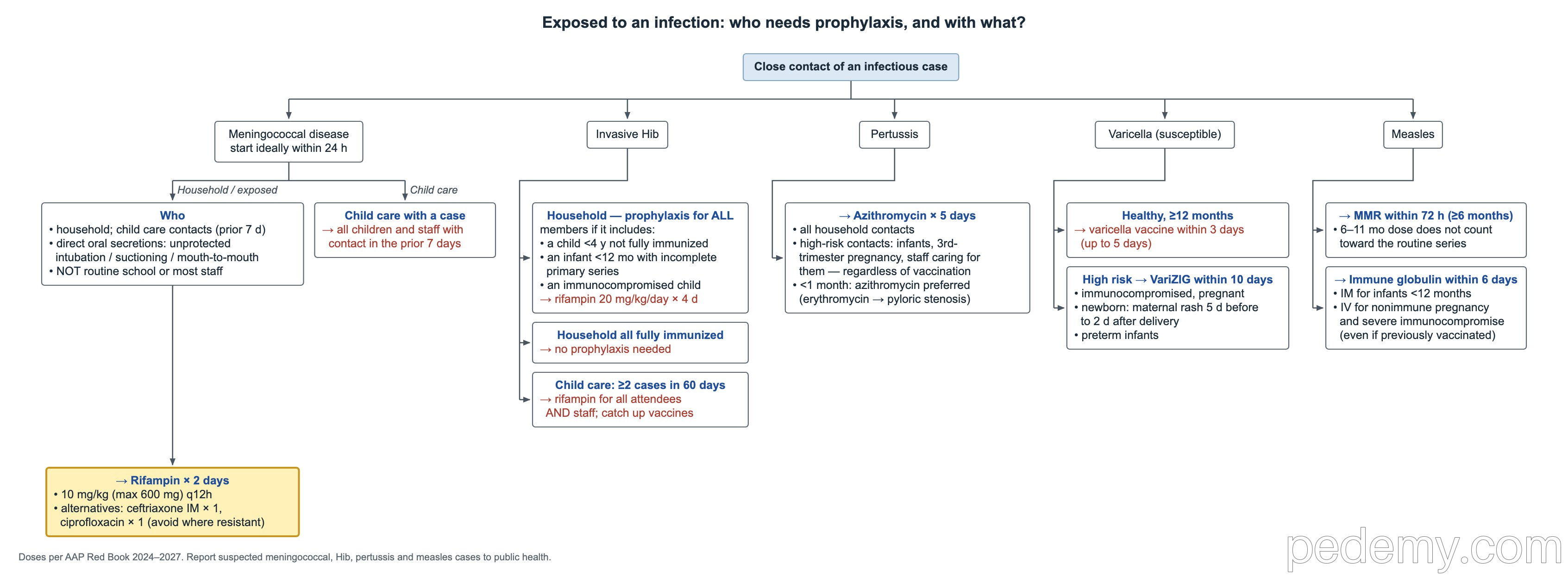
A patient treated only with penicillin or ampicillin also needs prophylaxis before discharge, because those drugs do not clear nasopharyngeal carriage. Ceftriaxone or cefotaxime treatment does.
| Drug | Dose | Notes |
|---|---|---|
| Rifampin | Under 1 month: 5 mg/kg every 12 h for 2 days. 1 month and older: 10 mg/kg (max 600 mg) every 12 h for 2 days | First choice in children; orange body fluids; not in pregnancy |
| Ceftriaxone | Under 15 years: 125 mg IM once. 15 years and older: 250 mg IM once | Preferred in pregnancy |
| Ciprofloxacin | 20 mg/kg (max 500 mg) by mouth once | Avoid where ciprofloxacin-resistant strains have been reported |
Invasive Hib disease
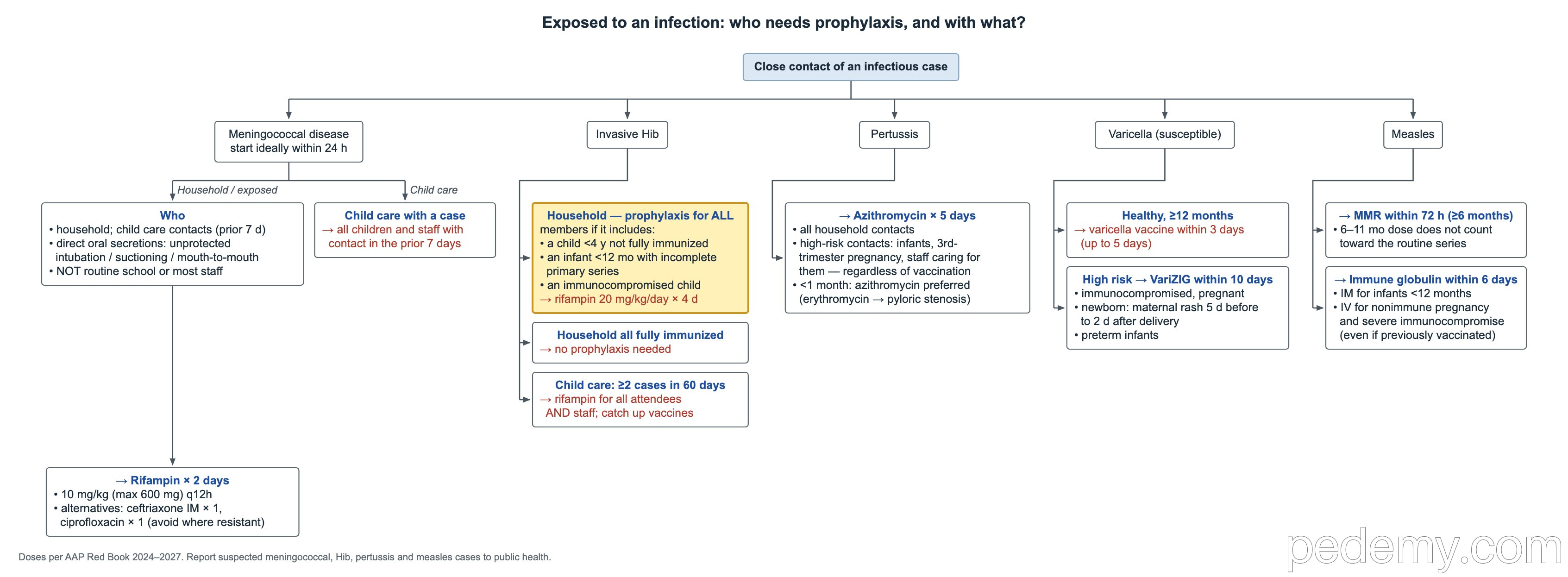
Rifampin clears carriage and protects unimmunized young children in the home. Whether to treat depends on who lives in the household.
- Give rifampin to ALL household members if the home includes a child under 4 years who is not fully immunized, an infant under 12 months who has not finished the primary series, or an immunocompromised child.
- Dose: rifampin 20 mg/kg (max 600 mg) once daily for 4 days; 10 mg/kg for infants under 1 month.
- If every household contact is fully immunized, no prophylaxis is needed.
- Child care: 2 or more invasive Hib cases within 60 days → rifampin for all attendees and staff, plus catch-up Hib vaccine for unimmunized children.
- Unimmunized or incompletely immunized contacts also get Hib vaccine.
Pertussis
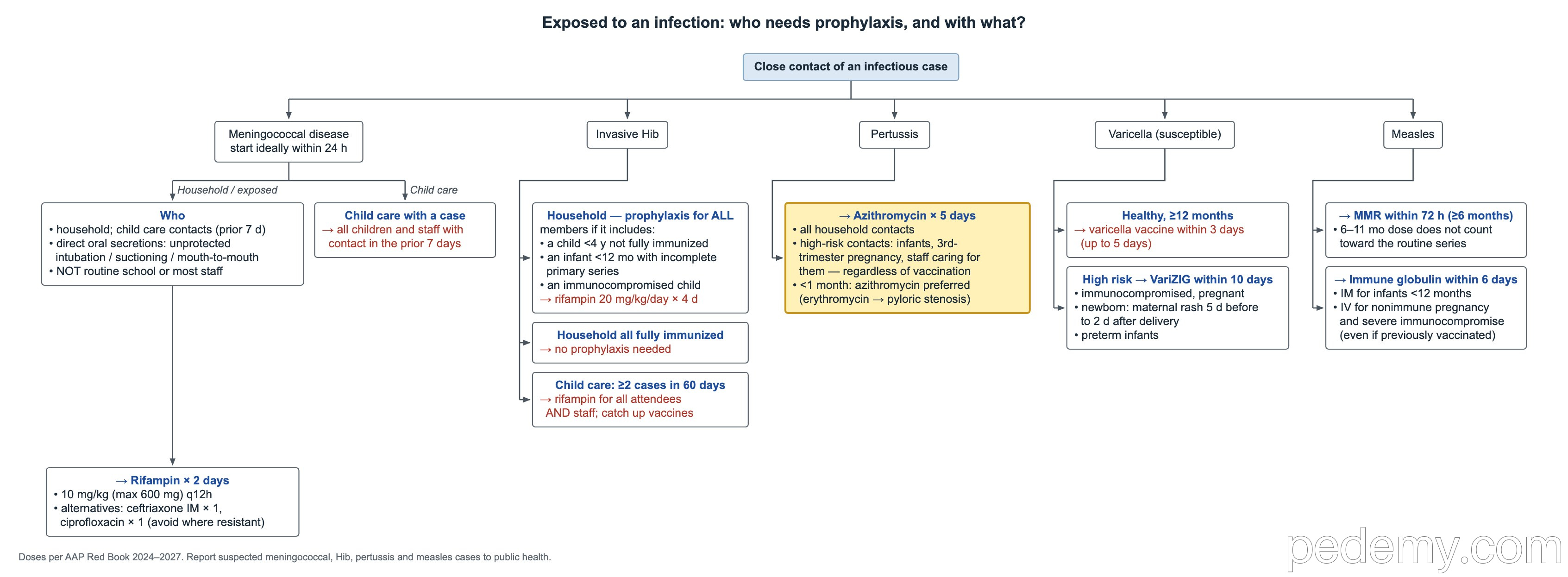
Give post-exposure antibiotics to all household contacts and to high-risk contacts (infants, women in the third trimester and anyone who cares for or lives with them), regardless of vaccination status. Vaccine protection wanes, so a fully vaccinated health-care worker caring for infants still needs prophylaxis.
Azithromycin is preferred at every age. In infants under 6 months the dose is 10 mg/kg once daily for 5 days. Older children: 10 mg/kg (max 500 mg) on day 1, then 5 mg/kg (max 250 mg) on days 2–5.
- Erythromycin in young infants, especially in the first 2 weeks, is linked to infantile hypertrophic pyloric stenosis: projectile non-bilious vomiting weeks later.
- Azithromycin also carries a smaller pyloric stenosis risk; watch infants under 1 month.
- Start prophylaxis within 21 days of the case's cough onset.
Varicella exposure
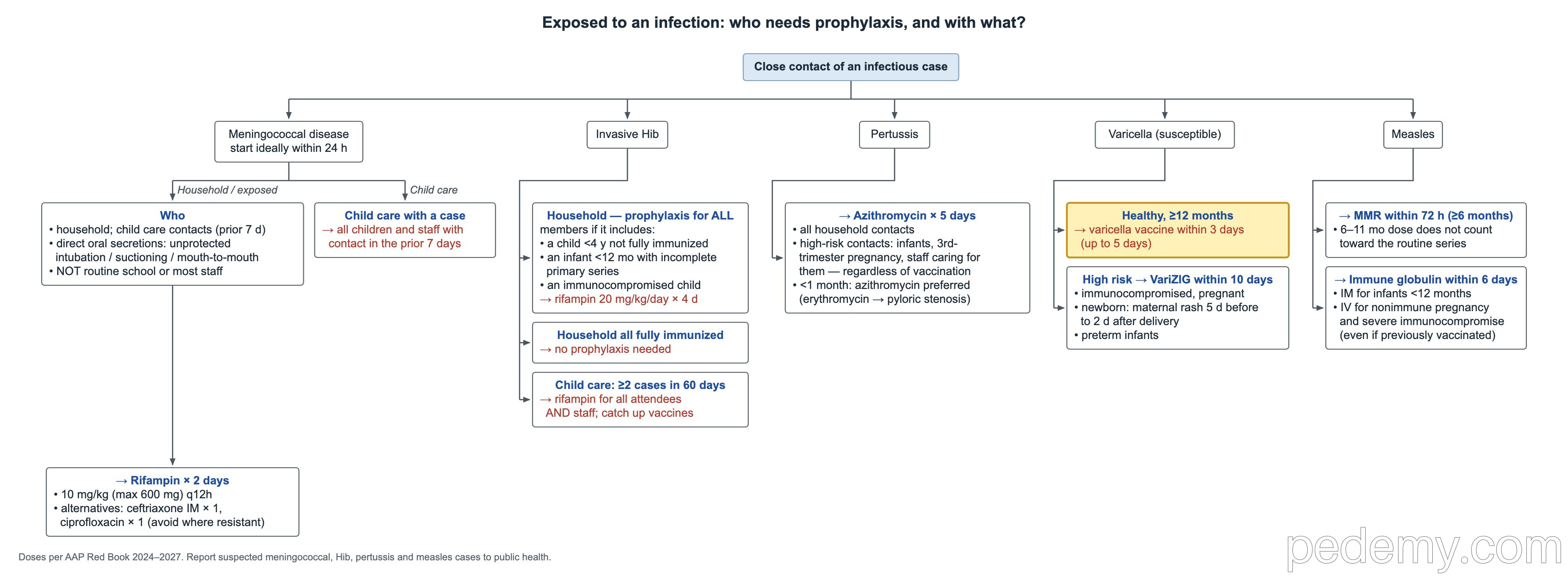
For a healthy child 12 months or older without immunity, give varicella vaccine as soon as possible: within 3 days of exposure, and up to 5 days. It prevents or softens the illness and counts as a routine dose.
- VariZIG for exposed people at high risk who cannot get the live vaccine: immunocompromised children, nonimmune pregnant women, and some preterm infants.
- Newborns whose mother's varicella rash starts from 5 days before to 2 days after delivery also get VariZIG.
- Give VariZIG as soon as possible, up to 10 days after exposure.
- If VariZIG is not available, IVIG or oral acyclovir are alternatives.
VariZIG in pregnancy
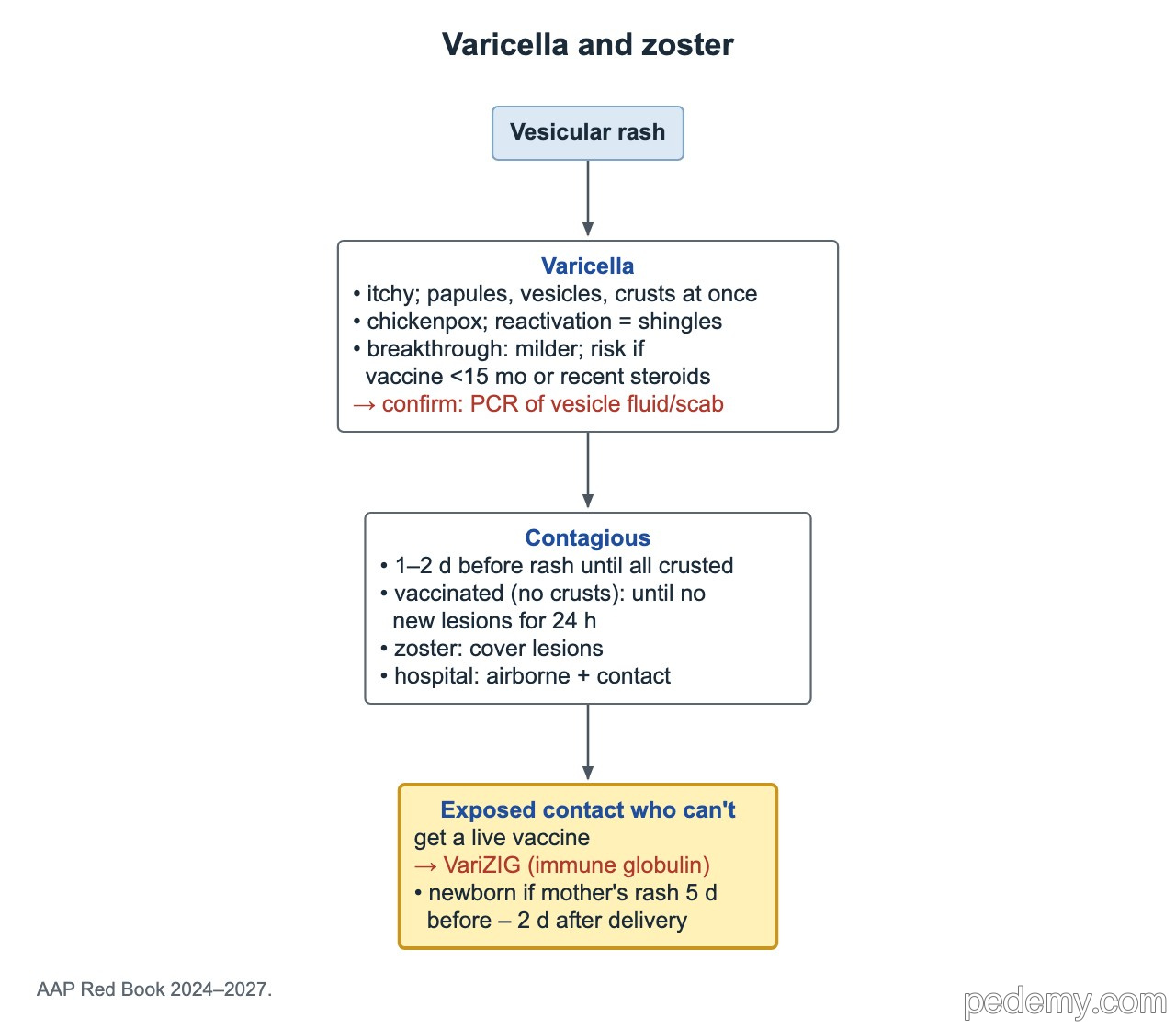
A pregnant woman without varicella immunity who is exposed should receive VariZIG, ideally right away and no later than 10 days after exposure. Live varicella vaccine is not given during pregnancy.
Measles and tetanus
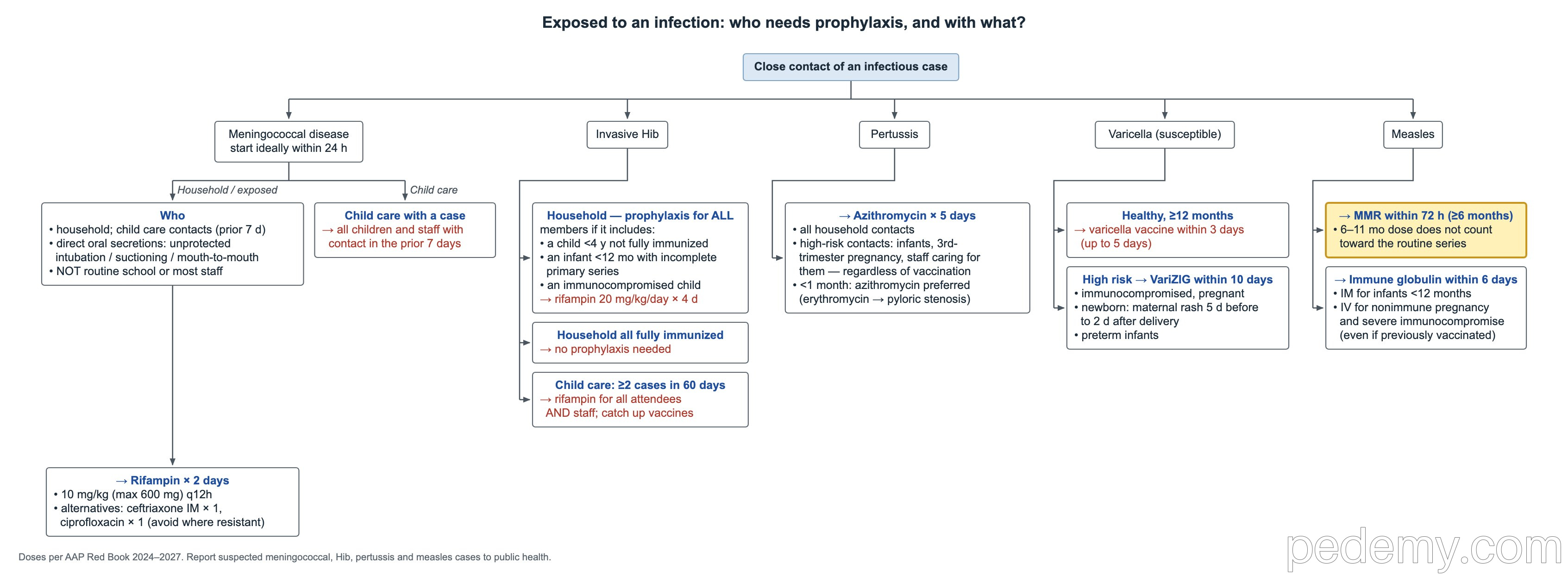
- Measles: MMR within 72 hours of exposure for susceptible contacts 6 months and older.
- An MMR dose given at 6–11 months does not count toward the routine 2-dose series: repeat at 12–15 months and 4–6 years.
- Immune globulin within 6 days: IM for infants under 12 months; IV for nonimmune pregnant women and severely immunocompromised people, even if previously vaccinated.
- Tetanus spores come from soil, not from people, so community vaccine coverage gives no herd protection. Every child needs their own doses.
Common questions
Who needs prophylaxis after a meningococcal case?
Household members, child-care contacts in the 7 days before illness, and anyone exposed to the patient's oral secretions. Most school and hospital contacts do not.
Does a fully vaccinated contact need pertussis prophylaxis?
Yes, if they are a household contact or a high-risk contact. Vaccine status does not change the recommendation.
How long after exposure can VariZIG be given?
Up to 10 days after exposure, but the sooner the better.
Study this topic
Sources
- ACIP 2020: Meningococcal vaccination recommendations (MMWR)
- ACIP 2014: Prevention and control of Haemophilus influenzae type b disease (MMWR)
- CDC 2005: Recommended antimicrobial agents for treatment and postexposure prophylaxis of pertussis (MMWR)
- ACIP 2013: Prevention of measles, rubella, congenital rubella syndrome and mumps (MMWR)
- AAP Red Book Online
Written for Pedemy in our own words from the sources above; checked November 2026. For education only, not medical advice; check doses and local protocols before treating a patient. Pedemy is independent and not affiliated with or endorsed by the organizations cited.