

At a glance
- Thrush is a Candida yeast infection that causes white patches inside a baby's mouth.
- A white coating on the tongue alone is usually milk and fades once solid foods start.
- Patches on the inner cheeks, lips, gums or roof of the mouth point to thrush.
- With anti-yeast medicine thrush usually clears in 4 to 5 days; untreated it can last 2 to 8 weeks.
- Give the medicine for at least 7 days, and until the patches have been gone for 3 days.
- Washing bottle nipples and pacifiers with soap and water is enough; you do not need to throw them out.
- Get care now for no urine in over 8 hours, a very dry mouth, or a baby under 1 month who seems unwell.
What thrush looks like
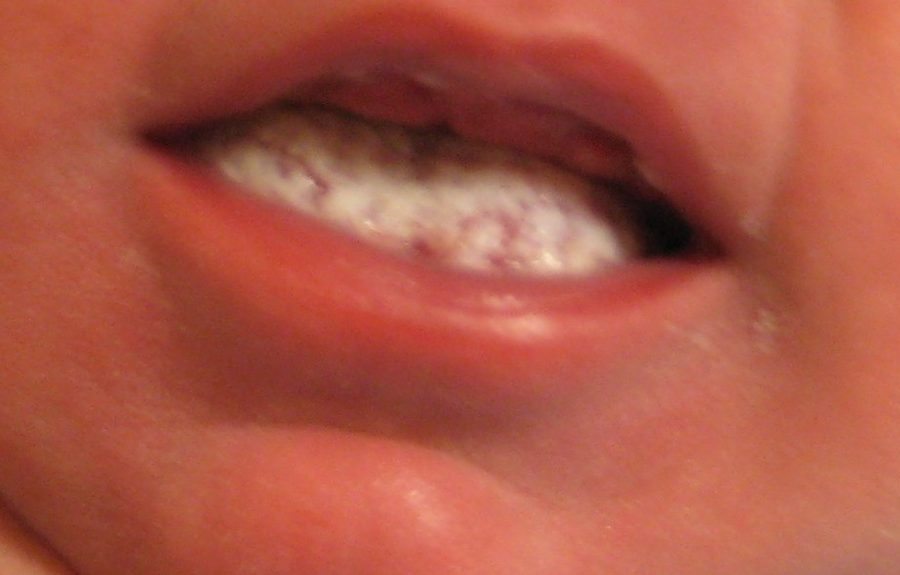
Thrush shows as white or yellowish patches on the inner cheeks, lips, gums, tongue or roof of the mouth. The patches are often uneven in shape and may bleed a little if rubbed.
A white tongue with no other patches is usually a milk coating, not thrush. It goes away once the baby eats solid foods.
Sore patches can make sucking uncomfortable, so some babies fuss at feeds. The same yeast can also cause a red diaper rash with a raised border.
Milk tongue or thrush?
- White on the tongue only
- Baby feeds comfortably
- Fades with solid foods; no medicine
- Patches on cheeks, lips, gums or palate
- May bleed a little if rubbed; feeds can hurt
- Needs a prescription anti-yeast medicine

Why babies get thrush
- Candida lives on everyone's skin and in the mouth in small amounts.
- Newborns can pick it up from the mother during pregnancy or birth.
- Antibiotics can upset the normal mouth germs and let the yeast overgrow.
- Babies born early or very small have a higher risk.
- Thrush in a child older than 2 to 3 years, or thrush that keeps returning, can be a sign of diabetes or a weak immune system and needs a check.
Treating thrush
- The doctor usually prescribes an anti-yeast liquid such as nystatin.
- A common amount is 1 mL for babies under 1 month and 2 mL after that; follow your own prescription.
- Give it 4 times a day, putting half in each side of the mouth and some directly on the patches.
- Wait 30 minutes after a dose before the next feed so the medicine stays in the mouth.
- If the patches are not improving, paint the medicine onto them with a cotton swab.
- Do not scrape the patches off; it hurts and can make them bleed.
Thrush treatment day by day
- Day 1Start the medicine 4 times a day; no feeding for 30 minutes after each dose.
- Days 4 to 5Patches are usually fading or gone.
- Day 7 at the earliestStop only when patches have been gone for 3 days.
- Without treatmentThrush may take 2 to 8 weeks to clear.
Feeding, bottles and pacifiers
- Keep sucking time on a bottle to about 20 minutes per feed while the mouth is sore.
- Offer the pacifier only when nothing else soothes, and a smaller regular one may rub less than an orthodontic shape.
- Wash bottle nipples and pacifiers with soap and water after use.
- If you breastfeed and your nipples become sore, call your own doctor or OB within 24 hours.
- For a yeast diaper rash, an over-the-counter anti-yeast cream applied 2 times a day usually helps.
- Your baby can go to child care with thrush.
When to get help
- Call 911 or your local emergency number if your baby is very hard to wake, limp, struggling to breathe, or turning blue or gray.
- Get care now for signs of dehydration: no urine for more than 8 hours, dark urine, a very dry mouth or no tears.
- A baby under 1 month who is not acting normally, or any baby who looks very sick, needs to be seen now.
- A baby under 3 months with a temperature of 100.4°F (38°C) or higher needs a doctor right away.
- Call within 24 hours for fever in an older baby, bleeding in the mouth, or drinking less than normal.
- Call during office hours for white patches inside the cheeks or lips, since a prescription is usually needed.
Thrush: when to get help
- Call 911 nowVery hard to wake, limp, struggling to breathe, or blue or gray color.
- Get seen nowNo urine in 8 hours, very dry mouth, under 1 month and unwell, or fever under 3 months.
- Call within 24 hoursFever in an older baby, bleeding in the mouth, drinking less, or sore nipples while breastfeeding.
- Call in office hoursWhite patches inside the cheeks or lips in a baby who feeds well.
- Care at homeWhite tongue only, or treated thrush that is getting better.
Common questions
How do I know if it is thrush or milk on my baby's tongue?
When only the tongue is white, milk is the usual reason. Patches that also cover the cheeks, lips or gums suggest thrush and are worth showing to the doctor.
Is thrush painful for babies?
It can be. Some babies fuss or pull away during feeds, so watch how much your baby drinks and how many wet diapers there are.
Can I keep breastfeeding if my baby has thrush?
Yes, keep feeding. If your nipples start to burn or hurt, ask your own doctor within a day, since you may need treatment too.
Do I need to boil bottles and pacifiers when my baby has thrush?
The AAP symptom guide says a wash with soap and water is enough. If thrush keeps coming back, ask the doctor whether extra cleaning would help.
How long does thrush last in babies?
Treated thrush usually settles in less than a week, while untreated thrush can linger for up to 8 weeks. It can come back, especially after antibiotics.
Can my baby go to day care with thrush?
Yes. There is no need to keep a baby with thrush at home if they are otherwise well.
Sources
- AAP — Thrush and Other Candida Infections
- AAP — Thrush (symptom checker)
- CDC — Candidiasis Basics
- NIH MedlinePlus — Thrush - children and adults
Written for Pedemy in our own words from the sources above; checked October 2026. For education only, not medical advice. Pedemy is independent and not affiliated with or endorsed by the organizations cited.