

At a glance
- Cradle cap is thick, yellowish, oily scale on a baby's scalp; about 70% of 3-month-olds have it.
- It usually starts between 3 weeks and 2 months of age.
- It is not caused by poor hygiene, it is not an allergy, and it is not contagious.
- Most babies need no treatment; it usually fades over weeks to months and is often gone by age 1.
- Wash with a mild baby shampoo about every other day and gently brush away loose scales.
- Do not use dandruff shampoo; ask the pediatrician before any medicated shampoo or cream.
- See the doctor for oozing, pus bumps, bleeding, odor, swelling, or a rash spreading past the scalp.
What cradle cap looks like
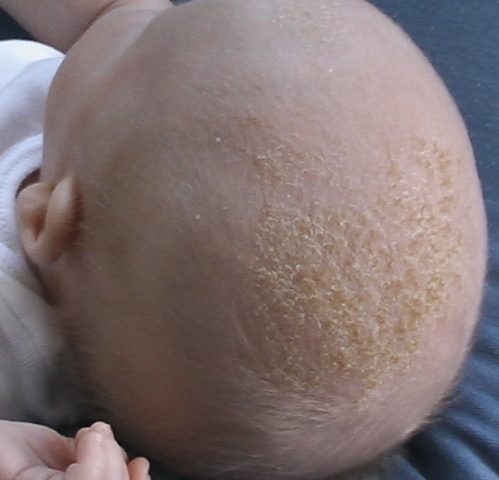
Cradle cap forms thick, crusty, yellow or brown scales, often in greasy patches on top of the head. Scales can also show up on the eyebrows, eyelids, ears or around the nose.
On darker skin it may look like flaking with lighter or white patches, and any rash on the body can look darker than the baby's skin or purplish.
When the same rash appears in the neck creases, armpits or diaper area, it is called seborrheic dermatitis, and on the body it is often mistaken for diaper rash.
How cradle cap can look on different skin tones
- Greasy yellow or brown scales
- Red skin under the scales
- Flakes with lighter or white patches
- Body rash darker than the skin or purplish

What causes it
The exact cause is not known. Doctors think the baby's oil glands make too much oil, possibly because of hormones from the mother or a reaction to a common skin yeast.
It is not an infection, it does not spread to other people, and it does not mean the baby is being washed too little.
Loosening the scales at home
- Wash the hair about every other day with a mild baby shampoo.
- While the shampoo is on, massage the scalp with your fingertips or a soft baby brush.
- For stubborn scales, rub in a little mineral oil, coconut oil or petroleum jelly and leave it overnight.
- Wash the oil out the next day with baby shampoo so it does not build up.
- Do not pick or scratch the scales, which can let germs in; hair that comes away with them grows back.
- Once the scalp is clear, keep washing regularly with baby shampoo to help stop the scales coming back.
Loosening cradle cap step by step
- SoftenFor thick scales, rub in a little oil or petroleum jelly the night before.
- WashShampoo with mild baby shampoo about every other day.
- BrushMassage with a soft brush or fingertips to lift loose flakes.
- RinseRinse well so no oil or shampoo is left behind.
- Leave the restDo not pick at scales that are still stuck; try again next wash.
When medicine is used
Dandruff shampoo is not recommended for babies and young children. Medicated shampoos can irritate a baby's skin, so check with the pediatrician first.
If the rash is crusted, weepy or spreading, the doctor may prescribe an antifungal or a mild hydrocortisone cream. Antibiotics are used only for a skin infection, which is uncommon.
How long cradle cap lasts
Cradle cap usually clears within weeks to a few months and has mostly gone by the first birthday. Some toddlers keep a little flaky buildup, and in a few children it lasts until age 2 or 3.
When to see the doctor
- Call 911 or your local emergency number if your baby is very hard to wake, limp, struggling to breathe, or turning blue or gray.
- A baby under 3 months with a temperature of 100.4°F (38°C) or higher needs a doctor right away.
- Call the doctor soon if the scalp oozes, bleeds, smells bad, swells, forms pus bumps or crusts, or seems painful.
- A fever with a red, weepy scalp can mean the skin is infected, so get it checked the same day.
- Book a visit if a bad rash spreads beyond the scalp, or if the scales are no better or getting worse after home care.
- Strong itching is unusual for cradle cap, so ask the doctor to check whether it could be another skin problem.
Cradle cap: when to get help
- Call 911 nowVery hard to wake, limp, struggling to breathe, or blue or gray color.
- Get seen nowUnder 3 months with a temperature of 100.4°F (38°C) or higher.
- Call the same dayOozing, bleeding, pus bumps, bad smell, swelling or pain, especially with fever.
- Book a visitSpreading rash, strong itch, or no better after gentle care.
- Care at homeGreasy scales on a comfortable, happy baby.
Common questions
Is cradle cap caused by poor hygiene?
No. It comes from extra oil in the baby's skin, not from how often you bathe your baby.
Can I use coconut oil for cradle cap?
Yes. The AAP lists coconut oil, mineral oil and petroleum jelly as options to soften thick scales overnight; shampoo it out the next day.
Should I pick off cradle cap?
No. Picking can break the skin and invite infection; let washing and a soft brush lift the flakes over time.
When does cradle cap go away?
For most babies it fades within a few months and is gone before age 1, though some toddlers keep mild flaking for longer.
Can I use dandruff shampoo on my baby?
Not without medical advice. Dermatologists do not recommend it for children, and adult products can sting or irritate a baby's skin.
Is cradle cap itchy?
Rarely. If your baby keeps scratching or seems bothered, the rash may be something else, such as eczema, and is worth a check.
Sources
- AAP — What is Cradle Cap?
- AAD — Seborrheic dermatitis: Diagnosis and treatment
- AAD — Seborrheic dermatitis: Signs and symptoms
- NIH MedlinePlus — Cradle cap
Written for Pedemy in our own words from the sources above; checked October 2026. For education only, not medical advice. Pedemy is independent and not affiliated with or endorsed by the organizations cited.