

Main decision tree
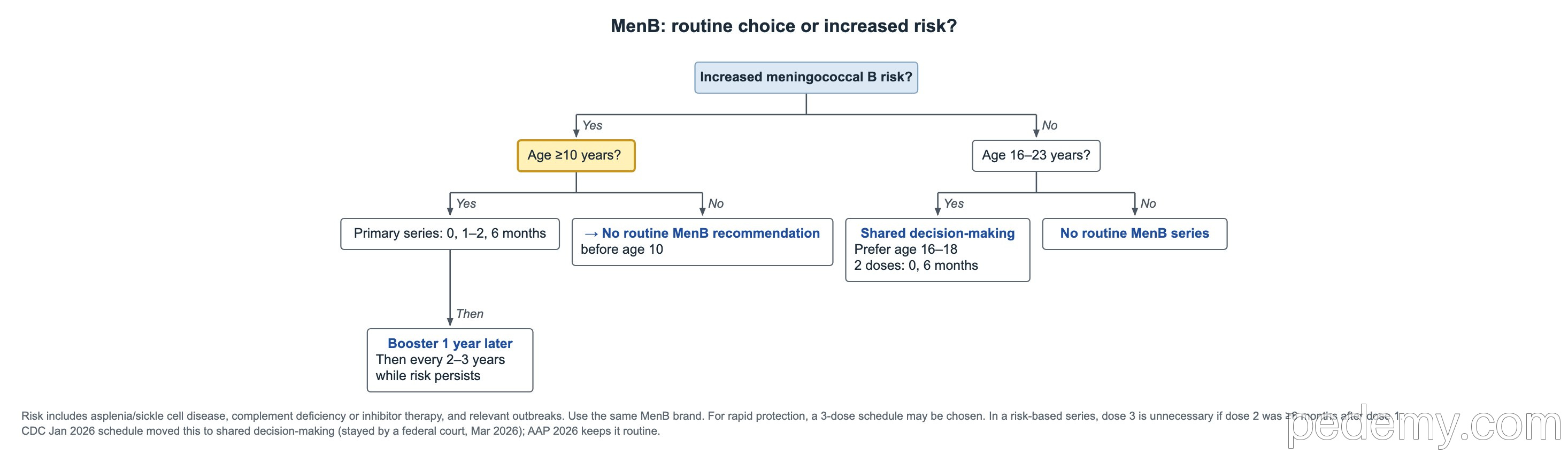
MenB: routine choice or increased risk?
At a glance
- Healthy teens and young adults 16–23 years can get MenB after a shared decision with their clinician; 16–18 years is the preferred age.
- Healthy teens: 2 doses 6 months apart; if dose 2 is given sooner, add a dose 3 at least 4 months after dose 2.
- High risk from 10 years (asplenia, sickle cell disease, complement deficiency or inhibitor): 3 doses at 0, 1–2 and 6 months.
- High-risk boosters: 1 year after the series, then every 2–3 years while the risk lasts.
- Bexsero and Trumenba are not interchangeable: use the same brand for every dose.
- MenB does not replace MenACWY; teens need both kinds for full coverage.
- Do not give after anaphylaxis to a previous dose or a vaccine component.
More decision trees
From Pedemy's flashcards. Tap a tree to open it full size.
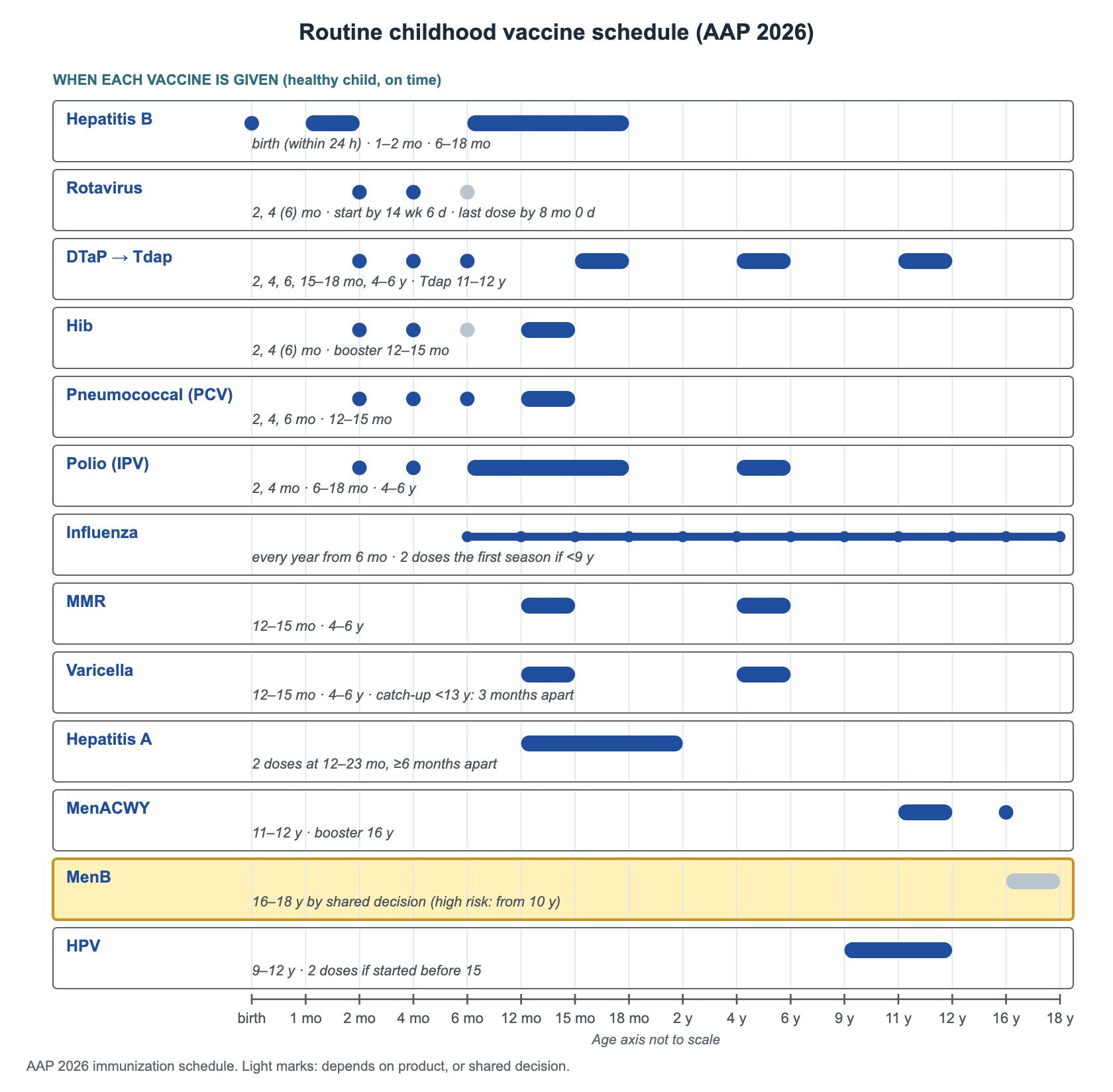
Routine childhood vaccine schedule (AAP 2026) — schedule graph
Who should get MenB
- Healthy teens and young adults 16–23 years: shared clinical decision-making, preferably at 16–18 years.
- From 10 years: asplenia (including sickle cell disease), persistent complement component deficiency, or a complement inhibitor such as eculizumab or ravulizumab.
- From 10 years: people in a serogroup B outbreak.
- Microbiologists who work with Neisseria meningitidis.
Doses and boosters
| Who | Primary series | Boosters |
|---|---|---|
| Healthy teen, 16–23 years | 2 doses, 6 months apart (add dose 3 if dose 2 was under 6 months) | None |
| High risk, 10 years or older | 3 doses at 0, 1–2 and 6 months | 1 year after the series, then every 2–3 years |
| Serogroup B outbreak | 3 doses at 0, 1–2 and 6 months | 1 dose if 1 year or more since the series |
Bexsero vs Trumenba
- Both are licensed for 10–25 years and protect against serogroup B.
- They are made from different proteins, so they are not interchangeable: every dose, including boosters, must be the same brand.
- If the brand of earlier doses is unknown, start again with one brand.
- Penbraya combines MenACWY with Trumenba's MenB component; any later MenB doses must then be Trumenba.
Who should not get it, and side effects
- Do not give after anaphylaxis to a previous dose or a vaccine component.
- In pregnancy, delay unless the risk is high and the benefit outweighs it.
- Common: sore arm, often marked, plus headache, tiredness, muscle aches and fever for a day or two.
- Teens can faint after any injection; have them sit for 15 minutes afterwards.
Common questions
Is the MenB vaccine required?
Not for healthy teens. It is a shared decision between the family and clinician at 16–23 years, best at 16–18 years. It is recommended for children 10 years and older with asplenia, sickle cell disease or complement problems.
What is the difference between MenACWY and MenB?
They protect against different serogroups. MenACWY covers A, C, W and Y; MenB covers B. Neither covers the other.
Can Bexsero and Trumenba be mixed?
No. Use the same brand for every dose. If the first brand is unknown, restart with one brand.
How many doses of MenB does a teen need?
A healthy teen needs 2 doses 6 months apart. A teen with a high-risk condition or in an outbreak needs 3 doses at 0, 1–2 and 6 months.
Does a teen with sickle cell disease need MenB boosters?
Yes. Give a booster 1 year after the series, then every 2–3 years while the risk lasts.
Sources
- CDC: Child and adolescent immunization schedule and catch-up guidance
- CDC: Child and adolescent schedule notes (meningococcal vaccination)
- CDC: Meningococcal vaccine recommendations
- AAP: Immunization schedule (aap.org)
Written for Pedemy in our own words from the sources above; checked October 2026. For education only, not medical advice. Pedemy is independent and not affiliated with or endorsed by the organizations cited.