

Main decision tree
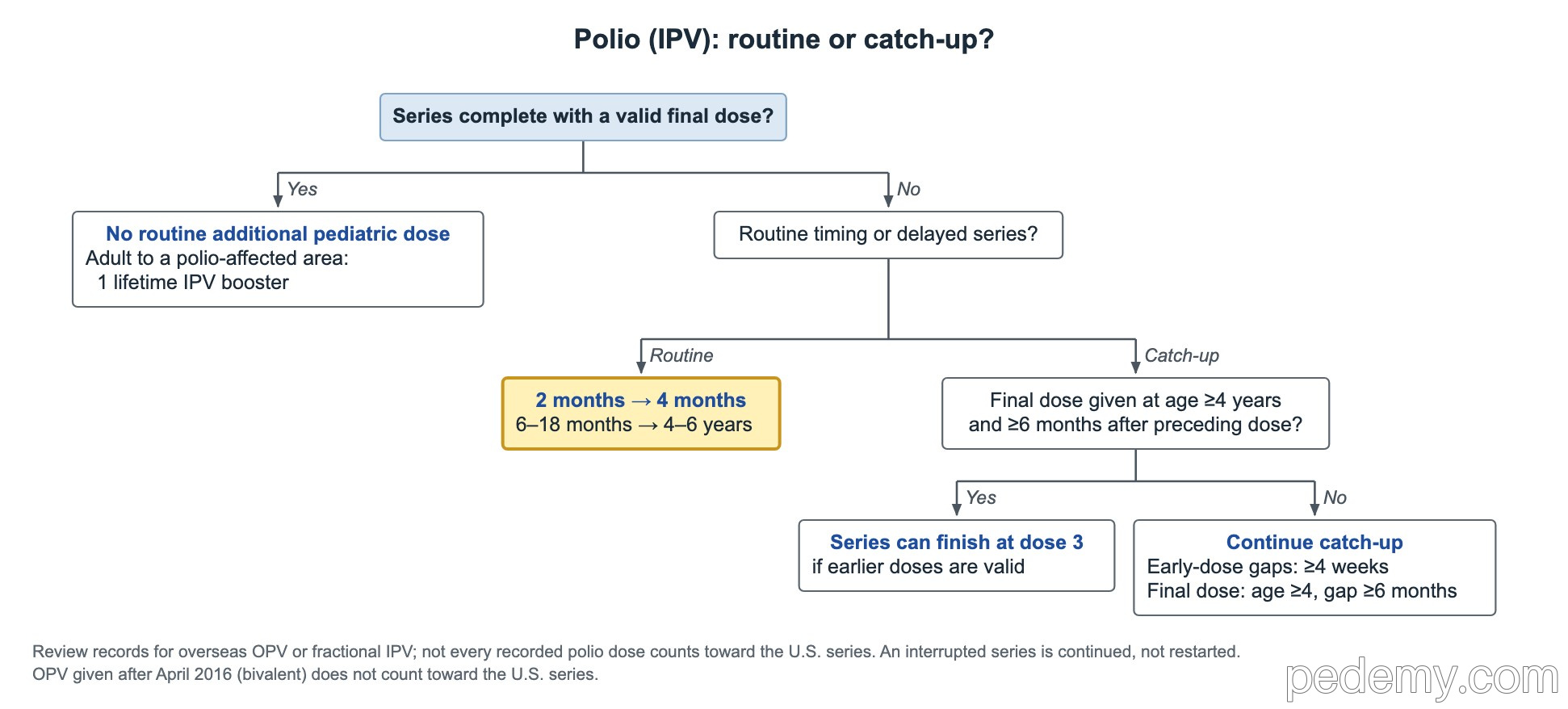
Polio (IPV): routine or catch-up?
At a glance
- Routine schedule: 4 doses at 2 months, 4 months, 6–18 months and 4–6 years.
- The final dose must be given at 4 years or older and at least 6 months after the previous dose.
- 4 or more doses before age 4 still need one more dose at 4 years or older.
- 3 doses are enough if dose 3 was given at 4 years or older and at least 6 months after dose 2.
- Oral polio vaccine (OPV) from abroad counts only if it was trivalent; OPV given on or after April 1, 2016 does not count unless the record says trivalent.
- IPV is not routinely given to US residents 18 years or older.
- Do not give after a severe allergic reaction to a previous dose or a component (it can contain traces of neomycin, streptomycin or polymyxin B).
More decision trees
From Pedemy's flashcards. Tap a tree to open it full size.
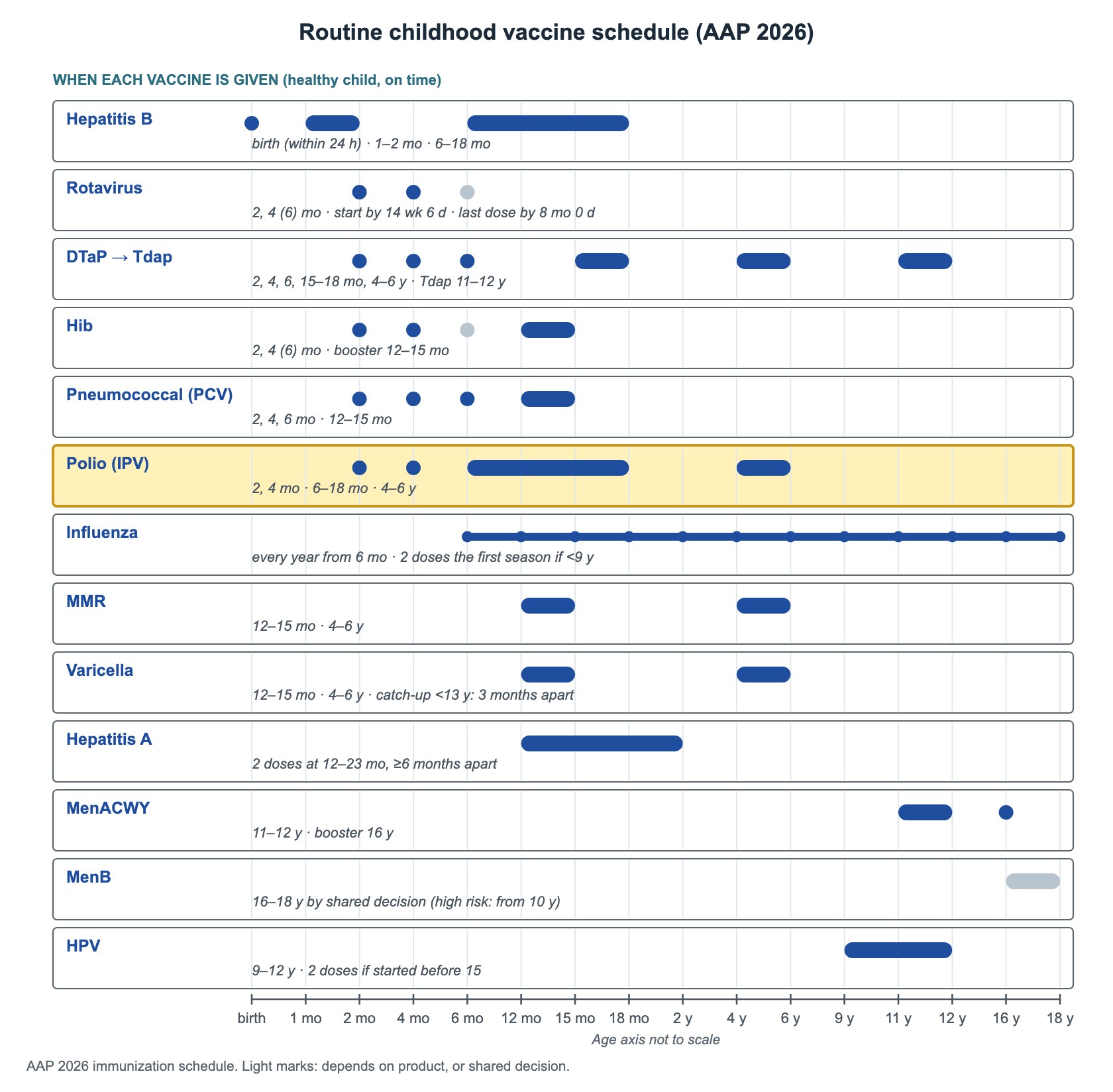
Routine childhood vaccine schedule (AAP 2026) — schedule graph
Routine schedule
- IPV at 2 months, 4 months, 6–18 months and 4–6 years.
- The 4–6 year dose must be at 4 years or older and at least 6 months after dose 3.
- Combination vaccines (such as DTaP-IPV-Hib-HepB) may bring the total to 5 doses; that is fine.
Catch-up rules
- Minimum age for dose 1 is 6 weeks; doses 1, 2 and 3 are at least 4 weeks apart.
- The final dose is always at 4 years or older and at least 6 months after the previous dose.
- A child who starts at 4 years or older needs 3 doses: 4 weeks, then 6 months apart.
- Never restart the series: count every valid dose already given.
- Catch-up is not routine for US residents 18 years and older.
Polio doses given abroad (OPV)
- Only trivalent OPV (tOPV), which covers all 3 polio types, counts toward the US series.
- OPV given before April 1, 2016 counts, because it was trivalent.
- OPV given on or after April 1, 2016 does not count unless the record says trivalent: from then on, countries used bivalent OPV, which misses type 2.
- A child with OPV-only or mixed OPV-IPV records needs the same number of doses as the US IPV schedule, with the same rule for the final dose.
- If the record is unclear, count only documented valid doses and give IPV to finish; extra doses are safe.
Who should not get it, and side effects
- Do not give after a severe allergic reaction (anaphylaxis) to a previous dose or a component, including neomycin, streptomycin or polymyxin B.
- Pregnancy is a precaution; give only if there is a real risk of exposure.
- A moderate or severe acute illness is a reason to delay, not to skip.
- Side effects are mild: soreness and redness where the shot was given. IPV cannot cause polio.
Common questions
How many polio shots does a child need?
Four: at 2 months, 4 months, 6–18 months and 4–6 years. Three can be enough if the third was given at 4 years or older and at least 6 months after the second.
Does my child need a polio booster at 4 years if they already had 4 doses?
Yes, if all 4 doses were given before age 4. The final dose must be at 4 years or older and at least 6 months after the previous dose.
Do polio drops given in another country count?
Only trivalent oral polio vaccine counts. Drops given before April 1, 2016 count; drops given on or after that date do not, unless the record says they were trivalent.
Can IPV cause polio?
No. IPV contains killed virus and cannot cause polio. Only the oral vaccine, which is no longer used in the US, carries that very rare risk.
Do adults need a polio vaccine?
Most US adults vaccinated as children do not. Adults never vaccinated, or at higher risk (some travelers, lab and health workers), should talk to their doctor.
Sources
- CDC: Child and adolescent immunization schedule and catch-up guidance
- CDC: Child immunization schedule notes
- CDC: Polio vaccine recommendations
- CDC: Contraindications and precautions (General Best Practice Guidelines)
Written for Pedemy in our own words from the sources above; checked October 2026. For education only, not medical advice. Pedemy is independent and not affiliated with or endorsed by the organizations cited.