

Main decision tree
MenACWY: routine or medical risk?
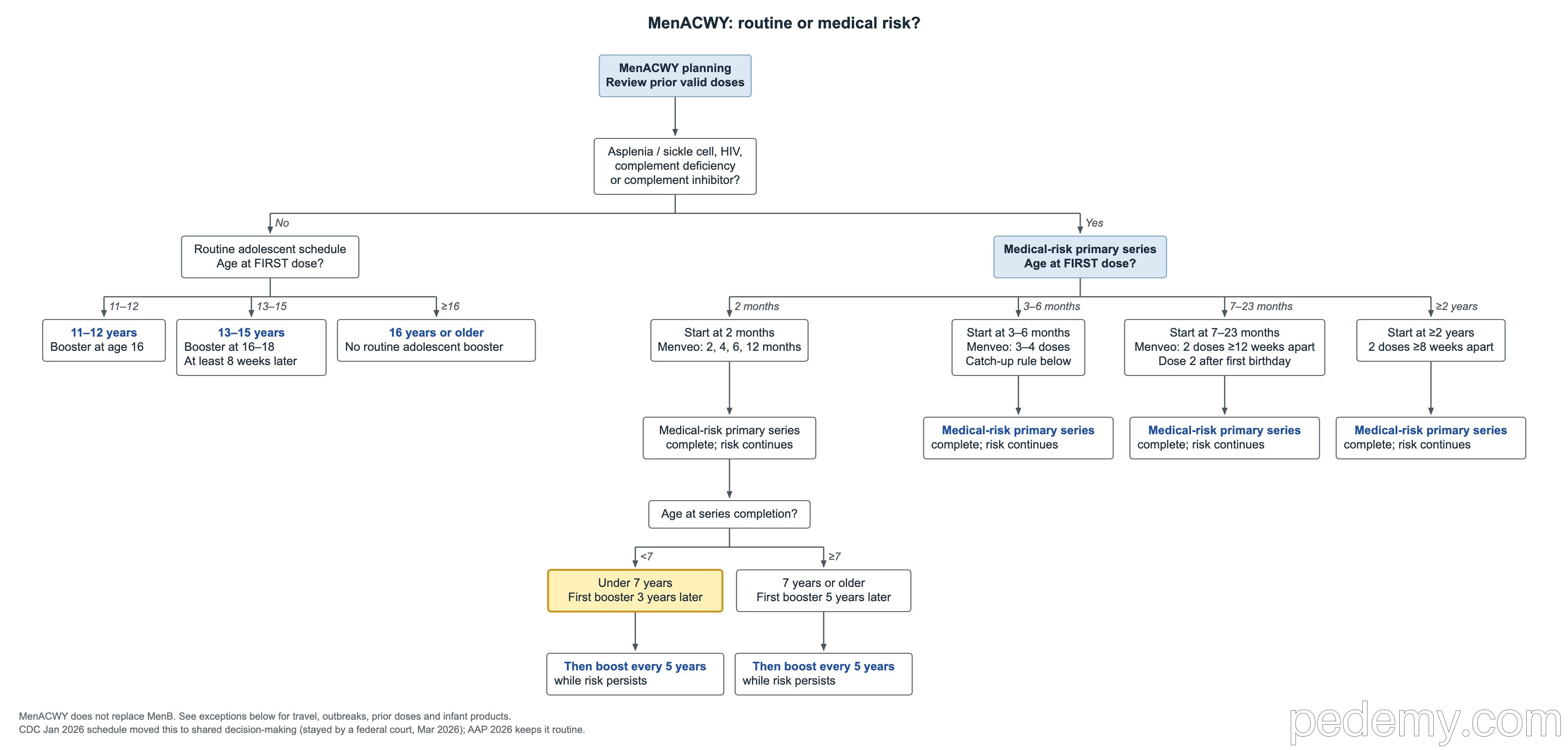
At a glance
- Routine: 1 dose at 11–12 years and a booster at 16 years.
- First dose at 13–15 years: booster at 16–18 years. First dose at 16 years or older: no booster needed.
- Catch-up through 18 years; first-year college students in residence halls and military recruits up to 21 years get 1 dose if they had none at 16 or older.
- Asplenia, sickle cell disease, complement deficiency, complement inhibitors (eculizumab, ravulizumab) and HIV: start from 2 months with a 2- to 4-dose series by age.
- High-risk boosters: 3 years after a primary series finished before age 7, then every 5 years while the risk lasts.
- Travel to the African meningitis belt or for Hajj or Umrah needs MenACWY before the trip.
- MenACWY does not cover serogroup B; that needs a separate MenB vaccine.
More decision trees
From Pedemy's flashcards. Tap a tree to open it full size.
Routine childhood vaccine schedule (AAP 2026) — schedule graph
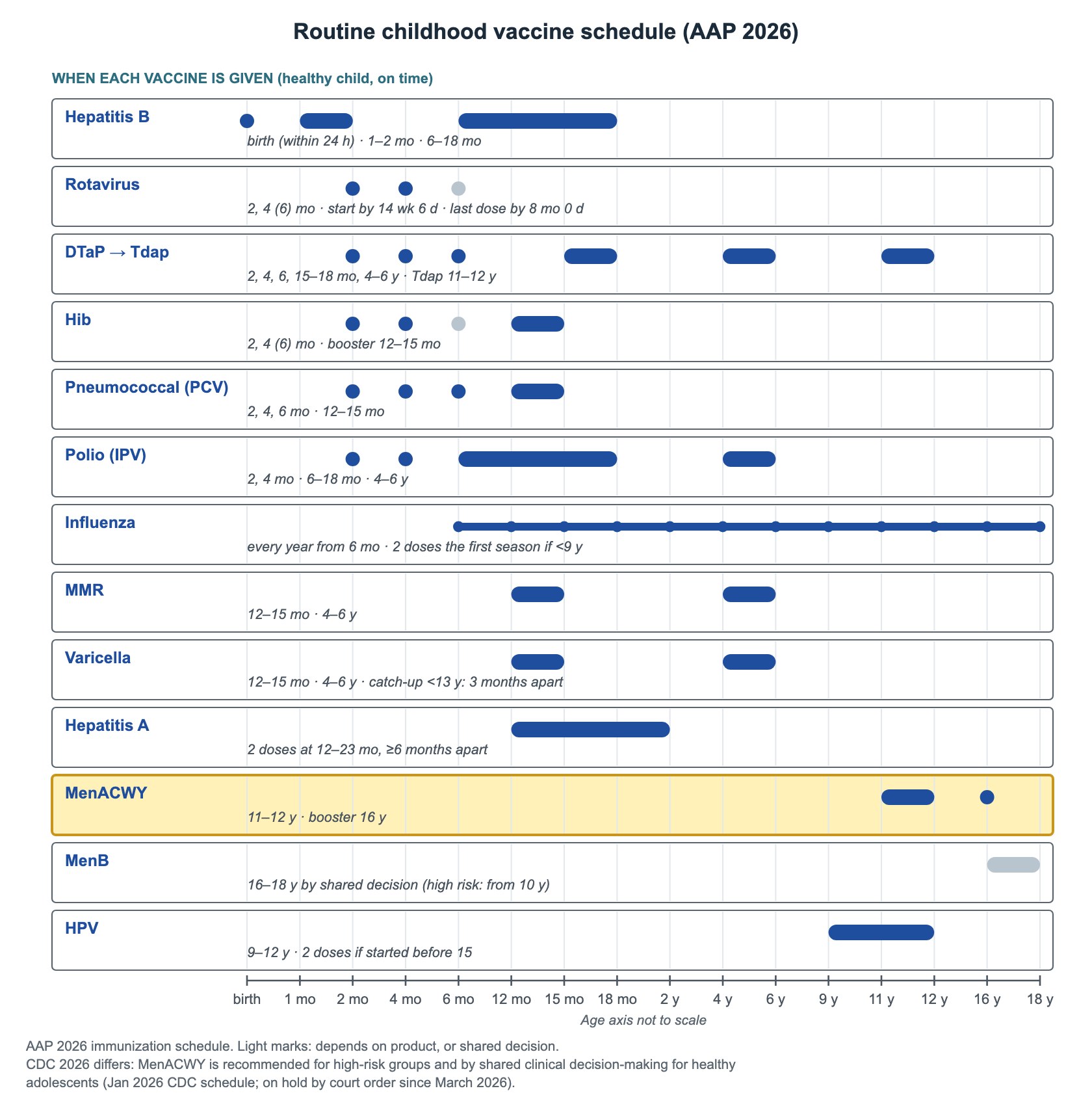
Routine schedule
- Dose 1 at 11–12 years.
- Booster at 16 years.
- First dose at 13–15 years: booster at 16–18 years, at least 8 weeks later.
- First dose at 16–18 years: 1 dose only.
- Adolescents with HIV get a 2-dose primary series (8 weeks apart) at 11–12 years, plus the booster at 16 and boosters every 5 years.
Catch-up rules
- Routine catch-up runs through 18 years.
- First-year college students in residence halls and military recruits get 1 dose if they had none at 16 or older.
- MenACWY can also be given up to 21 years to anyone with no dose at 16 or older.
- Menveo and MenQuadfi can both be used; count doses of either.
Children at higher risk
| Age at first dose | Primary series | Boosters while risk lasts |
|---|---|---|
| 2–6 months | Menveo at 2, 4, 6 and 12 months | 3 years later, then every 5 years |
| 7–23 months | Menveo, 2 doses 12 weeks apart (dose 2 after age 1) | 3 years later, then every 5 years |
| 2–6 years | 2 doses, 8 weeks apart | 3 years later, then every 5 years |
| 7 years or older | 2 doses, 8 weeks apart | Every 5 years |
Who counts as high risk
- Anatomic or functional asplenia, including sickle cell disease.
- Persistent complement component deficiency, or a complement inhibitor such as eculizumab or ravulizumab.
- HIV infection.
- Travel to or living in the African meningitis belt, or Hajj or Umrah (1 dose from 2 years; age-based series under 2).
- Being part of a community outbreak caused by serogroup A, C, W or Y.
Who should not get it, and side effects
- Do not give after anaphylaxis to a previous dose or a vaccine component; Menveo also after severe allergy to diphtheria toxoid or CRM197, MenQuadfi after severe allergy to tetanus toxoid.
- A moderate or severe acute illness is a reason to delay; a mild cold is not.
- Common: sore arm, redness, headache, tiredness and mild fever for a day or two.
- Teens can faint after any injection; have them sit for 15 minutes afterwards.
Common questions
Is the meningitis vaccine at 16 years really needed?
Yes. Protection from the 11–12-year dose fades within a few years, and the risk is highest at 16–21 years, so the booster covers those years.
Does a 17-year-old who never had MenACWY need 2 doses?
No. A first dose at 16 years or older is enough for a healthy teen; no booster is needed.
Does my child need the meningitis vaccine for college?
First-year students living in residence halls need a dose if they had none at 16 years or older. Many colleges require it.
Does MenACWY protect against meningitis B?
No. Serogroup B needs a separate MenB vaccine, discussed at 16–18 years for healthy teens and given from 10 years for high-risk children.
When does a child with sickle cell disease get MenACWY?
From 2 months, not at 11 years: an age-based series of 2–4 doses, then a booster 3 years later if the series ended before age 7, and every 5 years after that.
Sources
- CDC: Child and adolescent immunization schedule and catch-up guidance
- CDC: Child and adolescent schedule notes (meningococcal vaccination)
- CDC: Meningococcal vaccine recommendations
- AAP: Immunization schedule (aap.org)
Written for Pedemy in our own words from the sources above; checked October 2026. For education only, not medical advice. Pedemy is independent and not affiliated with or endorsed by the organizations cited.