

Main decision tree
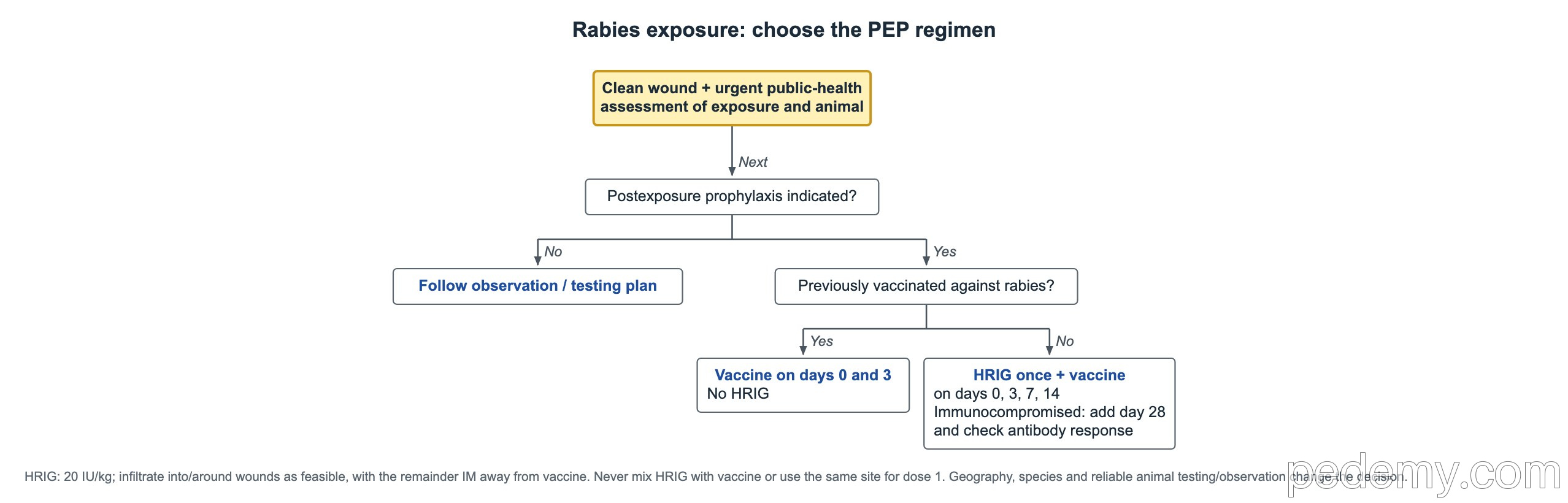
Rabies exposure: choose the PEP regimen
At a glance
- First, wash every bite or scratch with soap and water for about 15 minutes; this alone lowers the risk a lot.
- A healthy dog, cat or ferret that can be watched for 10 days usually means no PEP unless the animal falls ill.
- Bats, raccoons, skunks, foxes and coyotes are treated as rabid unless the animal tests negative.
- A bat found in a room with a sleeping person or a young child counts as an exposure, even with no visible bite.
- Never vaccinated: rabies immune globulin (RIG) into the wound plus 4 vaccine doses on days 0, 3, 7 and 14.
- Previously vaccinated: 2 vaccine doses on days 0 and 3, and no RIG. Immunocompromised: 5 doses plus RIG.
- Squirrels, rats, mice, hamsters, guinea pigs and rabbits almost never need PEP. Call the local health department about testing the animal.
What to do first
- Wash the wound with soap and running water for about 15 minutes; use povidone-iodine if available.
- Get medical care the same day; PEP is urgent but is not a reason for an emergency visit unless the wound needs it.
- Note the animal, where it is, and whether it was provoked; call animal control or the local health department to arrange observation or testing.
- Do not kill or damage the head of an animal that needs testing; the brain is needed for the test.
- Check tetanus vaccination and whether the wound needs antibiotics.
Which animals carry rabies
| Animal | Risk | What to do |
|---|---|---|
| Dog, cat, ferret | Low in the US if healthy; high in many countries | Watch for 10 days; PEP if it falls ill, or if it cannot be found and the health department advises |
| Bat | High; bites can be tiny and missed | PEP unless the bat tests negative |
| Raccoon, skunk, fox, coyote | High | PEP unless the animal tests negative |
| Squirrel, rat, mouse, hamster, guinea pig, rabbit | Very low | Usually no PEP |
| Groundhog, beaver, livestock, monkey | Varies | Call the local health department |
PEP schedules
| Person | Rabies immune globulin | Vaccine (1 mL IM) |
|---|---|---|
| Never vaccinated | 20 IU/kg on day 0, into and around the wound | Days 0, 3, 7, 14 |
| Never vaccinated and immunocompromised | 20 IU/kg on day 0, into and around the wound | Days 0, 3, 7, 14, 28, then antibody test |
| Previously vaccinated (complete course) | None | Days 0 and 3 |
Practical points
- The dose is the same for children and adults; RIG is dosed by weight.
- Give the vaccine in the deltoid, or the outer thigh in young children; never in the buttock.
- Never give RIG in the same syringe or site as the vaccine.
- There is no true contraindication to PEP; pregnancy and infancy are not reasons to withhold it.
- Keep to the schedule; if a dose is a few days late, carry on from where the series stopped.
Common questions
Does my child need rabies shots after a dog bite?
Usually not, if the dog is healthy and can be watched for 10 days in a country where dog rabies is rare. If the dog falls ill, cannot be found, or the bite happened abroad where dog rabies is common, PEP may be needed.
Is a bat in the bedroom a rabies exposure?
Yes, if it was in a room with a sleeping person, a young child or anyone who cannot reliably say whether they were touched. PEP is given unless the bat is caught and tests negative.
How many rabies shots are needed after a bite?
A child never vaccinated before gets rabies immune globulin plus 4 vaccine doses on days 0, 3, 7 and 14. A previously vaccinated child gets 2 doses on days 0 and 3, and an immunocompromised child gets 5.
Is it too late for rabies PEP after a few days?
No. Rabies can take weeks to months to develop, so PEP should still be started if an exposure is found late, as long as there are no symptoms.
Do squirrel or rabbit bites need rabies shots?
Almost never. Small rodents and rabbits rarely carry rabies; groundhogs and beavers are exceptions, so call the health department about those.
Sources
- CDC: Rabies post-exposure prophylaxis
- CDC: Rabies clinical screening (who needs PEP)
- CDC: Prevent rabies from bats
- CDC/ACIP: Reduced 4-dose rabies vaccine schedule for PEP (MMWR 2010)
Written for Pedemy in our own words from the sources above; checked October 2026. For education only, not medical advice. Pedemy is independent and not affiliated with or endorsed by the organizations cited.