

Main decision tree
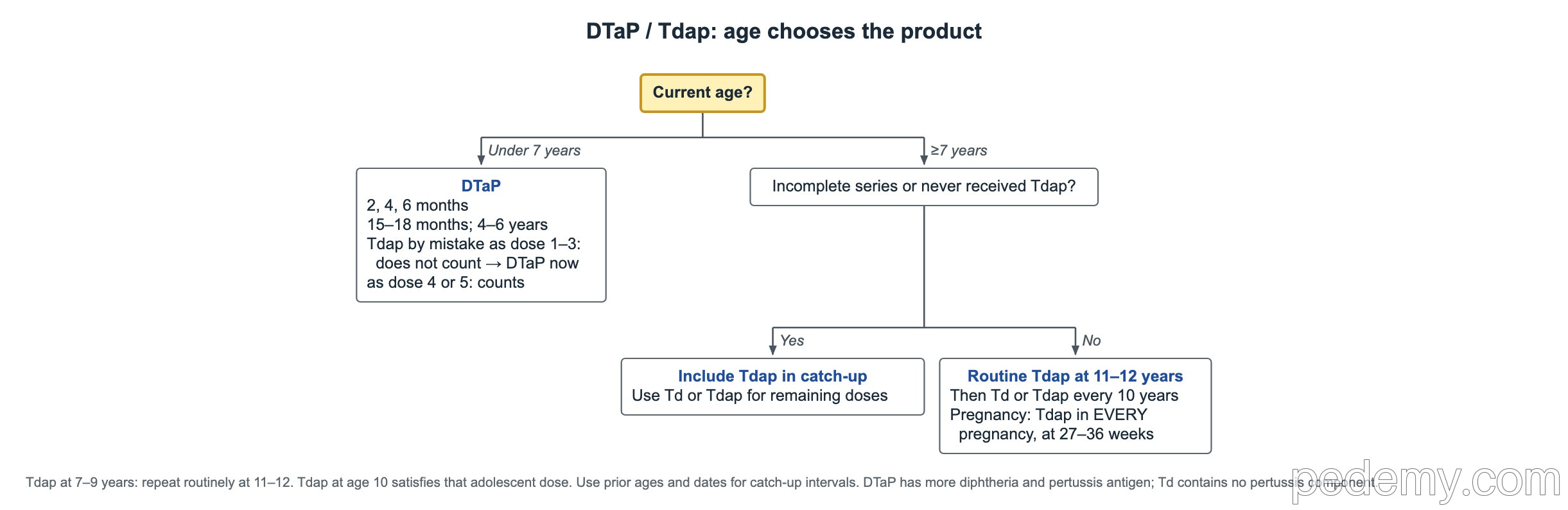
DTaP / Tdap: age chooses the product
At a glance
- DTaP is for children under 7 years: 5 doses at 2, 4, 6 and 15–18 months and 4–6 years.
- Tdap is the booster at 11–12 years, and in every pregnancy (ideally at 27–36 weeks).
- After that, Td or Tdap every 10 years, or sooner for a tetanus-prone wound.
- Dose 5 is not needed if dose 4 was given at age 4 years or older.
- Children 7 years and older who are behind get Tdap first, then Td or Tdap for the rest.
- A dirty or deep wound needs a tetanus dose if the last one was 5 or more years ago; TIG is added only when the child has had fewer than 3 doses or the history is unknown.
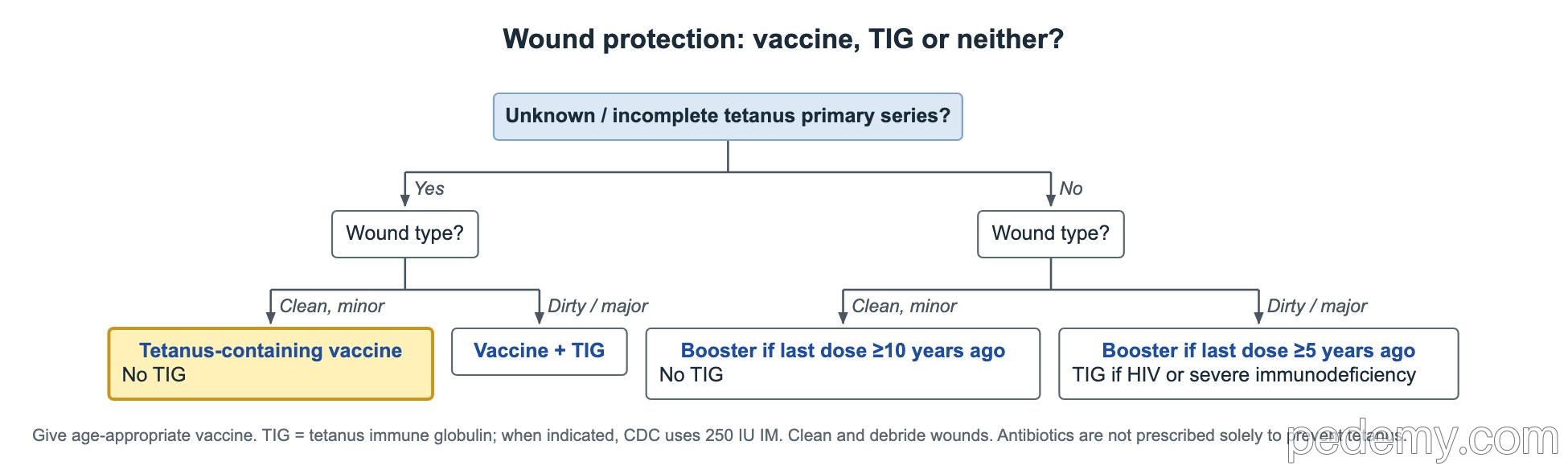
- Encephalopathy within 7 days of a pertussis-containing dose rules out further pertussis vaccine; give DT or Td instead.
More decision trees
From Pedemy's flashcards. Tap a tree to open it full size.
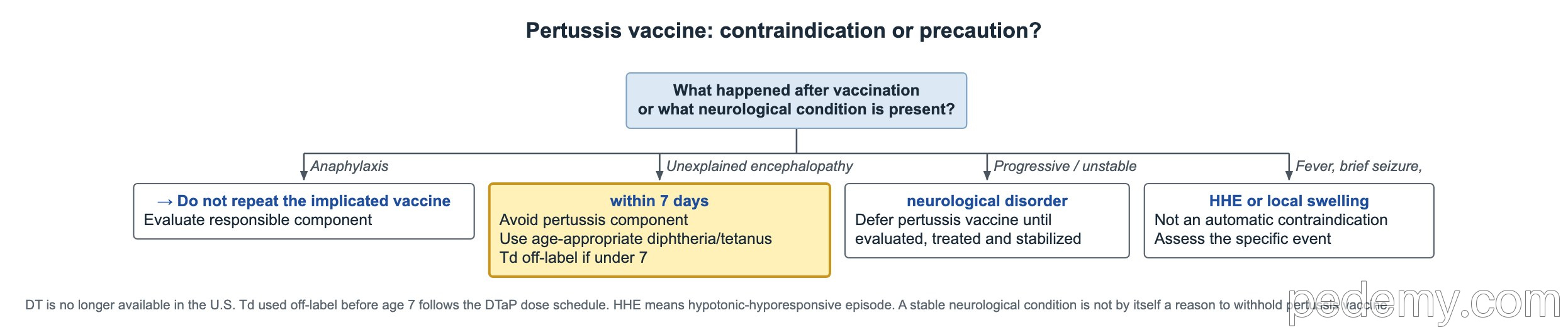
Routine childhood vaccine schedule (AAP 2026) — schedule graph
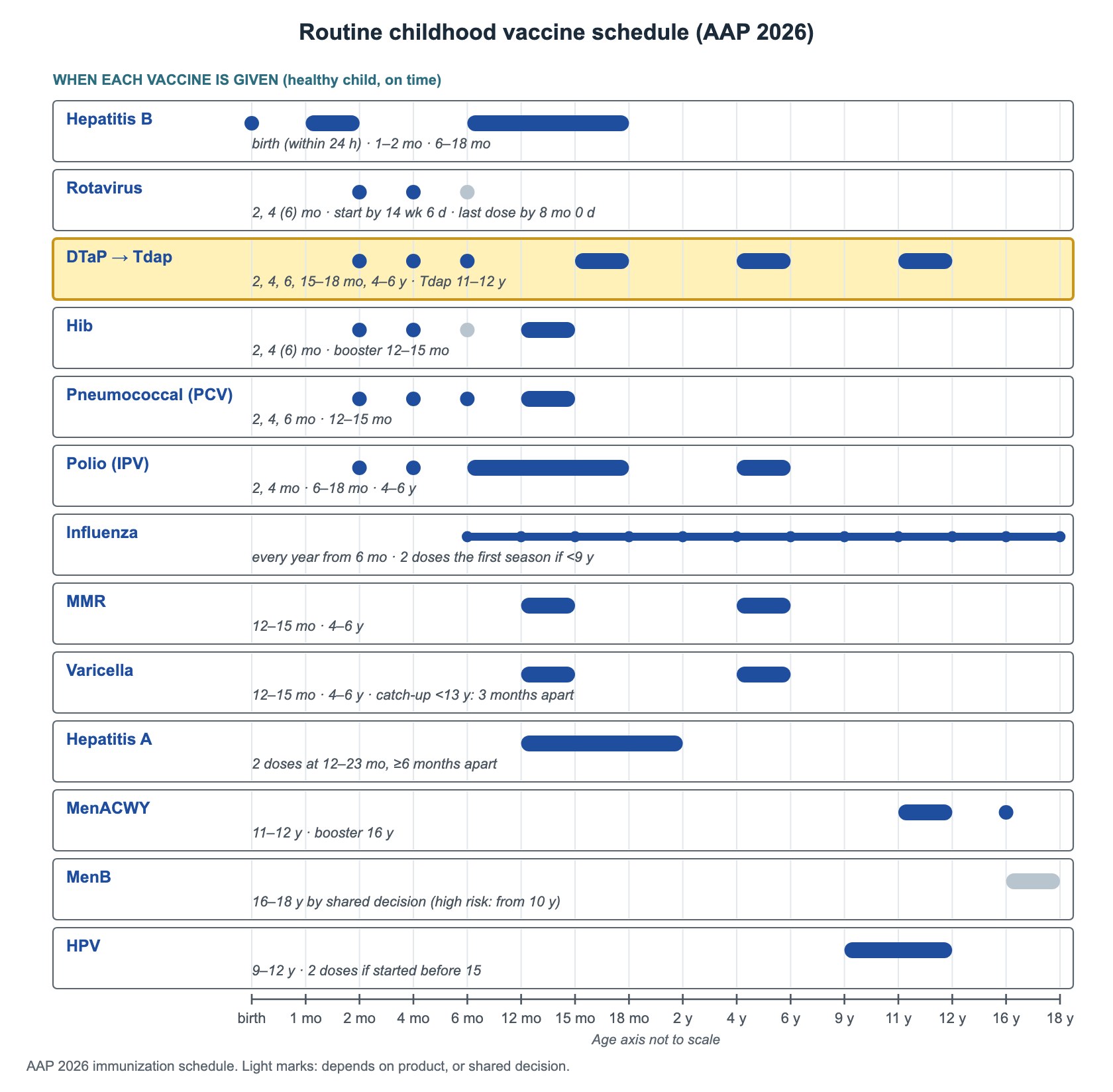
Wound protection: vaccine, TIG or neither?
DTaP, Tdap or Td: which one?
| Vaccine | Who gets it | What it covers |
|---|---|---|
| DTaP | Children under 7 years (the 5-dose infant and preschool series) | Full-strength diphtheria and pertussis, plus tetanus |
| Tdap | 11–12 years; every pregnancy; catch-up from 7 years; adults once | Reduced diphtheria and pertussis (the small "d" and "ap"), plus tetanus |
| Td | Boosters every 10 years after Tdap; wound care when Tdap is already done | Tetanus and reduced diphtheria, no pertussis |
| DT | Under 7 years who must not get pertussis vaccine | Tetanus and full-strength diphtheria |
Routine schedule
- DTaP at 2, 4, 6 and 15–18 months, and 4–6 years.
- Dose 4 can be given from 12 months if at least 6 months have passed since dose 3.
- Tdap once at 11–12 years.
- Tdap in every pregnancy, ideally early in weeks 27–36, to protect the newborn from pertussis.
- Td or Tdap every 10 years after that.
Catch-up rules
- Minimum age for dose 1 is 6 weeks. Doses 1–3 are at least 4 weeks apart; dose 4 at least 6 months after dose 3.
- Dose 5 is not needed if dose 4 was given at 4 years or older and at least 6 months after dose 3.
- From 7 years: one Tdap first, then Td or Tdap to complete 3 doses (the second 4 weeks after the first, the third 6 months later).
- A child of 7–9 years who gets Tdap as catch-up still gets the routine Tdap at 11–12 years; a child who got it at 10 years does not need another.
- Never restart the series: count every valid dose already given.
Who should not get it, or should wait
- Do not give if there was a severe allergic reaction (anaphylaxis) to a previous dose or a vaccine component.
- Do not give pertussis vaccine after encephalopathy (coma, prolonged seizures, decreased consciousness) within 7 days of a previous DTaP or Tdap with no other cause; use DT or Td.
- Wait and discuss: a progressive or unstable neurologic disorder (until stable), Guillain-Barré syndrome within 6 weeks of a tetanus dose, or an Arthus-type reaction to a previous dose (wait 10 years since the last tetanus dose).
- A moderate or severe acute illness is a reason to delay, not to skip. A mild cold is not.
Side effects
- Common: pain, redness and swelling at the site, fever, fussiness, tiredness and poor appetite for 1–3 days.
- Swelling of the whole arm or thigh can follow the 4th or 5th dose; it settles on its own and is not a reason to stop.
- Rare: high fever, inconsolable crying for 3 hours or more, a febrile seizure, or a pale, floppy episode (hypotonic-hyporesponsive episode).
Common questions
What is the difference between DTaP and Tdap?
Both protect against tetanus, diphtheria and pertussis. DTaP has full-strength diphtheria and pertussis and is used under 7 years; Tdap has smaller amounts and is the booster from 7 years, at 11–12 years and in pregnancy.
Does a child need a tetanus shot after a cut?
For a clean minor cut, only if they have had fewer than 3 doses or the last dose was 10 or more years ago. For a dirty, deep or puncture wound, give a dose if the last one was 5 or more years ago, and add TIG if they have had fewer than 3 doses or the history is unknown.
Why is Tdap given in every pregnancy?
The mother's antibodies cross the placenta and protect the baby from whooping cough in the first months, before the baby's own DTaP series works. Antibody levels fall quickly, so a dose is needed in each pregnancy, ideally at 27–36 weeks.
Is dose 5 of DTaP always needed?
No. If dose 4 was given at age 4 years or older (and at least 6 months after dose 3), dose 5 is not needed.
Can a 10-year-old get Tdap?
Yes, as catch-up. If it is given at 10 years it counts as the adolescent dose; if given at 7–9 years, the child still gets Tdap again at 11–12 years.
Sources
- CDC: Child and adolescent immunization schedule and catch-up guidance
- CDC: Tetanus — clinical guidance and wound management
- CDC: Contraindications and precautions (General Best Practice Guidelines)
- AAP: Immunization schedule (aap.org)
Written for Pedemy in our own words from the sources above; checked October 2026. For education only, not medical advice. Pedemy is independent and not affiliated with or endorsed by the organizations cited.