

Main decision tree
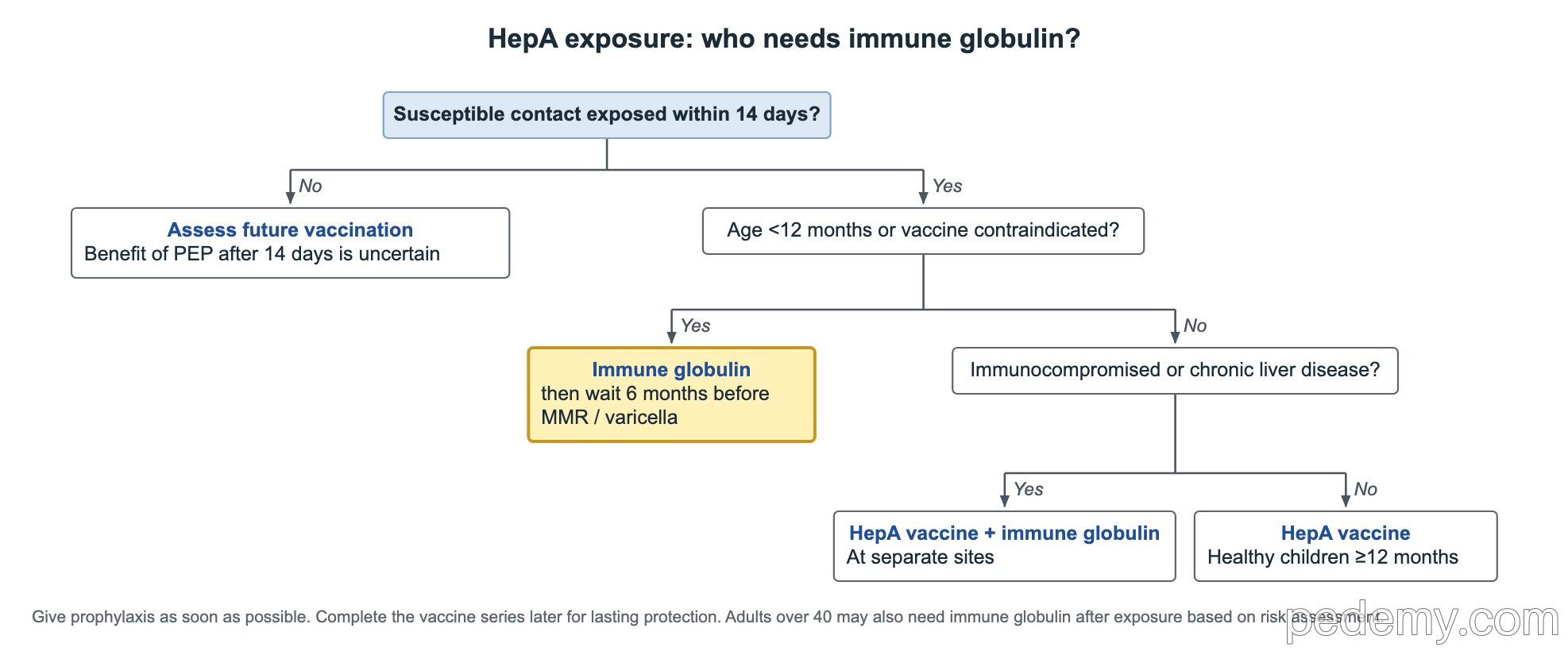
HepA exposure: who needs immune globulin?
At a glance
- Routine schedule: 2 doses between 12 and 23 months, at least 6 months apart.
- Catch-up: any unvaccinated child or teen through 18 years gets 2 doses, at least 6 months apart.
- After an exposure, protection works only if given within 2 weeks.
- Exposed and unvaccinated: under 12 months get immune globulin (IG); healthy children 12 months and older get 1 dose of vaccine.
- Immunocompromised or chronic liver disease: vaccine plus IG after an exposure.
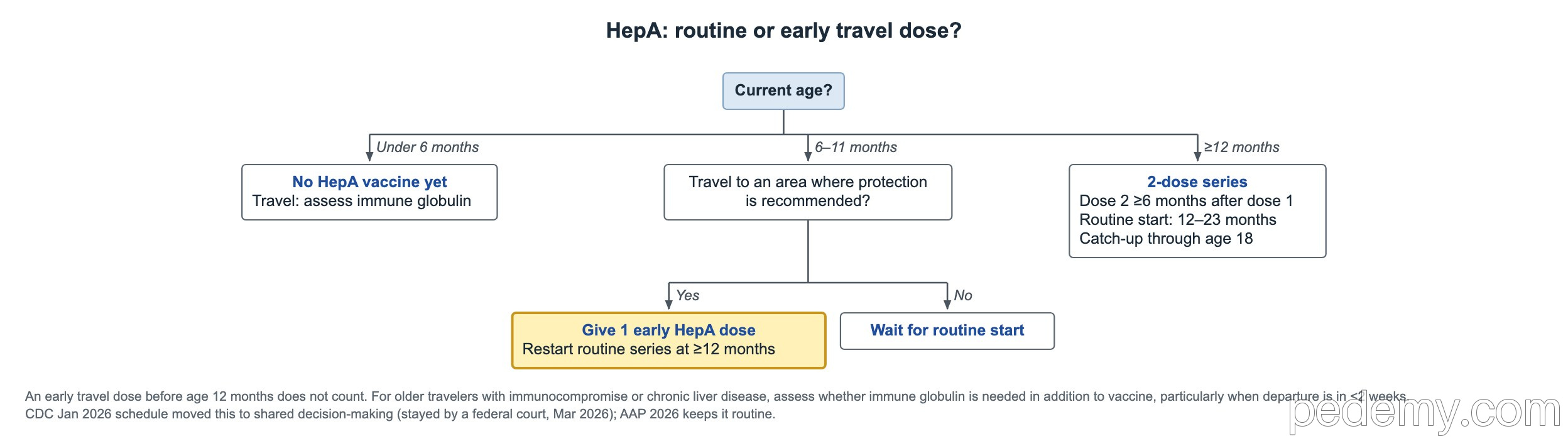
- Babies 6–11 months who travel get 1 dose before the trip; it does not count, so they still need 2 doses from 12 months.
- After IG, wait 6 months before giving MMR or varicella vaccine.
More decision trees
From Pedemy's flashcards. Tap a tree to open it full size.
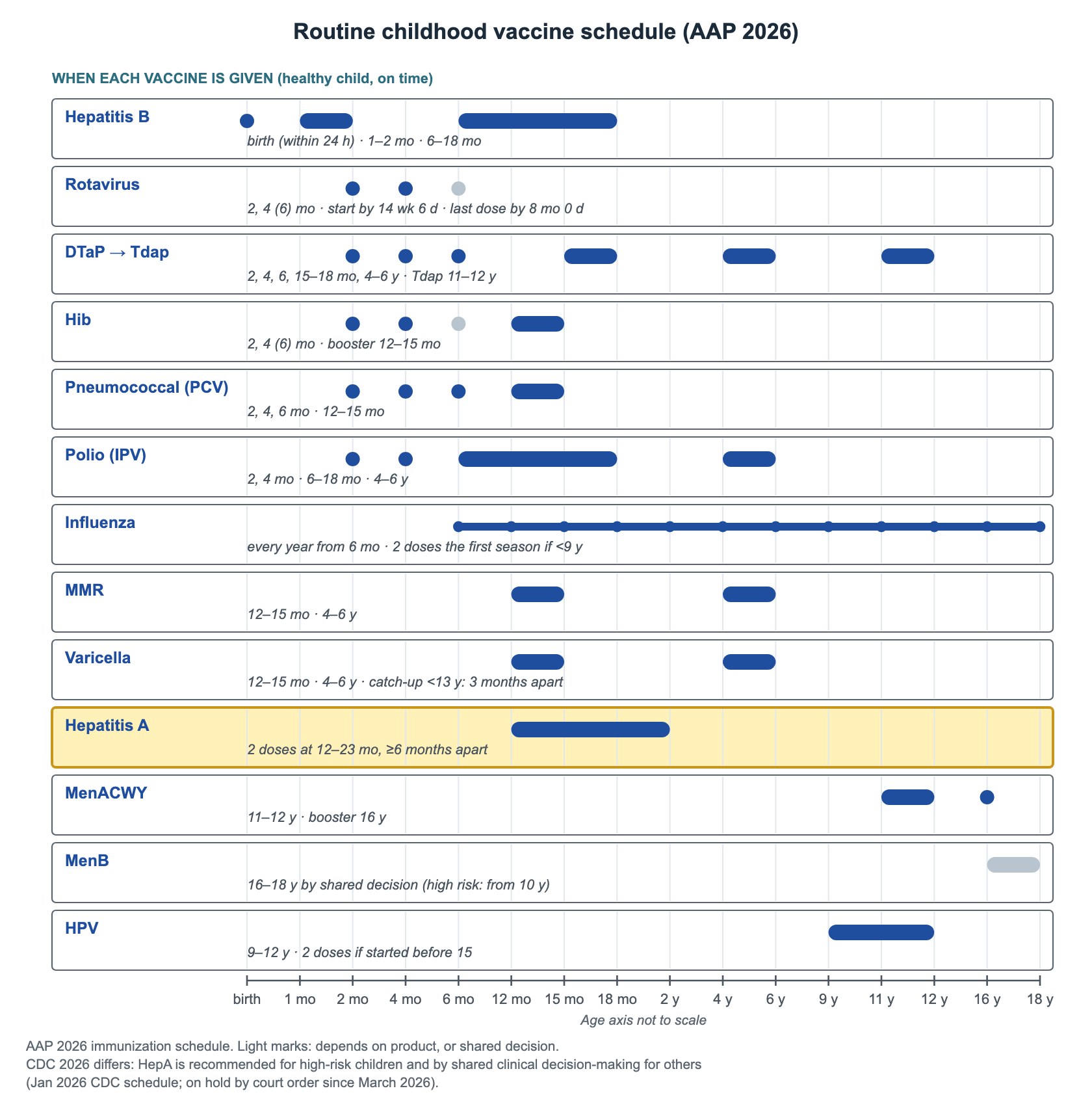
Routine childhood vaccine schedule (AAP 2026) — schedule graph
Routine schedule
- Dose 1 at 12–23 months and dose 2 at least 6 months later.
- Havrix and Vaqta are the pediatric vaccines; either can be used for either dose.
- Two doses give long-lasting protection; no booster is recommended for healthy children.
Catch-up rules
- Any child or teen through 18 years who has not had 2 doses should get them, at least 6 months apart.
- A dose given before 12 months does not count; restart counting at 12 months.
- If dose 2 is late, just give it: never restart the series.
After an exposure
| Unvaccinated child | Within 2 weeks of exposure |
|---|---|
| Under 12 months | IG 0.1 mL/kg |
| 12 months and older, healthy | 1 dose of hepatitis A vaccine |
| Immunocompromised or chronic liver disease (12 months and older) | 1 dose of vaccine plus IG 0.1 mL/kg |
| Vaccine not allowed (severe allergy) | IG 0.1 mL/kg |
Before travel
- Under 6 months: IG, with the dose based on how long the trip is.
- 6–11 months: 1 dose of vaccine before travel; it does not count, so give 2 more from 12 months.
- 12 months and older: start or finish the 2-dose series; give dose 1 as soon as travel is planned.
- Immunocompromised or chronic liver disease leaving within 2 weeks: vaccine, and IG can be added.
Who should not get it, and side effects
- Do not give after a severe allergic reaction (anaphylaxis) to a previous dose or a vaccine component.
- A moderate or severe acute illness is a reason to delay, not to skip.
- Common side effects are a sore arm or leg, headache, tiredness and poor appetite for a day or two.
Common questions
When do babies get the hepatitis A vaccine?
The first dose is given between 12 and 23 months, and the second at least 6 months later. Children who missed it can catch up at any age through 18 years.
My child was exposed to hepatitis A. What should we do?
If the child is not vaccinated and the exposure was within the last 2 weeks, act now. Healthy children 12 months and older get 1 dose of vaccine; babies under 12 months get immune globulin; children with weak immunity or liver disease get both.
Can a baby under 12 months get the hepatitis A vaccine for travel?
Yes, from 6 months. One dose is given before the trip, but it does not count, so the baby still needs 2 doses starting at 12 months. Babies under 6 months get immune globulin instead.
Is 1 dose of hepatitis A vaccine enough?
One dose protects most healthy children within about 2 weeks, but the second dose is needed for long-lasting protection.
Does immune globulin affect other vaccines?
Yes. After hepatitis A immune globulin, wait 6 months before giving MMR or varicella vaccine, because the antibodies can stop these live vaccines from working.
Sources
- CDC: Child immunization schedule notes
- CDC MMWR: Prevention of hepatitis A virus infection in the United States (ACIP, 2020)
- CDC Yellow Book: Hepatitis A
- CDC: Clinical overview of hepatitis A
- AAP: Immunization schedule (aap.org)
Written for Pedemy in our own words from the sources above; checked October 2026. For education only, not medical advice. Pedemy is independent and not affiliated with or endorsed by the organizations cited.