

Main decision tree
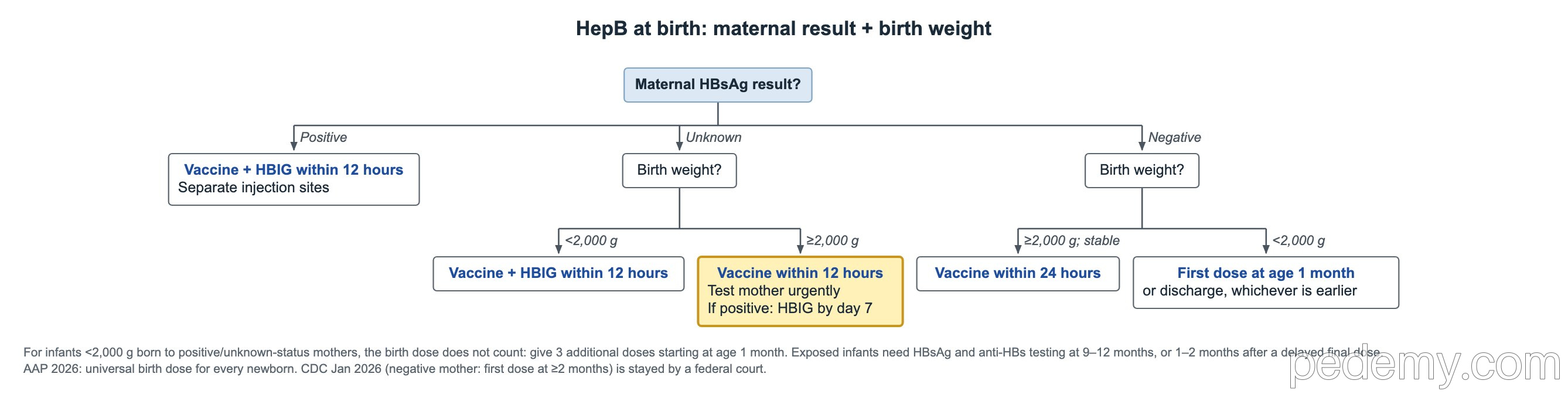
HepB at birth: maternal result + birth weight
At a glance
- Routine schedule: 3 doses at birth, 1–2 months and 6–18 months.
- The AAP recommends a birth dose for every newborn, within 24 hours of birth if medically stable.
- Mother HBsAg positive: hepatitis B vaccine and HBIG within 12 hours of birth, at any birth weight.
- A birth dose given to a baby under 2,000 g does not count; these babies need 3 more doses (4 in total).
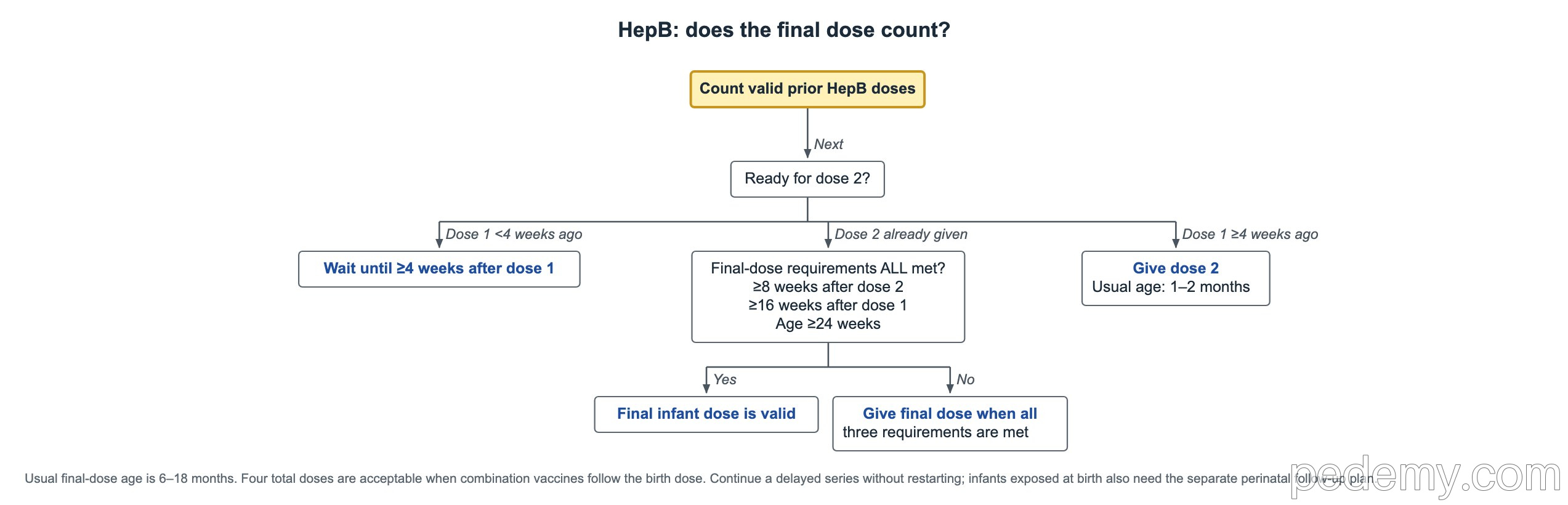
- The final dose must be given at 24 weeks of age or older, or it has to be repeated.
- Babies of HBsAg-positive mothers need a blood test (HBsAg and anti-HBs) at 9–12 months to confirm protection.
- The only contraindication is a severe allergic reaction to a previous dose or a vaccine component, such as yeast.
More decision trees
From Pedemy's flashcards. Tap a tree to open it full size.
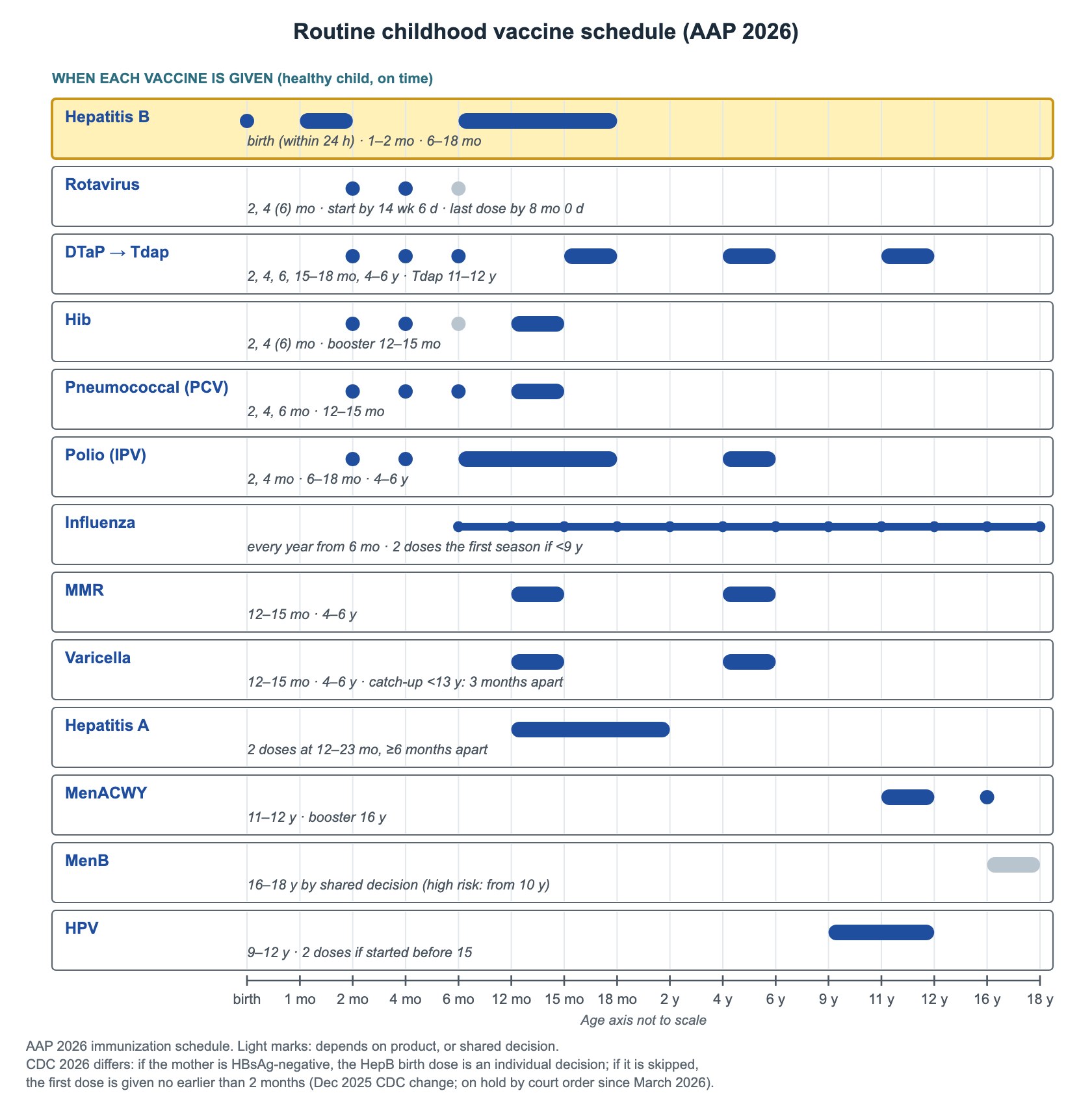
Routine childhood vaccine schedule (AAP 2026) — schedule graph
Newborns: what to give by the mother's result
| Mother's HBsAg | 2,000 g or more | Less than 2,000 g |
|---|---|---|
| Positive | Vaccine + HBIG within 12 hours; birth dose counts (3 doses) | Vaccine + HBIG within 12 hours; birth dose does not count (4 doses) |
| Unknown | Vaccine within 12 hours; HBIG by day 7 if the mother is positive | Vaccine + HBIG within 12 hours unless she is negative by then; birth dose does not count |
| Negative | Vaccine within 24 hours | First dose at 1 month or discharge, whichever comes first |
Routine schedule
- Dose 1 at birth, dose 2 at 1–2 months, dose 3 at 6–18 months.
- Combination vaccines that contain hepatitis B can bring the total to 4 doses after the birth dose; that is fine.
- Babies of HBsAg-positive mothers should finish on time, with the last dose at 6 months.
Catch-up rules
- At least 4 weeks between doses 1 and 2, 8 weeks between doses 2 and 3, and 16 weeks between doses 1 and 3.
- The final dose must be given at 24 weeks of age or older; if not, give another dose.
- Unvaccinated children and teens through 18 years get the full 3-dose series.
- Teens 11–15 years can instead get 2 doses of the adult-formulation Recombivax HB, at least 4 months apart.
- Never restart the series: count every valid dose already given.
Testing babies of HBsAg-positive mothers
- Test HBsAg and anti-HBs at 9–12 months, or 1–2 months after the last dose if the series finished late.
- Do not test before 9 months, so HBIG antibodies have gone and late infection is not missed.
- Anti-HBs 10 mIU/mL or more and HBsAg negative: protected, nothing more to do.
- Anti-HBs under 10 mIU/mL and HBsAg negative: give 1 more dose and retest 1–2 months later; if still under 10, finish a second series and retest.
- HBsAg positive: the baby has hepatitis B and should be referred for follow-up.
Who should not get it, and side effects
- Do not give after a severe allergic reaction (anaphylaxis) to a previous dose or a vaccine component, including yeast.
- A moderate or severe acute illness is a reason to delay, not to skip; for a newborn of an HBsAg-positive mother, do not delay.
- Common side effects are a sore leg or arm and a low fever for a day or two.
Common questions
Why do newborns get the hepatitis B vaccine?
A baby infected at birth has about a 90% chance of lifelong infection, which can lead to liver cancer and cirrhosis. The birth dose protects babies whose mothers' infection was missed or tested negative too early, as well as babies exposed by other family members.
What is HBIG and when does a baby need it?
HBIG (hepatitis B immune globulin) gives ready-made antibodies for immediate protection. A baby needs it within 12 hours of birth if the mother is HBsAg positive, or if her status is unknown and the baby weighs under 2,000 g.
Does the birth dose count for a premature baby?
Not if the baby weighed under 2,000 g at the time. These babies need 3 more doses starting at 1 month of age, 4 in total.
Can a mother with hepatitis B breastfeed?
Yes. Breastfeeding is safe once the baby has had hepatitis B vaccine and HBIG, and it should not be delayed.
When is a baby tested after the hepatitis B series?
Only babies of HBsAg-positive mothers need testing. Check HBsAg and anti-HBs at 9–12 months of age, or 1–2 months after the last dose if the series was delayed.
Sources
- CDC: Child and adolescent immunization schedule and catch-up guidance
- CDC: Child immunization schedule notes
- CDC: Clinical overview of perinatal hepatitis B
- CDC MMWR: Prevention of hepatitis B virus infection in the United States (ACIP, 2018)
- AAP: Immunization schedule (aap.org)
Written for Pedemy in our own words from the sources above; checked October 2026. For education only, not medical advice. Pedemy is independent and not affiliated with or endorsed by the organizations cited.