

Main decision tree
Giving different vaccines: same day or separate?
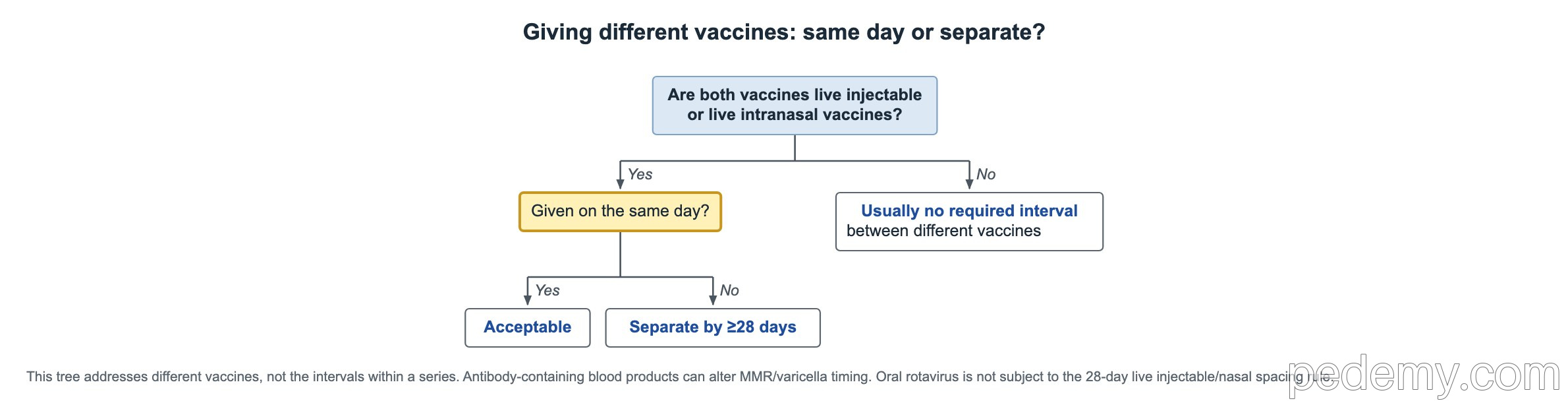
At a glance
- Doses given up to 4 days before the minimum age or interval still count; 5 or more days early, repeat the dose.
- Never restart a series: count every valid dose, however long ago it was given.
- All vaccines due can be given at the same visit, in separate sites.
- Two live injected or nasal vaccines (MMR, varicella, LAIV, yellow fever) go on the same day or at least 28 days apart.
- True contraindications are few: anaphylaxis to a previous dose or component, and for live vaccines, pregnancy or severe immunosuppression.
- Mild illness, antibiotics, prematurity, breastfeeding, a pregnant household contact and egg allergy are not reasons to wait.
- After immune globulin or blood products, MMR and varicella are delayed 3–11 months depending on the product.
More decision trees
From Pedemy's flashcards. Tap a tree to open it full size.
HepB at birth: maternal result + birth weight
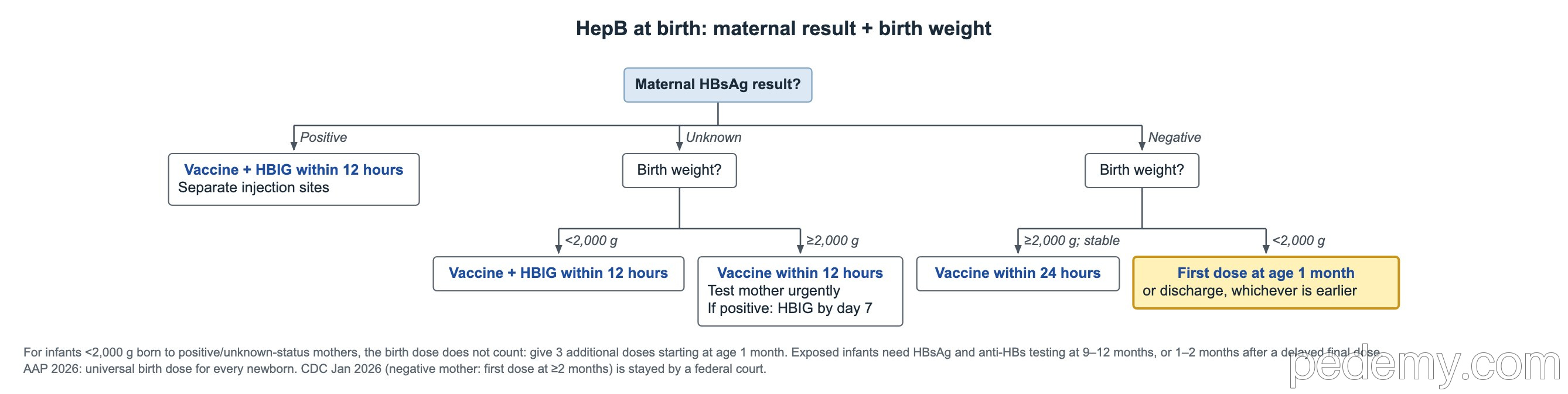
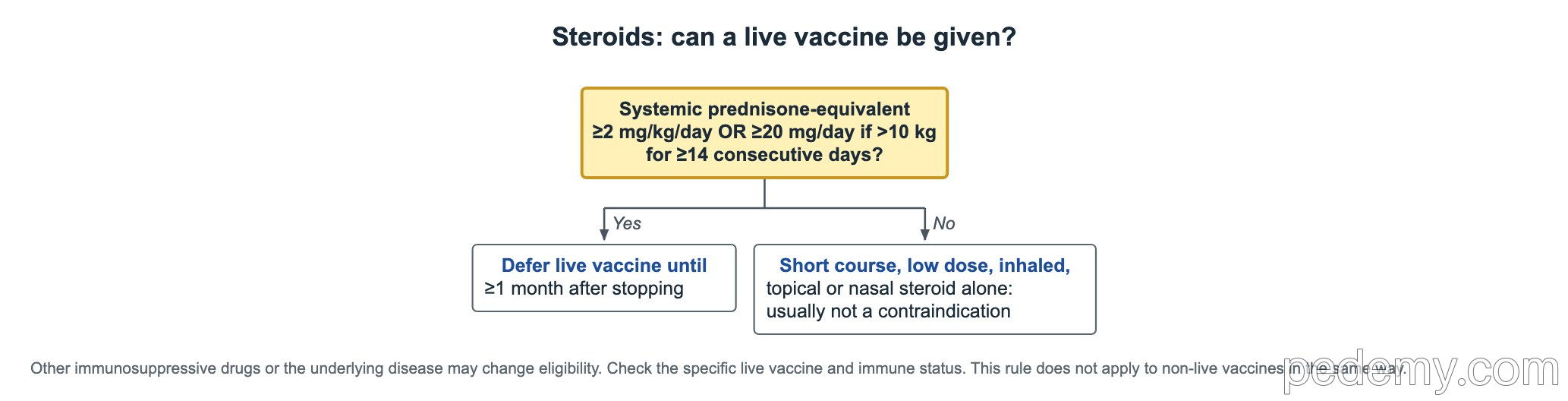
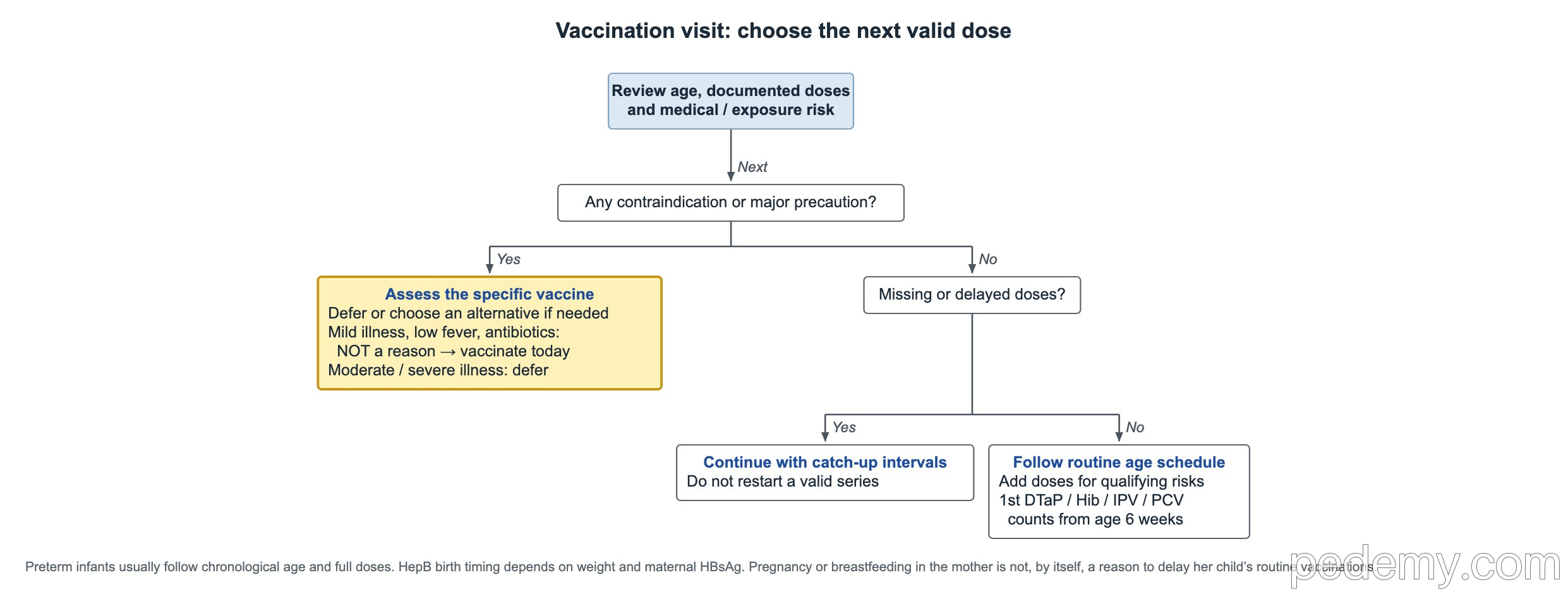
Minimum ages, intervals and the 4-day grace period
- Every vaccine has a minimum age and a minimum gap between doses; doses given earlier may not work.
- A dose given up to 4 days before the minimum still counts. Use this to judge records, not to plan visits early.
- A dose given 5 or more days early does not count: repeat it at least the minimum interval after the invalid dose.
- The grace period does not apply to the 28-day gap between two live vaccines, or to rabies vaccine. Some states do not accept it for school records.
- Common minimum ages: HepB at birth; DTaP, IPV, Hib, PCV and rotavirus at 6 weeks; flu at 6 months; MMR, varicella and HepA at 12 months; HPV at 9 years.
Late doses, same-day vaccines and live vaccines
- Never restart a series or add extra doses because of a long gap; give the next dose that is due.
- Give every vaccine that is due at the same visit. This is safe and gets the child protected sooner.
- Two live injected or nasal vaccines not given the same day need at least 28 days between them; otherwise the second is repeated.
- Inactivated vaccines and live oral vaccines need no spacing from any other vaccine.
- A TB skin test or blood test can be done on the same day as MMR; otherwise wait at least 4 weeks after MMR, because measles vaccine can cause a false-negative result.
True contraindications and precautions
- Any vaccine: a severe allergic reaction (anaphylaxis) to a previous dose or a vaccine component.
- Live vaccines: pregnancy, and severe immunosuppression (for example cancer treatment, transplant, severe primary immune deficiency).
- High-dose steroids (2 mg/kg/day, or 20 mg/day if over 10 kg, of prednisone for 14 days or more): wait at least 1 month after stopping before MMR or varicella.
- Pertussis vaccines: encephalopathy within 7 days of a previous dose. Rotavirus: SCID or a past intussusception.
- Precaution: a moderate or severe acute illness, with or without fever. Delay until better, then vaccinate.
Not reasons to delay
- Mild illness such as a cold, ear infection or mild diarrhea, with or without a low fever.
- Taking antibiotics, or recovering from an illness.
- Prematurity: vaccinate by age from birth, at full dose (the HepB birth dose under 2 kg is the exception).
- Breastfeeding, by the mother or the baby.
- A pregnant or immunocompromised person at home: MMR, varicella and rotavirus are still given to the child.
- Egg allergy, even severe: any flu vaccine suitable for the age can be given with no extra precautions. MMR is also fine.
- Recent exposure to an infection, a family history of vaccine reactions or seizures, or a non-vaccine allergy such as penicillin.
Delays after immune globulin and blood products
Antibodies in these products can stop MMR and varicella vaccines from working. Inactivated vaccines, rotavirus, LAIV and yellow fever are not affected. If MMR or varicella was given first and the product followed within 14 days, repeat the vaccine after the interval below (or check immunity).
| Product (usual dose) | Wait before MMR or varicella |
|---|---|
| Washed red cells; RSV monoclonal antibody | No wait |
| HBIG; tetanus IG; red cells in adenine-saline | 3 months |
| Rabies IG | 4 months |
| VariZIG | 5 months |
| Packed red cells; whole blood; IG for measles exposure | 6 months |
| Plasma or platelets | 7 months |
| IVIG 300–400 mg/kg | 8 months |
| IVIG 1 g/kg | 10 months |
| IVIG 2 g/kg (Kawasaki disease) | 11 months |
Common questions
Can a child get vaccines with a cold?
Yes. A mild illness, with or without a low fever, is not a reason to delay. Wait only for a moderate or severe illness.
Do you restart a vaccine series if a dose was missed?
No. Every valid dose counts however long ago it was given; just give the next dose that is due.
How far apart do MMR and varicella have to be?
Give them on the same day or at least 28 days apart. If they were given less than 28 days apart, the second one does not count and is repeated 28 days after it.
What is the 4-day grace period for vaccines?
A dose given up to 4 days before the minimum age or interval is still counted as valid. A dose given 5 or more days early must be repeated.
Can a baby be vaccinated if the mother is pregnant?
Yes. A pregnant household contact is not a reason to delay any routine vaccine, including MMR, varicella and rotavirus.
How long after IVIG can a child get MMR?
It depends on the dose: 8 months after 300–400 mg/kg, 10 months after 1 g/kg, and 11 months after 2 g/kg for Kawasaki disease.
Sources
- CDC: Timing and spacing of immunobiologics (General Best Practice Guidelines)
- CDC: Contraindications and precautions (General Best Practice Guidelines)
- CDC: Child and adolescent immunization schedule and catch-up guidance
- AAP: Immunization schedule (aap.org)
Written for Pedemy in our own words from the sources above; checked October 2026. For education only, not medical advice. Pedemy is independent and not affiliated with or endorsed by the organizations cited.