

Main decision tree
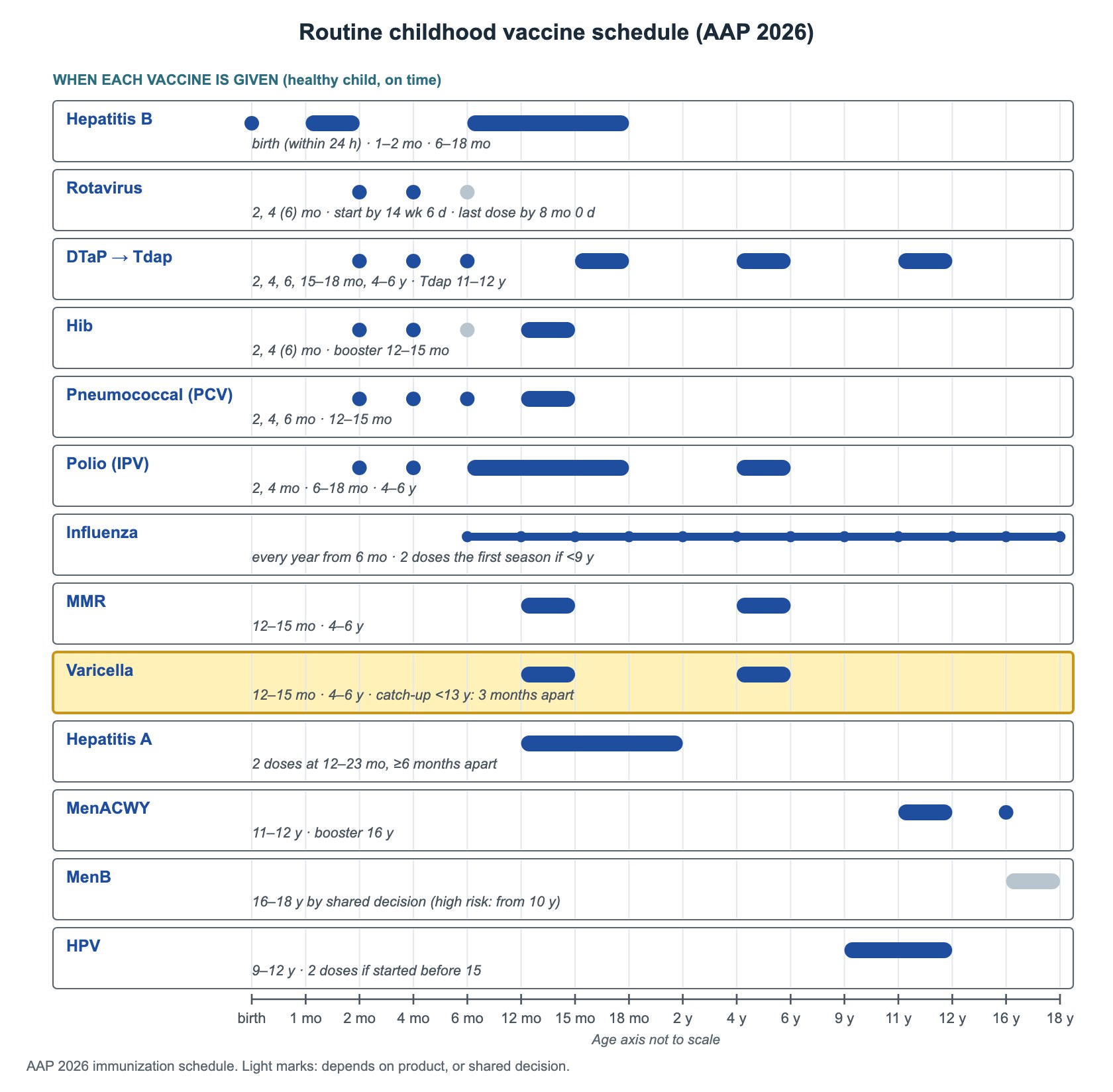
Routine childhood vaccine schedule (AAP 2026) — schedule graph
At a glance
- Routine: 2 doses, at 12–15 months and 4–6 years.
- Catch-up interval: 3 months under 13 years, 4 weeks from 13 years. A second dose given at least 4 weeks after the first still counts.
- After exposure, vaccine within 3 days (up to 5 days) can prevent or soften chickenpox in people without immunity.
- VariZIG within 10 days for high-risk people: immunocompromised, pregnant without immunity, and certain newborns and premature infants.
- Do not give in pregnancy or with severe immunodeficiency; avoid pregnancy for 1 month after each dose.
- Avoid aspirin for 6 weeks after the vaccine, and stop antivirals such as aciclovir 24 hours before it.
- Breastfeeding is not a reason to delay the vaccine for the mother or the baby.
More decision trees
From Pedemy's flashcards. Tap a tree to open it full size.
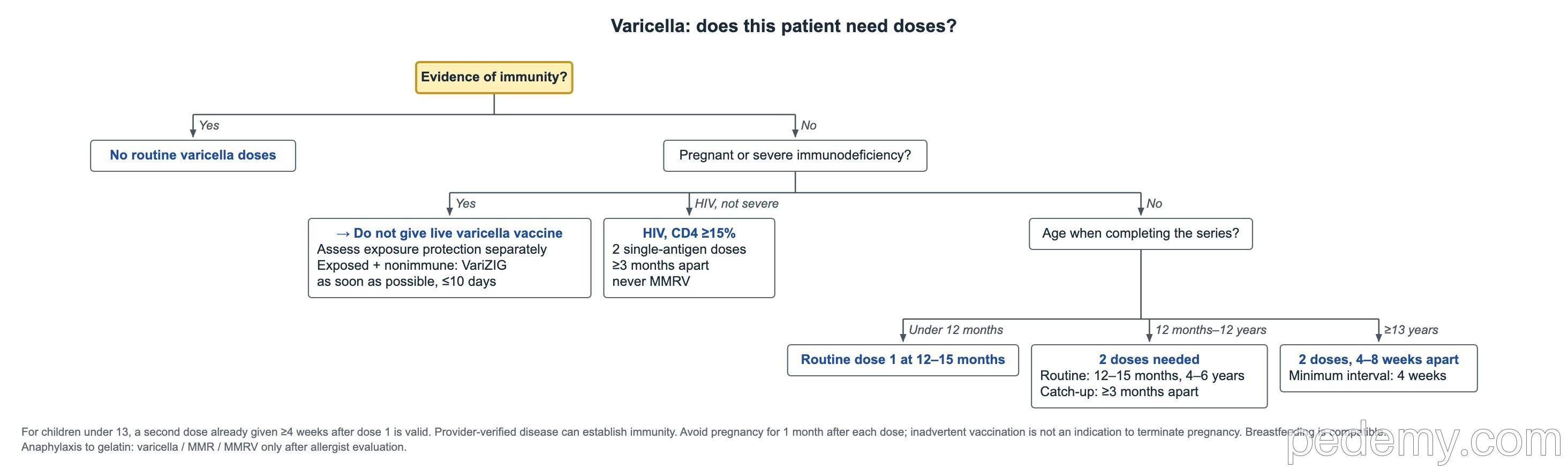
Varicella: does this patient need doses?
Another version 1 · Another version 2 · Another version 3 · Another version 4
Routine schedule
- Dose 1 at 12–15 months.
- Dose 2 at 4–6 years, or earlier once at least 3 months have passed.
- For dose 1 at 12–47 months, separate MMR and varicella shots are preferred over MMRV because MMRV causes slightly more febrile seizures.
- Varicella and MMR are both live vaccines: give them on the same day or at least 28 days apart.
Catch-up rules
- Minimum age is 12 months; a dose given before then does not count.
- Under 13 years: 2 doses at least 3 months apart; a second dose given at least 4 weeks after the first is still valid.
- 13 years and older: 2 doses at least 4 weeks apart.
- Children and teens with only 1 dose need a second dose, whatever their age.
- Evidence of immunity: age-appropriate doses, a positive IgG, or chickenpox or shingles diagnosed or verified by a clinician.
Who should not get it, or should wait
- Do not give after anaphylaxis to a previous dose or to neomycin or gelatin.
- Do not give in pregnancy; avoid pregnancy for 1 month after each dose.
- Do not give with severe immunodeficiency; children with HIV and CD4 at 15% or higher can be vaccinated.
- After high-dose steroids (2 mg/kg/day or 20 mg/day of prednisone or more) for 14 days or longer, wait 1 month after stopping.
- After immune globulin or blood products, wait 3–11 months depending on the product.
- Stop aciclovir, valaciclovir or famciclovir 24 hours before, and avoid them for 14 days after.
- Avoid aspirin and salicylates for 6 weeks after a dose because of Reye syndrome.
Side effects
- Common: soreness and redness at the site, and mild fever.
- A few chickenpox-like spots at the site or elsewhere in some children, usually within a month.
- Spread of vaccine virus to others is very rare and happens only when the vaccinated person has a rash; cover the spots.
- Febrile seizures are rare and more likely with MMRV.
Newborns and premature babies
- A baby whose mother's rash starts 5 days before to 2 days after delivery needs VariZIG as soon as possible, because the baby gets the virus without the mother's antibodies.
- Hospitalized premature babies born at 28 weeks or later need VariZIG after exposure if the mother is not immune.
- Hospitalized premature babies born before 28 weeks or weighing 1,000 g or less need VariZIG after exposure whatever the mother's status.
- A term baby exposed after the first few days of life does not routinely need VariZIG.
Common questions
Can the chickenpox vaccine be given after exposure?
Yes. Given within 3 days, and up to 5 days, it prevents most cases in people without immunity. It counts as a routine dose.
What is VariZIG?
VariZIG is varicella-zoster immune globulin: ready-made antibodies given IM within 10 days of exposure to people at high risk who cannot have the vaccine, such as immunocompromised children, pregnant people without immunity and some newborns.
What is the minimum interval between varicella doses?
3 months under 13 years and 4 weeks from 13 years. A second dose given at least 4 weeks after the first counts at any age.
Can a vaccinated child still get chickenpox?
Yes, but usually a mild case with fewer than 50 spots and little fever. Two doses make this much less likely than one.
Can I breastfeed after the chickenpox vaccine?
Yes. Breastfeeding is safe after the varicella vaccine, and breastfeeding mothers without immunity should get it.
Why avoid aspirin after the chickenpox vaccine?
Aspirin during chickenpox is linked to Reye syndrome, a rare but serious liver and brain illness, so it is avoided for 6 weeks after the vaccine.
Sources
- CDC: Varicella vaccine recommendations
- CDC: Clinical guidance for people at risk for severe varicella (VariZIG)
- CDC: Child and adolescent immunization schedule and catch-up guidance
- CDC: Contraindications and precautions (General Best Practice Guidelines)
Written for Pedemy in our own words from the sources above; checked October 2026. For education only, not medical advice. Pedemy is independent and not affiliated with or endorsed by the organizations cited.